- The paper introduces a hybrid GRF-GA methodology that integrates Gaussian process regression and a projection operator to enforce smooth gradation in lattice designs.
- The approach achieves significant stress reductions (e.g., from 30.14 MPa to 14.11 MPa) while satisfying strict geometric constraints for enhanced structural integrity.
- The framework demonstrates robust performance across various lattice topologies, paving the way for improved durability and multi-objective additive manufacturability.
Integration of Gaussian Random Fields with Genetic Algorithms for Smooth Optimization of Functionally Graded Lattice Structures
Introduction
Additive manufacturing (AM) has enabled the practical realization of complex lattice structures with tailored functional properties. Functionally graded lattice (FGL) structures leverage spatially varying geometric parameters, facilitating smooth transitions and thus avoiding stress concentrations that can compromise structural integrity. Traditional non-gradient-based optimization techniques, such as genetic algorithms (GAs), are challenged by their propensity to yield abrupt parameter transitions, leading to undesirable mechanical responses. The paper "Integrating Gaussian Random Functions with Genetic Algorithms for the Optimization of Functionally Graded Lattice Structures" (2604.03713), addresses the core challenge of enforcing smooth gradation within GA-based optimization via the integration of Gaussian random fields (GRF), Gaussian process regression (GPR), and a dedicated projection operator.
Methodology: Design Space Construction via GRF/GPR
The standard discretization of FGL domains (Figure 1) assigns geometric parameters (e.g., strut thickness, angle) to nodes that characterize either the center or corners of unit cells. The GRF-based approach generates spatially correlated parameter fields via a multivariate Gaussian, where the mean and covariance are controlled by the RBF kernel. The length scale (l) hyperparameter enables precise regulation of profile smoothness, with larger l values producing smoother transitions.
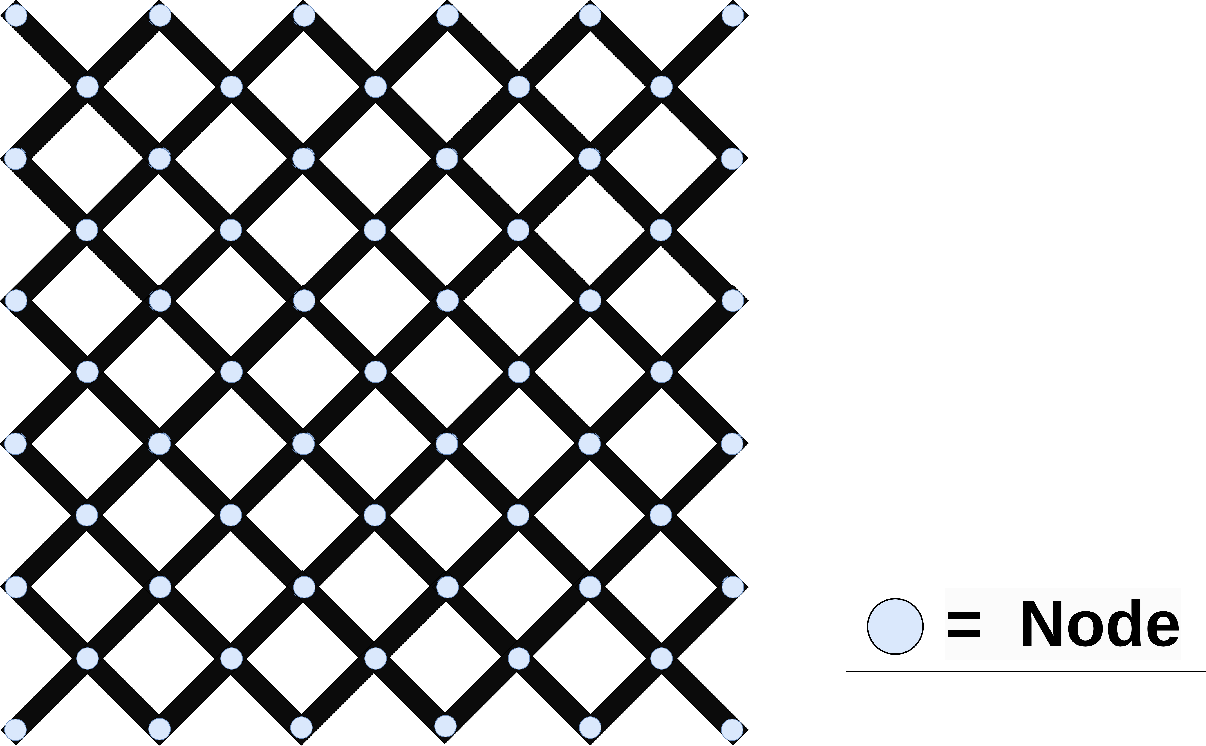
Figure 1: FGL domain is discretized into the nodes, and each node is assigned a geometric parameter value.
In the presence of deterministic geometric constraints at boundaries, GPR is utilized. Given observed node-parameter pairs on the boundary, the unobserved interior values are sampled from the posterior distribution conditioned to satisfy these boundary constraints. This permits both flexible smoothness control and strict adherence to engineering requirements.
The GA operates on initial populations generated using GRF/GPR. Standard SBX crossover and polynomial mutation can destroy inherited smoothness, especially after several generations. To counteract this, a projection operator is employed after each crossover and mutation step; this operator projects the offspring's parameter vector onto the subspace spanned by the dominant eigenvectors of the GRF covariance matrix, assuring that high-frequency (non-smooth) components are suppressed without sacrificing diversity. The full workflow is diagrammed in Figure 2.
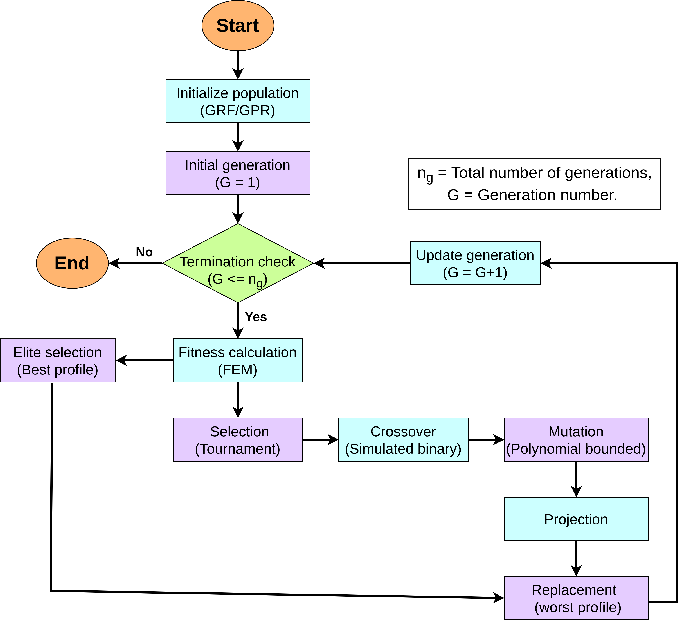
Figure 2: Flowchart of genetic algorithm framework used for the functionally graded lattice structure optimization.
Numerical Results: Comparative Stress and Deflection Analysis
Multiple structural topologies, including re-entrant (auxetic) and centered-rectangular lattices, are optimized for various objectives (e.g., maximizing or minimizing tip deflection, minimizing stress under load). The GRF-based framework consistently produces geometric profiles with higher smoothness while obtaining objective function values indistinguishable from conventional GAs. However, maximum and high-percentile von Mises stress values are dramatically reduced for the GRF/GPR-generated designs.
For instance, in a re-entrant lattice structure optimized for tip deflection, maximum nodal von Mises stress drops from 30.14 MPa (conventional GA) to 14.11 MPa (GRF, l=40 mm) without degradation in achievable objective values (see Section "Re-entrant unit cell-based lattice structure, Case 1"). The corresponding distributions of high-stress nodes (those exceeding the 99.5th percentile in the baseline design) further confirm the stress-relief effect induced by graded smoothness.
Analogous improvements are observed in rectangular lattice-based cantilever and MBB beam benchmarks, under both mechanical and thermal loads, and even in GPR-constrained optimization (where boundary node values are fixed).
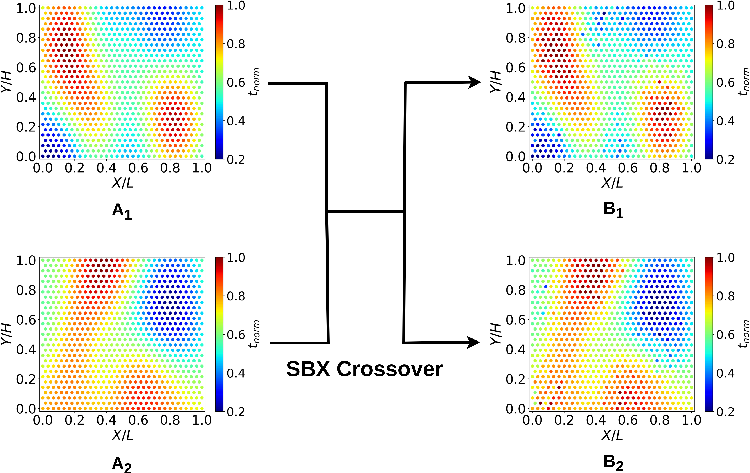
Figure 3: Sample of the normalized Strut thickness distribution over the FGL structure before (A1 and A2) and after (B1 and B2) the crossover operation.
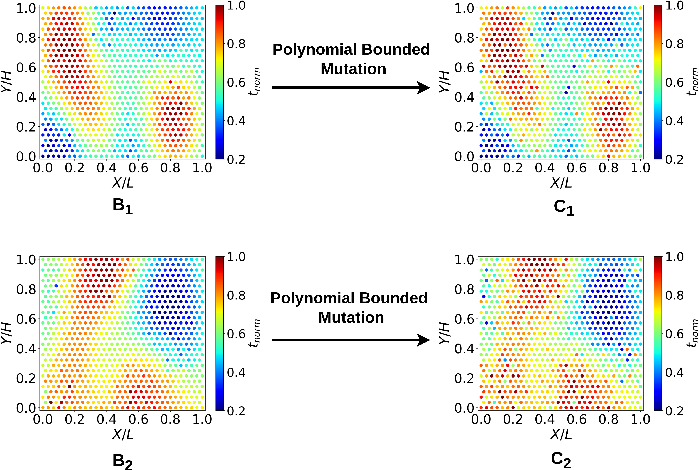
Figure 4: Sample of the normalized strut thickness distribution over the FGL structure before (B1 and B2) and after (C1 and l0) the mutation operation.
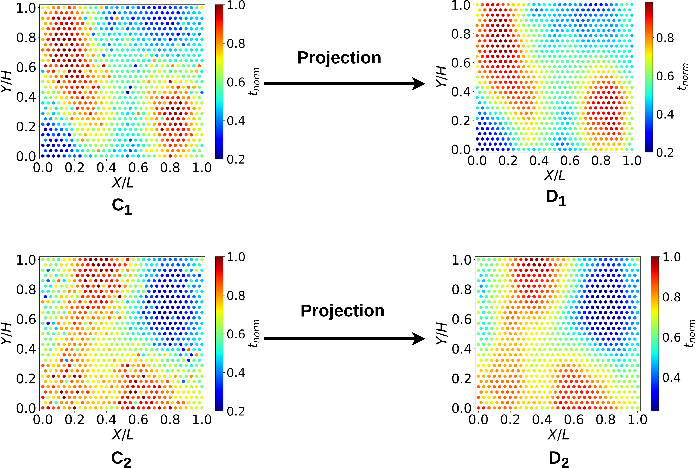
Figure 5: Sample of the normalized strut thickness distribution over the FGL structure before (l1 and l2) and after (l3 and l4) the projection operation.
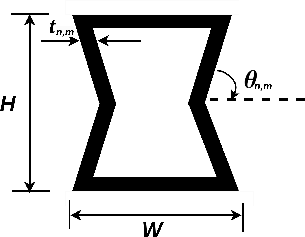
Figure 6: Schematic of a single re-entrant unit cell located at position l5 in the lattice structure.
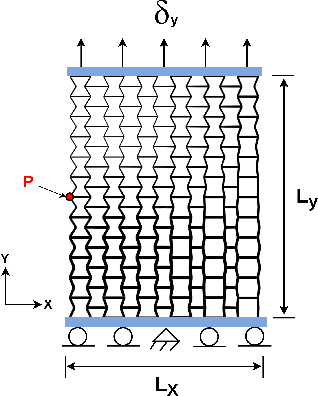
Figure 7: Schematic of the re-entrant unit cell structure subjected to the uniform displacement at the top surface.
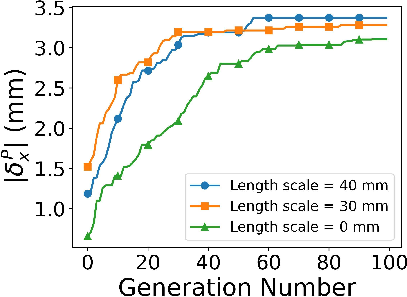
Figure 8: Evolution in the maximum deflection value of the point "P" for the best individual with respect to the GA generation.
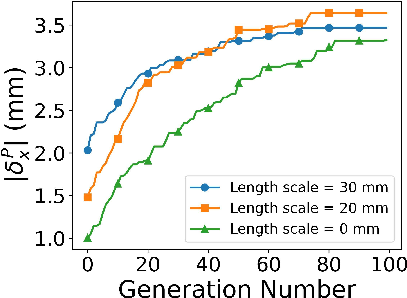
Figure 9: Evolution in the maximum deflection value of the point "P" for the best individual with respect to the GA generation.
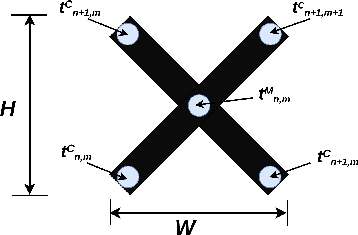
Figure 10: Schematic of a single centered rectangular unit cell located at position l6 in the lattice structure where the nodal values are used as parameters governing the thickness of the struts.
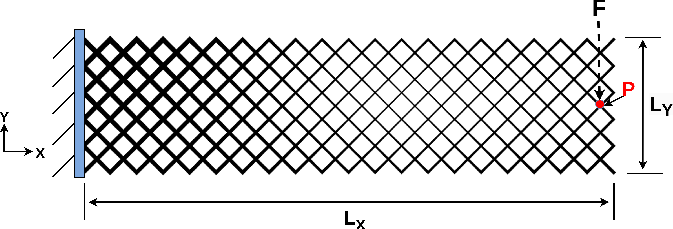
Figure 11: Schematic of the cantilever beam subjected to a point load.
Discussion: Implications and Future Directions
The proposed integration of GRF/GPR with GAs yields a smooth design representation space without the limitations imposed by analytical profiles (such as power or B-splines, which lack expressive capacity for arbitrary geometry). The framework achieves both global search capability and smoothness enforcement—essential for practical realization of FGL structures in AM and for real-world structural performance.
The decoupling of smoothness control from objective-driven search via the explicit length-scale parameter, as well as direct GPR-based handling of geometric constraints, has substantial implications for reliability engineering of architected materials. The observed dramatic reduction in local stress concentrations prescribes future investigation into fatigue, damage tolerance, and optimal redundancy of FGL structures, particularly under multifield loading. Furthermore, the projection operator formalism is compatible with other evolutionary metaheuristics and surrogate modeling strategies.
Potential extensions include multi-objective optimization for additive manufacturability (e.g., minimization of support structures), inclusion of anisotropic correlation kernels for directionally graded materials, and integration with topology optimization frameworks beyond lattice-based representations.
Conclusion
This work demonstrates that the synthesis of GRF/GPR-based smooth profile generation and a projection-enforced GA overcomes the major limitations of conventional non-gradient-based optimization for FGLs. The result is a robust, general framework that delivers high-performance graded structures with reduced susceptibility to stress concentrations, broad parametric flexibility, and strict satisfaction of complex engineering constraints—all critical attributes for next-generation architected materials.

