- The paper introduces a label-aware approach that fuses image and label cues to address inconsistencies in prompt retrieval for visual in-context learning.
- It employs a Mixture-of-Experts and query-adaptive routing, achieving up to a 15% mIoU gain across standard benchmarks like segmentation and detection.
- Ablation studies confirm that components such as prompt label fusion and decoupled optimization are critical for the enhanced performance of the framework.
Label-Aware Prompt Retrieval for Visual In-Context Learning
Introduction
Prompt selection is an essential component in Visual In-Context Learning (VICL), directly impacting the functional capacity of visual foundation models to perform diverse downstream tasks. Conventional prompt retrieval pipelines focus principally on encoding image-based similarity while discarding explicit label information, which can introduce substantial label inconsistency between prompts and queries. The paper "Love Me, Love My Label: Rethinking the Role of Labels in Prompt Retrieval for Visual In-Context Learning" (2604.03657) systematically re-examines this paradigm, empirically demonstrating the correlation between label consistency and VICL performance. The authors propose the first explicit, label-aware prompt retrieval framework, introducing a mechanism that fuses image and label cues for prompt representation and utilizes a Mixture-of-Experts (MoE) and query-adaptive routing for inference, even when the query label is unknown.
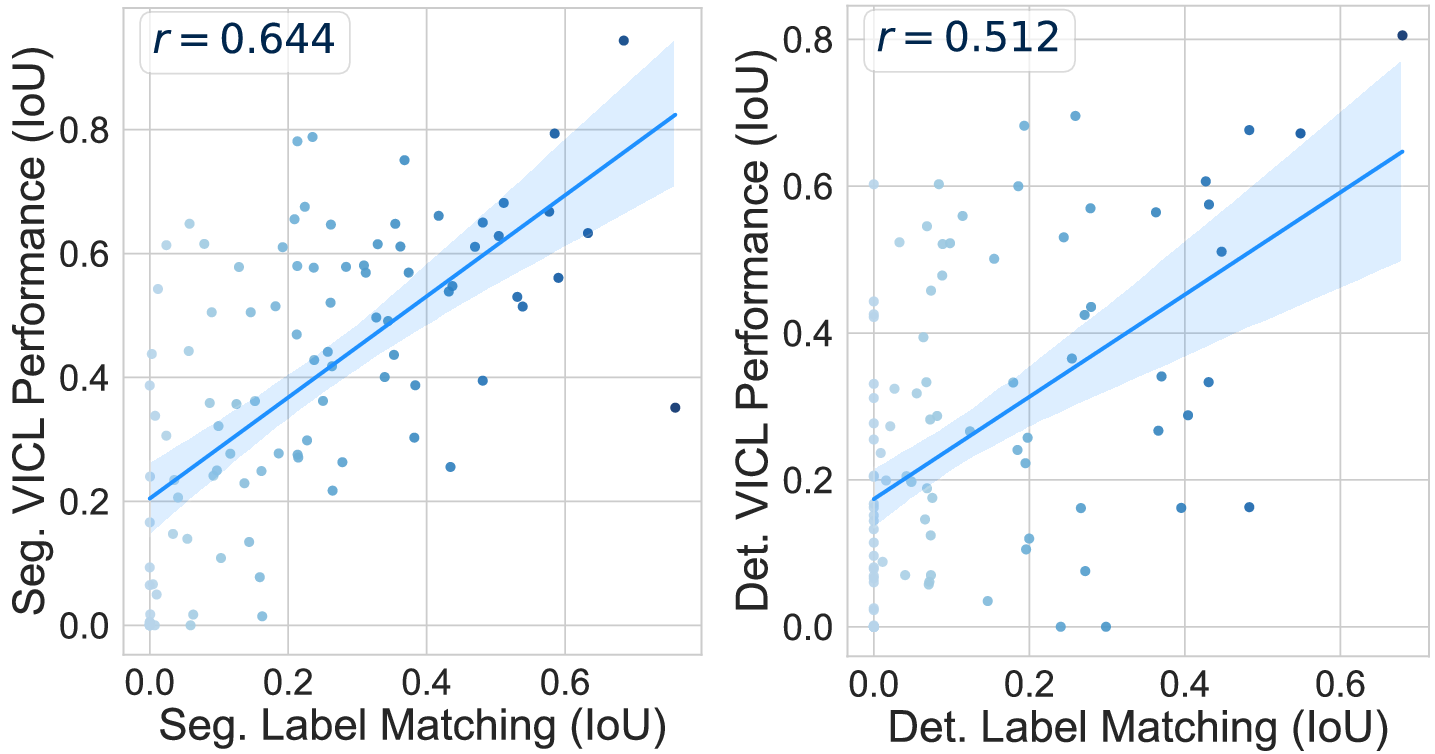
Figure 1: An empirical study on 100 query-prompt pairs reveals label matching consistency is positively correlated with VICL performance.
Motivation and Problem Analysis
The empirical findings underscore that mere image similarity in prompt retrieval is insufficient: visually similar but label-inconsistent prompts can degrade performance, especially in settings like segmentation, detection, or colorization where label semantics are not trivially entangled with visual similarity. As illustrated, image-only approaches tend to conflate prompt selection across queries with divergent label demands, which disrupts model conditioning and task-anchoring efficacy.
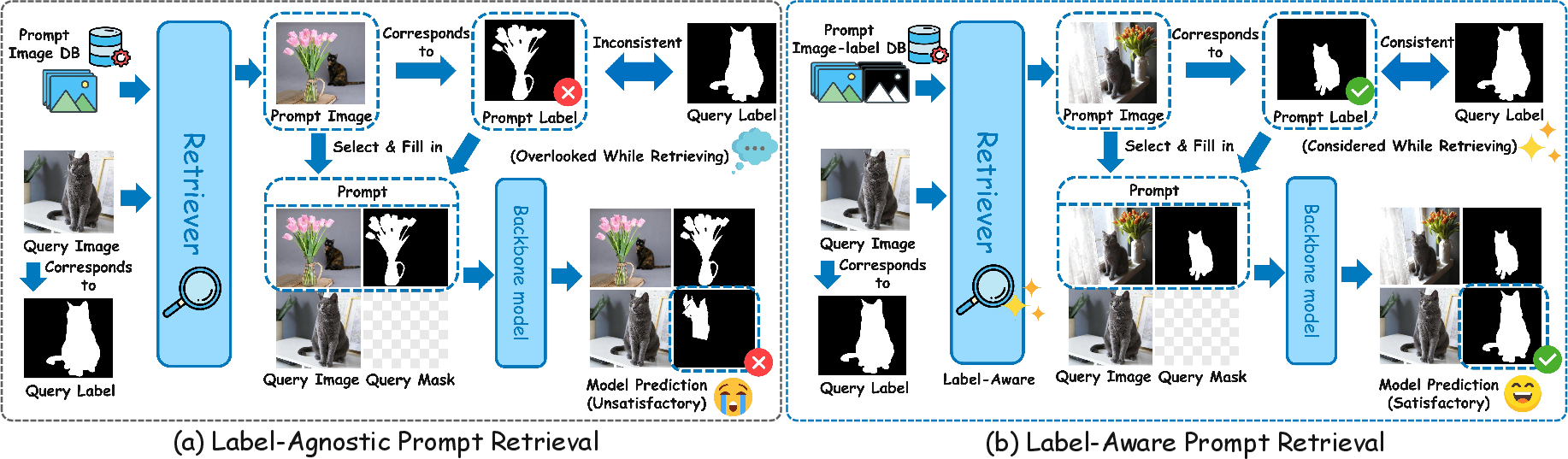
Figure 2: (a) Label-agnostic retrieval selects prompts by image similarity, susceptible to label mismatches. (b) Label-aware retrieval considers both visual and label consistency.
Label-Aware Prompt Retrieval Architecture
The proposed framework injects label information into prompt embeddings and utilizes a Mixture-of-Experts (MoE) mechanism on both query and prompt encoding branches. Each expert encodes a distinct mode, hypothesized to correspond to semantically meaningful patterns (beyond simple category-level distinctions). A query-conditioned router infers a weight distribution over these experts, which, in the absence of query-side label supervision, enables soft adaptation to implicit semantic cues within the query. At inference, label-aware prompt selection computes a cosine similarity between the routed, label-fused embeddings of the prompt and query, retrieving the most label-consistent candidate.
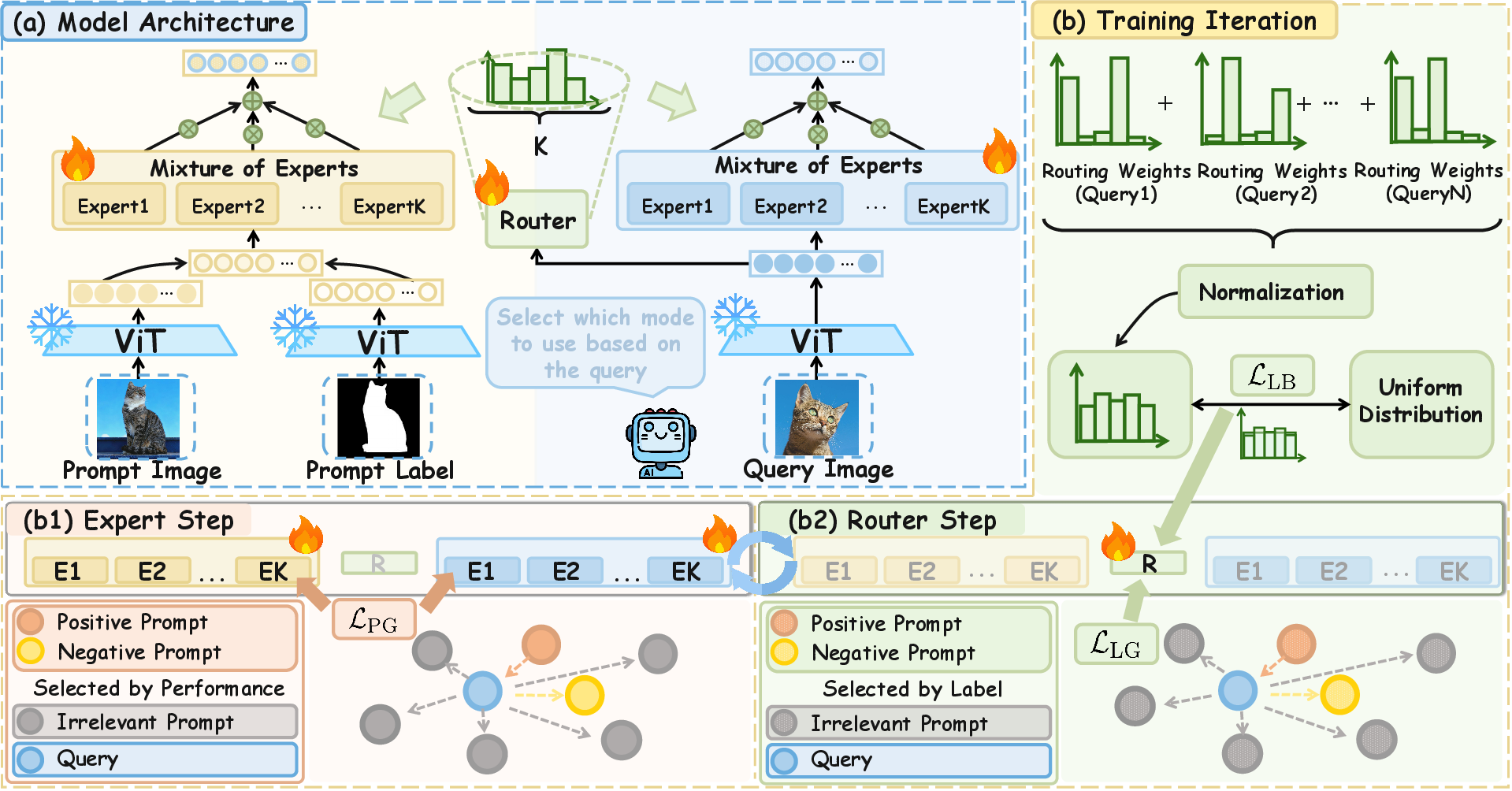
Figure 3: (a) Prompt labels are explicitly fused into prompt embeddings. Mode-specific experts produce distributed features, and a query-conditioned router extracts label-aware embeddings. (b) Training alternates performance-guided contrastive learning for experts and label-guided contrastive learning plus load balancing for the router.
Training Regimen
Training decouples the optimization trajectories of the experts and the router. For the experts, a contrastive loss is employed using VICL task performance for positive/negative sampling, encouraging mode specialization. The router is supervised using label-matching consistency between prompt/query pairs, alongside a KL-based load-balancing regularizer to enforce sufficient exploration and utilization of all expert paths.
Empirical Evaluation
Main Results
On standardized VICL benchmarks—foreground segmentation (Pascal-5i), single-object detection (Pascal VOC 2012), and image colorization (ImageNet-1K)—the label-aware framework exhibits consistent empirical gains, surpassing prior SoTA retrieval (SupPR, Partial2Global) and rerank-based (RH-Partial2Global) pipelines. Noteworthy, segmentation mIoU improvements exceed 6% over the strongest retrieval baseline and 3.5% over reranking under canonical (no-voting) settings. For detection and colorization, complementary improvements are observed.
Qualitative Analysis
Qualitative case studies highlight the resolution of label inconsistency failure modes prevalent in label-agnostic selectors. The label-aware approach retrieves semantically aligned prompts, resulting in visibly improved task outputs (segmentation masks, colorizations).
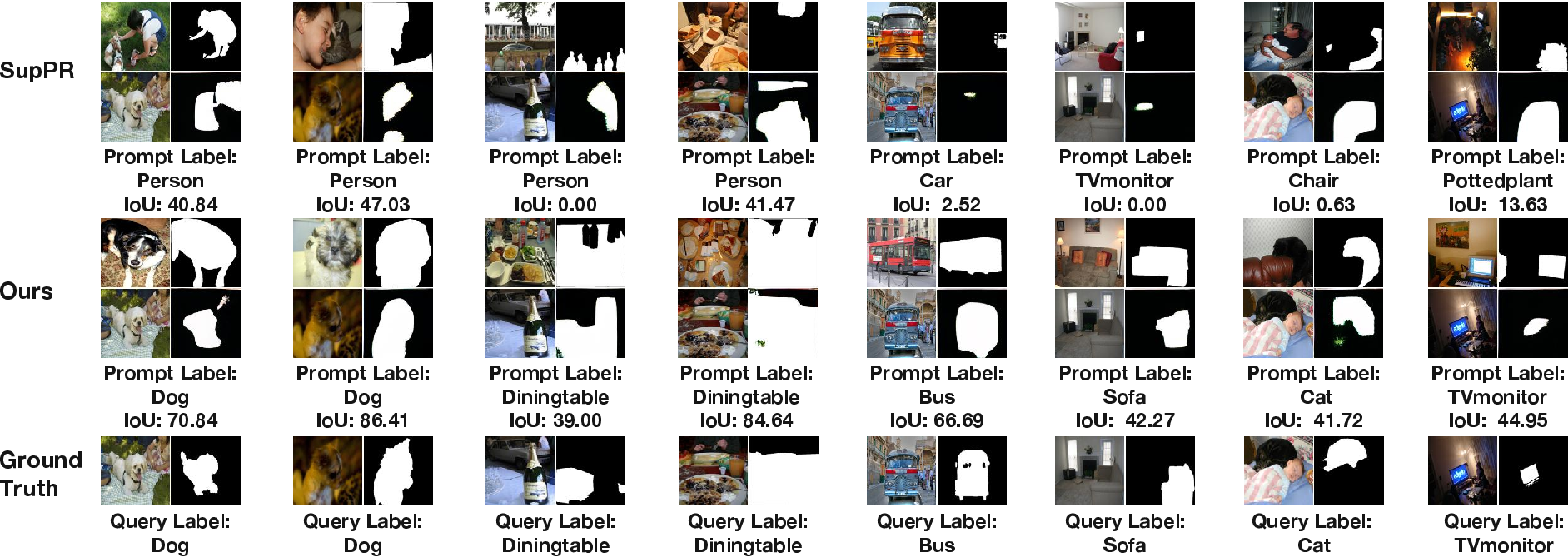
Figure 4: Label-aware prompt retrieval robustly selects label-compatible examples, consistently outperforming label-agnostic retrieval in VICL prediction fidelity.
Cross-Fold and Cross-Extractor Generalization
The framework achieves strong transferability across cross-validation folds and generalizes effectively when substituting the backbone feature extractor (e.g., CLIP → DINOv2), indicating encoder-agnostic properties. Cross-fold transfer experiments show gains up to 15% mIoU over retrieval and rerank alternatives, supporting the argument that the expert-router architecture confers meaningful robustness across domains/tasks.
Interpretability and Mode Specialization
Expert activation analyses reveal that the query-conditioned router distributes focus differently across experts depending on the underlying category and task complexity, with some experts capturing fine-grained structures not reducible to simple class labels. Semantically similar classes exhibit analogous mode activations, suggesting the model’s ability to discover sub-structures in visual tasks.
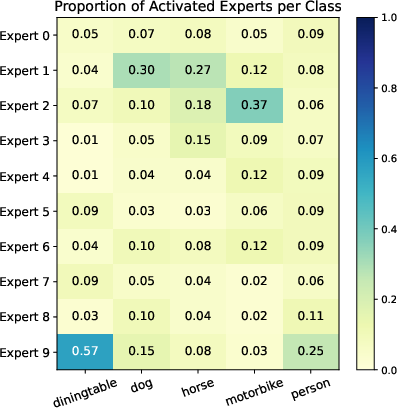
Figure 5: Heatmap of expert mode selection ratios per category, revealing that expert activations align with semantic structure and category affinity.
Ablation Studies
Ablations confirm the criticality of each architectural component: removing prompt label fusion or query-side router reduces accuracy markedly. Optimizing the router and experts jointly (instead of alternately) leads to unstable optimization and degraded performance, underscoring the necessity for targeted, decoupled supervision. The performance-guided and label-guided contrastive objectives are synergistic; either’s removal adversely impacts results.
Implications and Future Directions
This work definitively substantiates the necessity and value of incorporating label cues in VICL prompt retrieval. The MoE with query-adaptive routing offers a principled strategy for handling label ambiguity and semantic diversity at prompt selection. The encoder-agnostic nature, empirical robustness, and substantial improvement argue for broader adoption of explicit label-aware conditioning mechanisms in multi-task, multimodal foundation models. Future research avenues include systematic exploration of mode interpretability, scalable expert/router architectures, and joint modeling of label hierarchies for complex structured prediction tasks.
Conclusion
The integration of label-aware prompt retrieval—via label-injected embeddings, expert-based mode decomposition, and query-adaptive routing—substantially improves visual in-context learning performance across a spectrum of vision tasks. Empirical analysis establishes the pivotal role of label consistency in prompt selection, augmenting both in-domain accuracy and cross-domain robustness. These results motivate a paradigm shift from image-focused to semantically balanced prompt retrieval strategies in VICL, with direct ramifications for generalist vision foundation models and prompt-based multi-task AI systems.
(2604.03657)

