- The paper demonstrates a crossover from linear to nonlinear viscoelastic scaling near jamming using oscillatory shear and transient relaxation protocols.
- It reveals a robust t^(-1/2) decay in stress relaxation at low strain and a strain-dependent softening of the storage and loss moduli.
- Findings highlight the emergence of transient rigidity and reversible–irreversible transitions, challenging conventional harmonic approximations.
Pre-yielding Mechanical Response Near the Jamming Transition
Introduction and Motivation
The mechanical response of athermal, frictionless particulate systems near the jamming transition continues to be a central topic in soft matter, highlighting their critical role in the rheology of emulsions, foams, and granular matter. Above the jamming threshold ϕJ, the system acquires rigidity, exhibiting nontrivial criticality and anomalous viscoelastic scaling. Two principal anomalies are well established: the scale-free frequency response, G∗(ω)∼ω1/2, in the linear regime, and the nonlinear shear softening, G(γ)∼γ−1/2, in the quasi-static limit. Their coexistence near ϕJ and the interplay under finite driving remain insufficiently explored, particularly how one smoothly interpolates from the linear to the nonlinear response as control parameters are tuned.
This study systematically investigates the pre-yielding regime, focusing on the scaling structure and crossover of viscoelastic moduli above and below jamming, utilizing large-scale simulations under both oscillatory and step strain protocols. Special attention is given to the coupling/decoupling of frequency and amplitude structures in the modulus and to the nature of transient relaxation under nonlinear perturbations.
Simulation Protocols and Model
The authors simulate two-dimensional equimolar binary mixtures of frictionless, athermal particles with a size ratio Dlarge/Dsmall=1.4, interacting via a harmonic repulsion. Initial jammed configurations are generated through quasi-static and cyclic volumetric training, and shear-stabilized using protocols tailored to avoid structural bias (FIRE minimization combined with Lees-Edwards boundaries). The main observables are computed during two complementary protocols:
- Oscillatory shear: γ(t)=γsin(ωt), measuring storage (G′) and loss (G′′) moduli over a range of amplitudes and frequencies.
- Transient relaxation: Application of a step strain, recording relaxation modulus G(t), the potential energy, force unbalance, and non-affine displacement as functions of time.
Both above, at, and below the critical packing fraction ϕJ, the shear moduli and dynamics are analyzed, with averages taken across multiple independent initializations to reduce sample-to-sample fluctuations.
Frequency and Strain-Amplitude Scaling in Oscillatory Shear
In the linear regime (G∗(ω)∼ω1/20), the complex modulus reproduces the well-known scaling G∗(ω)∼ω1/21 over a broad window for G∗(ω)∼ω1/22, reflecting the plateau in the vibrational density of states near jamming. As G∗(ω)∼ω1/23 increases, shear softening is observed with G∗(ω)∼ω1/24 in the quasi-static regime. A primary contribution here is a detailed mapping of G∗(ω)∼ω1/25 as both G∗(ω)∼ω1/26 and G∗(ω)∼ω1/27 are finite and within their respective scaling regimes.
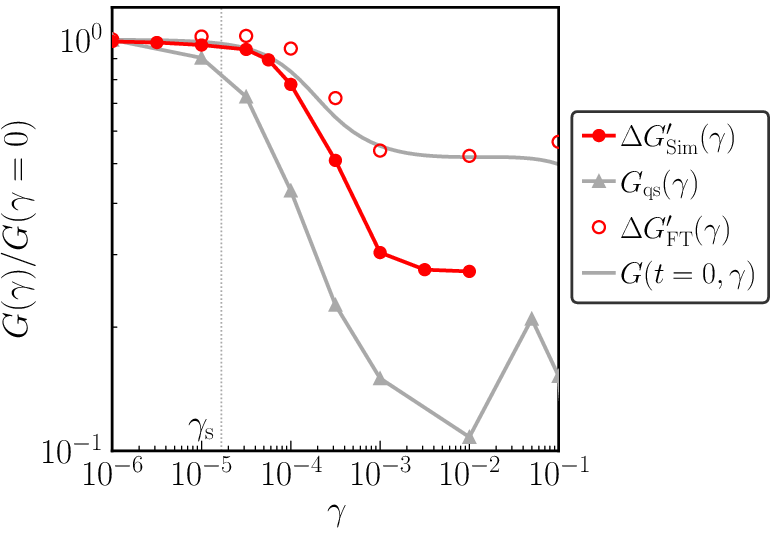
Figure 1: G∗(ω)∼ω1/28-dependence of the moduli normalized by their zero-strain values at G∗(ω)∼ω1/29, highlighting the nontrivial deviation between quasi-static and finite-frequency responses.
Key findings include:
- For fixed G(γ)∼γ−1/20 and finite G(γ)∼γ−1/21, increasing G(γ)∼γ−1/22 induces pronounced softening of G(γ)∼γ−1/23 and G(γ)∼γ−1/24, whereas increasing G(γ)∼γ−1/25 at fixed G(γ)∼γ−1/26 enhances the modulus until softening saturates.
- The onset strain for softening, G(γ)∼γ−1/27, is systematically higher for oscillatory shear compared to the quasi-static curve, implicating a non-affine/affine displacement interplay and strain-protocol dependence.
- The superposition hypothesis G(γ)∼γ−1/28, where G(γ)∼γ−1/29 recovers both limiting scalings, holds qualitatively but with significant differences in the explicit scaling function and the onset of softening depending on protocol.
Notably, the modulus remains finite below ϕJ0 for large enough ϕJ1, defying the na\"ive expectation that all static rigidity vanishes exactly at ϕJ2. This persistence reflects the formation of transient, dynamically formed contact networks under finite amplitude oscillatory driving, connecting to the reversible–irreversible transition in particle dynamics.
(Figure 2)
Figure 2: ϕJ3 as a function of control parameters, illustrating the rounded crossover through ϕJ4 and the emergence of rigidity below jamming at finite strain amplitude.
Emergence of Nonlinear Rigidity and the Reversible-Irreversible Transition
Through extensive parameter scans, the work demonstrates that below ϕJ5, moduli ϕJ6, ϕJ7 remain strictly zero in the small-strain regime but become nonzero at a packing fraction lower than ϕJ8 for large ϕJ9. The locus where the modulus vanishes—denoted as Dlarge/Dsmall=1.40—systematically decreases as Dlarge/Dsmall=1.41 increases. This correlates with the dynamical phase boundary of the loop-reversible to irreversible trajectory transition observed in non-Brownian suspensions, where persistent contact networks percolate under oscillatory driving. The study thereby forges a quantitatively explicit link between mechanical rigidity and the microscopic statistical transition in particle retracing.
Transient Stress Relaxation and Robustness of Algebraic Dynamics
The response to a step strain reveals critical separation of timescales and power-law decay structures. For small Dlarge/Dsmall=1.42, stress relaxation follows Dlarge/Dsmall=1.43 and Dlarge/Dsmall=1.44, as predicted by harmonic-mode decomposition and the high density of low-frequency vibrational modes. Increasing Dlarge/Dsmall=1.45 into the nonlinear regime (Dlarge/Dsmall=1.46), the decay exponents for energy and force cross over to the values reported for steepest-descent relaxations from high-temperature random configurations: Dlarge/Dsmall=1.47, Dlarge/Dsmall=1.48. Strikingly, the Dlarge/Dsmall=1.49 scaling for γ(t)=γsin(ωt)0 persists robustly into the softening regime, well beyond linear response. This robustness does not follow from mere harmonicity, as demonstrated by a breakdown of the single-basin harmonic approximation against the observed data as γ(t)=γsin(ωt)1 is increased.
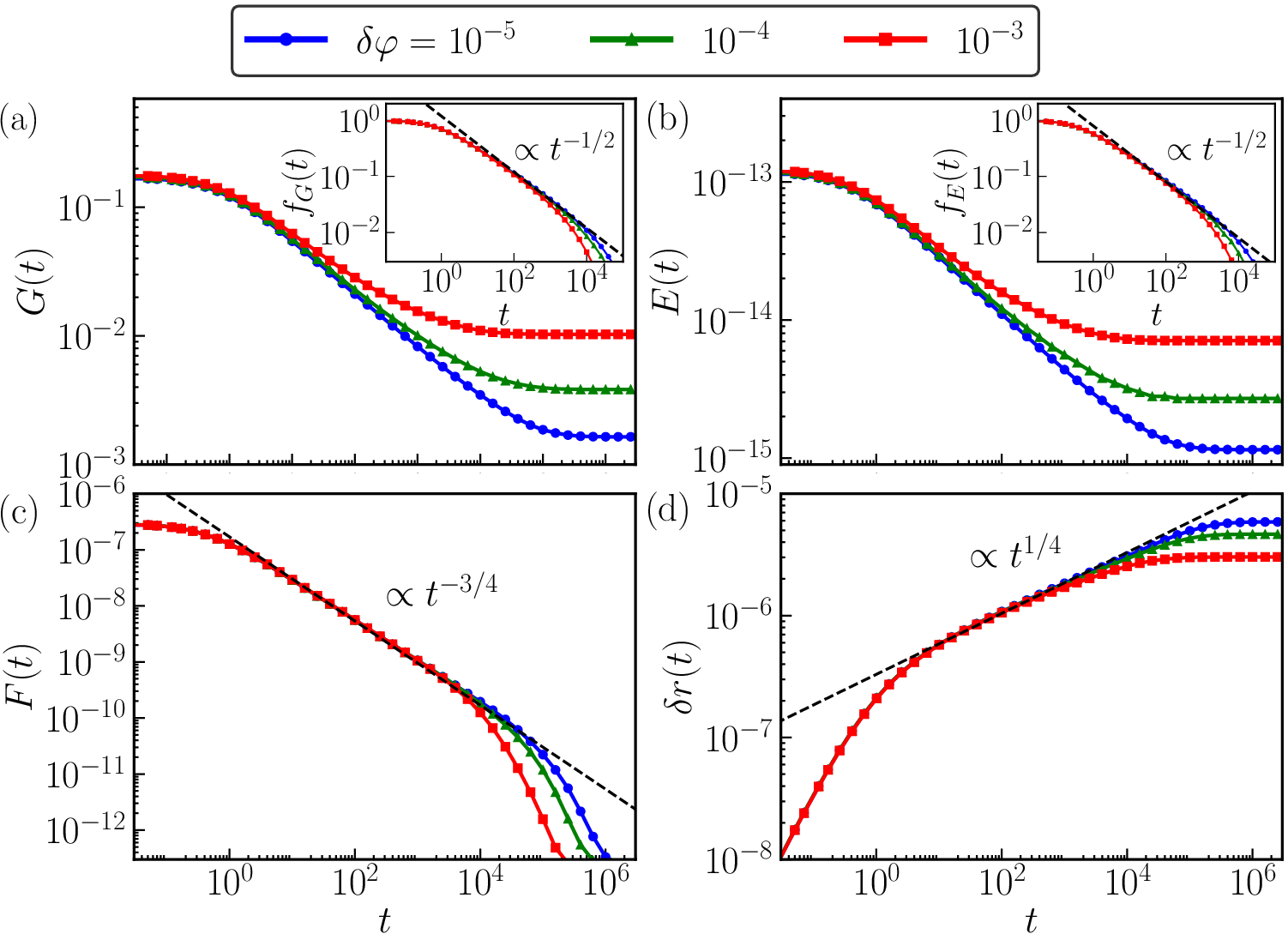
Figure 3: Transient relaxation of the modulus for fixed strain amplitude in the linear regime, illustrating algebraic decay and the scaling regime.
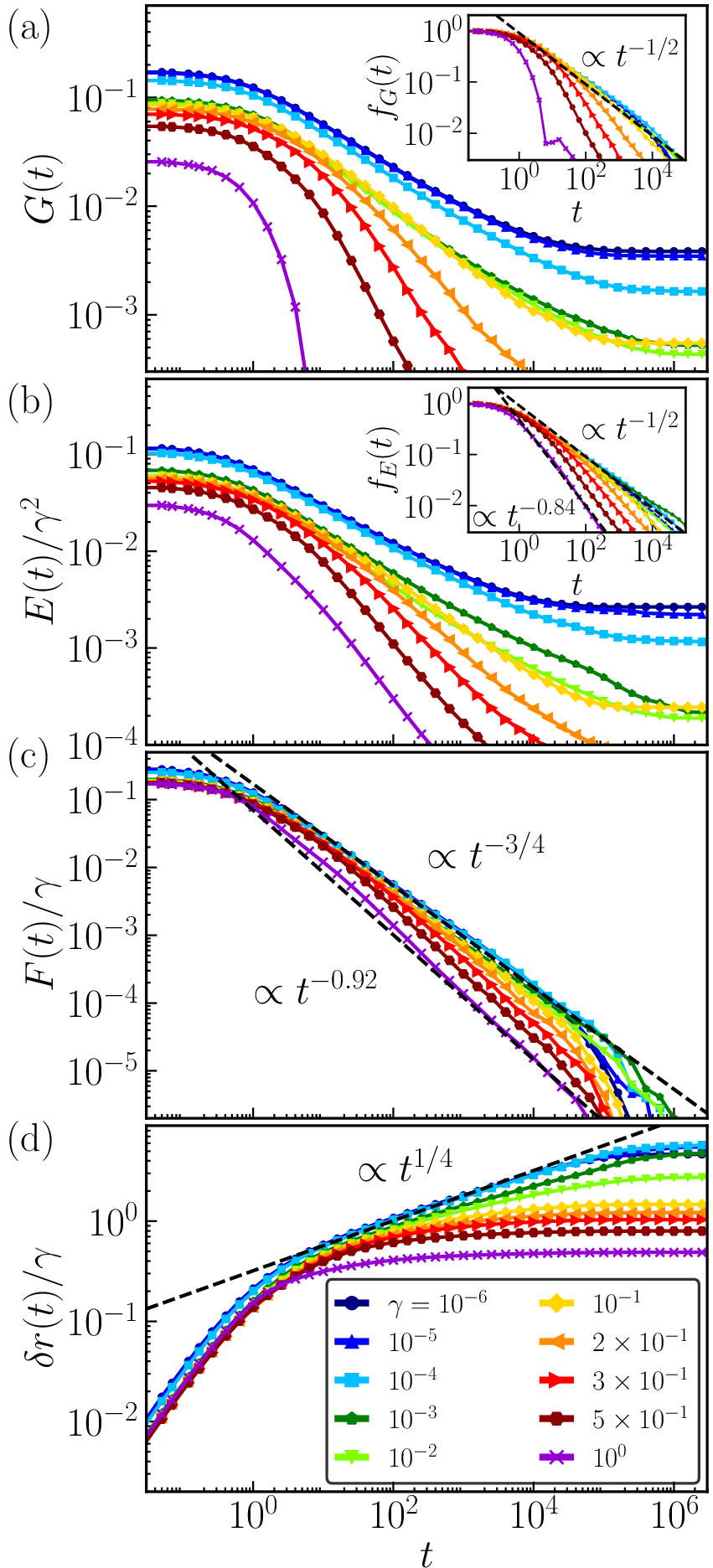
Figure 4: Nonlinear regime relaxation for various γ(t)=γsin(ωt)2, showing how the decay exponents and timescales evolve with strain amplitude.
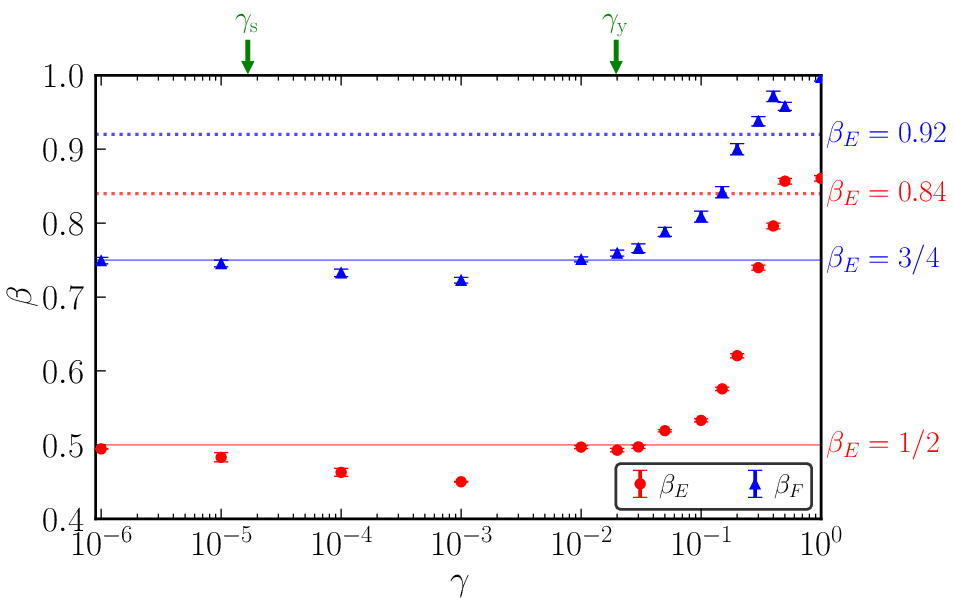
Figure 5: γ(t)=γsin(ωt)3-dependence of the decay exponents for γ(t)=γsin(ωt)4 and γ(t)=γsin(ωt)5, indicating a crossover from linear response to steepest-descent relaxation values at large strain.
Analysis shows that the decoupling between short- and long-time responses and the softening of instantaneous moduli is deeply connected with non-affine displacements and the underlying energy landscape topology. The data challenge the prevailing assumption that the overall algebraic scaling is a direct consequence of single-basin (harmonic) relaxation, pointing instead to more intricate, possibly hierarchical, evolution across basins as strain increases.
Implications and Future Directions
This study establishes that nonlinear viscoelasticity near jamming cannot be subsumed under trivial superposition of linear and nonlinear scaling, whether in stationary or transient protocols. Emergent rigidity below the nominal jamming density at finite amplitude underscores the role of dynamically created structures and bridges between reversibility transitions and mechanical onset. The observed protocol-specific onset strains and the preservation or transformation of decay exponents with increasing strain reflect deeper geometric and dynamical transitions not captured by mean-field or harmonic approximations.
These results have several implications:
- They provide a precise framework for interpreting experimental and simulation moduli near jamming, cautioning against naive application of Cox–Merz-type rules.
- The link to reversible–irreversible transitions suggests that the design of materials with targeted mechanical response may require fine control of oscillatory amplitude and the statistics of contacts over driving cycles.
- The robustness and eventual crossover of relaxation exponents suggest that the topology of the energy landscape and the strain-induced connectivity of contact networks are crucial for understanding yield, flow, and aging phenomena.
Future developments can focus on larger system sizes (to resolve finite-size scaling near the rigidity threshold), on characterizing the full statistics of reversible versus irreversible trajectories, and on generalizing to frictional, adhesive, or polydisperse systems. Theoretical work is needed to build analytical models incorporating non-affine dynamics and basin connectivity, particularly to capture the nonlinear and history-dependent viscoelastic response revealed here.
Conclusion
The paper systematically clarifies the interplay and limits of anomalous scaling in pre-yielded amorphous solids near jamming. It provides quantitative data and conceptual connections between rheological response, microscopic dynamics, and energy landscape structure, revealing a new perspective on nonlinear viscoelasticity in marginal solids (2604.03651).

