- The paper demonstrates that Floquet modulation of a YIG sphere enables controllable superradiant phase transitions with discrete first- and second-order behaviors.
- It develops an effective Hamiltonian incorporating magnon Kerr nonlinearity and tunable magnon-photon couplings, analyzed through quantum Langevin equations.
- The findings suggest practical routes for enhanced quantum sensing and control in driven-dissipative, hybrid quantum systems using standard microwave cavities.
Superradiant Phase Transitions in Cavity Magnonics Driven by Floquet Engineering
Introduction
This work rigorously analyzes superradiant phase transitions (SPTs) in cavity magnonics employing Floquet engineering as a control modality ["Superradiant phase transition in cavity magnonics via Floquet engineering" (2604.03646)]. The proposed architecture consists of a strongly coupled magnon-photon system, realized by embedding a yttrium iron garnet (YIG) sphere in a microwave cavity. Magnon modes in the YIG experience a Floquet-type periodic modulation of their frequency, which enables fine-tuned control over system parameters and interaction strengths.
Unlike prior cavity-magnon SPT schemes that depend on microwave parametric driving, this approach leverages only accessible Floquet modulation to traverse the full phase diagram—including discrete first- and second-order transitions—without the inherent technical overheads associated with parametric amplifiers or specially designed waveguide cavities. The theoretical framework establishes an effective Hamiltonian that captures both magnon Kerr nonlinearity and Floquet-modulated bilinear interactions, solved self-consistently using quantum Langevin equations to characterize the complete set of steady-state phases.
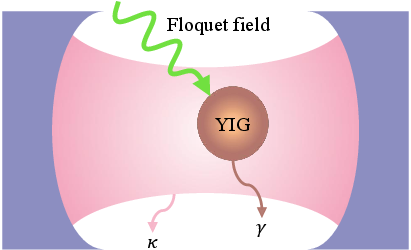
Figure 1: Schematic view of the Floquet-driven cavity magnonic system, comprising a microwave cavity and a YIG sphere under periodic drive, permitting strong magnon-photon coupling.
Floquet-Engineered Effective Model
Starting from a composite system with time-dependent magnon frequency modulation, the derivation proceeds by sequentially applying two unitary transformations. The first, into a Floquet-rotating frame, leverages the Jacobi-Anger expansion to recast the dynamics in terms of Bessel-function-controlled sidebands. Then, by suitable rotating frame and rotating wave approximations (RWA), only two relevant interaction channels—one rotating and one counter-rotating—are retained, leading to an effective time-independent Hamiltonian:
Heff=ωca†a+ωmb†b+2Kb†b†bb+λr(a†b+ab†)+λcr(a†b†+ab),
where λr and λcr are tuned by the amplitude Ω and the frequency ωD of the Floquet field via Bessel functions. The effective detunings and couplings become explicit and tunable parameters.
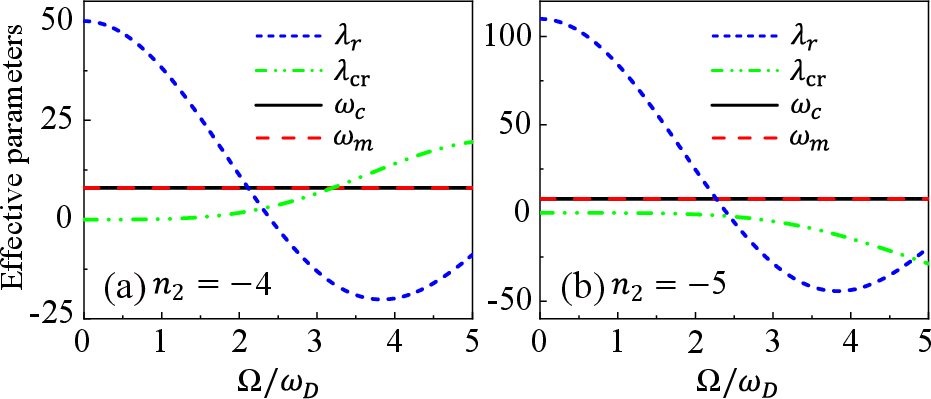
Figure 2: Dependence of effective cavity/magnon frequencies and coupling strengths on reduced Floquet drive; Bessel-function modulation permits the realization of ultra-strong and anisotropic coupling regimes.
Steady-State Phase Analysis
Quantum Langevin equations are constructed to incorporate both coherent dynamics and dissipative losses for photons and magnons. The steady-state manifold is obtained within a mean-field approximation (applicable for macroscopic occupation), with quantum fluctuations subsequently analyzed through linearization and covariance matrices.
Four distinct phases emerge in the phase diagram, characterized by the stability regions of the trivial and nontrivial solutions for the mean magnon number:
- Parity-Symmetric Phase (PSP): ⟨b†b⟩=0, corresponding to the vacuum/normal phase, with a conserved parity symmetry.
- Parity-Symmetry-Broken Phase (PSBP): ⟨b†b⟩+>0, displaying macroscopic magnon occupation, indicative of superradiance.
- Bistable Phase (BP): Both the above solutions are stable; final state is determined by initial condition/preparation.
- Unstable Phase (UP): No stable fixed points; dynamical instability dominates.
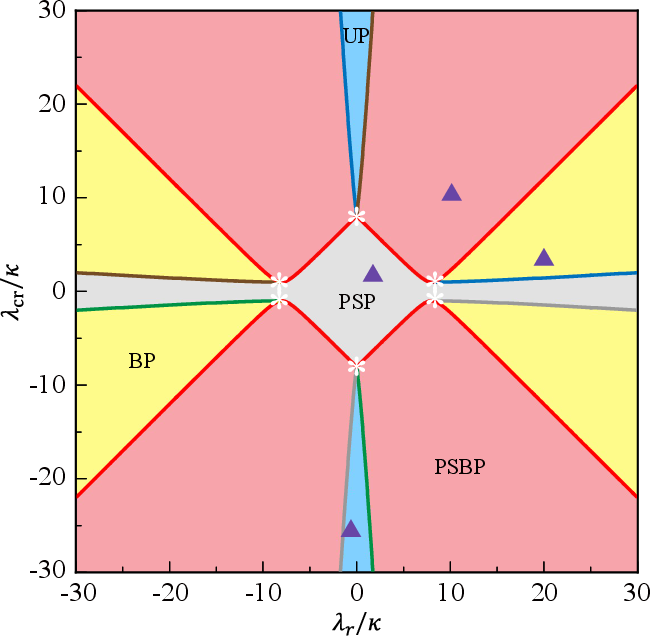
Figure 3: Steady-state phase diagram of the cavity magnonic system as a function of coupling strengths, revealing parity-symmetric, symmetry-broken, bistable, and unstable regions, with clearly demarcated phase boundaries and tricritical points.
Dynamical simulations confirm these phase assignments: the system can be prepared to traverse among phases depending on the specific values of modulation amplitude and interaction anisotropy. The positions of tricritical points, boundary conditions for each region, and analytic criteria for physically meaningful, stable solutions are provided.
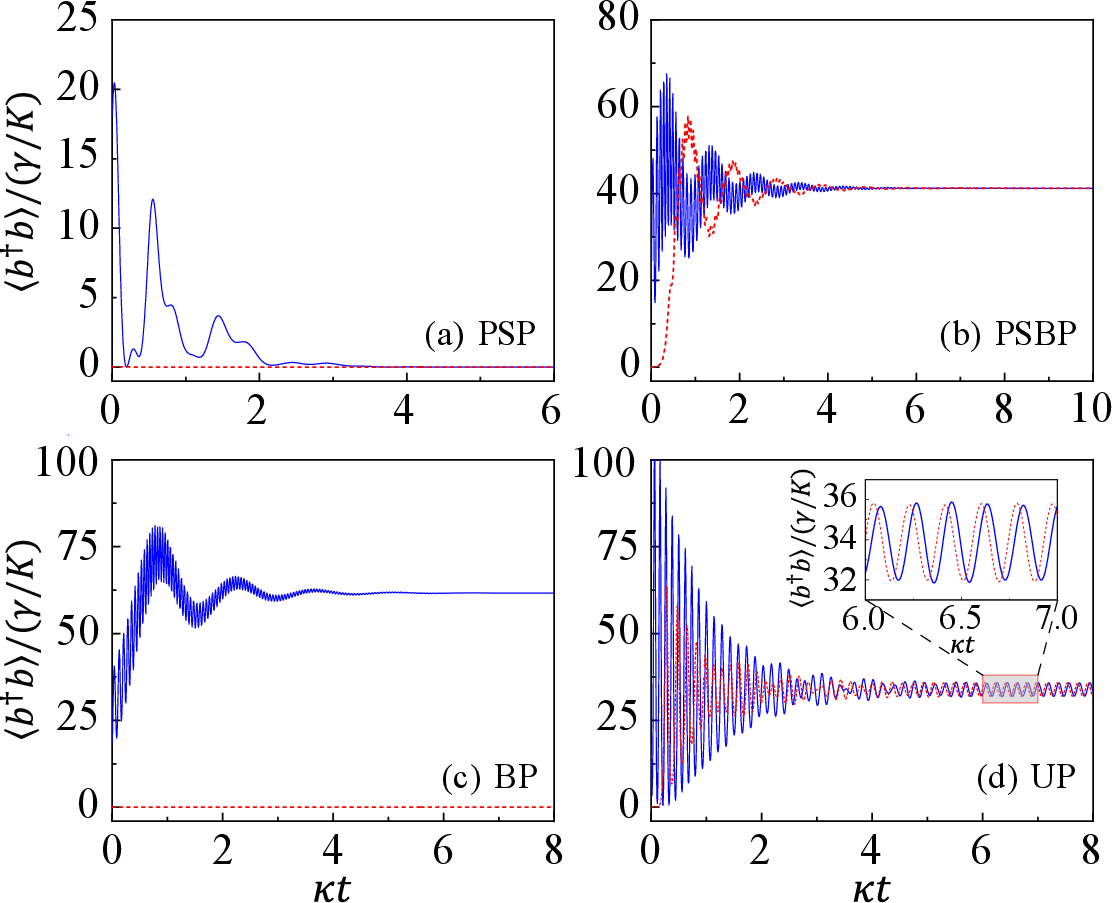
Figure 4: Representative time evolutions of magnon number, sampled in the different phases (parity-symmetric, symmetry-broken, bistable, and unstable), showing convergence and bifurcation phenomena tied to initial conditions and the underlying landscape.
Superradiant Phase Transition Signatures
By varying the Floquet drive amplitude Ω, the effective magnon-photon interaction anisotropy can be tuned, driving the system across the SPT boundaries. The system response exhibits a first-order transition from PSP to PSBP (discontinuous jump in magnon population signaling spontaneous parity breaking), and a second-order transition (continuous return to PSP) at higher Floquet strengths where magnon occupation vanishes smoothly.
Near the phase boundaries, there is a pronounced enhancement in magnon number fluctuations—observable in the covariance matrix formalism—as expected from critical phenomena. These diverging fluctuations act as clear markers for the quantum phase transitions.
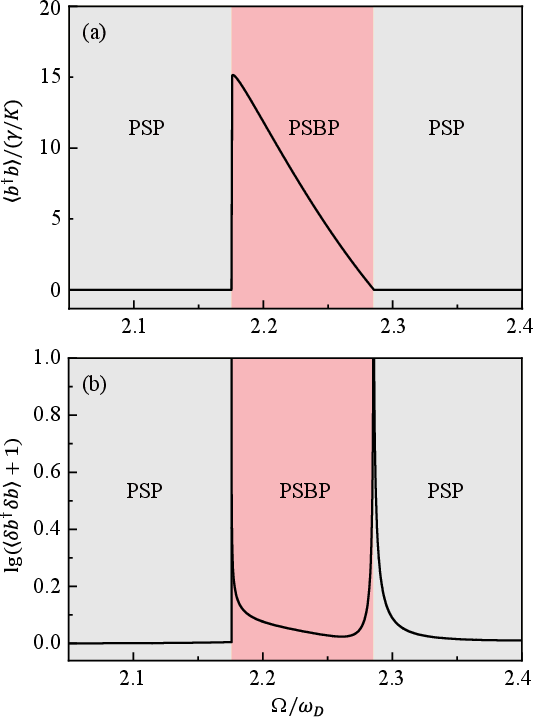
Figure 5: Floquet drive dependence of scaled magnon number and associated magnon number fluctuations; discontinuous jumps and divergence at critical points signify first- and second-order transitions, respectively.
Implications and Future Directions
Floquet engineering is shown to be a robust and experimentally accessible route for exploring and controlling quantum phase transitions in hybrid magnon-photon systems. The ability to modulate both the rotating and counter-rotating magnon-photon interactions via periodic driving, in conjunction with Kerr-type magnon nonlinearities, provides a flexible method for realizing both equilibrium and nonequilibrium phase transitions within standard three-dimensional microwave cavity architectures. This flexibility removes the major technical hurdles of prior approaches and is compatible with widespread cavity QED and magnonics platforms.
Theoretical implications extend to symmetry-protected transitions, dynamical multistability, and critical fluctuation phenomena in open hybrid quantum systems. On the practical side, these results suggest potential routes for continuous variable quantum control and quantum sensing, as SPTs can be manipulated via purely AC modulation without engineering hardware-specific parametric drives.
The observed bistable and unstable regimes, as well as the potential for dynamical symmetry breaking and restoration via higher-harmonic Floquet components, signal interesting directions for future studies that could encompass nonreciprocal effects, controlled criticality, and even explorations of topological phase diagrams within cavity magnonics.
Conclusion
The presented work systematically develops a Floquet-based framework for engineering and observing quantum superradiant phase transitions in cavity magnonic platforms. By harnessing periodic modulation of the magnon frequency, the system’s extensive phase diagram—with parity-symmetric, symmetry-broken, bistable, and unstable regions—is rendered both tunable and accessible. The predicted critical phenomena, including discontinuous transitions and diverging fluctuations, can be mapped without recourse to experimental conditions demanding parametric drives, opening broad opportunities for the investigation and application of driven-dissipative quantum phase transitions in magnonic and hybrid quantum systems.

