- The paper introduces an inference reuse mechanism that fuses heavy YOLOv5-based I-frame detection with lightweight ResNet18 compressed-domain cues.
- It leverages incremental inter-frame association using motion vectors and residuals to effectively reduce computational cost while maintaining high detection fidelity.
- Experimental results indicate up to 99.75% face detection accuracy and over 80% inference reduction, demonstrating robust privacy protection in IoT video analytics.
ComPrivDet: Efficient Privacy Object Detection in Compressed Domains Through Inference Reuse
Introduction
ComPrivDet is introduced as an inference-optimized privacy object detection framework tailored for video analytics scenarios typical in large-scale IoT deployments. The central innovation lies in an inference reuse mechanism that accelerates privacy object detection in compressed video, balancing stringent efficiency requirements and high detection fidelity. The design leverages partial decoding of temporally sparse I-frames and intelligent frame selection, substantially reducing the resource burden common in frame-by-frame pixel-domain object detection pipelines.
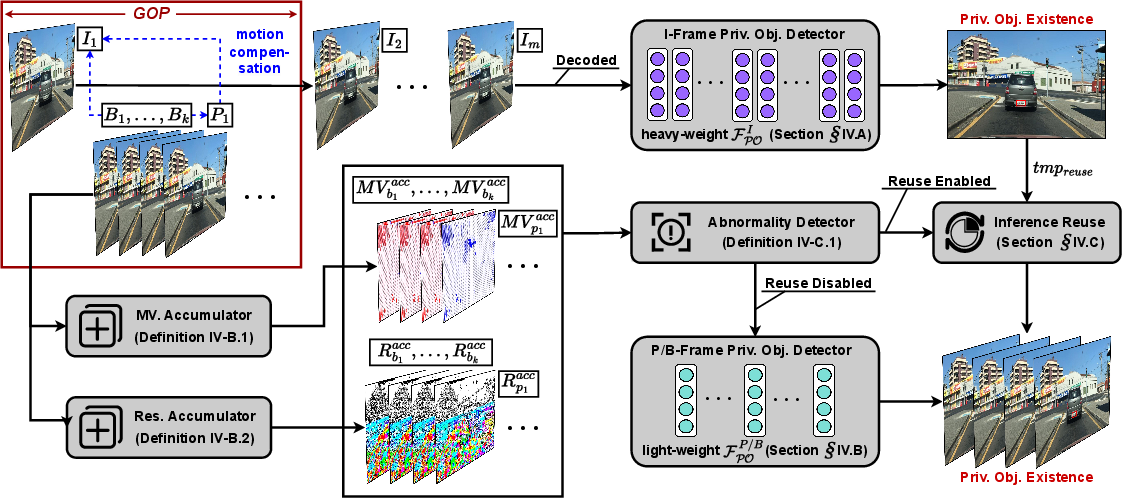
Figure 1: System overview of ComPrivDet, illustrating the interaction between I-frame detectors, P/B-frame compressed-domain cues, and the inference reuse mechanism.
System Architecture and Methodology
ComPrivDet adheres to the Group of Pictures (GOP) structure inherent to modern video codecs (e.g., H.264/HEVC), leveraging the observation that I-frames are more likely to contain newly appeared privacy-sensitive objects owing to their role in scene change representation. The method employs a high-capacity YOLOv5-based model for decoded I-frames while deploying a highly efficient ResNet18 on compressed-domain features (i.e., motion vectors and residuals) for predicted (P/B) frames.
A key innovation is the incremental inter-frame association. Utilizing accumulated motion vectors and residuals, the framework reconstructs unbroken motion-compensation paths between P/B-frames and the GOP-initial I-frame, enabling maximal inference reuse. This is illustrated by tracking the propagation and accumulation of motion and residual information across the GOP.
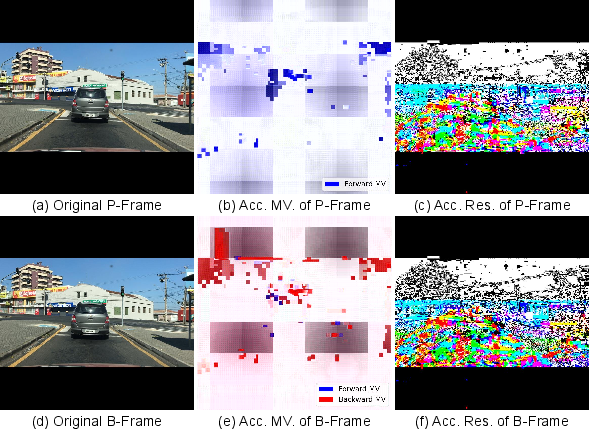
Figure 2: Examples of accumulated motion vectors and residuals, exposing the mapping between P/B-frames and the GOP's I-frame for efficient association.
The inference reuse mechanism selectively skips the computationally expensive inference on P/B-frames, only invoking lightweight detection when accumulated compressed-domain cues suggest significant appearance changes (i.e., cases likely to contain new, privacy-sensitive objects not present in the I-frame). The detection of such "abnormal" frames is governed by zero motion and statistically deviant residuals, ensuring that no privacy objects are missed due to lack of GOP refresh.
Detailed Algorithmic Contributions
1. Multi-Model Collaboration and Inference Reuse: The pipeline distinguishes itself by fusing heavyweight pixel-domain inference (for I-frames) with lightweight compressed-domain inference (for abnormal P/B-frames), orchestrated through a precise, statistical decision mechanism.
2. Incremental Association via Accumulated Motion and Residuals: ComPrivDet tracks pixel-wise propagation across GOPs by incrementally updating each frame’s motion information. This reconstructs a deterministic mapping to pixel locations in the original I-frame, mitigating misalignment due to inter-frame prediction chains.
3. Efficient Frame-Skip Policy: By leveraging the statistical distribution of residuals (e.g., three-sigma deviation) and zero motion detection, the mechanism attains high recall of new objects while minimizing inference invocations, effectively maximizing both accuracy and computational efficiency.
Experimental Validation
Ablation on Thresholds and Frame Reuse: Varying the sensitivity threshold τab and detection confidence τconf, ComPrivDet maintains 99.75% accuracy for face detection and 96.83% for license plate detection while skipping over 80% of the inferences, an operational point unattainable with prior methods.
Latency Overhead Analysis: The inference reuse module introduces minimal additional computational overhead—less than 3% of total latency—verifying the practicality of real-time deployment.
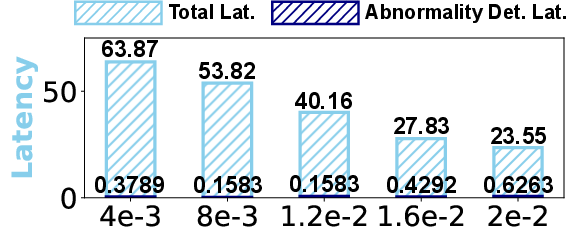
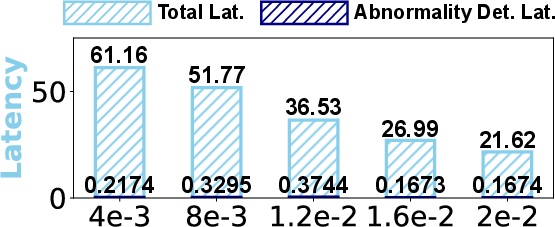
Figure 3: Ratio of abnormality determination overhead to total inference latency for face and license plate detection.
Comparison with Pixel-Domain and Compressed-Domain Baselines: Empirical studies using YouTube Faces, UFPR-ALPR, and GOT-10k benchmarks reveal substantial statistical gains:
- Against pixel-domain one-stage detectors (YOLOv5, SSD, EfficientDet): ComPrivDet achieves up to 2.33% higher accuracy for private face detection and up to 1.36% for license plate detection, all while reducing inference latency by more than 55%.
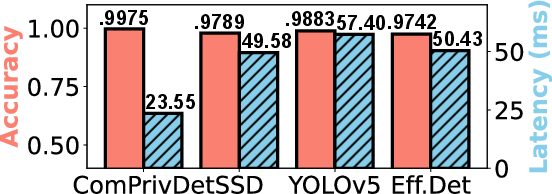
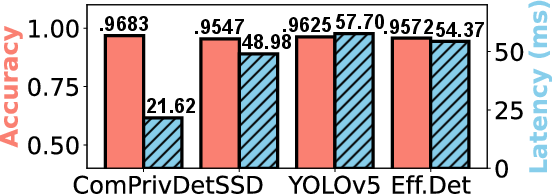
Figure 4: Side-by-side accuracy and latency comparison with leading pixel-domain detectors, emphasizing ComPrivDet's efficiency advantage.
- Against compressed-domain frame-level methods (MCD-Net, DMC-Net, BFSeg-Net): Accuracy improvements reach up to 30.31%, with comparable or lower latency.
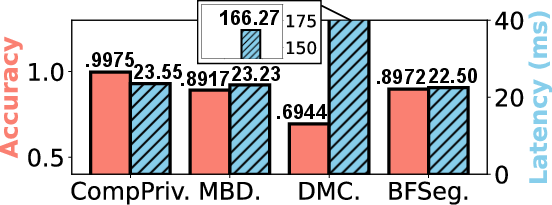
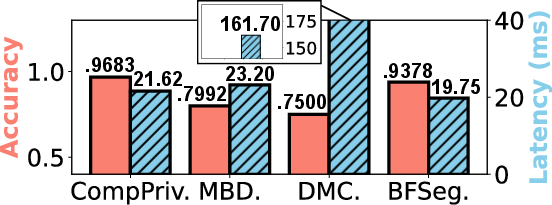
Figure 5: Comparison with compressed-domain frame-level detectors, showing marked accuracy superiority at matched or superior speed.
- Against GOP-level detectors (MM-Net, SftRef-Net): ComPrivDet yields 7.17–8.28% improvements in face detection accuracy and 0.61–0.83% for license plate detection, with latency reductions exceeding 68%.
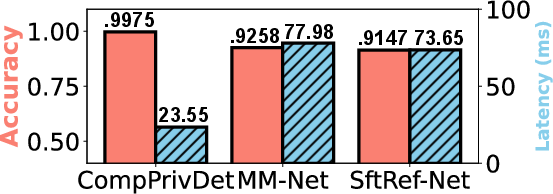
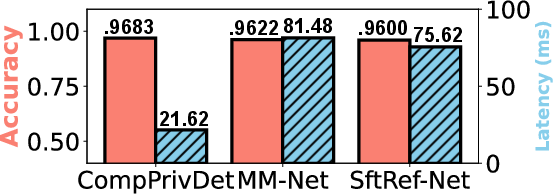
Figure 6: Benchmarking against competing GOP-level detectors, ComPrivDet demonstrates strong accuracy and significant efficiency advantages.
Ablation Analysis: Increasing τab boosts both the reuse rate and overall task accuracy due to the I-frame model's superiority and the infrequency of unrecognized new object appearance—confirming the formal analysis given by the system capability theorem.
Implications and Potential Directions
ComPrivDet substantiates that judicious integration of compressed-domain signals with selective pixel-domain inference not only enables efficient privacy object detection but can outperform conventional pixel-domain pipelines despite partial data. The approach underscores the critical role of inference reuse and statistical anomaly detection when processing compressed streams in resource-constrained IoT settings.
Theoretically, this work advances the field by formalizing inter-frame association in the compressed domain and providing statistical foundations for optimizing detection-capability/latency trade-offs. Practically, the method is directly extensible to multi-object settings and privacy-preserving video analytics at scale.
Future research can extend the selective inference mechanism to heterogeneous privacy object sets, dynamic video source conditions, and adaptive policies based on long-term statistical modeling of video content. Additionally, integration with hardware-efficient video decoders and federated edge intelligence presents avenues for advancing privacy and deployment scalability.
Conclusion
ComPrivDet advances the state of the art in efficient privacy object detection under compressed video by systematically exploiting inference reuse, statistical anomaly detection, and multi-model collaboration. The method demonstrates superior accuracy and substantial latency reduction against leading pixel- and compressed-domain techniques. This framework offers a blueprint for scalable, privacy-aware video analytics in IoT, balancing computational efficiency and rigorous privacy compliance (2604.03640).