- The paper demonstrates that repeated reactive interactions in mini-ultimatum games can sustain fairness by resisting unfair mutants through a critical discount factor.
- The paper employs a rigorous two-species evolutionary framework and stochastic mutation-selection dynamics to analyze strategy stability among fair and unfair behaviors.
- The paper reveals that shorter effective game lengths bolster fairness, offering practical insights for designing fair multi-agent systems and resource allocation mechanisms.
Overcoming Unfairness via Repeated Interactions in the Mini-Ultimatum Game
Introduction and Motivation
This paper presents a rigorous theoretical framework for the evolution of fairness in populations engaging in the repeated mini-ultimatum game (mini-UG). Unlike classical models which focus on the Prisoner's Dilemma or single-shot ultimatum games, this work situates fairness in the context of repeated interactions governed by reactive strategies. Each player (offerer and accepter) chooses actions (high or low) based solely on the partner's most recent move, introducing history dependence within a minimalistic two-action structure. The analysis targets two central questions: (1) whether fair strategy pairs can resist invasion by unfair mutants and (2) how repeated games and evolutionary parameters influence the long-term prevalence of fairness.
Reactive Strategies and Game Structure
Reactive strategies are formalized with three parameters per player: two conditional probabilities representing responses to the opponent's prior action, and one initial action probability. Pure reactive strategies are categorized as fair (Fo, Fa: always-high), unfair (Uo, Ua: always-low), complier (Co, Ca: copy opponent), and anti-complier (Ao, Aa: oppose opponent). This abstraction enables tractable Markovian analysis while capturing essential dynamics of repeated decisions.
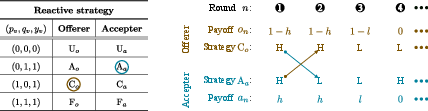
Figure 1: Schematic illustration of repeated reactive interactions, detailing conditional strategy pairs and their temporal transitions in payoffs and action selection.
Short-Term Evolutionary Stability Analysis
The evolutionary stability of fair strategy pairs was analyzed in infinite two-species populations using the two-species evolutionary stable strategy (2ESS) framework. Payoff matrices for combinations of fair and unfair strategies were derived under repeated interactions with discounting. The critical result is the identification of a threshold discount factor δc=1−l1−h, determined by the high (h) and low (Fa0) offer/demand parameters. Below Fa1, strategy pairs involving complier offerers and fair or complier accepters are 2ESS and resist invasion by unfair mutants. Above Fa2, only the pair (Fa3, Fa4) retains evolutionary stability.
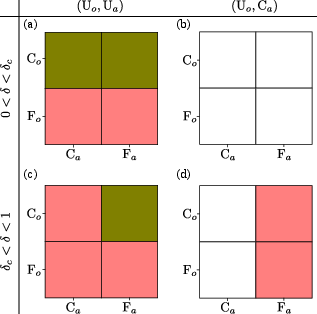
Figure 2: 2ESS phase diagrams contrasting fair and unfair strategy pairs across discount factor regions, highlighting critical thresholds and transition zones where fairness is unstable.
This result is notable: unlike classical games where long game length tends to support cooperation, in repeated mini-UGs, shorter effective game lengths (lower discount factors) robustly promote fairness, provided specific reactive strategies are adopted.
Long-Term Mutation-Selection Dynamics
A generalized stochastic two-population model was constructed to capture mutation-selection dynamics with finite population sizes and rare mutations. The model tracks the stationary distribution over all 16 possible monomorphic population states (strategy pairs), yielding fine-grained fairness rates. Analysis reveals the following:
- Under weak selection (Fa5), fairness rates are nearly constant across parameter space due to drift.
- With stronger selection (Fa6), fairness declines with increasing population size and discount factor.
- The transition in fairness frequency coincides precisely with Fa7.
- Below Fa8, fairness is maintained predominantly by (Fa9, Uo0) and (Uo1, Uo2). Above Uo3, only (Uo4, Uo5) persists, with unfair states emerging more frequently.
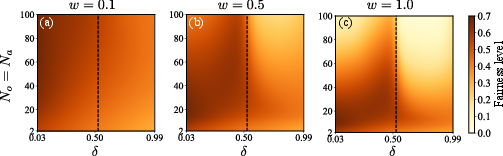
Figure 3: Long-term fairness rates mapped over population size and discount factor, exposing regions of high and low fairness driven by selection strength.
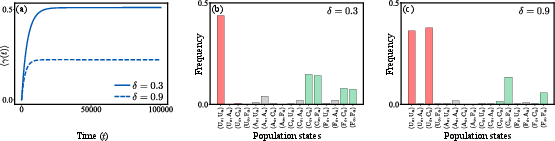
Figure 4: Temporal evolution and stationary distributions for fairness at distinct discount factors (Uo6, Uo7), illustrating the prevalence of fair strategy pairs under varying conditions.
These findings establish that repeated interactions, especially with shorter game horizons, are sufficient for the spontaneous evolution and maintenance of fairness, contingent on the adoption of complier strategies by offerers.
Implications, Contrasts, and Future Directions
Theoretical implications are multifaceted. The results directly challenge the paradigm from cooperation games that longer repeated interactions are necessary for evolutionary stability in reciprocal strategies. In the mini-UG, shorter effective game lengths suffice, provided population dynamics and strategy structure align appropriately.
Practically, the findings illuminate mechanisms for promoting fairness in social, biological, and artificial multi-agent systems. These include configuring game horizons, engineering reactive protocols, and harnessing complier behaviors in algorithmic negotiations and resource allocation.
Future research could extend the framework to asynchronous interactions, more expressive Markov (multi-memory) strategies, and explicit learning dynamics. Empirical validation and exploration of noise, action misperception, and more realistic environments will further ground theoretical predictions and inform design in AI-mediated games.
Conclusion
This paper rigorously demonstrates that repeated interactions in the mini-ultimatum game, governed by reactive strategies, can overcome the evolutionary advantage of unfairness. The existence of a critical discount factor defines the boundary between persistent fairness and the resurgence of unfair strategies. The complier offerer and tough accepter pairing is robust across all regimes, while shorter effective games further bolster the prevalence of fairness. These results not only enrich evolutionary game theory but also provide actionable insights for fostering fairness in dynamic, multi-agent environments.