- The paper derives exact solutions for nonrelativistic perfect fluid equations exhibiting conformal symmetry using group-theoretic methods.
- It demonstrates how symmetry parameters like ℓ and z control fluid expansion, density evolution, and higher derivative effects.
- The analysis extends to viscous fluids, providing insights for modeling high-density, fast-evolving flows in various physical systems.
Introduction and Context
The paper "Perfect fluid equations with nonrelativistic conformal symmetry: Exact solutions" (2604.03621) explores the construction of exact solutions to nonrelativistic perfect fluid equations exhibiting invariance under three distinct symmetry groups: the Schrödinger group, the ℓ-conformal Galilei group, and the Lifshitz group. The analytical approach centers on leveraging the group-theoretic method to systematically construct symmetry-invariant variables and fields, reducing complex PDEs to more tractable ODEs or algebraic systems. This strategy not only generalizes prior results in fluid mechanics with conformal symmetry but also highlights the interplay between symmetry parameters and fluid dynamical characteristics, such as expansion rate and density evolution.
Mathematical Framework: Symmetries and Invariant Equations
The study begins by defining the underlying symmetry algebras:
- Schrödinger group: Associated with scaling exponent ℓ=1/2.
- ℓ-conformal Galilei group: Parameterized by (half-)integer ℓ, allowing multiple acceleration generators; includes temporal translation, dilatation, special conformal transformation, spatial rotations and translations, Galilei boosts, and higher-order accelerations.
- Lifshitz group: Characterized by the dynamical critical exponent z, derived by omitting the special conformal generator.
The perfect fluid equations invariant under the ℓ-conformal Galilei group are: ∂t∂ρ+∂xi∂(ρυi)=0,ρD2ℓυi=−∂xi∂p,p=aρ1+ℓd1,
with D the material derivative. Notably, for ℓ>1/2, the Euler equation involves higher-order derivatives, reflecting the expanded generator set.
Exact Solutions in One Spatial Dimension
The group-theoretic approach enables explicit characterization of solutions under different symmetry subgroups in $1+1$ dimensions:
Higher-Dimensional Generalization
The scaling subgroup analysis is extended to arbitrary spatial dimensions:
- Invariant velocity: ℓ6 for ℓ7, with scale-invariant variables ℓ8.
- Density solutions: For integer ℓ9, ℓ0; for admissible half-integer ℓ1,
ℓ2
This manifests spatially localized density variations.
- Expansion rate: The parameter ℓ3 emerges physically as a quantifier for fluid expansion.
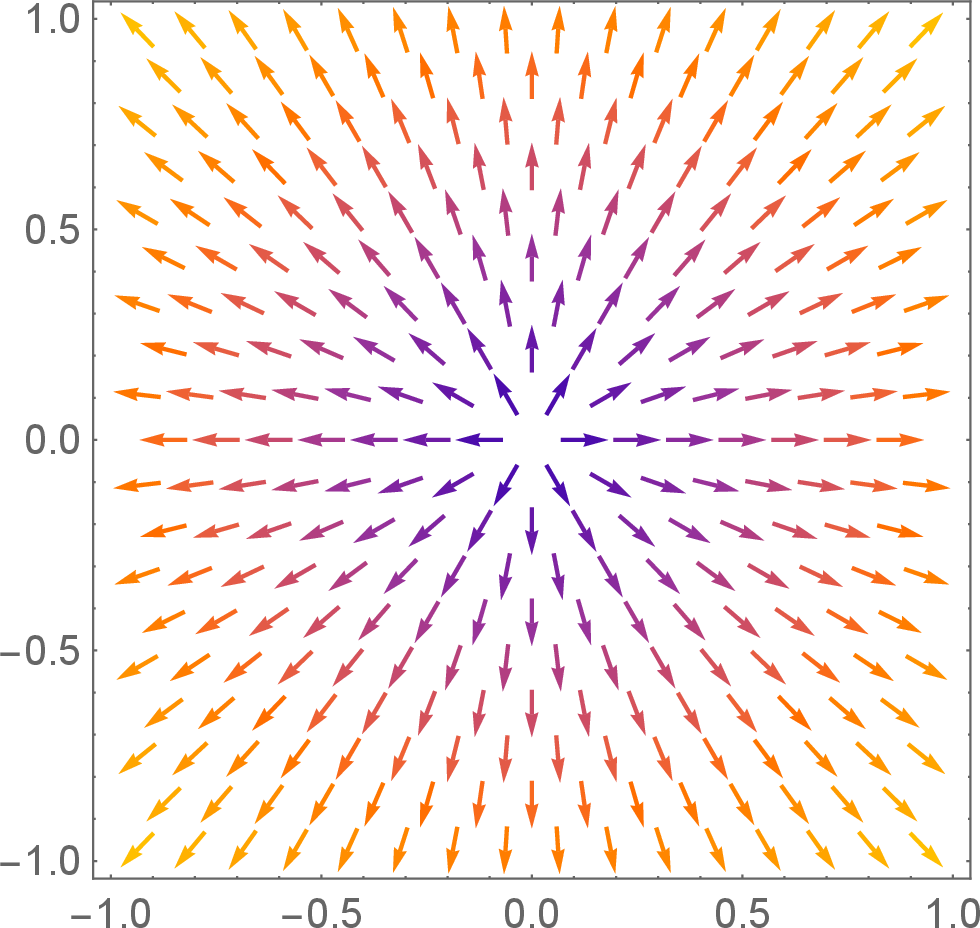
Figure 2: Streamline plot of the velocity field ℓ4 for ℓ5, ℓ6 in two dimensions.
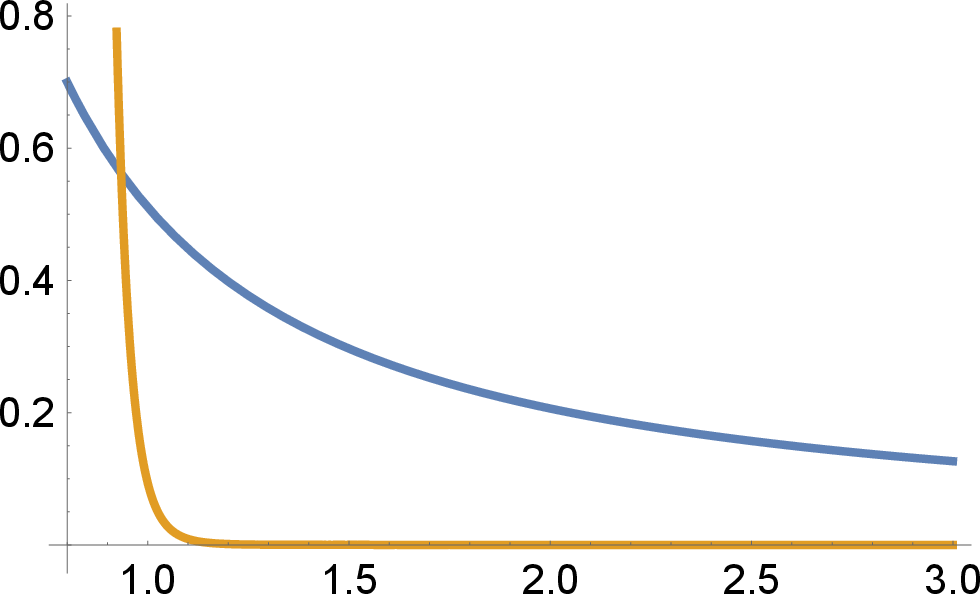
Figure 3: Mass evolution of a unit disk in two spatial dimensions for ℓ7 and ℓ8.
Applying symmetry transformations--special conformal and acceleration generators--enables construction of new solution families, enabling velocity field manipulation and spatial patterning.
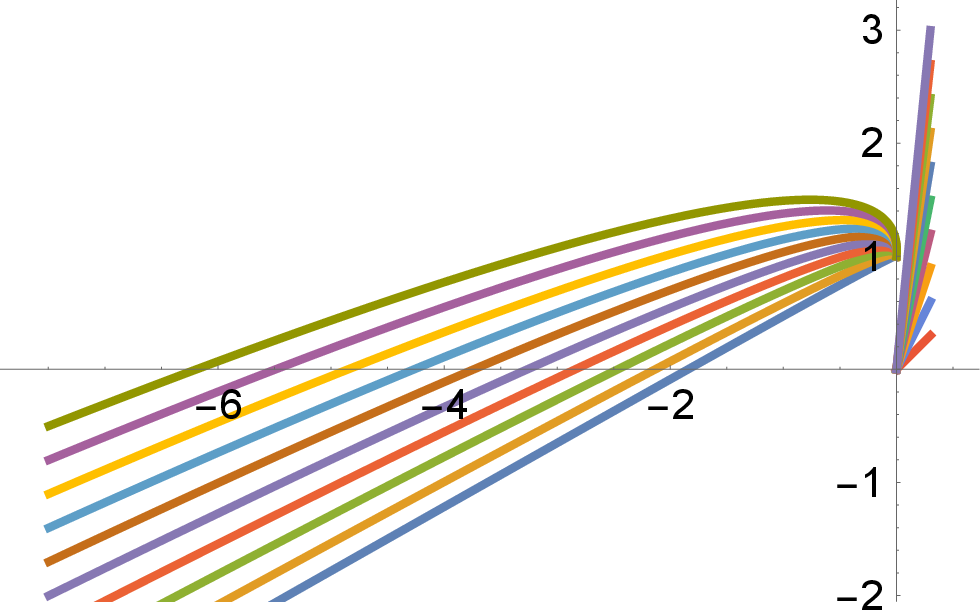
Figure 4: Example flow visualization after applying a specific acceleration transformation to the velocity field in 2D.
Lifshitz-Symmetric Fluid Equations
With the Lifshitz group (parameter ℓ9), the analysis yields:
Inclusion of Viscosity
The methodology extends naturally to viscous fluids:
- Modified Euler equation: Incorporating the rate-of-strain tensor z6, with viscosity coefficients scaling as density, maintains symmetry invariance.
- Scale-invariant viscous solutions: For integer z7, explicit expressions for z8, z9, ℓ0 are obtained; for half-integer ℓ1, transcendent equations arise.
Implications and Prospective Directions
The analysis demonstrates that by tuning symmetry parameters (ℓ2, ℓ3), the density and pressure of these nonrelativistic fluids can be made arbitrarily large for short intervals, suggesting potential applications in quark-gluon plasma modeling, early-universe cosmology, and explosion dynamics. The mathematical connections to Bjorken flow, symmetry-adapted expansions, and exact multi-dimensional solutions open theoretical avenues for further study, including supersymmetric extensions and Hamiltonian/Lagrangian formulations.
Conclusion
The group-theoretic approach presented in this paper results in explicit, analytic families of exact solutions for perfect fluid equations under nonrelativistic conformal symmetry. Physical parameters ℓ4 and ℓ5 are shown to control fluid expansion and density scaling. Adjustments to these parameters, along with free coefficients of the solution, allow for precision in the modeling of fast-evolving, high-density fluids relevant to diverse areas of mathematical physics. The theoretical implications for symmetry-driven fluid dynamics are complemented by practical utility in modeling complex physical systems, meriting further exploration into viscous, quantum, and supersymmetric regimes.