- The paper establishes a quantum-mechanical framework using HG×LG modes to analyze twisted light–atom collisions beyond dipole approximations.
- It demonstrates near-unit efficiency OAM transfer controlled by impact parameter and atomic coherence, yielding tunable atomic CM OAM states.
- The study identifies selection rule violations, superkick effects, and structured absorption profiles that open new avenues in quantum control and spectroscopy.
Interaction of Twisted Light with Free Twisted Atoms: A Quantum-Mechanical Wave-Packet Analysis
Theoretical Framework for Atom–Photon Collisions with OAM
This work establishes a quantum theory for the interaction between spatially localized atomic and photonic wave packets, both carrying well-defined orbital angular momentum (OAM). Unlike previous studies, the analysis goes beyond the dipole and infinitely heavy nucleus approximations, employing a fully nonrelativistic treatment of the hydrogenic atom's center-of-mass (CM) motion. Both the electronic and CM degrees of freedom are described using Hermite–Gaussian × Laguerre–Gaussian (HG×LG) modes, which allow for direct investigation of both Gaussian and vortex (twisted) packets. The photonic states include the possibility of structured (OAM-carrying) and longitudinally shaped pulses, implemented through exact quantum-mechanical perturbation theory.
Key to this approach is the consistent wave-packet formalism for both field and atom, providing S-matrix elements for absorption and scattering processes that naturally incorporate the effects of finite spatial and temporal coherence, nonparaxiality, and the kinematic characteristics of twisted states.
OAM Transfer and the Quantum State of the Atom
A principal result is the elucidation of OAM transfer in the absorption of a twisted photon by a localized atom. If the impact parameter b is sufficiently small compared to the atomic transverse coherence length σ, OAM is transferred with near-unit efficiency to the atomic CM wave packet. The OAM spectrum of the final atomic CM state is governed by the ratio b/σ, yielding an effectively quantized and tunable OAM content. Larger b values produce a biased OAM sideband structure and increased variance, a direct consequence of the packet nature of the collision:
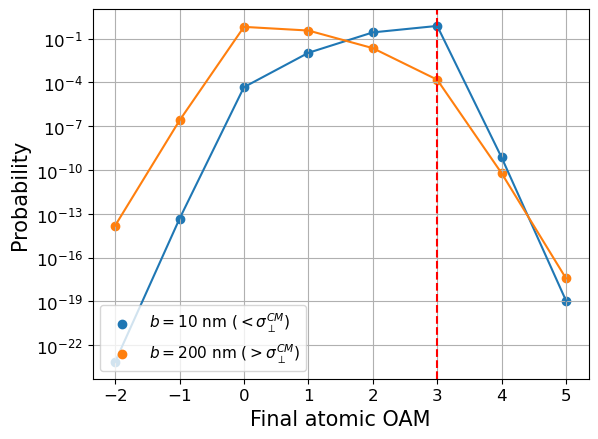
Figure 1: Estimated probability distribution of OAM in the evolved CM state for ℓ0=3; varying b shifts the mean OAM and increases its spread.
The final CM state becomes a superposition of angular momentum eigenstates, with the OAM distribution analytically describable in the small b≪σ regime. The mean and variance of the transferred OAM can be controlled by tuning b and the packet widths.
Selection Rule Violations and Cross Section Hierarchies
One of the most consequential theoretical findings is the hierarchy of selection rule violations induced by the finite wave-packet nature and the inclusion of CM recoil. Whereas, in standard plane-wave models, only transitions with mf=λ are allowed for a photon of helicity λ, the intrinsic spread and structuredness of the photon relax these rules—opening channels even for forbidden transitions (σ0), albeit with rapid suppression for each step away from the dipole-allowed channel:
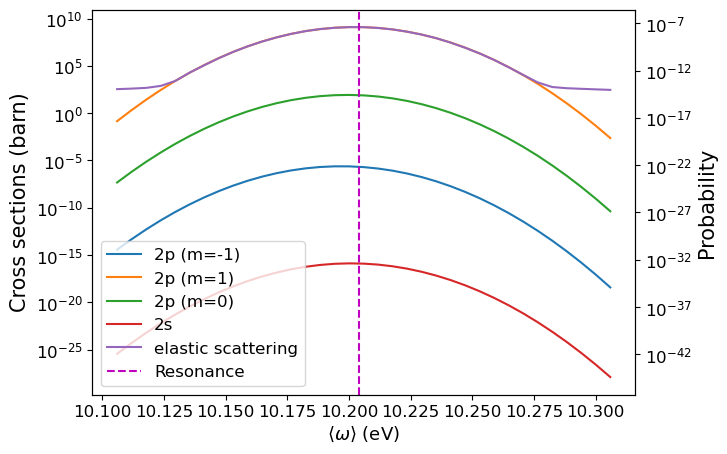
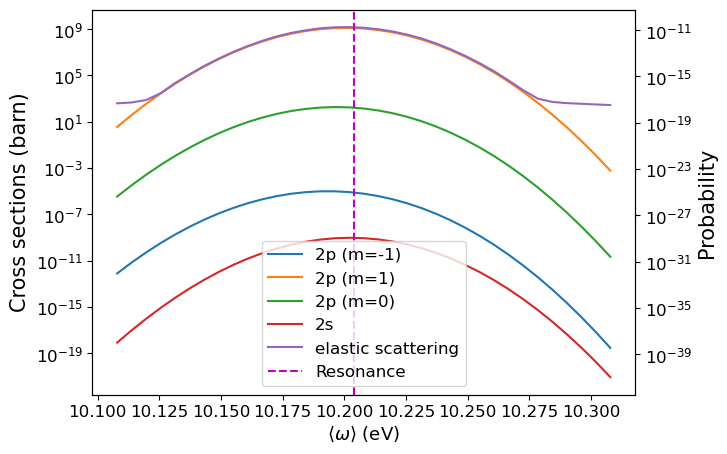
Figure 2: Probabilities and cross sections for σ1 transitions in hydrogen, showing dominance of the dipole-allowed channel and suppression of forbidden channels.
A robust ordering is observed where the dipole-allowed transition is dominant, with probabilities for forbidden transitions falling off by 10 orders of magnitude or more per step away from the leading channel.
Luminosity, Nonparaxiality, and Pulse Structure Effects
The analysis quantitatively incorporates the influence of photonic and atomic packet shapes on the absorption and scattering cross sections. The finite longitudinal coherence of femtosecond pulses regularizes the natural-linewidth inherent to electronic transitions, leading to substantial line broadening. Nonparaxiality, as realized in tightly focused photon beams (small σ2), produces asymmetric absorption profiles with extended tails below resonance, a direct result of the broadened and skewed photon spectrum:
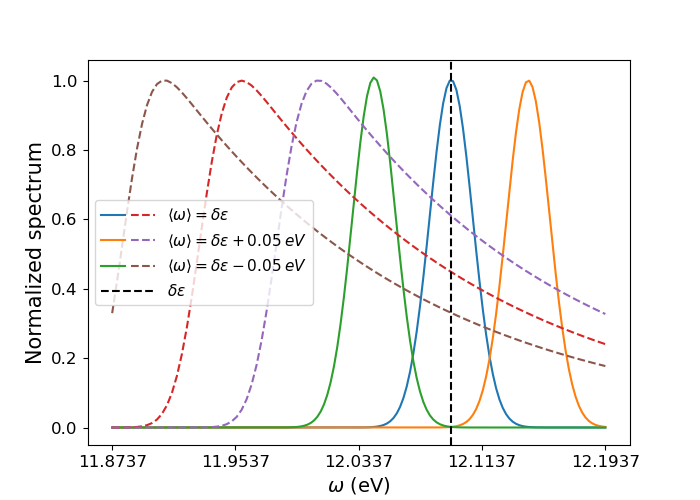
Figure 3: Energy spectra of Gaussian photonic packets with varying transverse coherence; decreased σ3 induces strong spectrum asymmetry and broadening.
Shaping of the longitudinal photon wave function via higher HG modes (σ4) results in multiple-peak resonance splitting, mirroring the energy spectrum of the structured pulse.
Superkick and Selfkick Effects: Kinematical Momentum Redistribution
A prominent finding is the quantum‐mechanical demonstration of the “superkick” and its dual, the “selfkick,” in atom–photon collisions. The superkick manifests as a pronounced transverse recoil imparted to the atomic CM when it absorbs a vortex photon off-center (σ5). Conversely, the selfkick emerges when a vortex atom absorbs a non-vortex photon, with transverse momentum redistribution arising in the atomic packet due to the localized interaction:
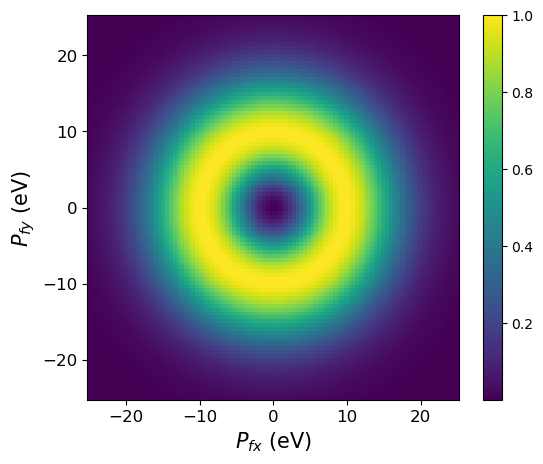
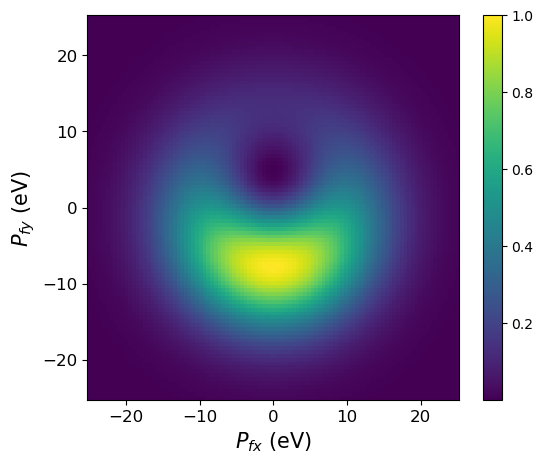
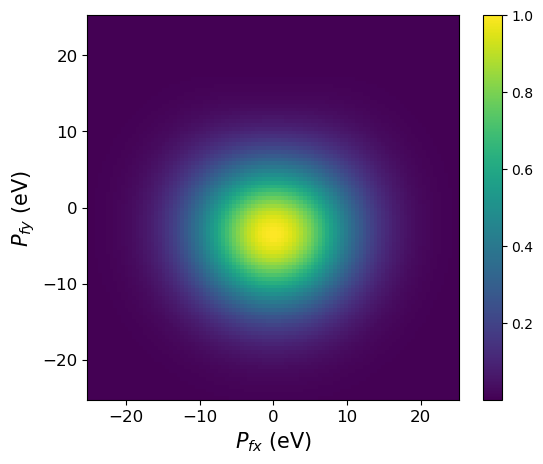
Figure 4: The superkick effect—transverse CM momentum probability density for various σ6; the ringlike symmetry is broken as σ7 increases.
These effects persist for paraxial and nonparaxial conditions. Their universality and symmetry-breaking enable them to be used as diagnostics for quantum vorticity in both light and matter, and are robust to the underlying interaction.
Hierarchy of Channel Suppression with Photon OAM
Detailed analysis for increasing photon OAM highlights that the absorption probability in forbidden channels decreases exponentially with σ8, while cross sections (due to compensating luminosity effects) decrease only linearly. The highest production rates for twisted atoms are thus achieved for single-quantum vortex photons; higher-order twisted photons result in exponentially suppressed rates, implying experimental optimization at low OAM.
Practical and Theoretical Implications
On the theoretical side, the formalism enables a self-consistent quantum description of generalized selection rule violations, OAM transfer, and motional–internal state entanglement. Practically, the findings suggest viable routes for the generation and control of twisted atomic (and ionic) states by means of structured light, complementing earlier approaches based on diffractive masks.
The superkick/selfkick effects provide tools for detecting vorticity and probing local momentum densities, applicable across a range of composite quantum systems. The line-shaping and resonance splitting effects provide new degrees of experimental control for high-precision spectroscopy, quantum control, and information protocols based on atomic CM OAM encoding.
Future Prospects
Potential extensions include:
- Exploitation of motional OAM for high-dimensional quantum encoding and entanglement between CM and internal (electronic or spin) degrees of freedom.
- Application to trapped ions, with cross-over to discrete motional states—directly relevant for quantum information processing.
- Use of the OAM transfer mechanism for angular-momentum–sensitive atom interferometry and enhanced rotational sensing.
- Exploration of fundamental processes in vortex–vortex scattering, and the emergence of mixed or entangled states post-decoherence.
Conclusion
This work delivers a rigorous quantum-mechanical foundation for OAM exchange in structured atom–photon collisions, revealing new channels for atomic vortex generation, the subtle breakdown of selection rules, controllable superkick-like recoils, and a rich phenomenology of cross-section and resonance structure shaped by the geometry and coherence of the interacting wave packets. These insights enable both precision atomic manipulation and diagnostics of quantum vorticity for emerging applications in quantum optics and information science.