- The paper introduces a deterministic protocol for arbitrarily high-dimensional Bell state analysis using ICO to overcome LOCC limitations.
- It demonstrates the experimental viability of ICO quantum switches (3-switch, 4-switch, and d-switch) for complete and nondestructive Bell state discrimination.
- The approach relies solely on local unitaries and shift gates within superpositions of causal orders, offering resource-efficient architectures for quantum communication.
Unambiguous High-Dimensional Bell State Analysis via Indefinite Causal Order
Introduction
The paper "Unambiguous arbitrary high-dimensional Bell states analyzer via indefinite causal order" (2604.03577) introduces a deterministic and complete protocol for high-dimensional Bell-state analysis (BSA) leveraging the operational paradigm of indefinite causal order (ICO). Traditional methods for BSA, particularly in dimensions greater than two, are fundamentally constrained by local operations and classical communication (LOCC), failing to achieve complete discrimination without ancillary entanglement, additional degrees of freedom, or nonlocal interactions. The presented scheme employs only single-qudit local unitaries embedded in an ICO quantum switch, bypassing the need for entangled resources or nonlocal operations and achieving one-shot, deterministic discrimination for d2 generalized Bell states in arbitrary dimension d≥3.
Limitations of LOCC-Based High-Dimensional BSA
In standard LOCC frameworks, the number of orthogonal entangled states that can be discriminated is upper-bounded by the ratio of Hilbert space dimension to the square of the sum of Schmidt coefficients. For maximally entangled states in d dimensions, this enforces N≤d; perfect discrimination of all d2 Bell states is thus prohibited. This motivates approaches beyond LOCC, especially those that exploit causality as a quantum resource.
Indefinite Causal Order Quantum Switches for BSA
ICO 3-Switch for Qutrit Bell States
The core construct is the ICO quantum 3-switch S3, which applies sequences of local unitaries Uk3⊗Vk3 to target qutrits controlled coherently by a third ancillary qutrit in the state ∣F0⟩c. The action of S3 correlates the groupings of the Bell basis states with the measurement outcome on the control system; the remaining ambiguity within each group is resolved by local projective measurement in the computational basis. Full injective mapping is accomplished deterministically for all nine two-qutrit generalized Bell states, circumventing the limitations derived from LOCC constraints.
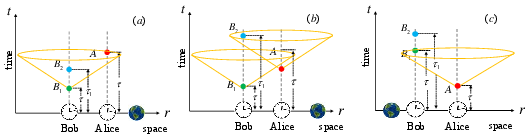
Figure 1: Quantum control of temporal order for constructing gravitational ICO 3-switch S3.
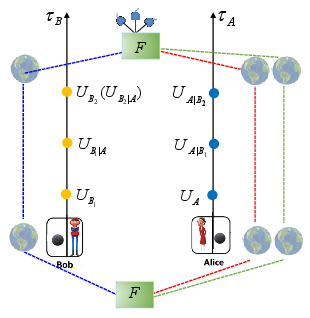
Figure 2: The gravitational ICO 3-switch d≥30—functional schematic for physical implementation using local unitaries and time-ordered events dictated by geometry.
ICO 4-Switch for Ququart Bell States
The scheme generalizes to the ICO quantum 4-switch d≥31, targeting d≥32 generalized Bell states for two ququarts. The control ququart is initialized in the equal superposition state d≥33; local shift operations d≥34 play the role of requisite unitaries. As in the qutrit case, the superposition of event orders, mapped to projective outcomes, partitions the Bell states into disjoint groups, each perfectly discriminated by joint post-processing of control and local projective measurements. No nonlocal operations are utilized, and all local gates are experimentally accessible shift operators.
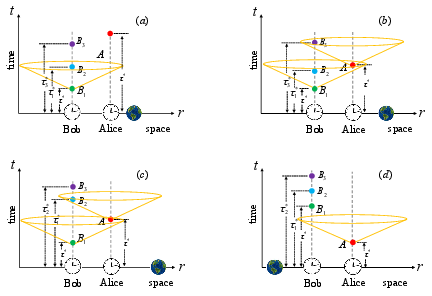
Figure 3: Quantum control of temporal order for gravitational ICO 4-switch d≥35.
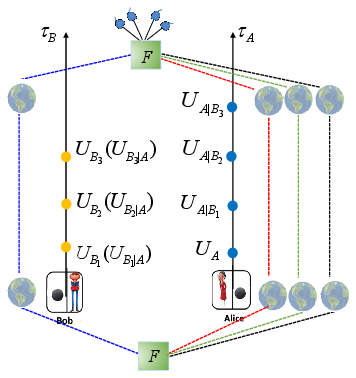
Figure 4: The gravitational ICO 4-switch d≥36—structured interaction graph for ququart systems.
Arbitrary d≥37-Dimensional ICO d≥38-Switch
The methodology extends to arbitrary Hilbert space dimension: an ICO d≥39-switch d0 is realized by embedding local shift gates d1 in all branches of the control system's superposition. The generalized Bell states d2 for d3 are mapped to orthogonal control states, further discriminated locally by measurement. The scheme achieves full discrimination power for the entire generalized Bell basis, independent of system dimension, in a nondestructive fashion that allows for repetition without depletion of the ICO resource.
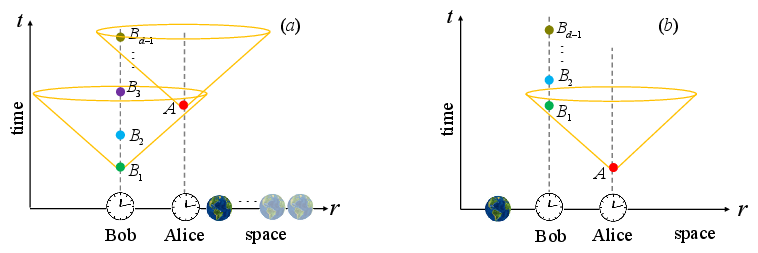
Figure 5: Quantum control of temporal order for gravitational ICO d4-switch d5.
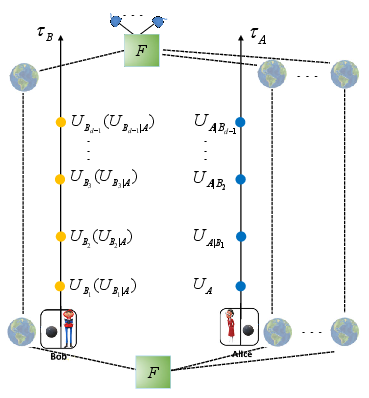
Figure 6: The gravitational ICO d6-switch d7—architecture for arbitrary dimension utilizing generalized shift gates and time-order superposition.
Physical Realization with Gravitational Indefinite Causal Order
The paper addresses implementation in spacetime by utilizing gravitational time dilation effects to physically realize indefinite orderings. Superpositions of mass configurations generate coherently controlled causal structures between events (operations on Alice's and Bob's qudits). Each configuration corresponds to a definite sequence of events, and the coherent superposition over geometries realizes the ICO. Tables of causal configurations and associated unitaries detail the entire construction for d8 and d9; the generalization to arbitrary N≤d0 is constructed analogously, further emphasizing experimental feasibility by reliance only on shift gates and controlled measurements.
Theoretical and Practical Implications
This work demonstrates that ICO can serve as a complete and universal resource for nonlocal quantum information processing tasks, leveraging solely local unitaries when embedded in superpositions of causal orders. This challenges the dogma that entangled ancillae or nonlocal operations are a necessity for high-dimensional BSA, and establishes ICO as a primitive for operational advantage beyond communication complexity and channel discrimination. By showing that the ICO switch is not consumed during the process—BSA is non-destructive—the approach lends itself to iterative or repeat-until-success protocols, opening avenues for resource-efficient architectures in high-dimensional QKD, teleportation, and quantum networks.
Conclusion
The paper presents a deterministic, one-shot solution for high-dimensional Bell state analysis using indefinite causal order, avoiding the traditional circuit complexity associated with nonlocal operations or entanglement-assisted strategies. The construction employs only local shift gates, implemented under superpositions of causal geometries, and achieves full discrimination power for N≤d1 Bell states in any dimension N≤d2. The ICO is thus established as a universal, nondestructive resource for generalized BSA—implying profound consequences for quantum information theory, experimental architectures in high-dimensional quantum communication, and the foundational study of causality in quantum theory.
(2604.03577)