- The paper demonstrates that CH4-driven atmospheres yield 5–90 times more haze mass and chemical complexity than CO-based experiments.
- The experimental design systematically varied dominant gases and carbon sources, revealing how redox state modulates photochemical haze formation.
- Analytical techniques like FTIR, AFM, and VHRMS confirmed that CH4 hazes exhibit diverse functional groups, larger particle sizes, and implications for exoplanet spectral modeling.
Introduction
This study provides a comprehensive experimental analysis of photochemical haze formation pathways in atmospheres relevant to terrestrial exoplanets, emphasizing the distinct roles of CO and CH4 as primary carbon sources. The work addresses compositional diversity expected in secondary, high-metallicity exoplanetary atmospheres and quantifies how redox state and available carbon species modulate haze production rate, particle properties, and chemical complexity. Laboratory simulations were conducted using a systematic suite of six representative atmospheric mixtures that isolate the effects of dominant background gases (CO2, N2, or H2O) and carbon source identity (CO vs. CH4).
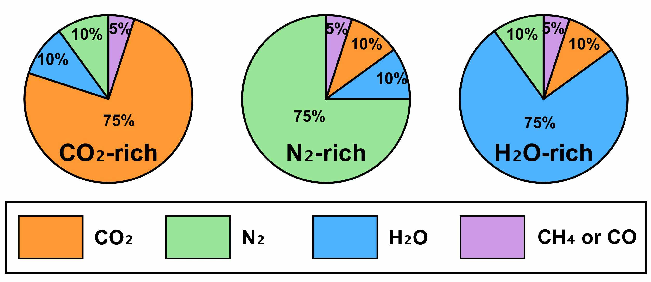
Figure 1: Initial gas mixing ratios for the six experiments, each utilizing a dominant species (CO2, N2, or H2O; 75%), two background gases (10% each), and 5% of either CH4 or CO.
Experimental Design and Analytical Methodology
Six controlled plasma discharge experiments were executed with initial mixtures set to simulate plausible exoplanet atmospheres. Each scenario was structured to have 75% of a dominant molecule (CO40, N41, or H42O) and 10% each of the other two, supplemented by 5% of either CH43 or CO to mimic variable carbon speciation under contrasting redox regimes. This design enables direct assessment of the mechanistic influence of carbon source across oxidizing/reducing conditions.
Gas-phase products were resolved and semi-quantified with residual gas analyzer (RGA) mass spectrometry, employing iterative Monte Carlo deconvolution to identify newly-formed species. Solid-phase haze particles were analyzed for yield, bulk density (via pycnometry), particle size distribution (via AFM), functional group structure (via FTIR), and soluble molecular constituency (via very high-resolution mass spectrometry).
Gas-Phase Chemistry: Carbon Speciation Dictates Product Complexity
Mass spectral deconvolution of the gas phase reveals that CH44 as a carbon source drives a vastly more complex and diverse array of photochemical products compared to CO. This pattern holds regardless of dominant background gas. The CH45-containing atmospheres yield multiple classes of hydrocarbons, N-bearing organics, and O- and N/O-heteroatomic compounds. In particular, reduced species such as NH46, H47, HCN, and saturated/unsaturated hydrocarbons are consistently more abundant when CH48 is present.
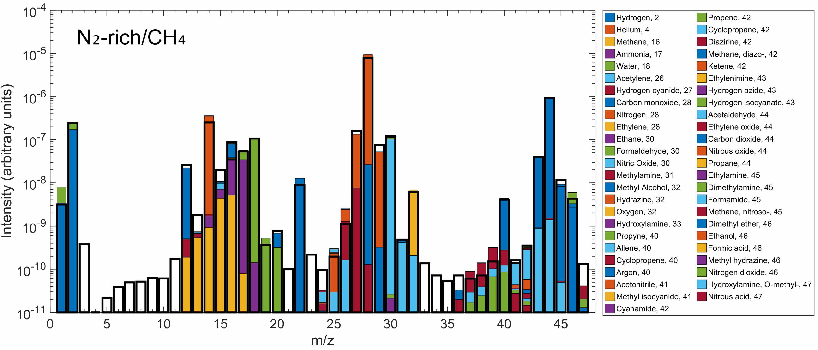
Figure 2: Gas-phase mass spectrum deconvolution for N49-rich/CH20 illustrates complexity and species-level partitioning in the plasma, distinguishing instrument background and true photoproducts.
Relative gas-phase product abundances clearly stratify experiments by carbon source and background gas oxidation state, as shown in the comparison of all six mixtures.
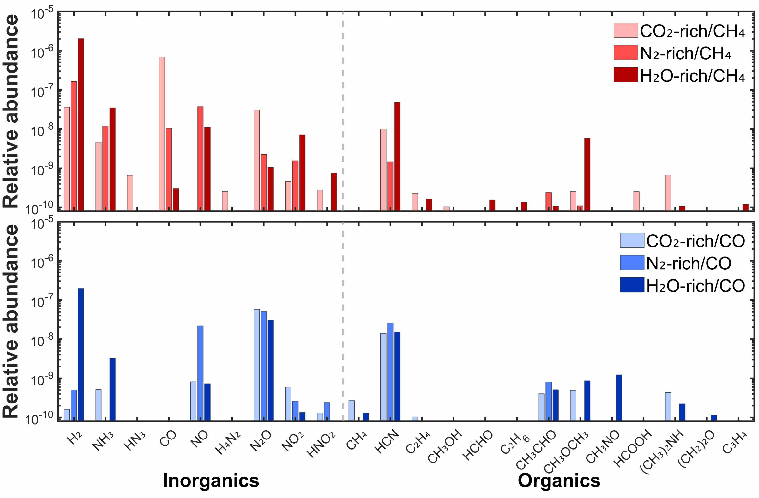
Figure 3: Gas-phase formation yields for all experimental combinations, highlighting greater molecular diversity and abundance in CH21-containing mixtures compared to CO analogs.
HCN emerges as a key intermediate, but haze production is not simply proportional to HCN abundance—pointing to a multi-precursor haze nucleation/growth mechanism.
Haze Particle Yields, Density, and Size: Strong Dependence on Redox State
Quantified haze yields display a dramatic dichotomy. The three CH22-based experiments yield orders of magnitude more mass than any of the CO-based trials. Specifically, haze production rates in N23-rich/CH24 and H25O-rich/CH26 cases exceed corresponding CO-based experiments by factors of ~80–90, and even the relatively oxidizing CO27-rich/CH28 experiment outproduces its CO analog by a factor of five.
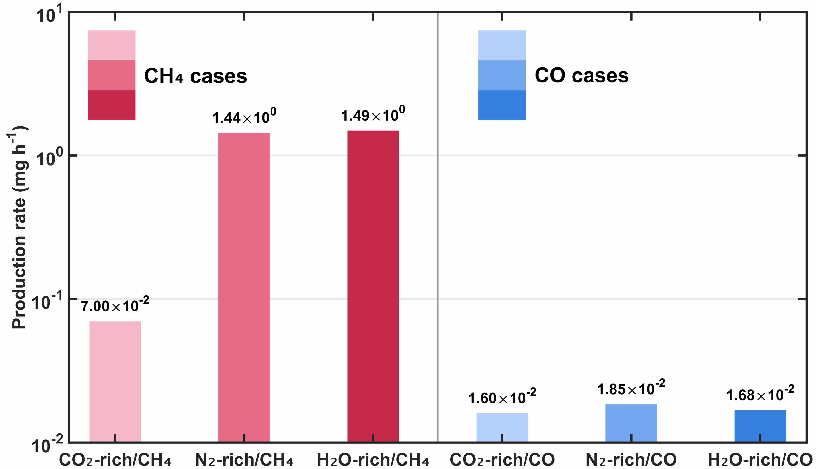
Figure 4: Haze yield as a direct function of both dominant background composition and carbon source.
Bulk analysis indicates that only the CH29 experiments produce sufficient mass for collected measurement; particle densities are in the range of 1.50–1.51 g cm20, at the upper end of previously reported values for exoplanet haze analogs, pointing to growth of larger, more polar molecules under these regimes.
The CO-based hazes, by contrast, yield substantially fewer and smaller (10–80 nm) near-spherical particles, as shown by AFM.
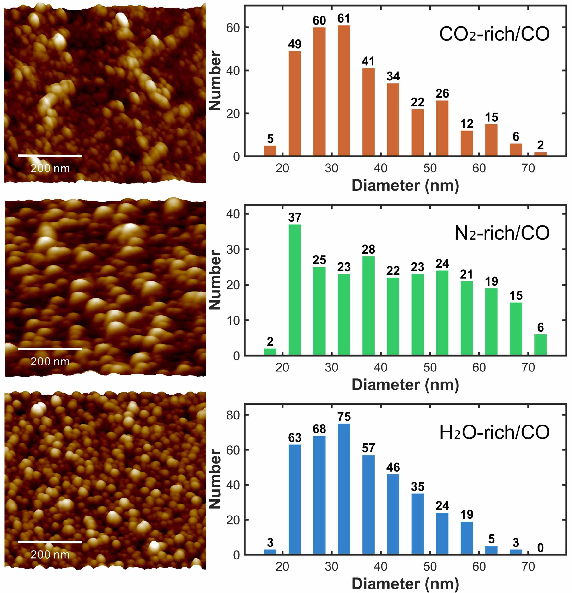
Figure 5: AFM characterization of particle size distributions for CO-based haze samples across three dominant backgrounds.
Chemical and Molecular Composition: Functional and Structural Diversity as a Function of Precursors
FTIR analysis demonstrates that CH21-driven hazes possess extensive functional group diversity, including saturated and unsaturated C–H, N–H, O–H, as well as various C=N, C=O, and other heteroatom features. Spectra of CO-based hazes are depleted in C–H and instead dominated by unsaturated, oxidized functionalities, highlighting the suppressive effect of oxidizing conditions on hydrocarbon growth.
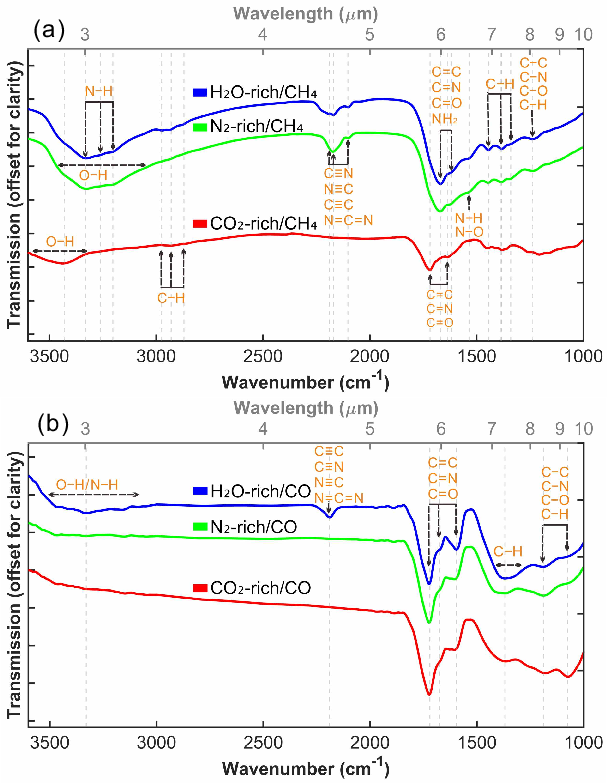
Figure 6: Comparative infrared spectra exhibit clear trends in vibrational signatures consistent with underlying redox-driven chemical differences between CH22- and CO-derived hazes.
Very high-resolution mass spectrometry mapping of haze analogs produced under N23-rich/CH24 and H25O-rich/CH26 conditions reveals thousands of unique molecular formulas, most with CHON composition, with long homologous series reflective of polymerization/oligomerization chemistry initiated by simple gas-phase species such as HCN, CH27O, and C28H29.
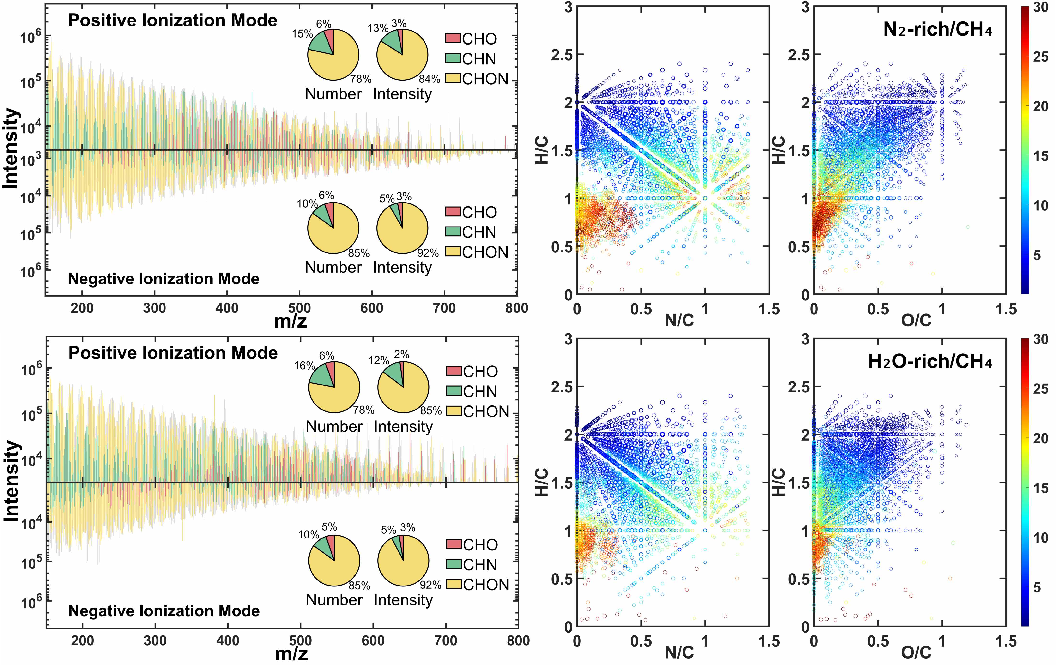
Figure 7: VHRMS results for N20-rich/CH21 and H22O-rich/CH23 hazes, with molecular assignment spectra, compositional breakdown by CHN, CHO, and CHON classes, and van Krevelen diagrams revealing unsaturation and heteroatom incorporation trends.
Implications for Exoplanetary Spectroscopy, Atmospheric Modeling, and Prebiotic Chemistry
The pronounced efficiency gap in haze yield between CH24- and CO-driven atmospheres directly underscores the role of atmospheric redox state as a master parameter controlling haze formation pathways. This finding has immediate consequences for radiative transfer models and interpretation of exoplanet transmission and emission spectra with JWST, ELTs, and future direct-imaging missions, as haze optical depth, particle microphysics, and chemical composition all modulate spectral appearance.
Compositional analyses suggest that reducing, CH25-enriched atmospheres not only supply thick, optically active haze layers, but also foster synthesis of prebiotically relevant molecules—including amino acid and nucleobase analogs—via gas-to-solid growth mechanisms, with VHRMS revealing plausible precursors for biochemistry. This supports the theoretical hypothesis that reducing environments more readily provide the chemical heterogeneity and complexity needed for origin-of-life chemistry, and that such systems are less likely to suffer the surface UV transparency penalty observed for oxidizing, haze-poor atmospheres.
Atmospheric microphysical modeling must incorporate true, experimentally constrained haze densities and particle sizes reported here to correctly simulate particle settling rates, vertical distributions, and wavelength-dependent scattering. Similarly, compositional dependence of FTIR features and functional group connectivity will be critical for interpreting observed spectral features, and for distinguishing between haze-rich CH26 exoplanets and relatively clear CO/CO27-dominated analogs.
Conclusion
This experimental study robustly demonstrates that CH28 is a vastly more effective initiator of organic haze production in terrestrial exoplanet atmospheres than CO, independent of the dominant background gas. CH29 atmospheres exhibit both higher haze yields (by factors of 5–90) and substantially greater chemical complexity. The strong compositional and physical partitioning between CO- and CH40-initiated hazes constrains forward models of atmospheric evolution, spectral characterization, and assessments of planetary habitability, highlighting the interplay between atmospheric chemistry, photochemistry, and particle microphysics. The results reinforce the paradigm that the atmospheric redox state is the first-order control on haze properties, with key implications for exoplanet observability and potential prebiotic chemical inventories (2604.03575).