- The paper introduces a novel nonparametric method to decompose spherically embedded time series into smooth trend, periodic, and residual components using optimal transport theory.
- It employs local Fréchet regression and penalized RSS minimization to estimate the trend and periodic components with proven convergence rates and robust de-seasonalization.
- Simulations and empirical case studies, including U.S. electricity and NYC CitiBike data, validate the model’s improved prediction accuracy and interpretable inference.
Spherical Time Series with Latent Trends and Periodicity: A Geometric Decomposition–Prediction Framework
Introduction
The analysis of non-Euclidean time series—particularly those naturally or equivalently mapped to spherical manifolds—has become increasingly salient due to their prevalence in engineering, econometrics, and urban analytics. The paper "Spherically Embedded Time Series with Unknown Trend and Periodic Components" (2604.03574) addresses the critical deficiency in the modeling of nonstationary spherically embedded time series driven by latent trend and periodic components. It introduces a nonparametric geometric architecture for trend-periodicity decomposition, leveraging optimal transport theory, Fréchet regression, and spherical time series modeling. Notably, the framework is agnostic to the parametric form of the deterministic structures and maintains topological faithfulness to the sphere, critical for valid inference and interpretable residual modeling.
Geometric Structure and Decomposition on the Sphere
Spherically embedded time series encompass data types such as directional, compositional, and distributional series—often encountered in time-resolved energy composition and urban mobility studies. The paper formalizes such series as trajectories {yt}t=1T on the unit Hilbert sphere S, equipped with the intrinsic geodesic metric dS. Critically, the lack of a global vector space structure precludes standard additive decompositions.
The proposed Spherical Trend-Periodicity Decomposition (STPD) model decomposes observations into three components:
- a smooth, nonparametric trend f(t/T)∈S,
- a periodic component g(t)∈S (with unknown period ϑ0),
- and a stationary stochastic residual.
Extraction of these additive-type components is operationalized via an optimal-transport-based "removal" operation, generalizing the Euclidean displacement to the spherical manifold. This map, Mb→a(c), constructs a geodesic-preserving transformation, defined using the exponential map and a skew-symmetric generator, and is designed to ensure that the subtracted result remains on S. The necessity of removal ordering is explicitly justified: trend removal must precede periodicity, due to the interaction between global and cyclic structure in non-Euclidean spaces.
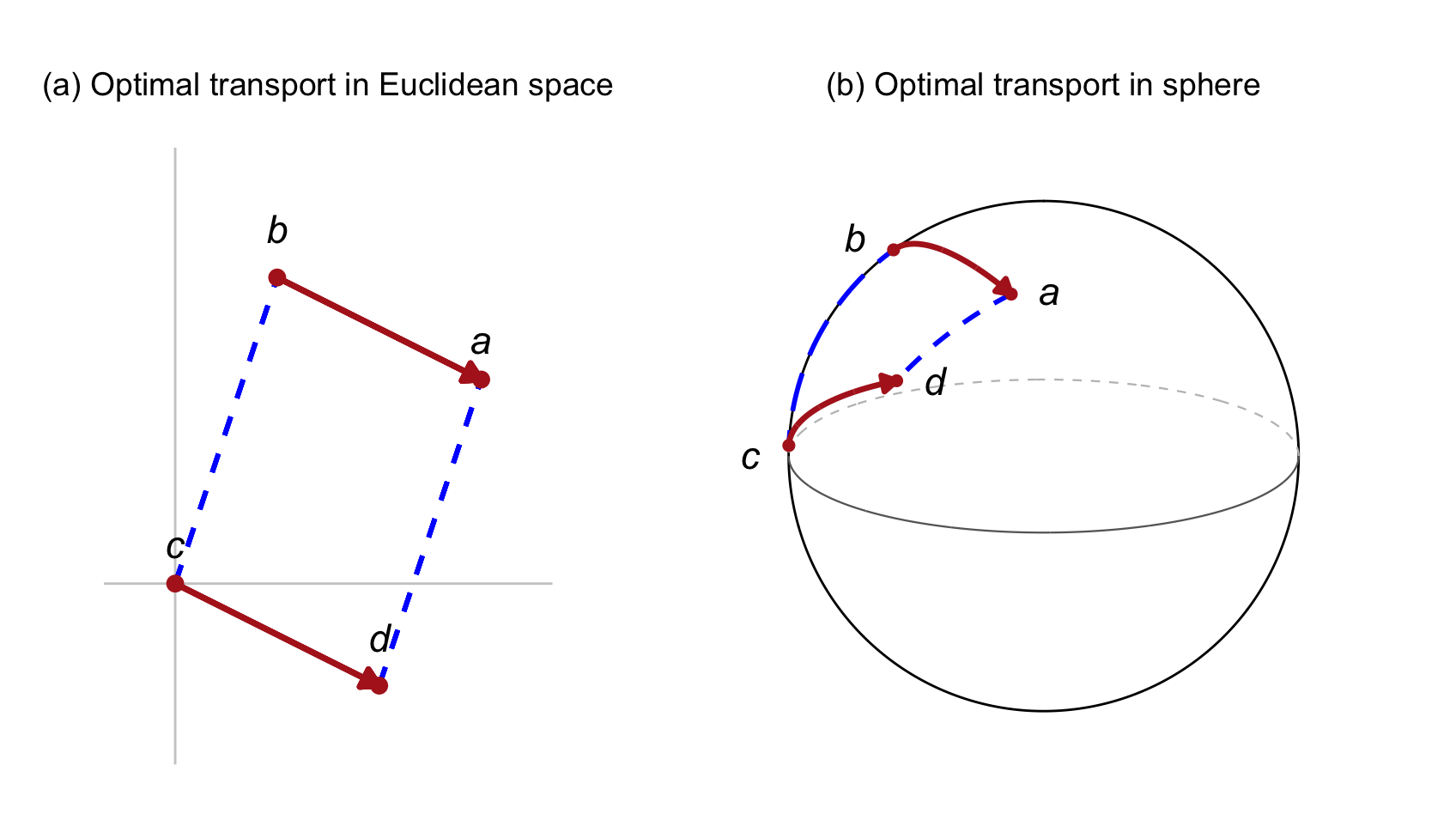
Figure 1: Schematic of the optimal transport–based trend or periodic component removal: (a) Euclidean versus (b) spherical construction. The latter preserves geodesic structure and ensures manifold coherence.
Nonparametric Component Estimation and Model Fitting
Component estimation employs local Fréchet regression for trend recovery, which adapts the classic local polynomial approach to arbitrary metric spaces and yields uniform convergence at a rate Op{(Th/log(1/h))−1/2}. Periodicity is estimated by a penalized residual sum of squares (RSS) minimization over candidate periods, employing a global Fréchet regression-based estimator, with a diverging regularization that penalizes overfitting multiples of the true period.
The final residuals—after sequential removal of the estimated trend and periodic components—serve as input for a spherical autoregressive (SAR) model. The framework formalizes this as a semiparametric Trend-Periodic Spherical AR (TPSAR) model, where stochastic dependence is modeled as a linear process in the Hilbert space of skew-symmetric operators. Consistency and convergence rates are established under α-mixing and regularity assumptions, with explicit treatment for the interaction between nonparametric estimation and subsequent SAR parameter learning.
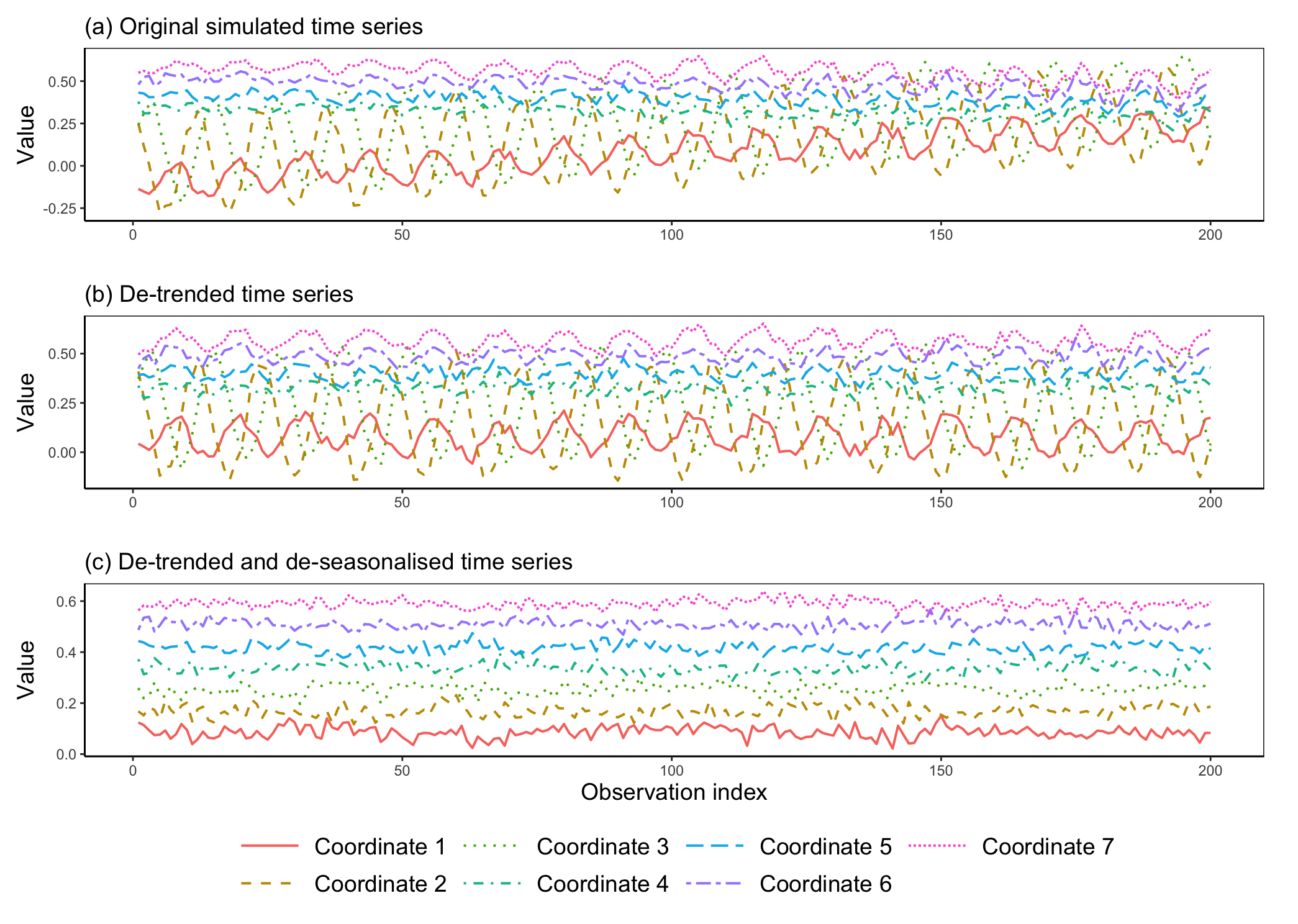
Figure 2: (a) Simulated spherically embedded time series with latent trend and periodicity; (b) after trend removal; (c) after subsequent de-seasonalization, leaving a stationary residual.
Simulation Studies
Extensive simulation studies test the finite-sample characteristics of the STPD and TPSAR estimators under varying sample sizes and AR dynamics. The experiments validate the theoretical convergence rates for the trend, periodic, and SAR component estimators. A strong claim is demonstrated regarding the reliable identification of the true period and the robust stationarity of the residuals after component removal. Roll-forward prediction studies further demonstrate that the proposed TPSAR model delivers uniformly lower multi-step geodesic prediction error than both SAR and differencing-based SAR (DSAR) baselines, especially with increasing forecast horizon.
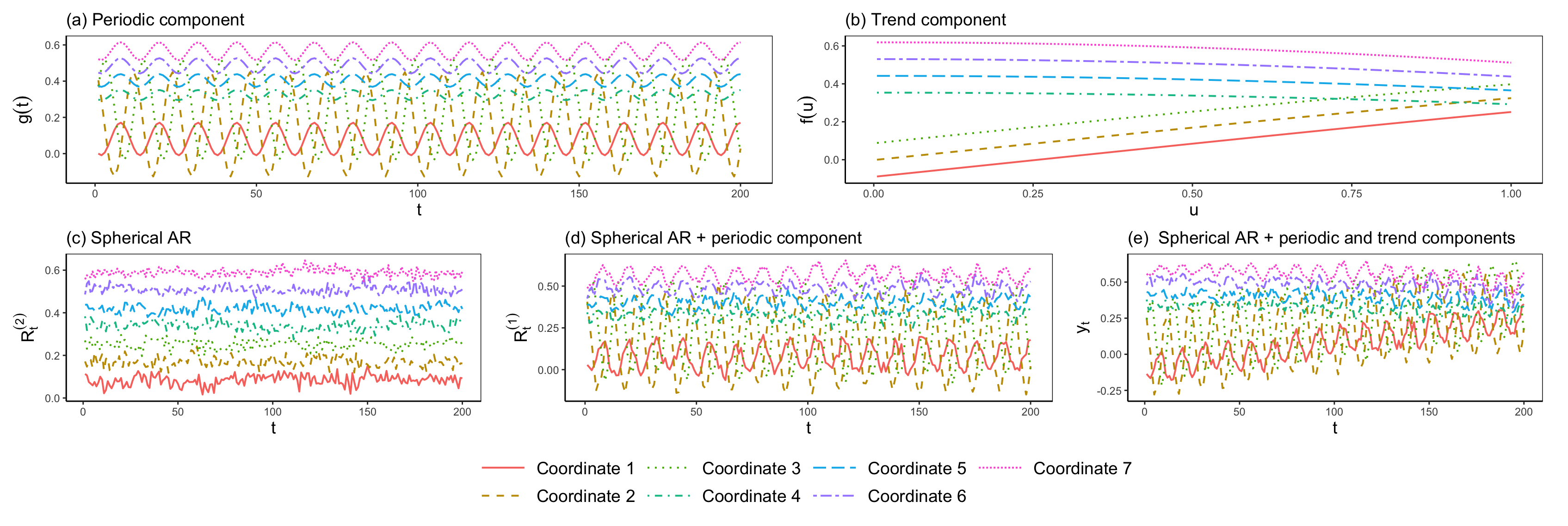
Figure 3: Generation of simulated components: periodic signal (a), trend trajectory (b), AR stationary residuals and sequentially integrated time series (c–e).
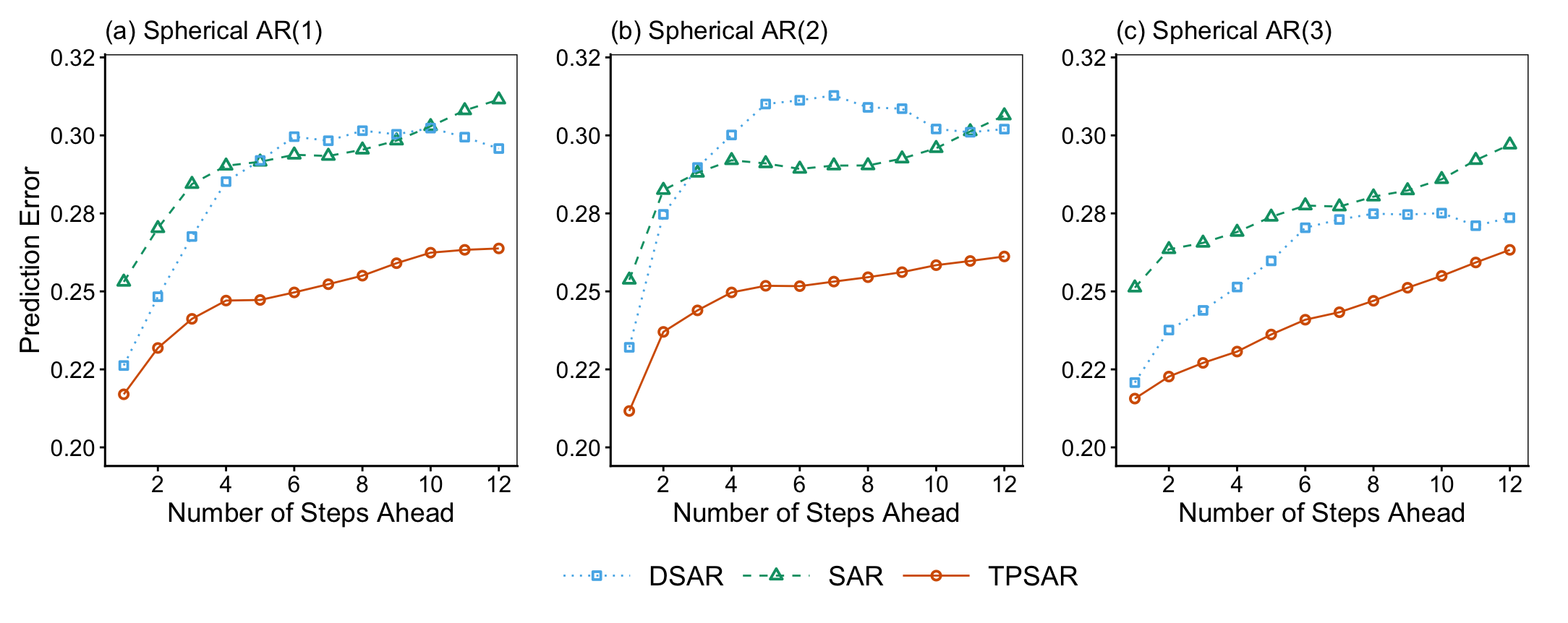
Figure 4: Multi-step-ahead average geodesic prediction errors. TPSAR exhibits uniformly superior performance relative to SAR and DSAR, with error escalation mitigated as forecast horizon increases.
Empirical Case Studies
U.S. Electricity Generation Compositions
Monthly compositional trajectories of U.S. electricity generation (coal, petroleum, gas, nuclear, hydro, renewables, solar) are mapped to a six-simplex and subsequently to the sphere for analysis. Application of STPD reveals both a persistent trend—characterized by declining coal and increasing renewables/gas—and a prominent annual cycle, successfully captured with estimated period S0.
Component removal yields a stationary residual, and the TPSAR model achieves enhanced forecasting accuracy compared to SAR and DSAR. The interpretability of extracted components facilitates domain insight, such as the identification of intra-annual fuel share variations aligned with demand/capacity constraints.
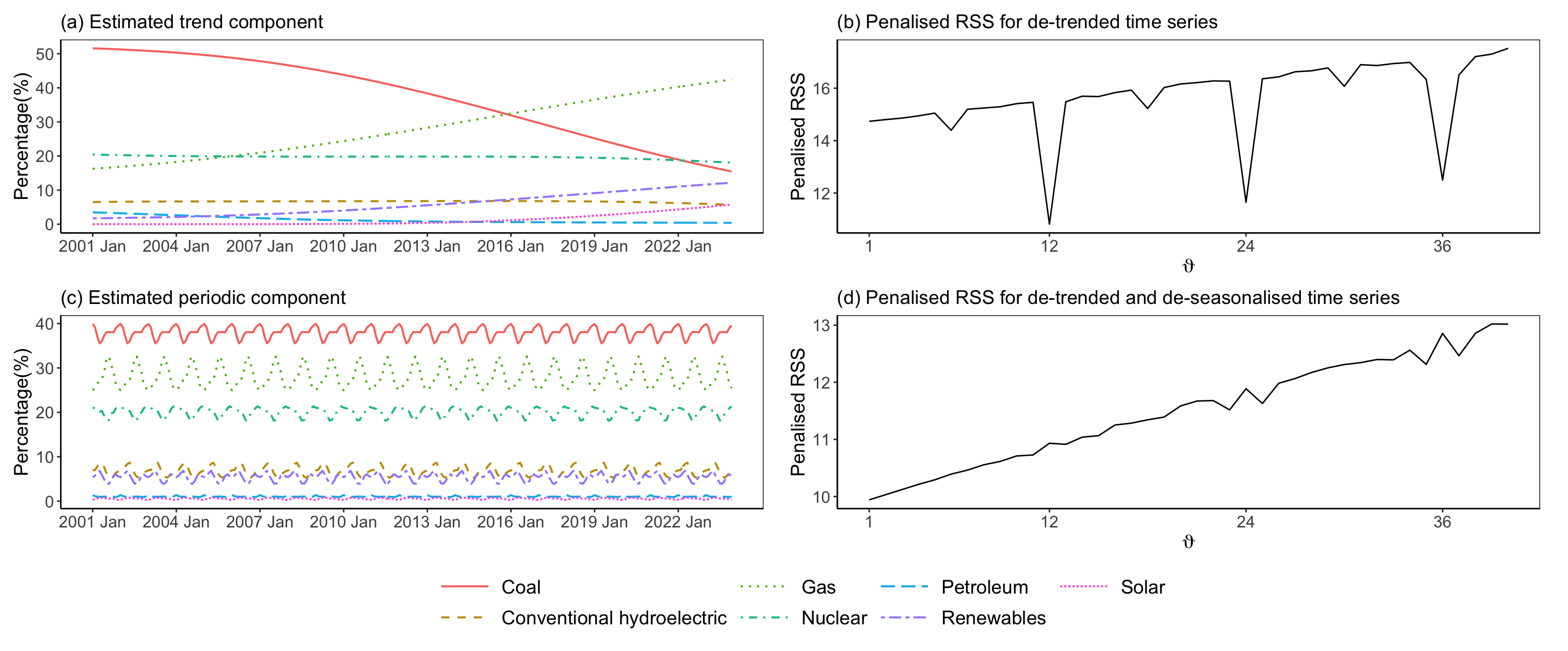
Figure 5: (a) Estimated trend in U.S. electricity generation shares; (b) penalized RSS for period selection; (c) periodic component with annual cycle; (d) confirmation of seasonality removal in final residuals.
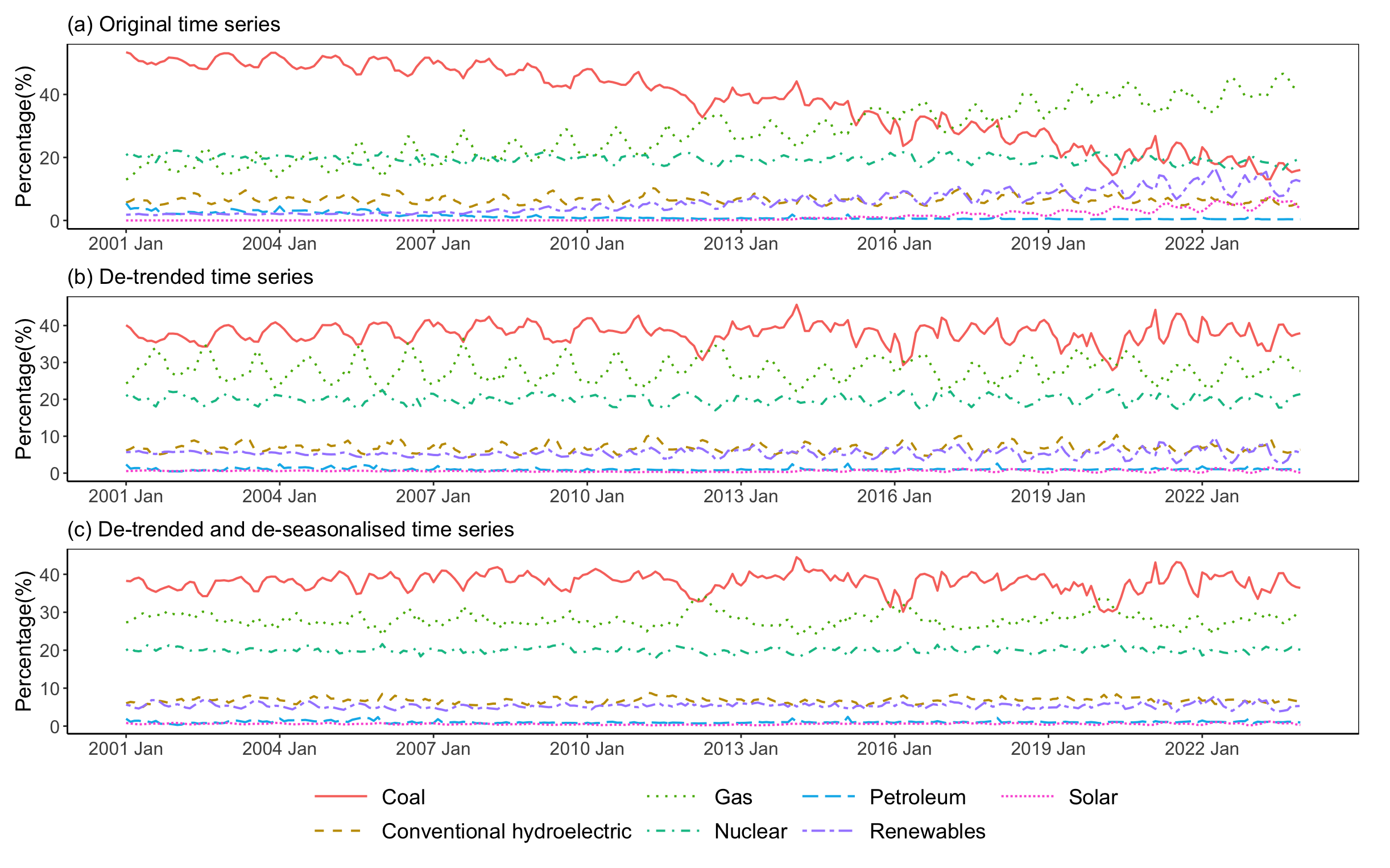
Figure 6: Timeline view of electricity generation shares: raw (a), de-trended (b), and de-trended/de-seasonalised stationary residual (c).
NYC CitiBike Trip Volume Distributions
Daily trip volume density functions are similarly mapped to the sphere. STPD identifies a pronounced 7-day periodicity (intra-week cycle) in the normalized trip profiles, robust to trend removal, with the periodicity eliminated in final residuals. The approach also resolves structural shape differences between weekday and weekend activity, supporting interpretable inference at the distributional level.
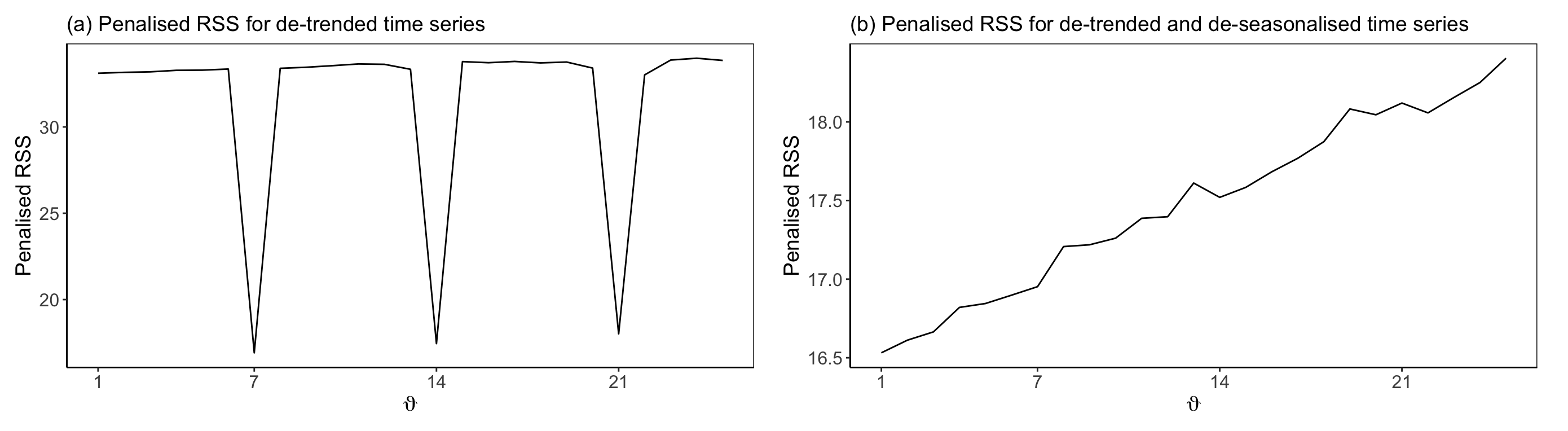
Figure 7: Penalized RSS for intra-week periodicity detection: (a) significant periodicity in de-trended distributional time series; (b) no remaining periodic signal post seasonality removal.
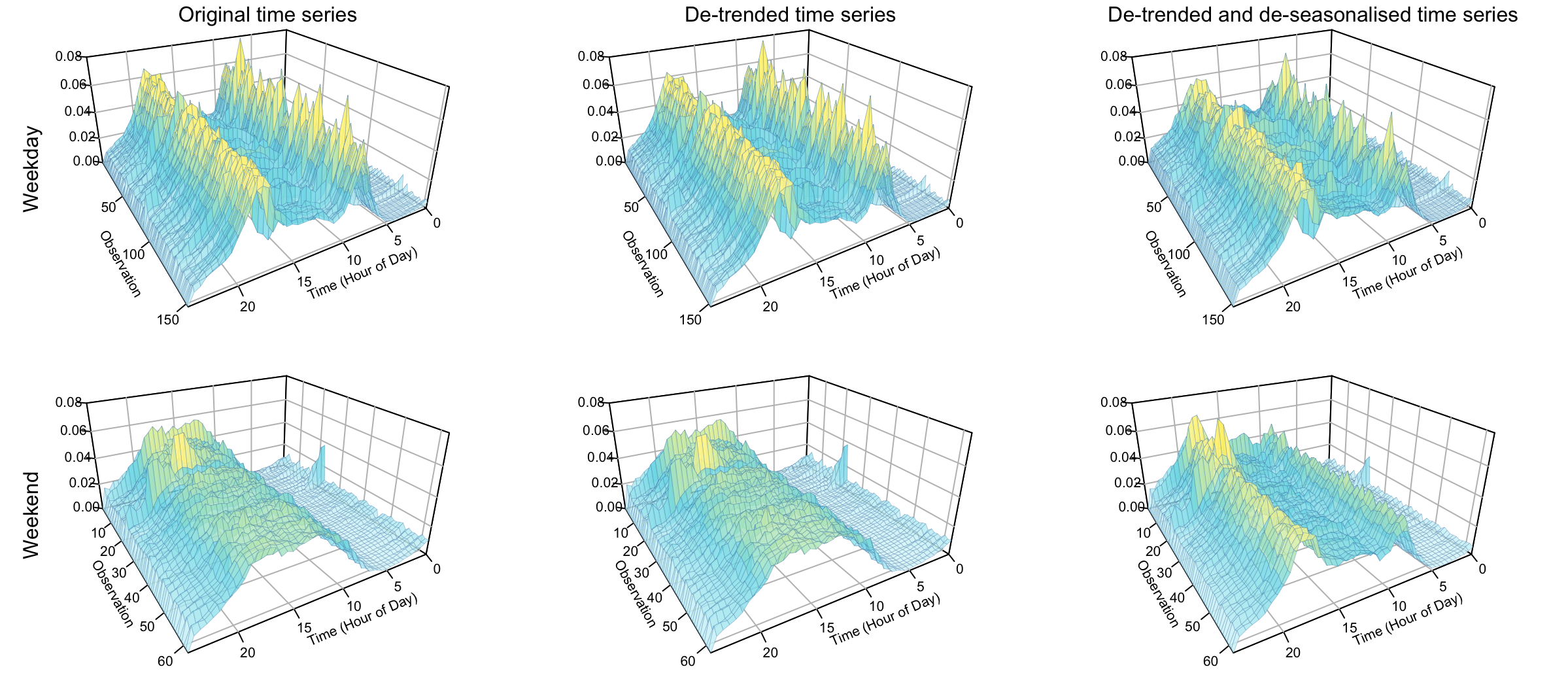
Figure 8: Trip volume density time series: original (first column), post-trend removal (second), and stationary residual (third). Rows separate weekday and weekend dynamics.
Theoretical Implications and Future Directions
Methodologically, this work establishes a coherent nonparametric paradigm for disentangling deterministic structure from stochastic dependency in object-valued (specifically spherically embedded) time series. The optimal transport–inspired removal operation may be generalized to other symmetric spaces or different manifold geometries (e.g., tree space, product manifolds). The integration with SAR modeling paves the way for more general nonstationary manifold-valued process models, and the theory extends to high-dimensional or infinite-dimensional settings.
From a practical perspective, the framework enables interpretable, topology-faithful inference for applications with functional, compositional, or shape-valued observations, e.g., climate, genomics, mobility, and socio-technological systems.
Conclusion
This work formalizes the geometric decomposition of nonstationary spherically embedded time series and establishes rigorous theory and scalable algorithms for modeling and prediction in these settings (2604.03574). The framework is validated with simulations and real-world applications, demonstrating consistent empirical gains and interpretability. Potential future work includes extensions to long-memory residuals, alternative manifold geometries, and application to broader classes of object-valued dynamical systems.

