- The paper introduces a dual-branch architecture combining global semantic anomaly detection with local patch-based forensic analysis.
- The methodology leverages heterogeneous vision foundation models and logit-space fusion to decorrelate errors and enhance detection robustness.
- Empirical evaluations demonstrate LOGER outperforms state-of-the-art approaches, maintaining high AUC even under significant image degradations.
LOGER: A Local–Global Ensemble for Robust Deepfake Detection
Introduction
The proliferation of deepfake generation techniques, especially in open domains, has exposed persistent vulnerabilities in current detection systems, primarily due to generalization difficulties under unseen manipulations and uncontrolled real-world degradations. The "LOGER: Local–Global Ensemble for Robust Deepfake Detection in the Wild" (2604.03558) introduces a local–global ensemble (LOGER) architecture, aiming to fuse global semantic anomaly detection with local patch-based forensic trace identification, thus maximizing robustness against diverse generative strategies and aggressive input degradations. LOGER combines heterogeneous vision foundation model (VFM) backbones and leverages both multi-resolution full-image inference and patch-level multiple instance learning (MIL) to decorrelate errors and enhance detection stability.
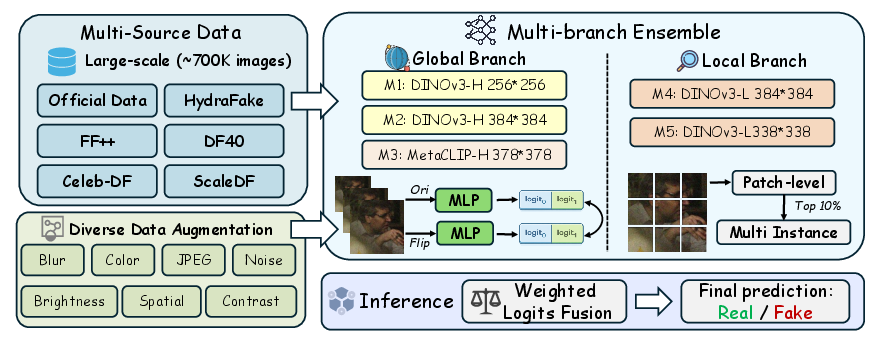
Figure 1: Overview of the LOGER framework, highlighting multi-backbone, multi-scale global and patch-level local modeling, and logit-space fusion.
Methodology
Global and Local Branch Integration
LOGER comprises two main components:
- Global Branch: Utilizes three models (M1, M2, M3) with full-image classification at multiple input resolutions. M1 and M2 adopt DINOv3-Huge with full-parameter fine-tuning; the only distinction is inference resolution (M1 at 256×256, M2 at 384×384), exploiting different spatial details. M3 employs MetaCLIP2-Huge, leveraging contrastive image–text-aligned representations. This backbone heterogeneity enables LOGER to capture both semantic and statistical anomalies while minimizing correlated errors.
- Local Branch: Integrates two DINOv3-Large models (M4, M5) for patch-level inference. Images are partitioned into non-overlapping grids, each patch scored using lightweight classifiers. MIL top-10% aggregation pools only the most suspicious locations, mitigating evidence dilution and improving sensitivity to localized artifacts frequently erased by global averaging. M4 exploits higher-resolution inference than training, while M5 is fine-tuned at a new resolution, increasing response diversity.
Training and test-time augmentations include extensive degradation perturbations (blur, JPEG compression, color shift, geometric distortions) and horizontal flip, addressing real-world conditions systematically.
Logit-Space Fusion
Ensemble predictions are aggregated in the logit space (pre-sigmoid). This design decision avoids masking inter-model disagreements—a common problem when averaging probabilities constrained between 0 and 1—and ensures that confident minority responses retain influence in the final prediction. Uniform weighting across the five constituent models enhances robustness, and flip TTA further regularizes orientation variance.
Empirical Evaluation
Cross-Benchmark Generalization
LOGER demonstrates strong out-of-distribution performance across diverse test sets, outmatching both specialized and adaptation-based baselines:
- On Effort [yan2024effort] Protocol-1, LOGER achieves average video-level AUC of 92.6%, surpassing prior best by at least +2.2%. Notably, it improves performance under severe compression and manipulation diversity (e.g., DFDC, DFDCP).
- On DF40 Protocol-2, covering multiple manipulation families, LOGER reaches average 96.4% AUC, outperforming state-of-the-art methods with clear margins.
- Under the GenD [yermakov2026deepfake] evaluation protocol, it remains competitive or superior across all benchmarks.
Robustness Analysis
LOGER maintains high AUC under severe degradations:
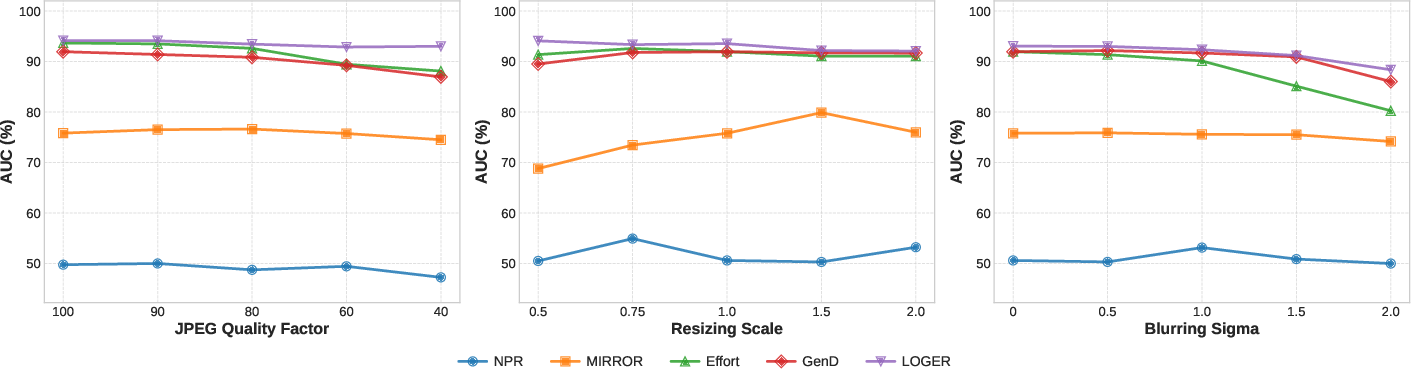
Figure 2: LOGER's AUC robustness to JPEG compression, resizing, and Gaussian blurring compared with baselines on five test sets.
- LOGER's drop under high degradation is an order of magnitude smaller than recent methods (e.g., Effort, GenD) and less than half the worst-case decline in Effort under blurring or compression.
- Even under JPEG QF=40 or blur σ=2.0, LOGER's AUC typically remains above 88–92%, illustrating its resilience across practical media transmission and adversarial attack scenarios.
Ablation and Failure Modes
Discussion and Implications
Complementary Error Decorrelation
Decorrelation between branch-specific errors, due to architectural and granularity heterogeneity, forms the theoretical basis for LOGER's ensemble stability. By fusing local and global signals implemented via different VFM architectures and resolution strategies, LOGER overcomes shortcomings of approaches fixated on a single feature level or backbone.
Data Diversity and Augmentation
Scaling law analyses indicate that data diversity, rather than raw quantity, is critical for generalization [wang2025scaling]. LOGER’s multi-source candidate pool, coupled with aggressive degradation augmentation, substantially improves transferability across content, generator, and manipulation axes, addressing a core bottleneck in previous deepfake detectors.
Implications for Detection in the Wild
Practical deployment in uncontrolled environments—the primary scenario for abuse and legal concern—necessitates resilience to uncontrolled image/video quality. LOGER provides the first validated architecture to approach this goal by design rather than by ad hoc evaluation, achieving validation AUC improvements of +17 points over best released baselines and only modest, interpretable generalization drops on private unseen splits.
Future Directions
The bottleneck analysis suggests that any future improvement should explicitly incorporate degradation-adaptive inference or meta-recognition mechanisms, potentially by conditioning detectors on input quality or integrating restoration modules. The trend towards even larger, richer VFMs and more sophisticated data augmentation pipelines is likely to continue; however, the diminishing marginal return on mere data scaling implies architectural advances like LOGER's decorrelated fusion will grow in relative importance.
Conclusion
LOGER represents a rigorously validated paradigm for robust deepfake detection, integrating multi-backbone, multi-resolution global classification with patch-level, MIL-aggregated local modeling. Its logit-space fusion of decorrelated error sources achieves strong cross-manipulation, cross-domain, and cross-degradation performance, as evidenced by consistent SOTA results across independent public benchmarks. Persistent challenges under extreme degradation remain, signposting explicit degradation adaptation as an unsolved, high-priority research direction.
Reference: "LOGER: Local–Global Ensemble for Robust Deepfake Detection in the Wild" (2604.03558)