- The paper demonstrates that coefficient reduction can improve sample retrieval by effectively mitigating hardware precision errors in quantum annealing.
- It employs three methods—IEM, BCE, and ALM—to distribute or encode high coefficients while preserving the logical ground state post minor-embedding.
- Empirical results across QUBO, MKP, and QAP instances indicate that method choice and auxiliary variable overhead critically impact performance.
Mitigating Precision Errors in Quantum Annealing via Coefficient Reduction of Embedded Hamiltonians
Overview and Motivation
Current quantum annealers, such as those based on the D-Wave platform, have achieved practical scale and accessibility, yet hardware-imposed limits on coefficient precision severely restrict their effectiveness on combinatorial optimization problems with complex interaction structures. This work provides a comprehensive, hardware-backed assessment of coefficient-reduction schemes under realistic hardware usage scenarios by accounting for the impact of minor-embedding. The analysis encompasses three principal approaches: interaction-extension, bounded-coefficient integer encoding, and the augmented Lagrangian method. The study elucidates their effects on both the scaling factors and the ultimate sample quality following minor-embedding, delivering actionable guidance for quantum annealer pre-processing.
Quantum Annealing: Precision Constraints and Minor-Embedding
Quantum annealers implement cost functions as Ising Hamiltonians of the form
H=i,j∑Jijσiσj+i∑hiσi,
where the effective use of quantum hardware is fundamentally limited by the dynamic range of input coefficients. Quantum hardware accepts only a finite range for hi and Jij; coefficients outside this range are rescaled, reducing effective precision and exacerbating control errors and analog noise. Crucially, the process of minor-embedding—mapping the problem graph onto the restricted hardware topology—introduces additional auxiliary spins and strong intra-chain couplings (chain strengths), which often dominate the physical dynamic range post-embedding.
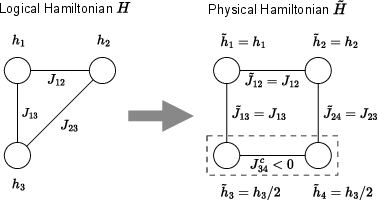
Figure 1: Example of minor-embedding of a triangle graph onto a square lattice, demonstrating chain formation and connectivity.
The chain strength must be carefully selected: too low and logical variable integrity is lost; too high and the hardware precision allocated to the problem Hamiltonian is diminished, increasing susceptibility to hardware errors.
Coefficient-Reduction Methods: IEM, BCE, ALM
Interaction-Extension Method (IEM)
The IEM [oku2020reduce] replaces large couplings with a network of weaker, auxiliary-variable-mediated interactions. For each logical coupling Jij exceeding a threshold M, it generates a set of auxiliary spins, distributing Jij over multiple interactions each of amplitude ≤M, thereby reducing the logical coupling range while maintaining the original ground state structure.
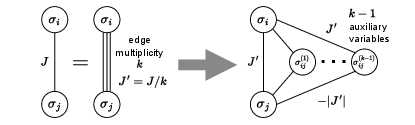
Figure 2: Schematic of the interaction-extension method, where a strong interaction is decomposed via auxiliary spins into a set of weaker, hardware-friendly connections.
Bounded-Coefficient Integer Encoding (BCE)
BCE [karimi2019practical] strategically encodes integer variables into binary variables such that each binary variable’s coefficient does not exceed a predefined threshold μ. This contrasts with standard binary encoding, where the largest variable may be assigned exponentially large coefficients (e.g., 2k). The trade-off is an increased number of auxiliary variables for lower μ, which can affect embeddability and chain length.
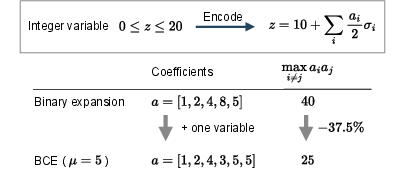
Figure 3: Example of bounded-coefficient encoding, suppressing coefficient magnitude at the cost of increased variable usage.
Augmented Lagrangian Method (ALM)
ALM [tanahashi2021augmented] mitigates large penalty coefficients in equality/inequality constraint encodings by introducing a linear penalty term with variable multipliers. The aim is to relax constraint enforcement while retaining solution feasibility, thus reducing extreme coefficients in the embedded cost function.
Experimental Protocol: Hardware-Backed Evaluation
Experiments are conducted across 130+ problem instances (QUBO, MKP, QAP) using D-Wave Advantage hardware. Logical models are first embedded via heuristic algorithms onto Pegasus topologies. For each instance, the evolution of external and coupling scaling factors is tracked, and comprehensive grid searches over chain strength are performed, with sample quality metrics (e.g., optimality probability, mean energy) evaluated at the empirical optimum. The design allows quantitative analysis of whether logical coefficient reduction translates into actual improvements under realistic hardware constraints and embedding overhead.
Empirical Results
Reduction of Logical External Fields: Necessity Analysis
On benchmark QUBO instances, minor-embedding is shown to automatically reduce physical external field magnitudes in almost all cases. The scaling factor of the physical external field hi0 is consistently below or comparable to that of the coupling hi1, except for specifically constructed pathological instances.
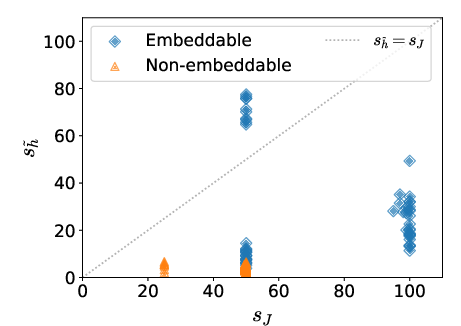
Figure 4: Distribution of scaling factors on QUBO instances from MQLIB post-embedding.
Thus, logical external field reduction is, in practice, redundant; the limiting factor is the coupling strength (both inter-chain and chain strength).
IEM Under Minor-Embedding
On both synthetic and real-world QUBO problems, IEM yields a significant reduction in the required chain strength. This reduction translates directly into a greater hardware-allocated dynamic range for the problem Hamiltonian and notably increased probability of ground state retrieval, except when the auxiliary variable overhead becomes excessive (which can negatively affect embedding quality and chain lengths).
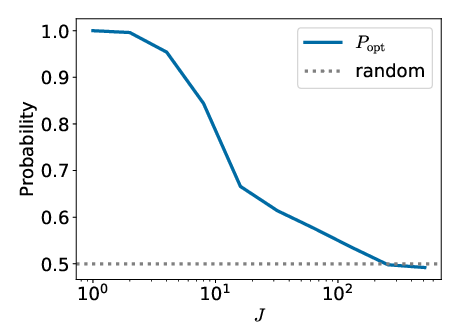
Figure 5: Probability of optimal solution retrieval as a function of logical coupling and chain strength after IEM application.
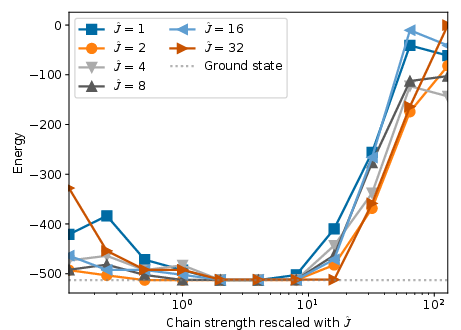
Figure 6: Average energy of samples for varying coupling thresholds applied in the interaction-extension method.
BCE Effectiveness: Integer-Constrained Problems
On toy MKP instances, the BCE method achieves ideal linear reduction in chain strength parallel to the reduction in logical coefficient magnitude, sharply increasing ground state retrieval for moderate values of hi2. However, on larger and structurally denser MKPs, the practical effect is blunted. The large number of auxiliary variables and dense connectivity compromise the ultimate reduction in physical coupling magnitude post-embedding and may degrade embedding quality and Hamiltonian representation.
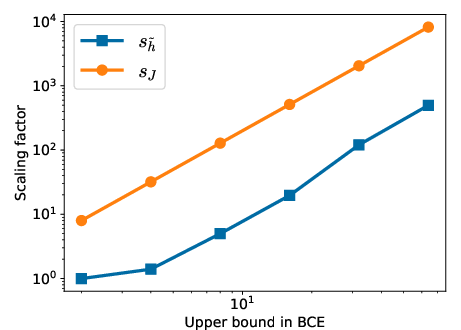
Figure 7: Scaling factors for physical external field and logical coupling strengths under BCE for varying coefficient bounds.
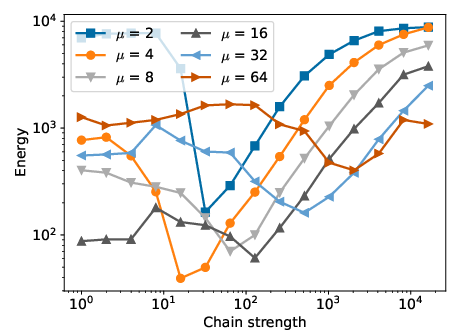
Figure 8: Corresponding energies as a function of chain strength for different coefficient bounds in BCE.
On QAPs, application of ALM perturbation delivers the theoretically anticipated reduction in necessary penalty coefficients in a simulated annealing setting without embedding. However, after minor-embedding and hardware sampling, the empirical benefit vanishes: feasibility rates and objective values are not improved, and can even worsen, due to the adverse interaction between the altered chain structure and the perturbed penalty landscape.
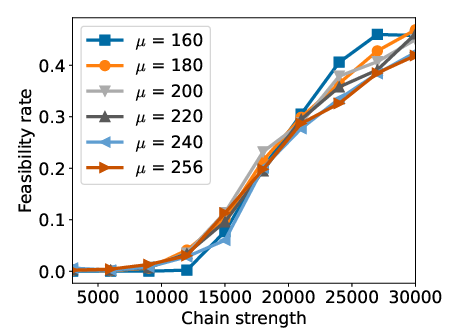
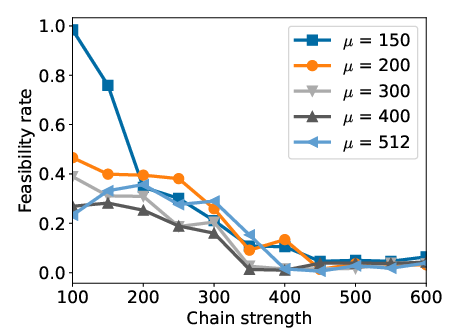
Figure 9: Feasibility rate as a function of penalty coefficient and ALM perturbation, distinguishing hardware and non-embedded cases.
Implications and Outlook
The work establishes that coefficient-reduction approaches must be evaluated in the context of minor-embedding and chain strength selection, not merely at the logical model level. Key implications include:
- Logical external field reduction can generally be omitted, as embedding inherently reduces their physical significance.
- IEM is highly effective for QUBO-like instances, allowing aggressive reduction in dynamic range and significant sample quality improvement, provided auxiliary variable proliferation is controlled.
- BCE efficacy is highly instance-dependent; while it works as designed for isolated or sparse integer constraints, it offers limited utility—and potential degradation—in dense, penalty-laden formulations.
- ALM/penalty perturbation interacts nontrivially with embedding; minor-embedding can entirely nullify the expected benefits due to the topology-induced restructuring of Hamiltonian coefficients.
Conclusion
Coefficient-reduction strategies offer real but nuanced means of mitigating analog errors in quantum annealing hardware. Their effectiveness requires hardware-conscious deployment, tailored to embedding-aware scaling dynamics. Future research should address embedding-aware reduction strategies, possibly including ground state–nonpreserving heuristics, and explore integration with error-correcting encodings and embedding algorithms optimizing for coefficient dynamic range. The framework herein establishes a rigorous experimental paradigm for such investigations.
Reference:
"Mitigating Precision Errors in Quantum Annealing via Coefficient Reduction of Embedded Hamiltonians" (2604.03546)