- The paper introduces improved numerical methods that mitigate ISM and dark matter sampling biases to quantify z=0 galaxy morphologies.
- It employs robust kinematic and spatial metrics, including rotation support and axis ratios, to classify and analyze galaxy structures.
- Findings reveal a non-monotonic morphology–stellar mass relation, emphasizing the dominance of internal baryonic processes over dark halo properties.
Morphological Analysis of Present-Day Galaxies in the COLIBRE Simulations
Overview and Motivation
This paper presents a comprehensive theory-space analysis of the morphologies of galaxies at z=0 in the COLIBRE suite of cosmological hydrodynamical simulations (2604.03503). The study responds to two persistent limitations in previous large-volume simulations: an imposed artificial pressure floor in the ISM and numerical heating of stellar discs due to massive dark matter (DM) particles. These numerical artifacts can bias galaxy thickness, rotational support, and the survivability of thin discs. By super-sampling DM particles and allowing the ISM to cool to much lower temperatures than is typical, COLIBRE enables improved exploration of the connections between morphology, internal galaxy physics, and dark halo properties, while retaining self-consistent scaling relations not calibrated on morphology.
Numerical Strategy and Metrics for Morphology
Morphology is quantified by four principal metrics: three are kinematic (kinematic spheroid-to-total mass ratio, ordered co-rotation kinetic energy fraction κcorot, and the azimuthal-to-dispersion velocity ratio Vϕ/σ1D), and one is spatial (minor-to-major axis ratio c/a from iterative inertia tensors). The fiducial aperture is 3R1/2 (three times the half-stellar-mass radius), which balances disc inclusion against contamination from extended stellar haloes.
For robustness, the authors rigorously assess:
- Sensitivity to aperture size and particle weighting,
- Effects of mass vs. luminosity weighting on morphology estimates,
- Particle number requirements for shot noise resilience,
- Resolution and feedback model dependence.
This systematic approach is essential for unbiased statistical inferences from the high-volume, multi-resolution COLIBRE dataset.
Morphological Classification and Operational Choices
The impact of operational choices is first demonstrated in the distribution of axis ratios.
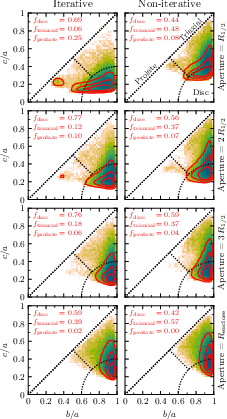
Figure 1: The distribution of axis ratios for {\tt L200m6} central galaxies, contrasting iterative and non-iterative calculations, and highlighting the importance of using appropriately sized, non-spherical apertures for shape inference.
Using iterative inertia tensor methods, combined with a 3R1/2 aperture, yields a higher fraction and clearer identification of flattened disc galaxies compared to non-iterative or inadequately sized apertures, which induce spheroidal biases. Further, the methodology demonstrates that too large an aperture allows contamination from kinematically hot outer components.
The impact of aperture size on kinematic metrics is also quantified.
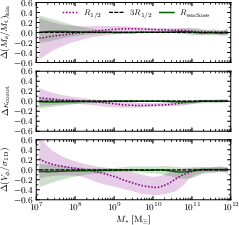
Figure 2: The median shift in kinematic morphology metrics as aperture size varies, underlining that small apertures systematically underestimate the rotational support.
The analysis reveals that, while luminosity-weighted metrics align well in angular momentum orientation, blue-band luminosity weights tend to bias morphology diagnostics toward thinner, more rotation-dominated values than mass-weighted metrics.
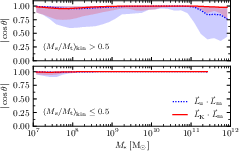
Figure 3: Misalignment angles between mass- and luminosity-weighted angular momentum; alignment remains high, supporting the mass-weighted reference frame choice for the fiducial analysis.
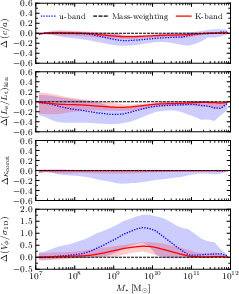
Figure 4: Mass- and luminosity-weighted morphology metric comparison, showing blue-band weighting artificially enhances estimated disc dominance.
Numerical Convergence and Resolution Tests
The robustness of morphological trends is established via convergence testing across resolutions and particle sampling strategies.
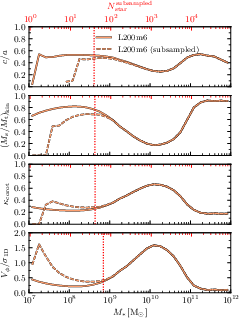
Figure 5: Median morphology parameters as a function of stellar particle number, indicating the threshold for reliable measurement (Nstar≈50) beyond which morphological bias from shot noise becomes significant.
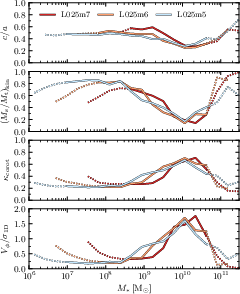
Figure 6: Convergence of morphology-mass relations for all four indicators across three main resolution levels in COLIBRE, demonstrating well-matched trends except in the poorly resolved regime.
The analysis finds all four main metrics are well-converged above the minimum particle limits, with morphological medians stable across >2 orders of magnitude in mass resolution.
Morphological Trends with Stellar Mass, Colour, and Environment
Morphological properties exhibit a characteristic dependence on stellar mass, peaking in disc-dominance around M⋆≈(1−2)×1010 M⊙, with dispersion-dominated spheroidal systems prevalent at both lower and higher stellar masses.
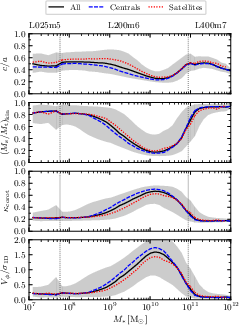
Figure 7: The median and 16th−84th percentile spread for all four morphology metrics as functions of stellar mass, for centrals and satellites. Satellite galaxies are systematically thicker and more spheroidal at fixed stellar mass.
Galaxies in the disc-dominated regime (M⋆∈[2×109,7×1010] M⊙) are thinnest and have the highest rotational support. Spheroid-dominated systems dominate at κcorot0 and κcorot1. This non-monotonic mass dependence is consistent with expectations from star formation efficiency, merger rates, and quenching frameworks.
Environmental effects are evident, with satellite galaxies at fixed mass exhibiting enhanced dispersion support and thicker morphologies, attributed to environmental quenching, tidal heating, and stripping.
The relation of morphology to intrinsic colour reflects familiar trends, with disc-dominated galaxies being bluer at fixed mass, but a nontrivial population of red discs exists, consistent with delayed morphological transformation relative to quenching.
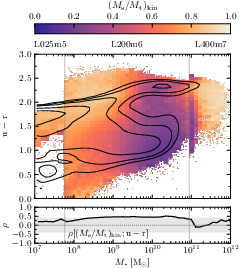
Figure 8: Distribution of galaxies in (u–r) colour vs. stellar mass, with bin-averaged spheroid-to-total ratio, illustrating the joint colour-mass-morphology distribution. Correlation coefficients by mass bin reveal strong but non-unity coupling.
Correlations Between Morphology and Internal/Halo Properties
The cross-correlation structure between different morphological metrics is explored quantitatively:
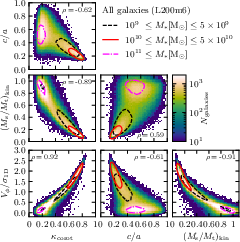
Figure 9: Pairwise joint distributions of four principal morphology metrics, overlaid with contours for three mass bins; kinematic metrics are highly correlated, with weaker (but significant) correlation to spatial flattening.
Morphology exhibits a stronger dependence on internal galaxy properties (SFR, gas content, stellar age) than on host halo properties at fixed stellar mass.
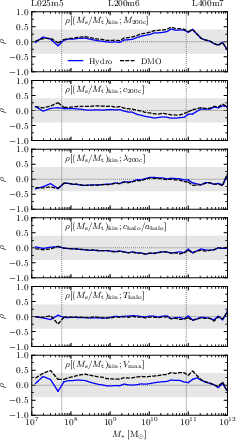
Figure 10: Spearman rank correlation coefficients of morphology (spheroid-to-total ratio) with six halo-scale properties as functions of stellar mass, for hydrodynamic and DMO simulations; general finding is modest, mass-dependent correlations, especially for halo mass, concentration, spin, and sphericity.
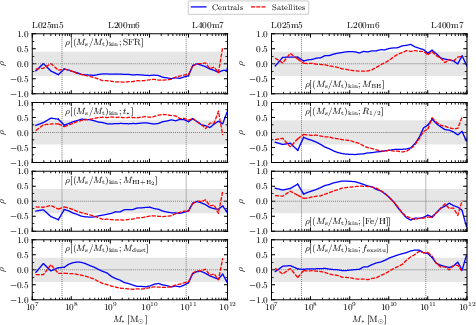
Figure 11: Correlation strengths between galaxy morphology and a series of internal baryonic properties, separated for centrals and satellites. Internal properties, especially SFR and gas content, show strong, mass-dependent correlations, with satellite trends often steeper due to environmental effects.
The authors demonstrate that at fixed stellar mass, morphology correlates only weakly with total halo mass, concentration, spin, and shape (κcorot2), and more strongly with quantities tied to gas fraction, SFR, age, and size. For high-mass galaxies (κcorot3), all morphology correlations weaken as most systems become uniformly spheroidal.
Implications and Theoretical Context
The ability of COLIBRE to predict a non-monotonic morphology-stellar mass relation, and the affirmation that morphology at fixed stellar mass is more tightly regulated by internal baryonic processes than by external DM halo structure, has significant implications. It supports a paradigm in which gas physics, star formation, and feedback processes dominate the phase-space structure of the stellar component, with the halo mainly furnishing the boundary conditions and merger history.
The findings also interact with recent constraints from IllustrisTNG, FIRE, and Romulus (e.g. [Tacchella et al. 2019], [Zeng et al. 2024], [Klein et al. 2025], [Tremmel et al. 2017]). While all modern models qualitatively reproduce the mass-morphology relation, discrepancies exist in the abundance and thickness of thin, low-mass disks, possibly due to variations in numerical implementation, feedback models, and the degree of DM particle super-sampling.
By explicitly demonstrating the impact of DM-to-baryon mass ratio and providing particle-number thresholds for morphological fidelity, this work informs numerical best practices and sets standards for theoretical–observational comparisons.
The presence of red discs in COLIBRE, and the strong dependence of morphology correlations on satellite vs. central status, further substantiate emerging scenarios of delayed morphological transformation and environmentally-driven quenching/morphological evolution ([Oxland et al. 2024], [Gentile et al. 2025]).
Conclusion
This paper establishes COLIBRE as a benchmark suite for morphology–property studies, rigorously quantifying the impact of numerical and methodological choices on morphology classification. It demonstrates that present-day galaxy morphology is dictated largely by internal baryonic processes, with only secondary modulation by DM halo properties at fixed mass. The results support a scenario of maximal disk domination near the stellar mass scale of peak star formation efficiency, flanked at both mass extremes by spheroidal, dispersion-supported systems.
By clarifying numerical constraints, aperture and weighting effects, and cross-metric correlations, this analysis provides a robust foundation for future forward-modelled, observation-matched predictions and for interpreting morphological evolution in the context of baryonic and cosmological structure formation physics. The outcomes directly inform best practices for theoretical and, prospectively, observation-driven studies of galaxy morphology in large-scale cosmological simulations.