- The paper demonstrates that two-frequency driving can override disorder-induced heating suppression through resonance-activated, multi-spin flip processes.
- Using a combination of experimental nuclear spin networks and numerical simulations, the study highlights the role of stochastic electron spin switching in enhancing heating rates.
- The findings offer design insights for optimizing robust quantum phases and developing high-gain quantum sensing protocols via controlled Floquet dynamics.
Breakdown of Disorder-Suppressed Floquet Heating under Two-Frequency Driving
Introduction and Theoretical Framework
Floquet engineering utilizes time-periodic modulation to realize nonequilibrium phases, effective Hamiltonians, and targeted quantum dynamics. In interacting quantum systems, however, Floquet driving generically entails system heating, eventually driving the density matrix toward featureless infinite-temperature states. Two well-studied mechanisms can suppress this heating: high-frequency drives, which exponentially slow energy absorption, and disorder, which inhibits resonant transitions and transport by localizing excitations and generating non-ergodic regimes [abaninExponentiallySlowHeating2015; abaninRigorousTheoryManyBody2017]. Prethermal plateaus—long-lived, metastable states described by truncated Floquet-Magnus expansions—are routinely observed in these regimes.
Conventional theories typically make two core assumptions: (i) the driving is essentially single-frequency (i.e., monochromatic), and (ii) the disorder is static. Both are often violated in realistic solid-state experiments. Common control protocols such as pulse-trains or stroboscopic digital drives introduce an additional frequency scale (the effective per-period spin rotation), leading to a bimodal Floquet structure. Furthermore, the disorder environment (e.g., nuclear Overhauser or electronic hyperfine fields) often fluctuates stochastically on timescales comparable to the system dynamics. This work explores the interplay of two-frequency Floquet drives and dynamical disorder, focusing on their impact on heating suppression.
Experiments were performed on a natural-abundance 13C nuclear-spin network in diamond, immersed in a dense environment of NV and P1 centers. The nuclear spins interact via dipolar couplings, and experience on-site disorder from hyperfine fields generated by the electron spins. Initialization is achieved by optically triggered hyperpolarization at low field, followed by mechanical shuttling into a 7.3 T detection field. Off-resonant trains of x-axis pulses induce detuned, periodic driving, thereby creating both a Floquet driving frequency ωd and an effective rotation frequency per period ωeff, determined by (ω1,τp,δω).
Prethermalization occurs after a transient (∼ms), yielding a state well-described by a generalized Gibbs ensemble with respect to the effective Floquet Hamiltonian HF. Transverse magnetization is monitored quasi-continuously via inductive detection, revealing the subsequent heating dynamics and timescale for thermalization to infinite temperature.
Breakdown of Disorder Protection: Double and Triple Spin-Flip Resonances
In this bimodal Floquet setting, multi-photon resonant conditions emerge when n0ωd+k0ωeff≃0. Physically, such resonances correspond to quantum paths in which k0 spins flip collectively by absorbing ∣n0∣ quanta from the drive. These higher-order processes are suppressed by both disorder (which introduces large inhomogeneous spread in transition energies) and dipolar dilution, rendering them nearly invisible in conventional single-frequency and static-disorder analyses.
Numerical simulations of random 10-spin clusters explicitly reproduce the emergence of these resonances, with pronounced operator growth (Pauli weight) at the predicted detuning conditions (e.g., double and triple-spin-flip points). In the disordered, dilute limit, such operator growth is sharply peaked, showing dramatic sensitivity to both drive frequency and disorder realization.
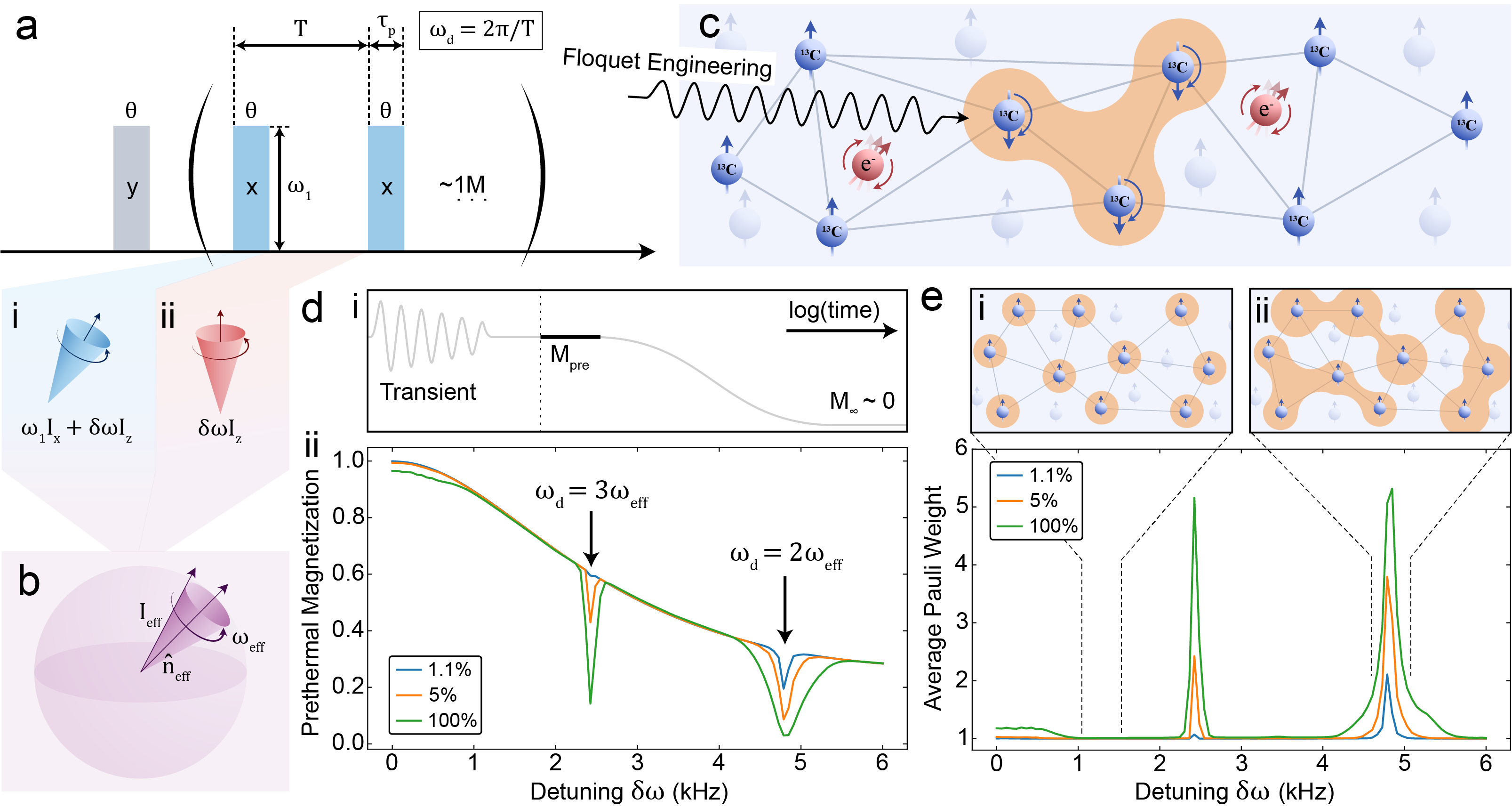
Figure 2: Sharp resonance peaks at specific detunings in experimentally measured heating rates, corresponding to double- and triple-spin-flip absorption conditions; numerical resonance locations and Lorentzian fits are in strong agreement with theory.
Experimentally, prethermal magnetization displays only a weak suppression at double- or triple-spin-flip resonance on the transient timescale, reflecting the robustness of disorder-induced protection during initial prethermalization. However, monitoring the long-time decay rate of Mpre reveals sharply peaked enhancements in heating at these predicted resonance detunings—an unequivocal breakdown of disorder-based suppression at late times. Detuning sweeps at various ωd0 confirm the scaling and location of these features, matching the bimodal resonance theory.
Electron-Driven Resonance Activation and Stochastic Mechanism
Surprisingly, these sharply enhanced heating rates persist despite strong positional disorder. The authors ascribe this to stochastic switching of electron spin states—an additional, fluctuating disorder source. In the absence of electron relaxation, each hyperfine configuration defines an independent disorder realization, and overlap between multi-spin flip transition energies and the drive-induced Floquet zone remains rare. However, stochastic switching of the electron environment dynamically modulates the local nuclear fields, causing rare nuclear clusters to cross the multi-photon resonance manifold intermittently in time.
This mechanism, mapped onto a stochastic Liouville framework, introduces noise-assisted transitions which activate absorption channels that would otherwise remain disorder-prohibited. Theoretical models combining disorder, bimodal Floquet interference, and Markovian electron noise successfully reproduce the magnitude, frequency scaling (observed as ωd1 at resonance), and functional form (Lorentzian line shapes) of the experimentally observed resonant heating enhancements.
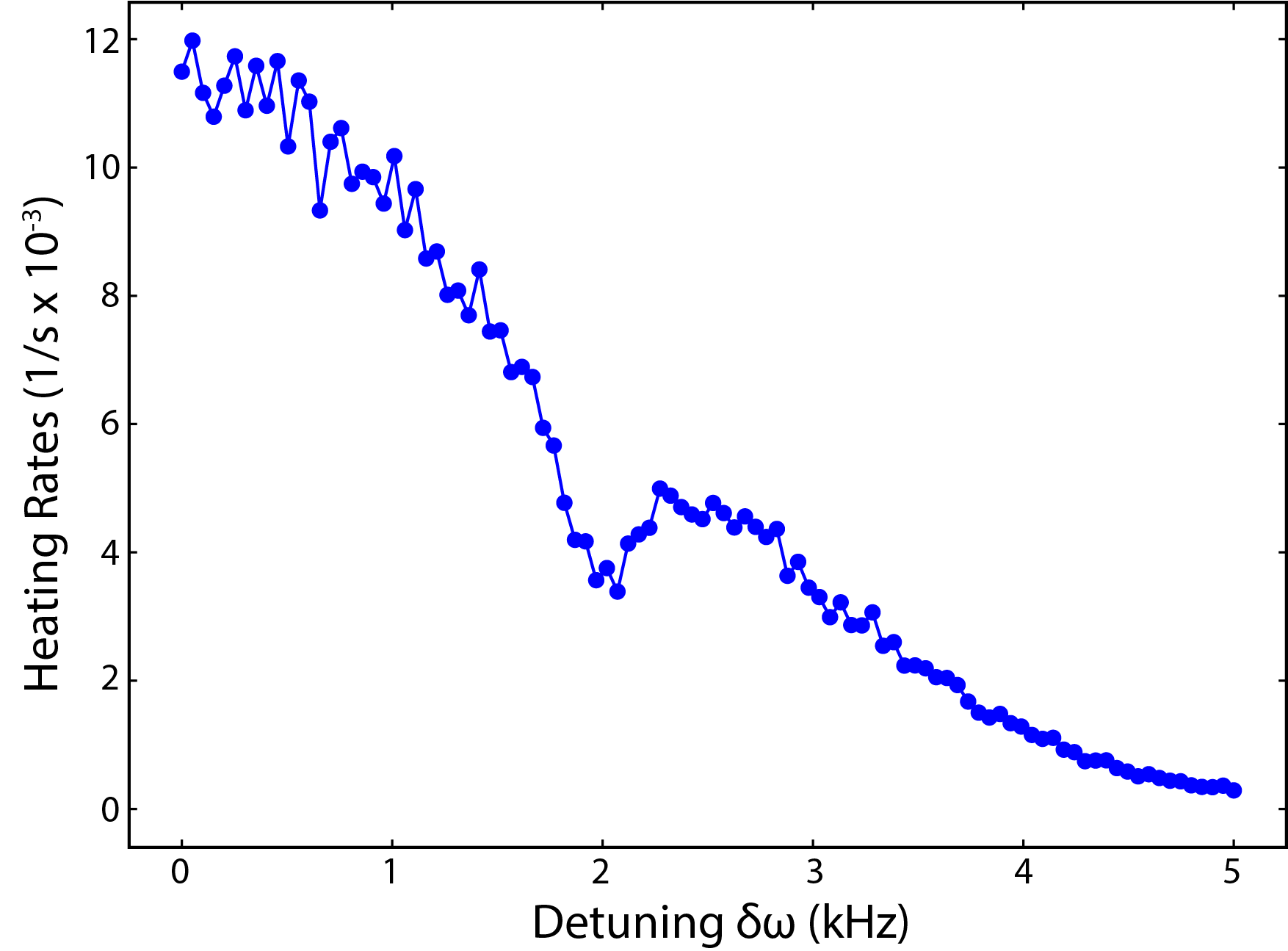
Figure 4: Monte Carlo simulations show an overall reduction in heating with detuning, but fail to reproduce the sharp resonance peaks, highlighting the importance of many-body and resonance effects beyond leading-order semiclassical theories.
Effects of External Control and Quantum Sensing Implications
To test the electron-mediated activation hypothesis, the protocol was repeated with strong continuous laser illumination, optically exciting NV centers and driving rapid stochastic transitions among electronic spin manifolds. Under illumination, the resonant heating peaks were strongly enhanced, verifying the centrality of dynamic electron environments in facilitating the breakdown of disorder protection.
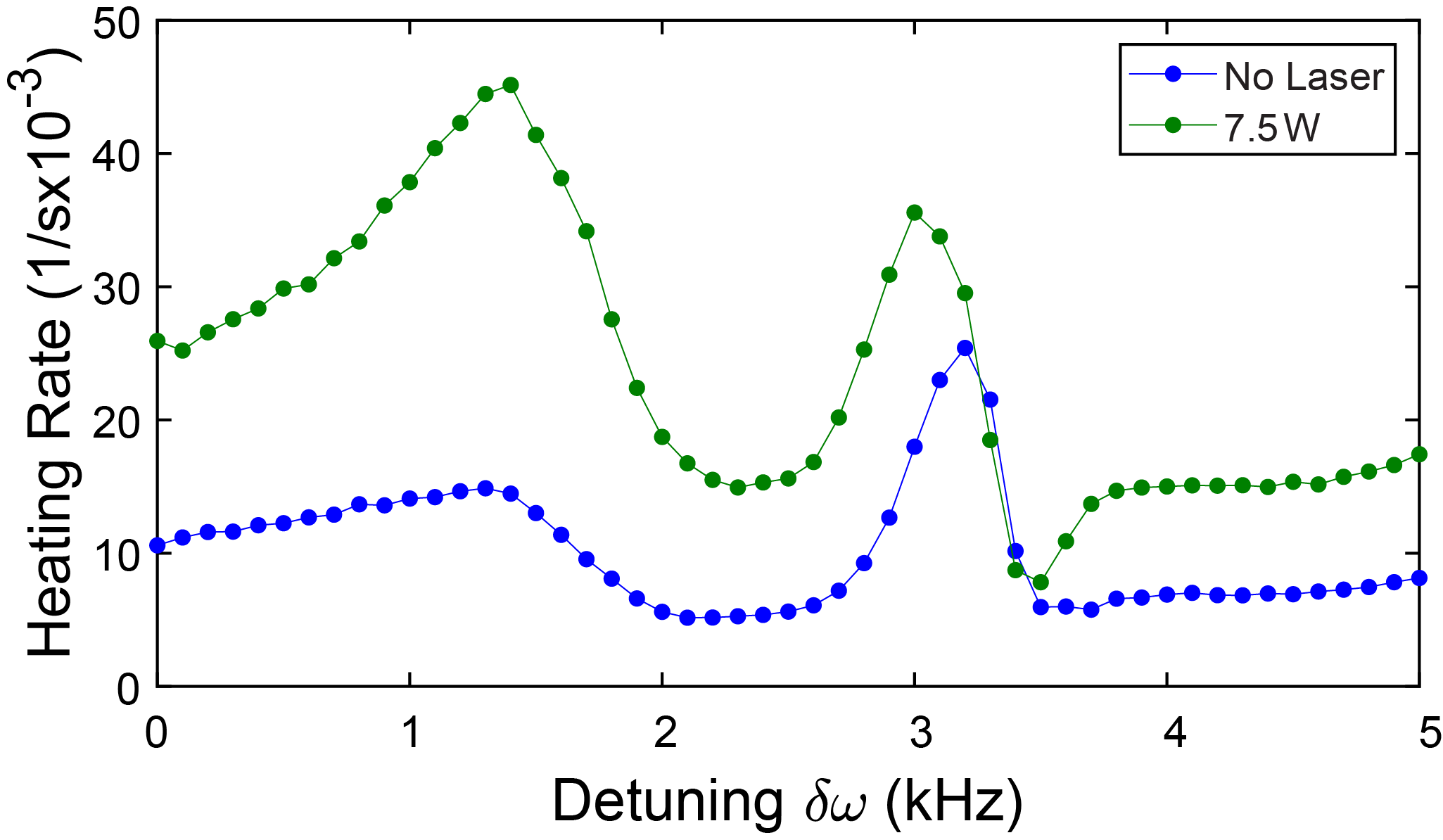
Figure 1: Laser illumination increases the resonant heating rate at triple-spin-flip resonance, confirming electron-mediated stochastic activation of multi-spin processes.
The extreme sensitivity of magnetization decay to resonance conditions suggests new routes to DC quantum sensing. By tuning close to a resonance, weak DC fields can abruptly trigger the system into resonance, yielding a sudden, amplified loss of prethermal magnetization. Such threshold-like responses offer practical opportunities for high-gain DC field transduction and may be engineered by judiciously choosing Floquet parameters and environmental control.
Numerical and Modeling Insights
Minimal toy models and stochastic Liouville formalisms have clarified the dominant mechanisms for both background and resonant heating. The background decay rate is well reproduced by a 'kick-induced dephasing' model, wherein stochastic electron transitions intermittently rotate nuclear quantization axes, with subsequent dephasing dominated by either dipolar transport or on-site hyperfine shifts depending on detuning regime. The resonance contribution is described via a bimodal Floquet-Magnus expansion, with multi-spin flip commutators only emerging at high-enough order, scaling with both positional disorder and driving frequency.
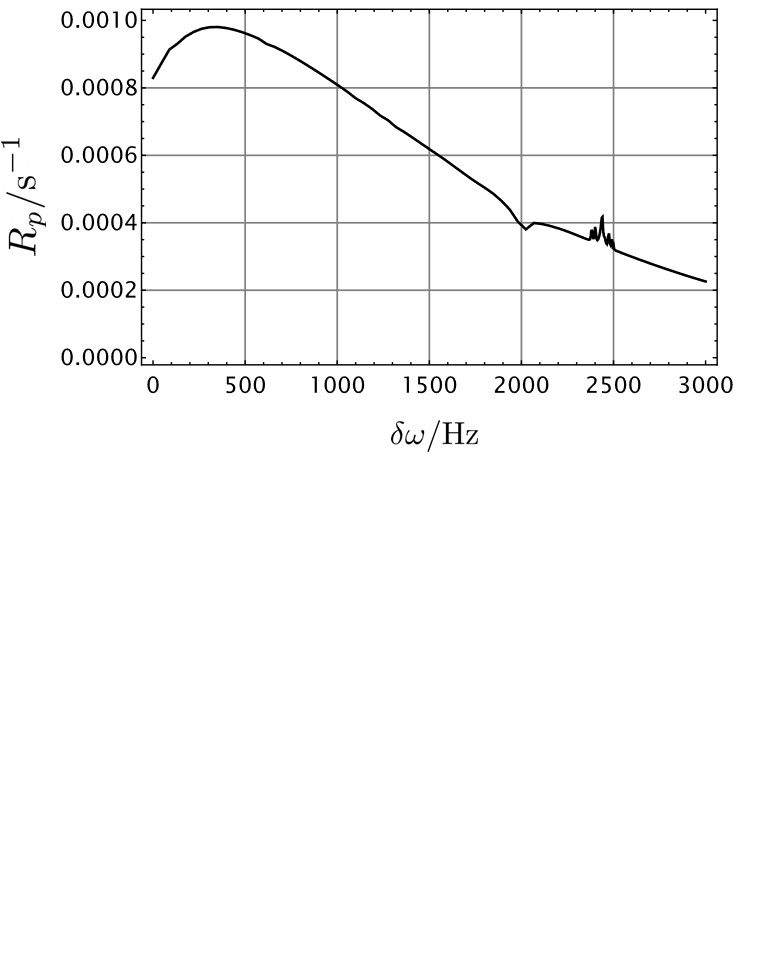
Figure 7: Cluster simulations of three-nuclear spins coupled to a single electron under detuned pulsed spin-locking reproduce the observed resonance peaks and offer insight into the frequency and disorder scaling of the resonant heating rate.
Broader Implications and Future Directions
These results delineate a resonance-activated limit for disorder-stabilized Floquet phases, indicating that dynamical disorder—specifically, environments with stochastic spectral diffusion or Markovian switching—fundamentally limits the protective power of disorder, even in regimes where strong localization and long prethermal plateaus are expected. This has broad implications for Floquet engineering of robust quantum memories, protected quantum phases, or time-crystalline order [beatrezCriticalPrethermalDiscrete2023b; choiObservationDiscreteTimecrystalline2017a]. Conversely, the sharp, threshold-like breakdown can be deliberately exploited for quantum sensing applications, leveraging the system's intrinsic gain near multispin resonances [sahin2025micromotion; moonDiscreteTimeCrystal2024].
The generality of the two-frequency and stochastic disorder framework suggests that resonance-activated heating breakdown is not limited to diamond or nuclear spin solids, but will manifest generically across solid-state qubits, engineered quantum simulators, and driven open systems in which disorder is dynamic rather than static [moriFloquetStatesOpen2023; martin2023controlling].
Conclusion
This work demonstrates that the often-assumed disorder-induced suppression of Floquet heating can catastrophically fail under two-frequency driving in the presence of dynamically fluctuating disorder. Sharp resonance peaks in heating rates at well-defined double- and triple-spin-flip conditions are experimentally observed and theoretically attributed to noise-assisted, electron-mediated activation of otherwise forbidden many-body Floquet transitions. These findings set fundamental bounds on the timescale for Floquet engineering in realistic platforms and offer practical design rules for both maximizing robustness and engineering sensing protocols based on threshold-like dynamical responses. Future directions include extending these ideas to aperiodic or quasiperiodic drives, probing other driven quantum matter platforms, and designing protocols that strategically avoid low-order resonance manifolds or stabilize the disorder against detrimental fluctuations.

