- The paper presents a novel QTM design that enables continuous twist-angle-dependent electronic characterization by integrating a modified AFM platform with custom rotation stages.
- The methodology includes precisely engineered tip fabrication using FIB deposition and stringent alignment protocols achieving <100 nm rotation centering.
- Experimental results reveal 60° periodic conductance modulation with peaks at 21.8° and 38.2°, confirming theoretical predictions and showcasing the instrument's sensitivity.
Quantum Twisting Microscope Construction: Technical Design and Experimental Analysis
Introduction
The development of the Quantum Twisting Microscope (QTM) as detailed in "Constructing a Quantum Twisting Microscope: Design Insights and Experimental Considerations" (2604.03483), addresses the need for direct and continuous twist-angle-dependent electronic characterization in layered materials, a central challenge in twistronics. Unlike conventional scanning probe instruments, the QTM enables momentum-resolved tunneling measurements by rotating stacked two-dimensional (2D) crystalline layers—a capability critical for probing emergent electronic phenomena in van der Waals systems and twisted heterostructures.
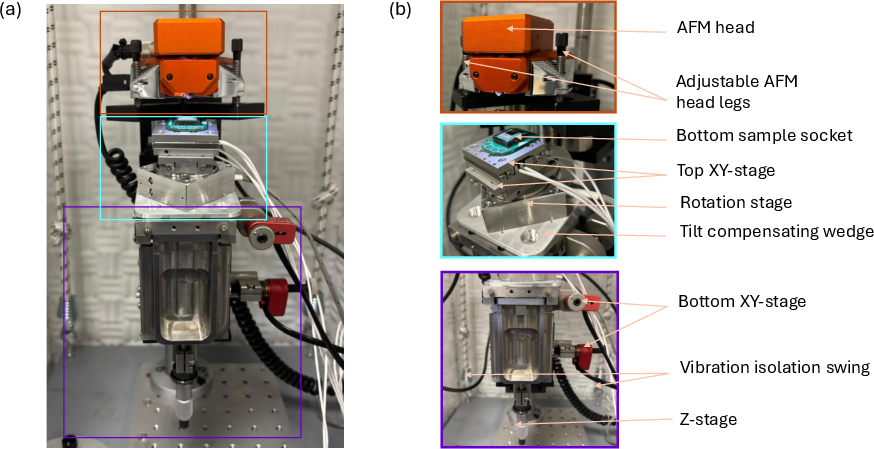
Figure 1: QTM instrument with commercial AFM platform and integrated rotation/translation stages; detailed view of AFM head and stage setups.
The construction utilizes a commercial Nanosurf Easyscan 2 AFM featuring an open geometry beneath the scan head, thus permitting the integration of custom rotation and translation stages without spatial constraint. The instrument’s adjustable legs provide precise tilt control, enabling compensation for the shorter QTM tip profile critical in twist-dependent measurements. Mechanical interference, a key limitation in conventional AFMs during rotational operation, is mitigated by careful stage assembly and the addition of a wedge to achieve the required cantilever-sample orientation.
QTM Tip Fabrication Process
Tip fabrication employs tipless cantilevers with a high spring constant (48 N/m) to ensure robust mechanical stability during rotation. Electrical contact is achieved via electron-beam deposition of a Cr/Au bilayer. Focused Ion Beam (FIB) deposition forms a platinum pyramid with optimized height (1.5–2.0 μm), crucial for both electrical and mechanical performance. Excessive pyramid height impedes membrane formation; insufficient height causes cantilever apex/sample contact prior to tip engagement, resulting in operational failure.
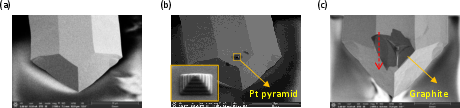
Figure 2: Progressive stages of QTM tip fabrication, showing tipless cantilever, platinum pyramid deposition, and graphite membrane transfer.
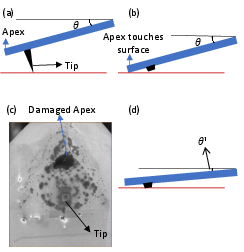
Figure 3: Schematic and SEM analysis of cantilever/tip height optimization; apex contact damage and solution by tilt angle adjustment.
Graphite transfer onto the platinum tip employs a modified PDMS stamping technique. Optimal flake thickness (10–50 nm) and controlled contact geometry ensure maximal adhesion and electrical continuity, while preventing deleterious wrinkling or slippage during rotation. The transfer is performed at elevated temperatures to promote van der Waals adhesion.
Stage Assembly and Alignment Protocols
The QTM's custom stage architecture consists of sequential translation and rotation modules. Dual XY translation stages independently align both the rotation axis beneath the AFM tip and the sample relative to the curved tip layer. The wedge component corrects cantilever-to-sample tilt, permitting optimal tip-sample engagement.
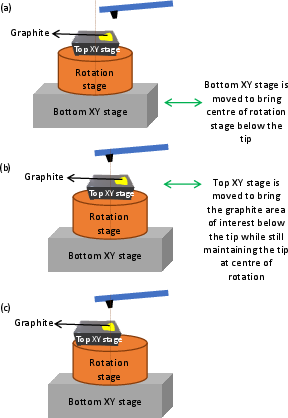
Figure 4: Alignment workflows for locating graphite region at rotation stage axis; iterative translational adjustment achieves precise rotational centering.
Fine alignment is validated by acquiring AFM topography at multiple rotation angles and superimposing scans to verify that the rotation center aligns with the scan area centroid within 100 nm, ensuring the area of interest remains stationary under rotation.
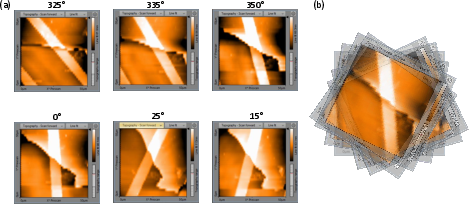
Figure 5: AFM topography scans at various rotation angles verify precise centering of rotation axis within scan area.
Robust vibration isolation is implemented to eliminate tip disengagement and spurious electrical artifacts during rotation.
Twist-Angle Conductance Measurements and Validation
The QTM's capability is validated through conductance measurements between graphite-coated tips and graphite substrates as a function of interlayer twist angle. The instrument applies an AC+DC bias to the tip, rotates the bottom graphite layer continuously, and records tip-sample current.
Conductance exhibits clear 60-degree periodicity, reflecting hexagonal lattice symmetry. Enhanced conductance appears at commensurate twist angles, specifically near 21.8° and 38.2°, corresponding to predicted stacking configurations that allow resonant momentum-conserving tunneling.
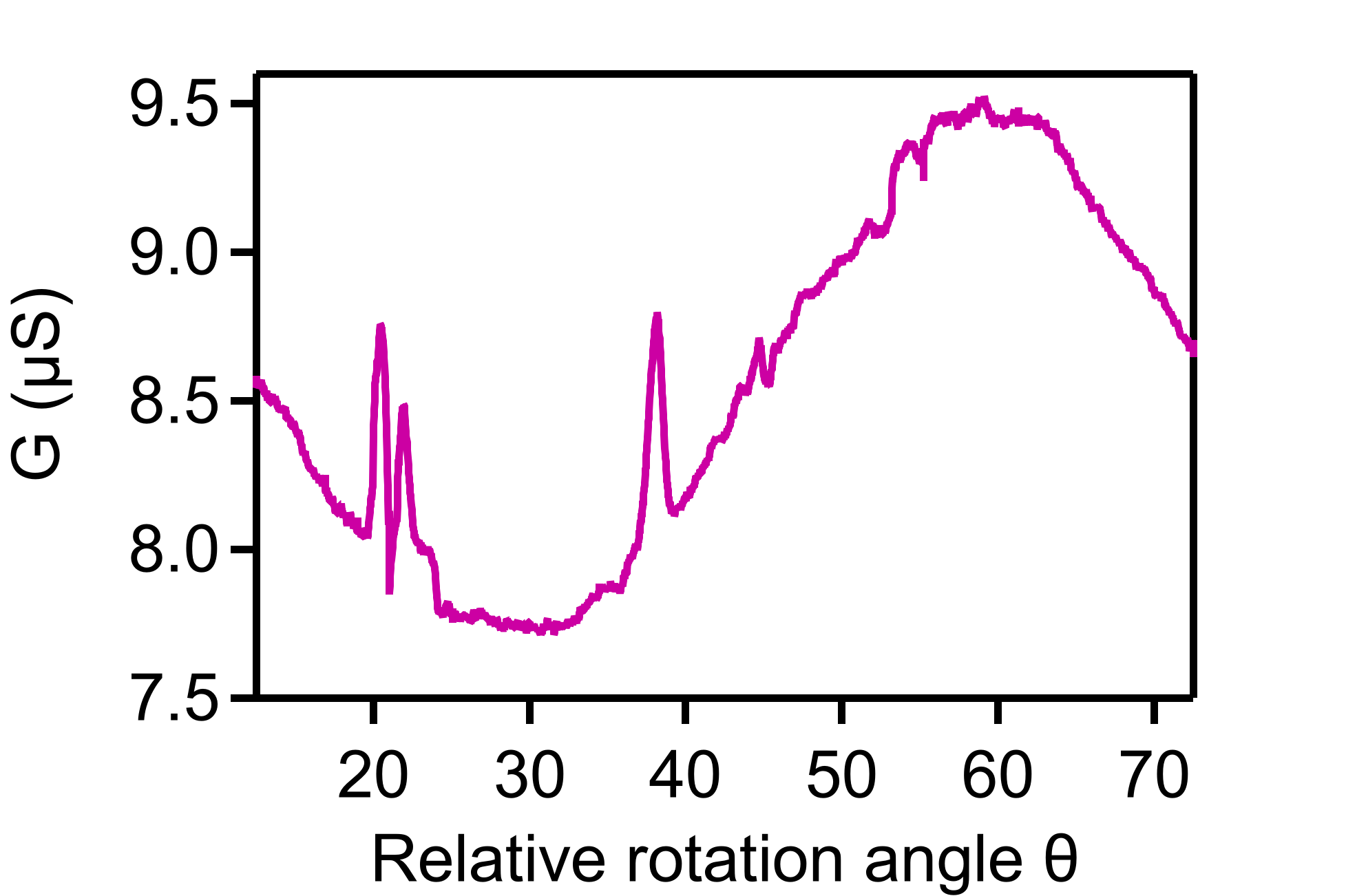
Figure 6: Conductance vs. twist angle displays 60° periodicity and robust peaks at commensurate angles (21.8°, 38.2°), confirming crystalline symmetry and momentum-resolved transport.
Peak positions match theoretical predictions for commensurate twist-induced overlap of Fermi surfaces [Bistritzer2010-md]. The highest conductance is observed near intravalley tunneling configurations; intervalley peaks predicted at other commensurate angles are not resolved, supporting theoretical models that include temperature broadening, limited commensurability sites, and lattice symmetry effects [Luican2011-hd, Kim2013-al].
Implications for Quantum Materials Research
The QTM, as demonstrated, enables direct twist-angle-dependent measurements in layered systems, establishing a foundation for momentum-resolved transport analysis across a range of van der Waals materials and artificial heterostructures. Its design overcomes prevalent mechanical and electrical challenges, allowing for reproducible, artifact-free measurements and facilitating broader adoption.
Extension of QTM techniques to freestanding oxide membranes [Li2022-sa, Pryds2024-wi], spin-selective chiral systems [Bloom2024-bb, Menichetti2023-ob], and correlated electron systems provides a versatile platform to probe phenomena such as moiré-superlattice engineering, chiral-induced spin selectivity, and tunable electronic correlations. The accessible implementation lowers experimental barriers, supporting investigations of novel quantum phases, artificial superlattice effects, and symmetry-protected transport mechanisms.
Conclusion
This work presents a comprehensive guide to constructing and operating a QTM from off-the-shelf AFM systems, encompassing detailed insights into fabrication, alignment, and measurement protocols. Experimental validation confirms periodic conductance modulation and resonant tunneling at commensurate twist angles in graphite, demonstrating instrument sensitivity to crystallographic symmetry and momentum-resolved transport. The QTM’s modular and reproducible design ensures scalability across a range of research topics in twistronics, moiré engineering, and beyond, setting the stage for future advances in probing emergent properties in quantum materials.