- The paper presents a robust orchestration suite that integrates diverse hardware, analytics, and planning modules for autonomous experimentation.
- It employs a modular, service-oriented design with language-agnostic integration via gRPC and protobuf, ensuring scalability and ease of use.
- Empirical studies demonstrate enhanced research efficiency through reduced variance and faster optimization in applications like materials synthesis.
Comprehensive Overview of ARES OS 2.0: Orchestrating Autonomous Experimentation Systems
Context and Motivation
ARES OS 2.0 introduces a robust open-source orchestration framework explicitly designed for Autonomous Experimentation (AE) and Self-Driving Laboratories (SDLs). The suite targets a critical bottleneck in transitioning from manual experimentation towards closed-loop research autonomy: integrating heterogenous hardware, analytical routines, and experiment planning modules into a cohesive, user-friendly system. The motivation stems from the escalating need for accelerated scientific discovery in materials science, chemistry, and biology, where traditional research paradigms remain overly labor-intensive and costly. By lowering the software engineering threshold, ARES OS aims to democratize access to SDLs beyond well-funded institutions and to catalyze research productivity across domains.
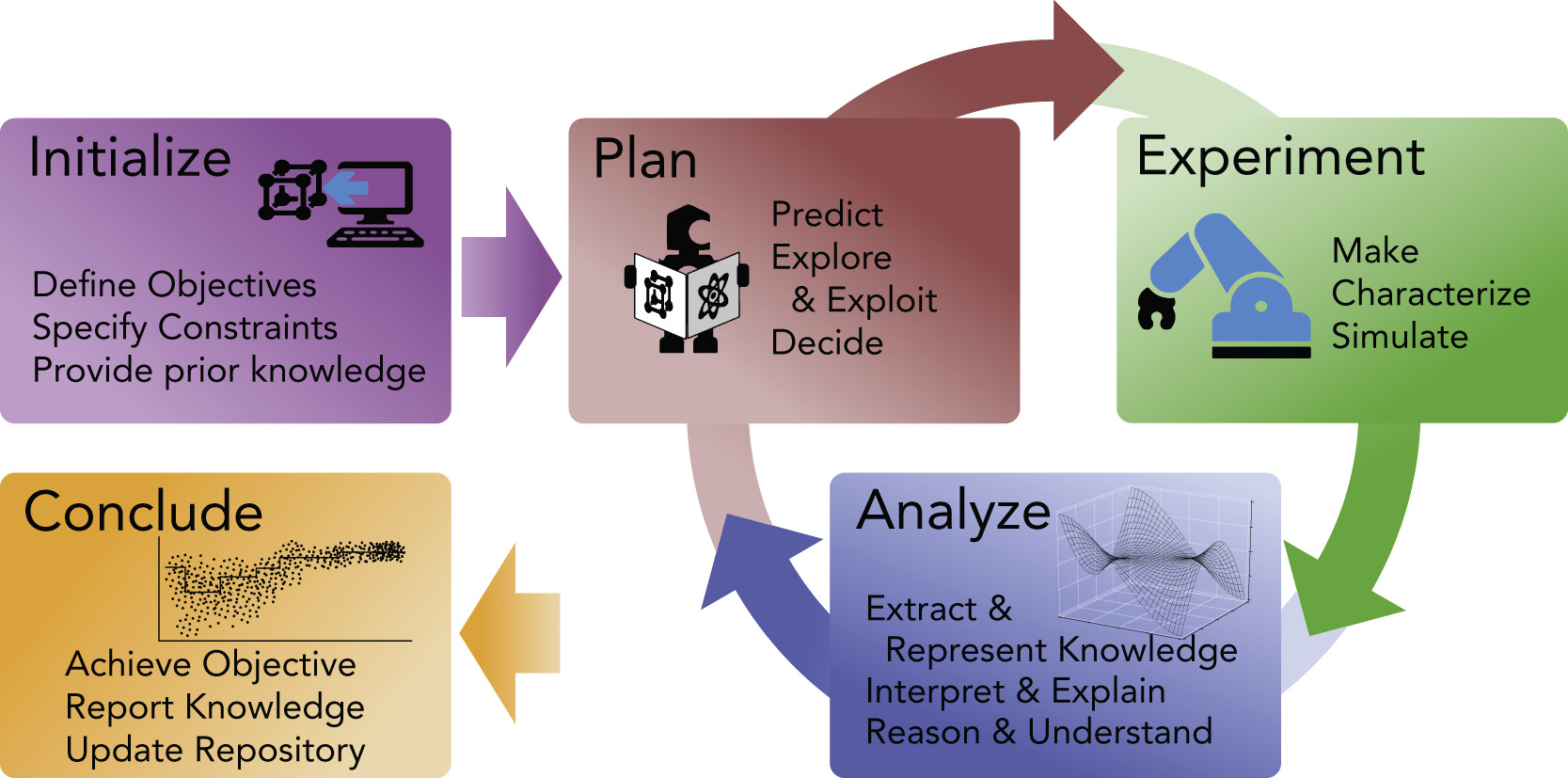
Figure 1: A closed loop, research autonomy process flow, illustrating the interconnectivity between experiment execution, in situ analysis, and AI-driven planning as realized by ARES OS.
Architecture and Design Principles
ARES OS 2.0 is architected around a service-oriented paradigm, implementing its core in C# with ASP.NET, and adhering strictly to SOLID design principles for modularity and maintainability. Central orchestration handles experimental routines, database connectivity (with support for SQL Server, SQLite, and Postgres), and module management, facilitating automation and autonomy at scale. Communication between the central node and peripheral modules leverages Google’s protobuf and gRPC, ensuring language-agnostic integration and seamless networked resource utilization (both local and remote). This design enables the creation, extension, and reuse of modules in various languages including Python, C#, Javascript, and R—bypassing vendor lock-in and restrictive domain specialization.
The user interface, delivered via Blazor, provides a centralized, intuitive hub for campaign management, hardware control, analyzer/planner module configuration, and data export, accessible through low- or no-code workflows. Additionally, the PyAres companion library (installable via PyPi) empowers Python-centric module prototyping and system integration, minimizing boilerplate and accelerating experimental pipeline assembly. The launcher utility streamlines deployment and configuration, including forked customization and certificate management.
Comparative Analysis and Domain Agnosticism
In comparison with contemporary open-source AE orchestrators such as MadSci, ChemOS2.0, and Minerva-OS, ARES OS distinguishes itself through its agnostic abstraction across scientific domains and its commitment to a researcher-first UX. While alternatives often specialize in narrow fields (e.g., exclusively chemistry or advanced materials), ARES OS demonstrates proven adaptability in additive manufacturing, wet chemistry, and chemical vapor deposition workflows. Its fully GUI-centric interaction model, consistent modularity, and extensible data handling greatly reduce onboarding friction for researchers with limited software engineering backgrounds.
Empirical Impact and Real-World Integration
The software suite has been operationalized in experimental platforms addressing materials science challenges, notably in carbon nanotube synthesis [waelder:2024, bulmer:2023] and autonomous Bayesian optimization in fused deposition modeling [deneault:2021]. Deployment in classroom settings for curriculum enhancement in ML and AE is underway, expanding the pedagogical reach of the framework. Empirical studies employing ARES OS have reported faster optimization, reduced experimental variance, and fewer trial requirements relative to manual protocols. The abstraction and modularity of ARES OS facilitate reproducibility, rapid hypothesis testing, and system flexibility in laboratory automation.
Research Implications and Future Prospects
ARES OS 2.0’s abstraction and orchestration capabilities hold significant implications for scaling AE infrastructure. By lowering software integration complexity, it enables broader adoption of SDLs and accelerates incorporation of AI/ML-based planners and in situ analytics. This democratization aligns with emerging research trends favoring open, community-driven SDL architectures. The design and deployment philosophy also provides a template for extensible AE platforms in other domains (such as synthetic biology and environmental science).
Theoretically, widespread adoption of ARES OS could catalyze a shift in experimental methodology towards greater autonomy, higher throughput experimentation, and more sophisticated optimization algorithms. Practically, the framework’s modularity supports incremental integration with evolving hardware and planning routines, ensuring compatibility with advances in robotics, AI, and ML pipelines. Its open-source nature encourages community contribution and continuous interoperability improvements.
Conclusion
ARES OS 2.0 represents a pragmatic orchestration suite for AE and SDLs, optimizing for low-barrier usability, modular extensibility, and domain flexibility across physical sciences. Its service-oriented, language-agnostic architecture, combined with GUI-driven workflows and comprehensive Python support, positions it as an enabling technology for autonomous research infrastructure. The framework’s empirical validation and domain-agnostic design suggest promising avenues for scaling research autonomy and facilitating the next generation of laboratory automation.