- The paper presents a high-resolution VLBI study confirming the compact, non-thermal nature of the persistent radio source associated with FRB 20190417A.
- It measures a flat-to-mildly declining spectrum (α = -0.19 ± 0.29) with precise flux densities at 5 and 1.4 GHz, effectively ruling out star-formation origins.
- The refined Lν–|RM| relation supports young, magnetar-driven nebula models and underscores the importance of VLBI in isolating FRB environments.
VLBI Constraints on the Spectrum of the Persistent Radio Source Associated with FRB 20190417A
Introduction
The study presents European VLBI Network (EVN) observations targeting persistent radio sources (PRSs) associated with repeating fast radio bursts (FRBs), with a particular focus on FRB 20190417A. The goals are to confirm the compact, milliarcsecond-scale nature of emission coincident with FRB 20190417A, measure its radio spectrum with very high angular resolution, and place the results in the context of the proposed Lν–|RM| relation for PRSs. Additionally, a stringent examination of the candidate PRS linked to FRB 20181030A is provided.
Observational Campaign and Data Analysis
Observations were carried out with the EVN at central frequencies of 5 and 8 GHz. Rigorous amplitude, phase, and polarization calibration procedures were employed to ensure accurate flux density and astrometric measurements. The synthesized beams provided sub-milliarcsecond spatial resolution, isolating emission regions coincident with repeating FRBs with minimal contamination from host galaxy star formation.
Detection and Properties of 20190417A-S1
A clear, unresolved compact radio component was detected at 5 GHz with S5GHz=150±45 μJy at a precise position coincident with FRB 20190417A. The lack of spatial extension implies a lower limit on the brightness temperature of Tb≳106−7 K, ruling out any thermal or extended star-formation origin, and robustly establishing the non-thermal nature intrinsic to FRB-related engines.
At 8 GHz, only a 5σ upper limit of 250 μJy was achieved. When benchmarked against the VLBI-based 1.4 GHz detection (S1.4GHz=191±39 μJy), the spectrum is flat-to-mildly-declining with α=−0.19±0.29 (Sν∝να). This makes FRB 20190417A the second PRS (after FRB 20121102A) to have its spectral index determined solely via VLBI, without host-galaxy contamination.
Upper Limits for 20181030A-S1
No compact emission was detected at either 5 or 8 GHz at the position of the candidate 20181030A-S1. The 5 GHz upper limit (<80 μJy) imposes a luminosity ceiling, translating to a spectral index constraint of α≲−1.2 relative to the VLA 1.5 GHz detection. If the VLA source is compact and persistent, this would indicate an unusually steep spectrum compared to other PRSs, but an alternative hypothesis is that the VLA emission is dominated by diffuse star-forming activity.
Radio Spectral Diagnostics and Physical Models
The measured flat spectral index for 20190417A-S1 is inconsistent with optically thin synchrotron emission from shock-accelerated electrons, which generally produce S5GHz=150±45 μ0 (S5GHz=150±45 μ1). Instead, the index is consistent with:
- A hard (S5GHz=150±45 μ2) fossil electron population, characteristic of pulsar wind nebulae (PWNe),
- The presence of a synchrotron turnover near GHz frequencies, arising either from minimum Lorentz factor electrons or from synchrotron self-absorption.
Constraints on magnetic field, particle density, and source size can be derived under each scenario, but both point toward a nebular origin with high energy density and efficient ongoing particle acceleration.
The S5GHz=150±45 μ3--|RM| Relation
Theoretical models predict that the PRS luminosity and the observed rotation measure (RM) should be physically linked if both originate in a young, magnetized nebula surrounding the compact FRB source. The flux and RM measurements for 20190417A enable recalibration of the prominent S5GHz=150±45 μ4–|RM| relation (see below).
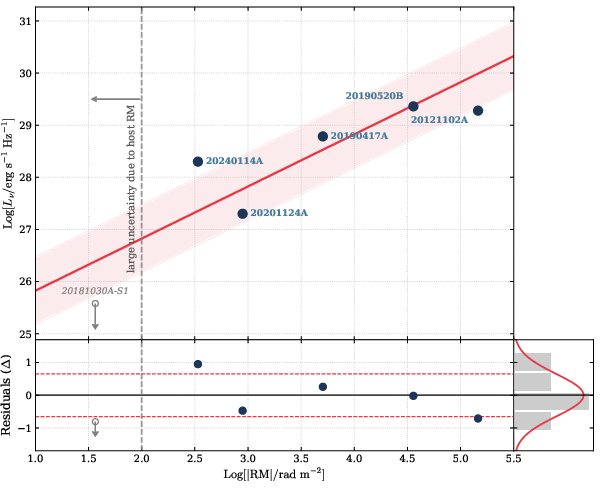
Figure 1: The S5GHz=150±45 μ5–|RM| relation for confirmed PRSs and candidates, showing the placement of FRB 20190417A (black circle), the unit-slope best fit (red line), and the observed scatter (S5GHz=150±45 μ6).
Inclusion of FRB 20190417A refines the estimated scatter in the relation to S5GHz=150±45 μ7 (in S5GHz=150±45 μ8), yielding an inferred nebular expansion index of S5GHz=150±45 μ9, consistent with expansion scenarios involving forward shocks in the free-expansion phase or nascent, continuously powered PWNe.
Implications and Theoretical Context
The VLBI constraints confirm that the persistent radio emission associated with FRB 20190417A is compact, non-thermal, and nebular. The spectral and Tb≳106−70–|RM| diagnostics support models where the nebula is powered by highly magnetized, young neutron stars—i.e., magnetars—with the persistent emission tracing ongoing outflow/wind activity and/or relic particle populations. The data exclude significant contamination from star formation or diffuse ISM emission and place the PRS squarely within the population of engines associated with luminous, highly-magnetized environments.
The upper limits for 20181030A demonstrate the necessity of high-resolution VLBI to disentangle nuclear persistent emission from host background, and suggest caution when identifying PRSs based solely on lower-resolution imaging.
The methodology, combining multi-frequency VLBI with correlative environment diagnostics (Tb≳106−71--|RM|), offers a blueprint for scrutinizing and standardizing PRS samples in the future. As sample sizes increase, tighter constraints on evolutionary models, parental channel diversity (e.g., SN vs. merger formation), and possible use of PRSs as cosmological or astrophysical probes will be achievable.
Conclusion
The paper demonstrates that VLBI is essential for robust, contamination-free PRS identification and spectral measurement. The detection of a compact, flat-spectrum PRS for FRB 20190417A and its consistency with nebular, synchrotron-powered emission provides stringent observational support for young magnetar scenarios. The Tb≳106−72–|RM| relation, refined by these results, is consistent with models of forward shock or young PWN expansion. Non-detections for other candidates highlight the necessity for high-angular-resolution follow-up in FRB environment studies. This work strengthens the emerging consensus that at least a subset of repeating FRBs are embedded in young, actively powered, highly magnetized nebulae.
Reference:
"The VLBI spectrum of the persistent radio source associated with FRB 20190417A" (2604.03429)

