- The paper introduces an unsupervised autoencoder framework for detecting limb faults using proprioceptive gait data from quadruped robots.
- It achieves high precision and recall in distinguishing normal from anomalous behavior, particularly in left-front and right-front limb faults.
- The approach enables adaptive locomotion transitions by integrating lightweight, real-time anomaly detection with recovery strategies in dynamic, remote environments.
Learning-Based Fault Detection for Legged Robots in Remote Dynamic Environments
Introduction
Fault tolerance is an essential property for legged robots operating in high-risk, remote settings where human oversight is minimal or impractical. The inability to autonomously detect limb faults severely constrains robust long-term deployment in dynamic, unstructured environments. "Learning-Based Fault Detection for Legged Robots in Remote Dynamic Environments" (2604.03397) addresses this challenge by presenting an unsupervised deep learning approach for real-time detection of limb failures in quadruped robots. The methodology leverages autoencoders trained exclusively on proprioceptive sensor data from nominal (non-damaged) locomotion, robustly distinguishing normal from anomalous gait patterns without explicit supervision or detailed physical modeling.
Fault Recovery and the Data-Driven Detection Framework
The proposed framework forms a crucial layer in a broader control and recovery architecture, intended to route appropriate high-level decisions (e.g., switching to tripedal gaits) based on fault state inference.
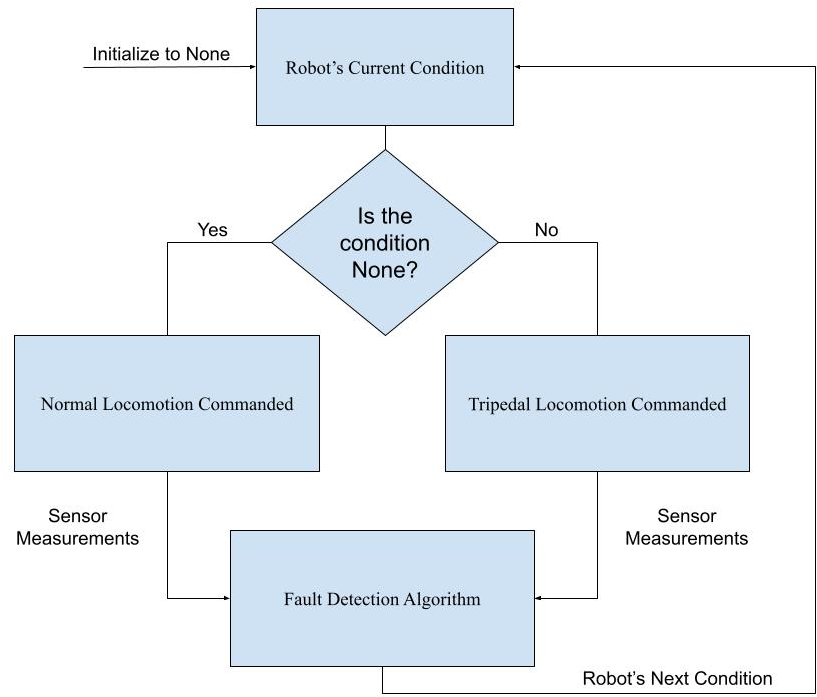
Figure 1: Flowchart of the proposed fault recovery system, wherein offline anomaly detection informs the selection of adaptive locomotion gaits in response to diagnosed limb faults.
The dataset for methodological development was derived from systematic empirical data collection on a physical quadrupedal platform (Minitaur), capturing fore-aft pronking behaviors under both intact and various single-limb-loss conditions (left-front, right-front, left-back, right-back) over diverse speeds and policies. Sensor streams comprise time, limb position and velocity (body coordinates), and bilateral hip motor currents, sampled at 60 Hz. Notably, the data collection paradigm is designed to closely reflect operational constraints—namely, variable data segment lengths and unlabeled episodic data.
Unsupervised Anomaly Detection via Autoencoders
The autoencoder architecture implemented for anomaly detection consists of a three-layer encoder (8-4-2 neurons, ReLU activations) and a symmetric decoder, optimized with mean squared error (MSE) as the loss function. The essence of the approach is leveraging low reconstruction error on nominal (in-distribution) trajectories, while limb-damaged states produce significantly higher losses due to deviations from learned spatiotemporal regularities.
Quantitative evaluation is performed by defining an anomaly threshold, parameterized as a multiple of the training loss mean and standard deviation, to optimize sensitivity-specificity trade-offs. Sensor input features are scaled via MinMax normalization, and model training utilizes a 60-20-20 split (train/validation/test) on undamaged data, with only post hoc validation/testing on the limb-failure cases.
Empirical Results
The trained autoencoder demonstrated strong discriminative capacity between normal and faulted locomotion. Visualizations of actual versus reconstructed sensor data for both intact and faulted states evidence this property.
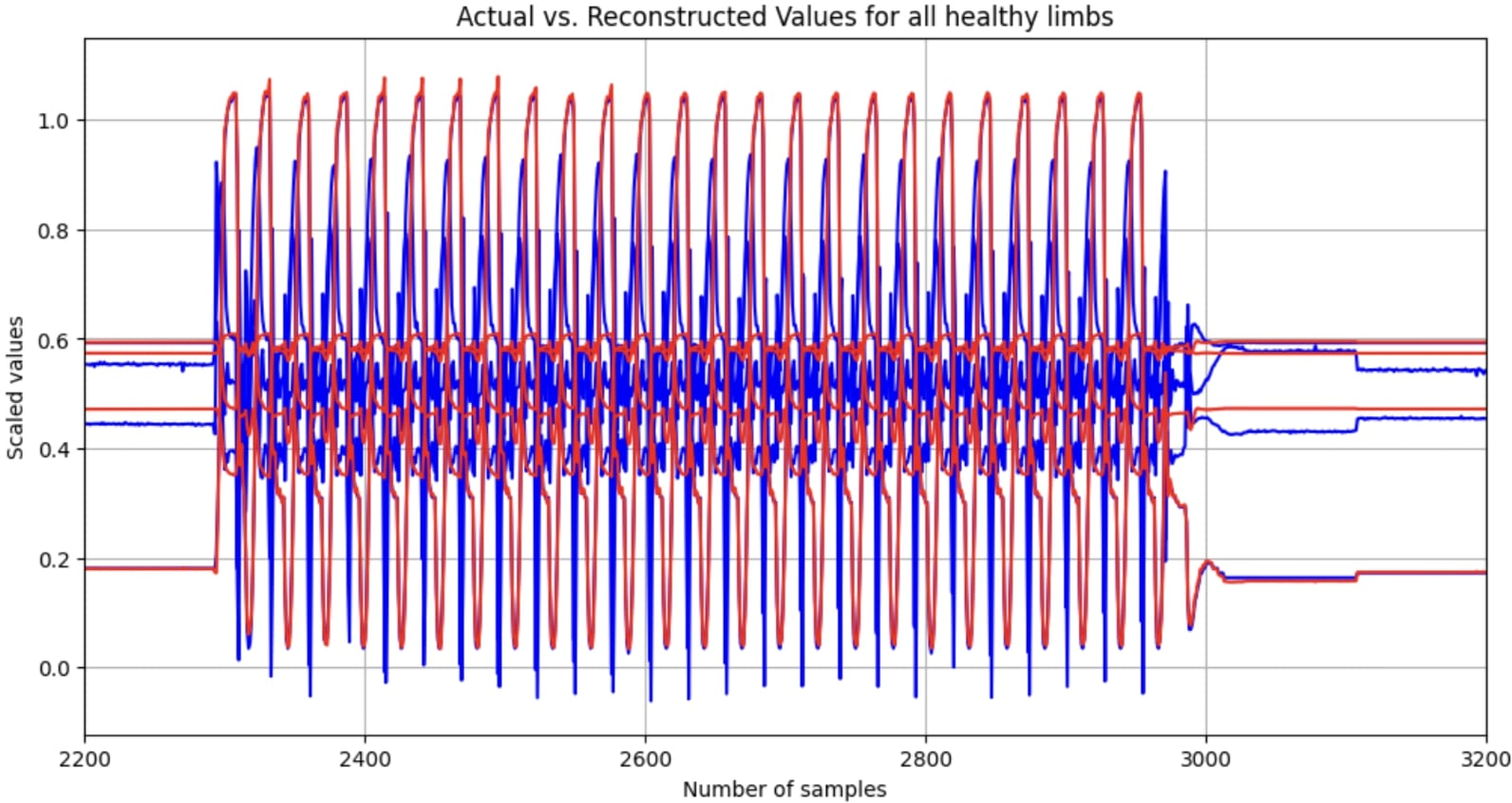
Figure 2: Actual (blue) versus reconstructed (red) sensor values for an intact robot executing pronking, showing tight correspondence indicating low reconstruction error.
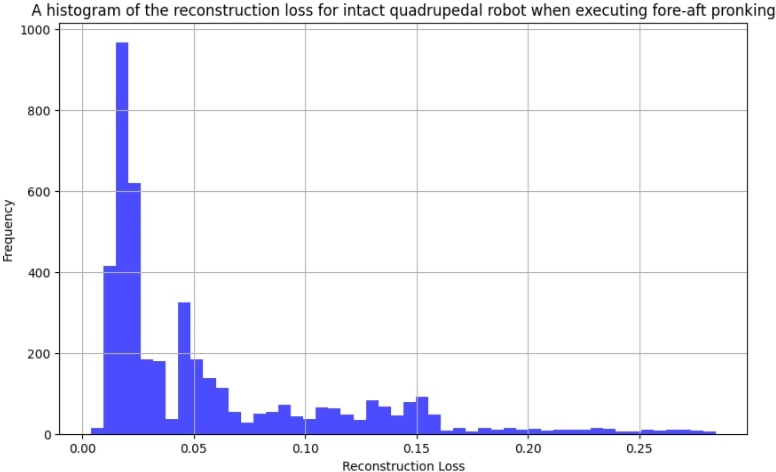
Figure 3: Distribution of reconstruction errors for the intact robot during fore-aft pronking, with the majority of nominal samples clustering at low loss levels.
Comparative analysis for the left-front (LF) and right-front (RF) limb-missing scenarios shows a marked divergence in reconstruction error profiles.
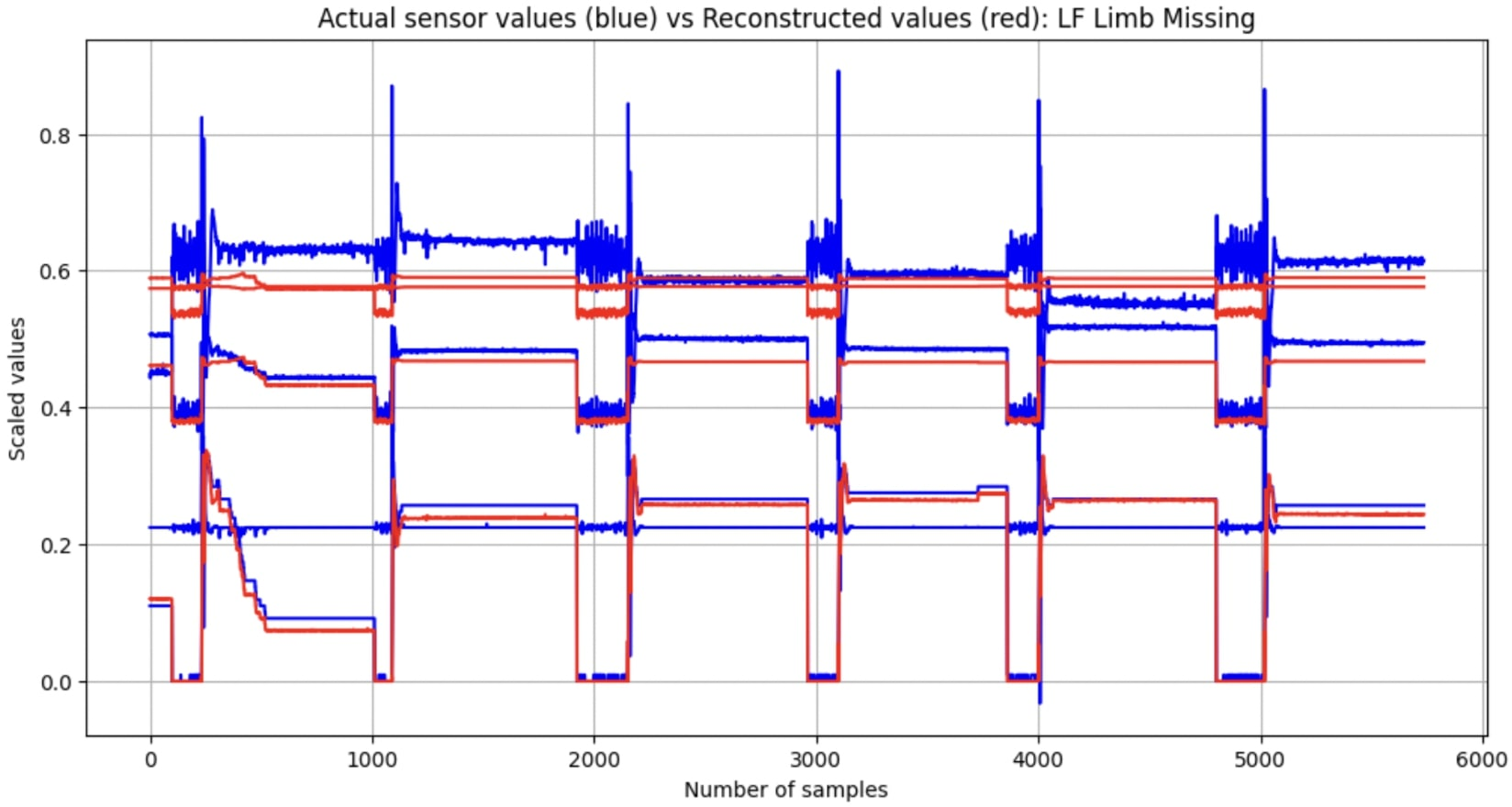
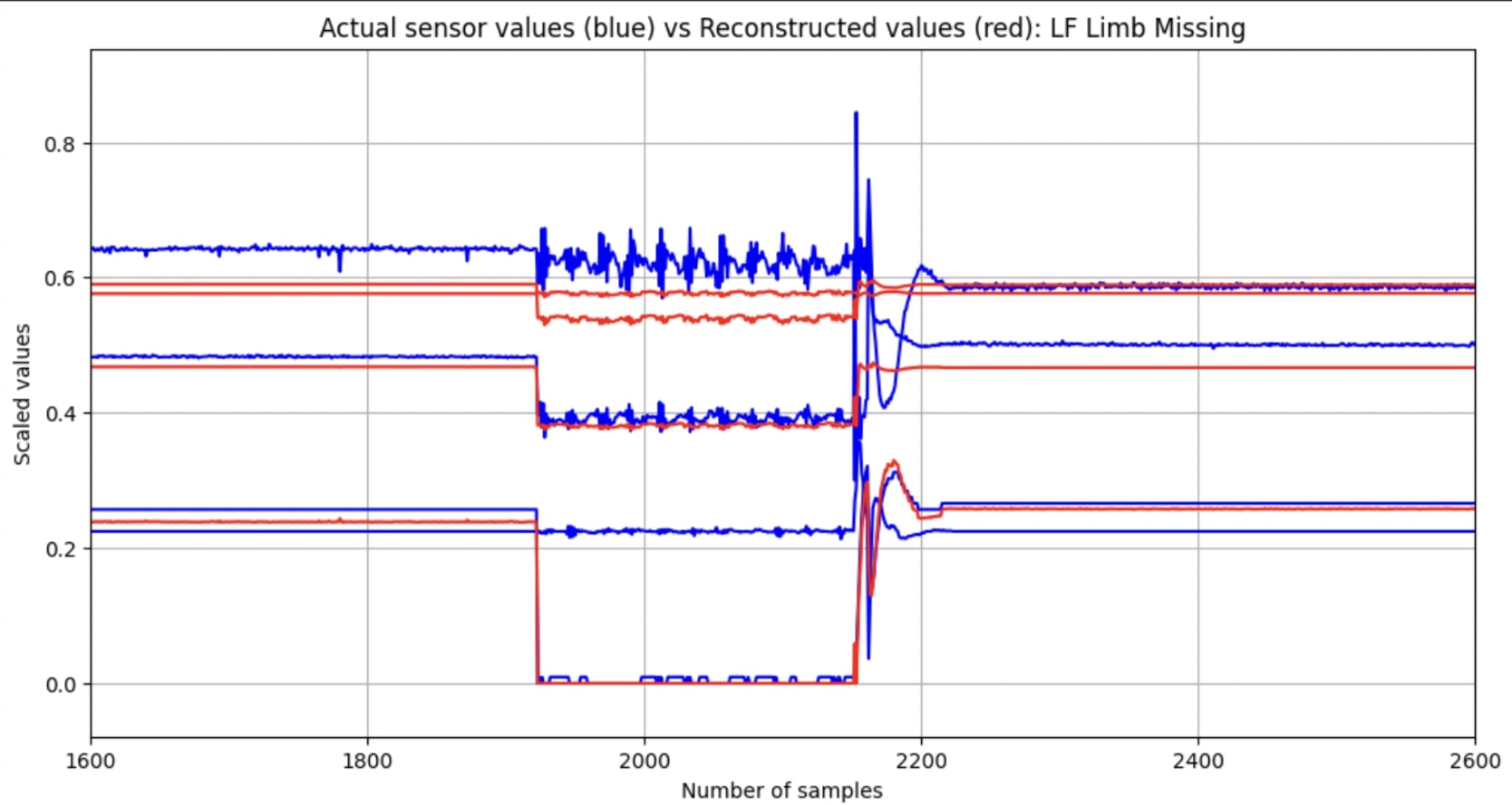
Figure 4: Actual and reconstructed sensor values for LF limb missing; discrepancies are substantial, resulting in high detected reconstruction loss indicative of fault.
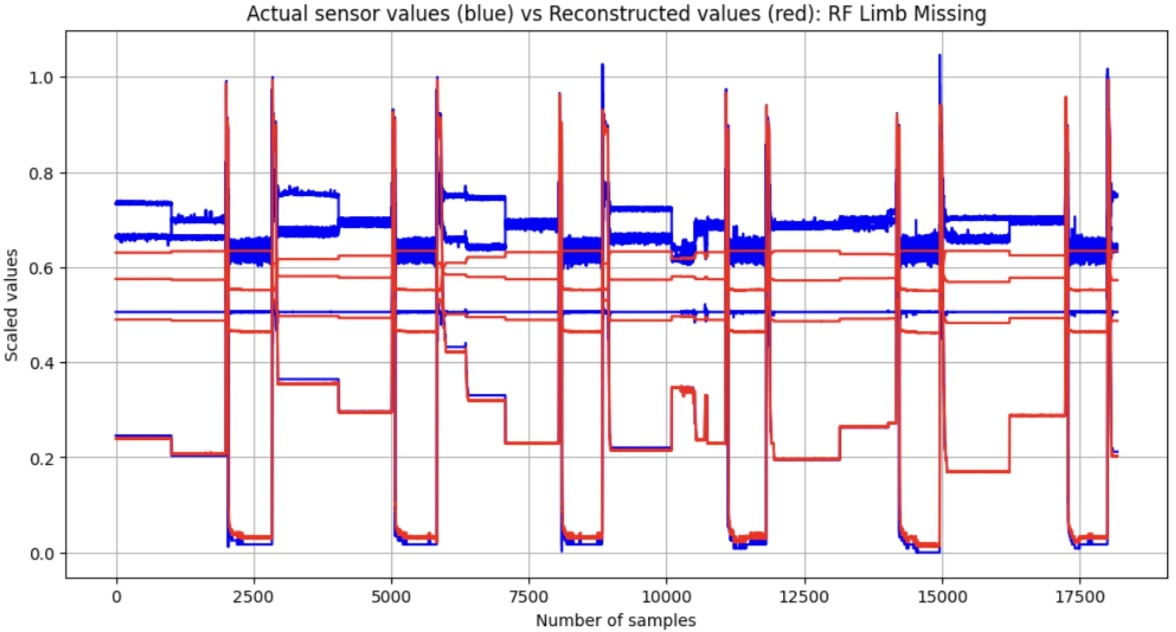
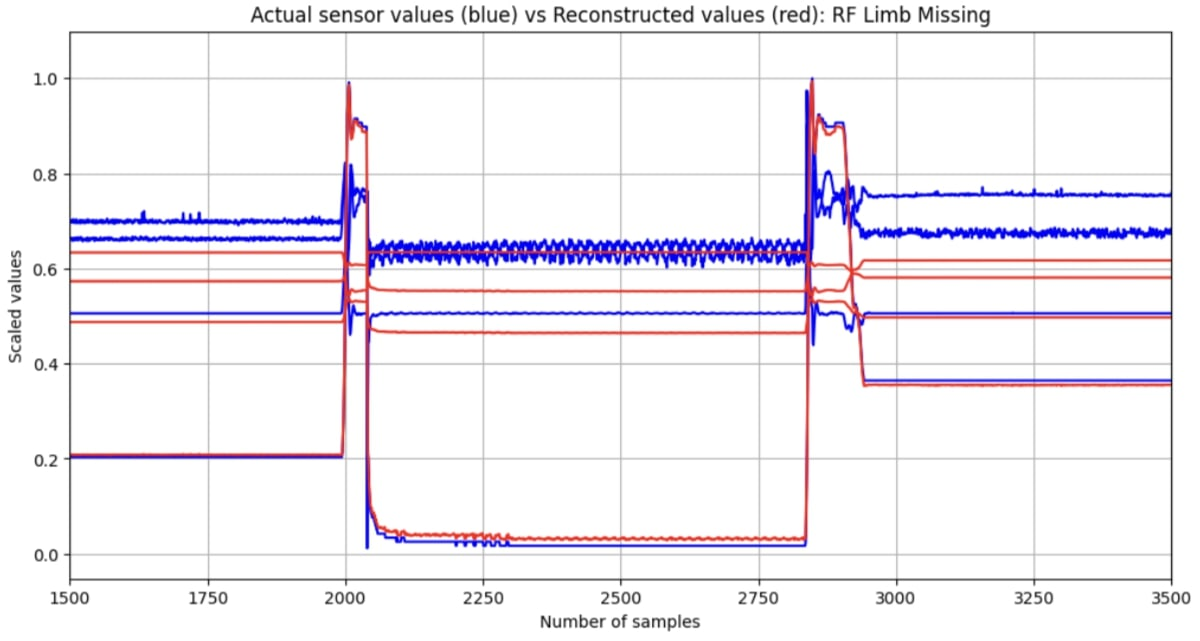
Figure 5: Actual and reconstructed sensor values for RF limb missing, demonstrating similar anomaly-driven divergence as in the LF case.
Histograms of reconstruction errors for these fault states reinforce separability.
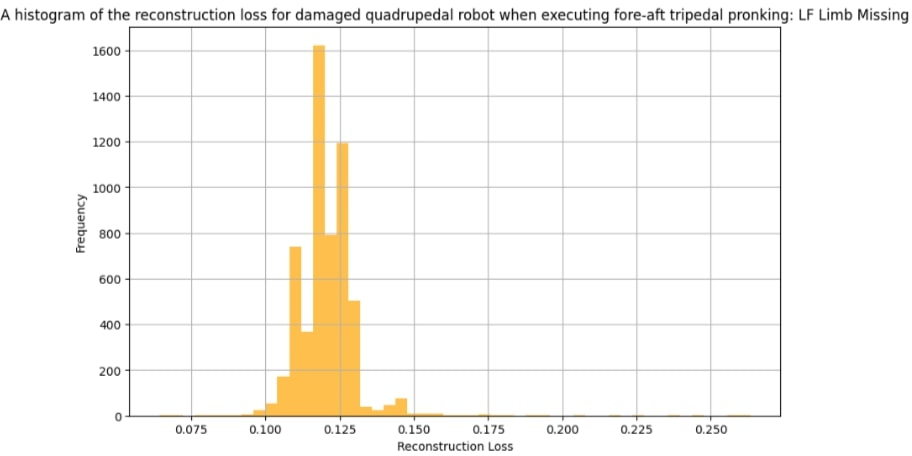
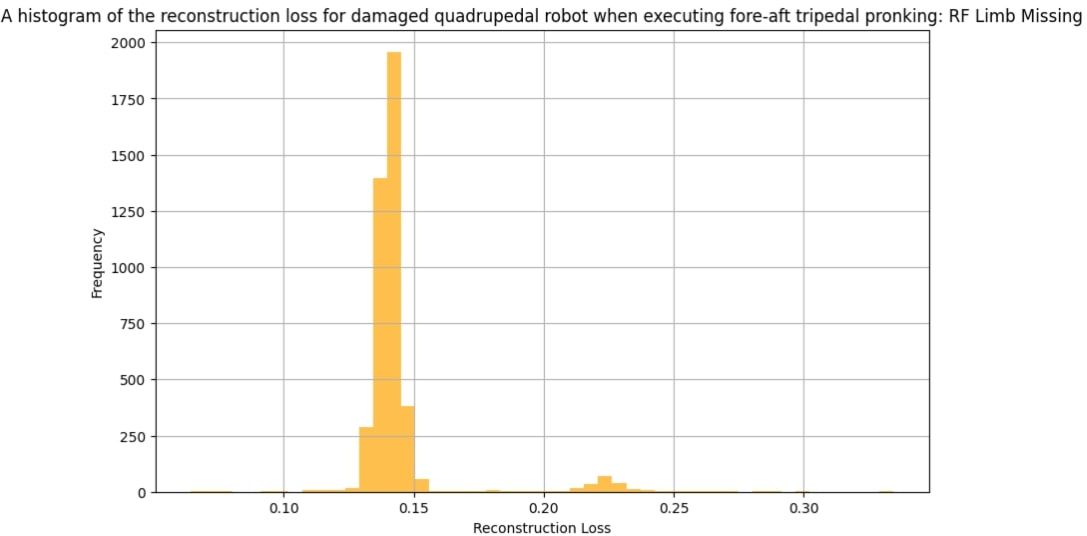
Figure 6: Distribution of reconstruction errors for damaged robot conditions (LF and RF missing), with losses heavily shifted away from the nominal range.
Overlaying the loss distributions for both normal and anomalous cases with the chosen threshold confirms effective anomaly isolation.
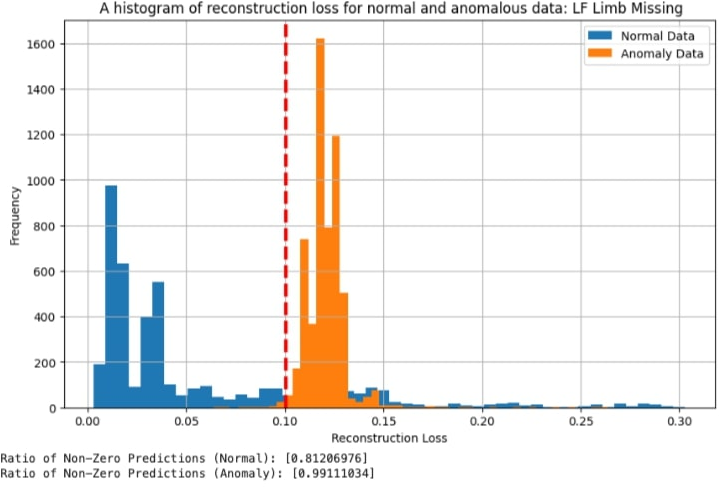
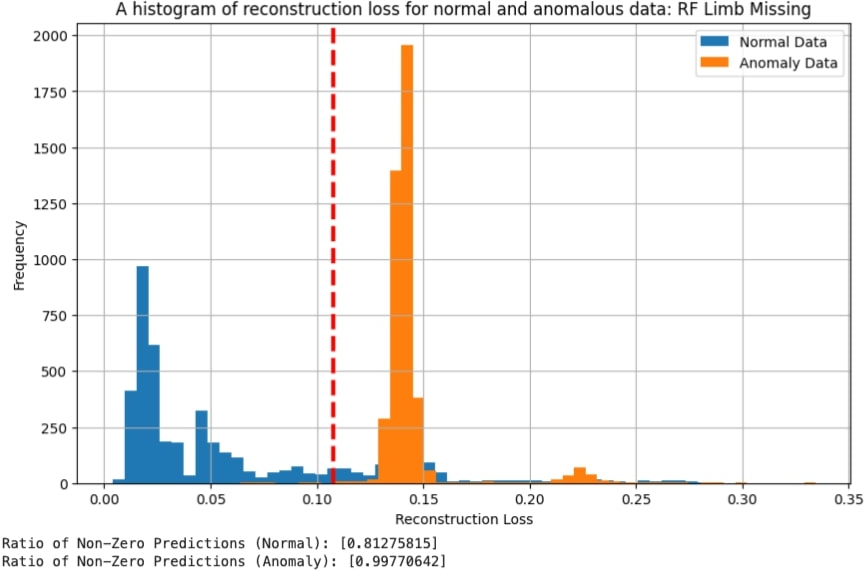
Figure 7: Distributions of reconstruction loss for normal and anomalous data, demonstrating clear separation and the effectiveness of the anomaly threshold for LF and RF limb faults.
The approach achieves high precision and recall: 84.39% (LF case) and 82.48% (RF case) of intact samples are classified as non-damaged, while 99.89% (LF) and 96.86% (RF) of damaged samples are flagged as anomalous. Of particular technical interest, training and validation loss dynamics over epochs reveal rapid convergence and low overfitting.
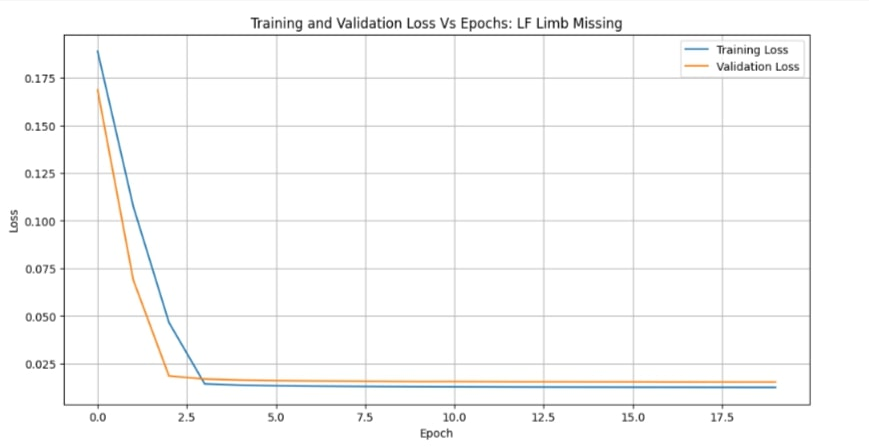
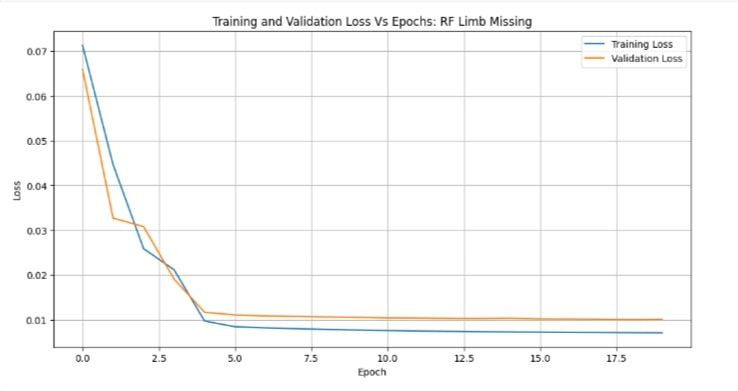
Figure 8: Training and validation loss curves for LF and RF limb-missing conditions, demonstrating robust and stable learning.
Implications and Future Directions
This work validates the feasibility of unsupervised learning strategies for fault detection in fielded robots, even when data labels and detailed kinematic models are unavailable. The autoencoder-based approach capably detects off-nominal locomotion in a computationally lightweight, scalable manner, enabling pragmatic integration with high-level autonomous recovery frameworks. The principal technical limitation lies in the single-limb-fault scope; extension to more complex, multi-fault settings and real-time adaptation remains to be investigated.
A future research trajectory involves ensemble modeling to synergistically capture inter-limb dependencies, which the paper hypothesizes will improve detection fidelity given a larger, richer dataset. Further integration with adaptive control modules could enable seamless, transitions between reactivity and recovery, substantially increasing the autonomy and mission longevity of legged platforms. Additionally, moving from offline to fully online detection is a critical deployment milestone for hazardous-environment robotics.
Conclusion
The study demonstrates that unsupervised, autoencoder-based anomaly detection using only proprioceptive gait data is an effective strategy for identifying major limb faults in quadrupedal robots. The approach exhibits high anomaly detection rates without the necessity for labeled failure data or detailed system identification. This establishes a foundation for further exploration into ensemble models, online adaptation, and end-to-end closed-loop recovery, with broad implications for resilient robotics applicable to real-world search, rescue, and hazardous operations.

