- The paper presents new empirical evidence of widespread young star formation in M82's halo, quantifying roughly 4×10^6 solar masses over 630 Myr.
- It employs deep HST and Subaru HSC photometry along with CMD-fitting techniques to map age gradients and validate extra-planar star formation.
- The study demonstrates that feedback-driven shocks in conjunction with environmental forces trigger star formation across M82’s extraplanar regions.
Overview and Scientific Context
"Stars Born in the Wind II: Widespread Extra-planar Star Formation in M82's Halo" (2604.03230) presents a detailed analysis of the recent star formation in the circumgalactic and halo environments of M82, leveraging deep HST and Subaru HSC resolved star photometry. The work interrogates the spatial distribution, star formation histories (SFHs), and physical origins of young (≲630 Myr) stellar populations in the M82 system, situating these findings in the context of outflow-driven, ram-pressure and tidal star formation mechanisms. The analysis integrates wide-field and high-resolution observations, CMD-fitting SFH determinations, and cross-wavelength dataset validation to build a comprehensive empirical narrative for the baryon cycling and environmental evolution in an archetypical starburst galaxy.
A panoramic Subaru HSC survey, with robust machine learning star-galaxy classification anchored by HST overlap, underpins the selection and mapping of young (≲400 Myr) main sequence and blue helium burning (MS+BHeB) stars. This reveals a diffuse stellar trail (the “M82 Tail”) extending ∼20 kpc eastward from M82’s southern halo, originating from a previously known arc-like feature (the “Southern Arcs”). These features are not co-located with classical red giant branch (RGB) halo populations, suggesting a distinct formation channel.
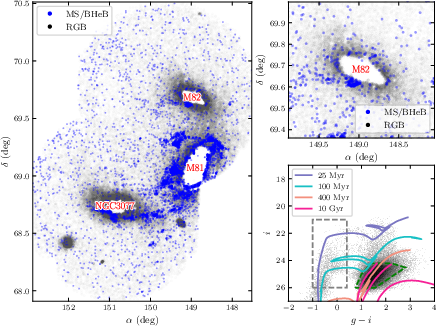
Figure 1: Subaru HSC panoramic mapping delineates populations of young and ancient resolved stars in the M81/M82 group, illustrating the spatial extent of the Southern Arcs and the eastward M82 Tail.
Targeted HST/WFC3 and ACS pointings along the Tail ("Deep Halo Fields") enable precise photometry and artificial star testing (AST) for accurate characterization of photometric completeness and uncertainty. Color-magnitude diagram (CMD) modeling with MATCH, using modern isochrone grids (Padua, MIST, BaSTI), and an explicit exclusion of old RGB-dominated regions, constrains the recent SFHs. The cumulative SFHs show both near-constant and episodic star formation at several loci, with strong temporal correlation to massive cluster formation intervals in the M82 disk. In the M82 Tail fields, an age gradient is observed, with younger stellar fractions increasing toward the galaxy, and older populations dominant further out.
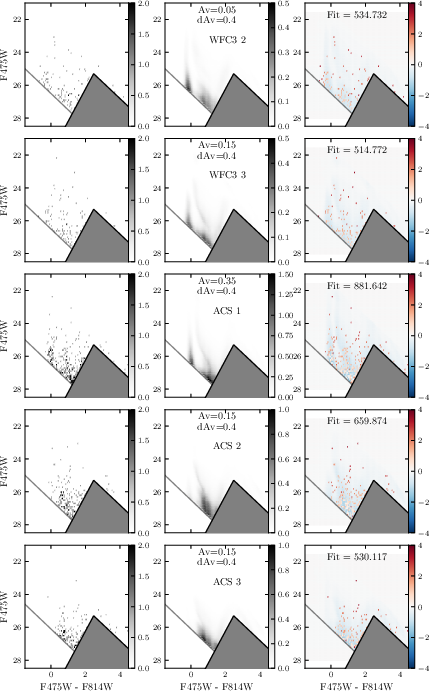
Figure 2: Example Hess diagrams juxtaposing observed and best-fit model CMDs in the Deep Halo Fields, highlighting the model’s ability to reproduce MS and HeB sequences and the exclusion of the RGB populations.
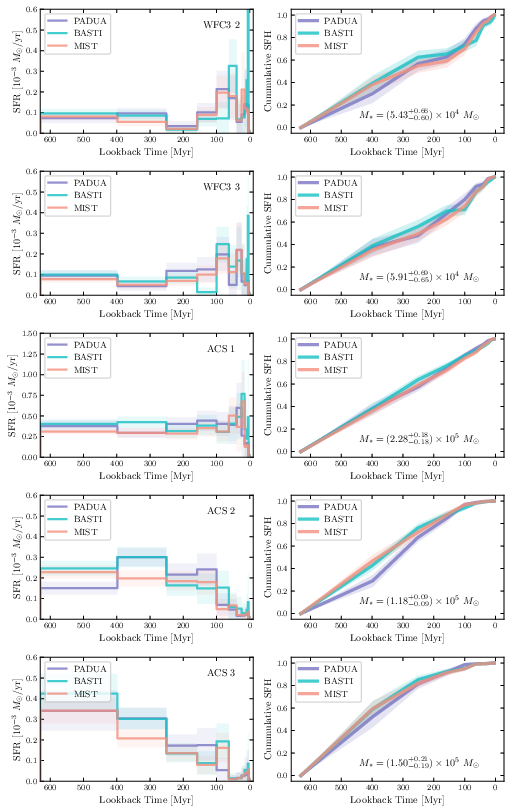
Figure 3: Best-fit SFHs for each Deep Halo Field, quantifying both time-resolved SFRs and the cumulative stellar mass formed over the last ∼630 Myr.
The total new stellar mass formed in the extended halo regions over ∼630 Myr is ∼4×10⁶M⊙, with the M82 Tail and Southern Arcs contributing at least ∼2×10⁶M⊙ and a similar mass inferred from the near-disk regions using the ANGST dataset.
Validation and Cross-wavelength Consistency
The existence of faint, blue stars responsible for the claimed halo star formation—especially in the near-disk regions mapped by ANGST—is validated by cross-matching against deeper JWST NIRCam detections (Cibola survey), which confirms that 86% of the blue ANGST stars have bona fide near-IR counterparts with colors consistent with young populations. This cross-wavelength purity check is essential for excluding spurious blends near completeness limits.
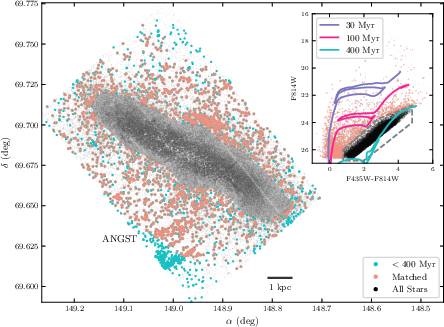
Figure 4: Cross-validation of young stellar populations in the ANGST and NIRCam datasets, supporting the reality of extraplanar recent star formation.
The spatial and temporal distribution of young stars necessitates a combined model for their origin. Three principal mechanisms are interrogated:
- Outflow-induced Shocks: The presence of young stars spatially associated with both the Southern Arcs and the Tail, and age correspondence with elicit star cluster formation epochs in the M82 disk, indicates the action of shocks from the starburst-driven superwind compressing ambient or stripped CGM gas.
- Ram Pressure Stripping: The orientation and age gradient of the M82 Tail are consistent with gas being stripped from M82’s halo via westward (contrary to some older N-body models) motion through the denser M81 CGM, forming a ram-pressure tail where subsequent star formation is triggered, plausibly in combination with shock-driven compression. The paper quantitatively constrains the ram pressure utilizing hot gas halo models, and finds that only diffuse halo gas (NH≲1018 cm−2) can be efficiently stripped—insufficient for star formation unless further compacted, for example, by superwind shocks.
- Tidal and Dynamical Heating: The data show no evidence for coincident RGB overdensities in the Tail, arguing strongly against a classical dynamical heating or tidal origin for these specific populations, although such mechanisms may contribute closer to the disk.
The observed stellar age gradients, absence of old RGBs in key extraplanar features, and the spatial anti-correlation of young stars and HI column density are emphasized as constraints that challenge purely classical tidal or ram-pressure-only formation channels.
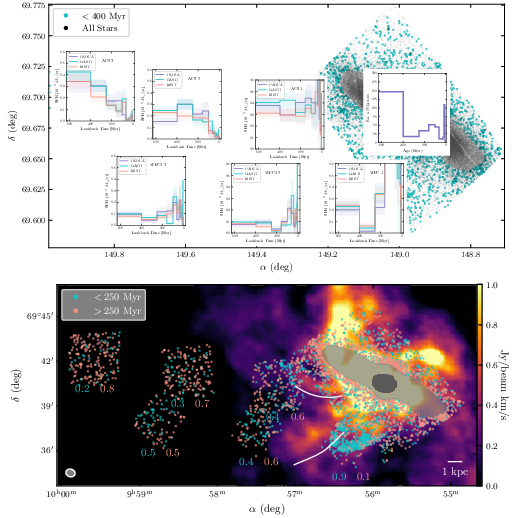
Figure 5: Composite visualization of recent SFHs across Deep Halo Fields and the M82 disk, allowing direct temporal comparison.
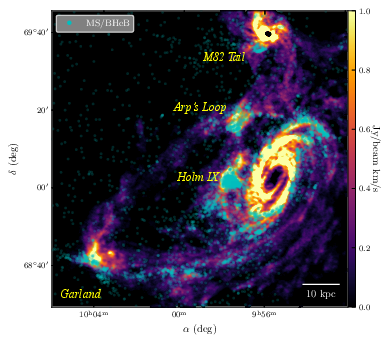
Figure 6: Map of HI and young stars in the M81/M82 system, demonstrating the spatial relationship between stellar over-densities and the neutral gas reservoir.
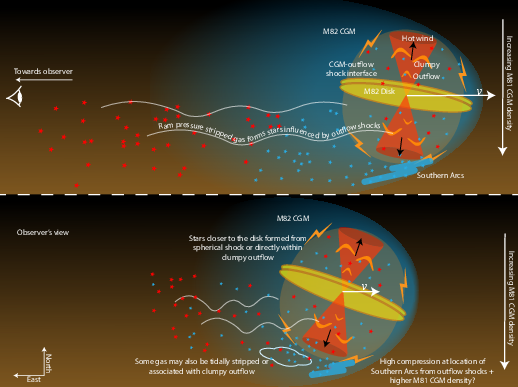
Figure 7: Schematic illustrating the interaction between M82’s outflow, stripped gas, and environmental processes driving extragalactic halo star formation.
Quantitative Conclusions and Implications
The global SFR in the M82 halo (≲4000) is a minor fraction compared to the disk SFR (≲4001), but represents a significant baryon transfer into the circumgalactic medium. The detection of age gradients within the Tail and alignment with disk star formation epochs provides strong empirical support for a multi-modal mechanism involving both environment-driven stripping and feedback-driven shock compression.
Notable claims:
- The M82 halo harbors widespread young (≲4002 Myr) stellar populations distributed up to ≲4003 kpc from the disk, with total new mass ≲4004 in the last ≲4005 Myr.
- The observed stellar age gradient across the Tail is incompatible with stochastic "disk heating" or purely tidal ejection scenarios.
- Ram-pressure stripping in the group environment is insufficient to trigger star formation alone unless abetted by outflow-driven shocks.
Broader Implications and Prospects
The results have important ramifications for the role of feedback (especially in the high-≲4006 Universe) in mediating baryon cycles, the longevity and formation efficiency of stripped tails, and the conditions for in-situ halo star formation. The case study of M82 demonstrates that moderate-density group environments can support extended, feedback-enhanced stellar halo growth outside the canonical merger channels.
For future studies, the authors advocate for spectroscopic follow-up of M82 Tail stars to directly measure kinematics and metallicity, which would further differentiate between disk/outflow/stripped gas origins. The imminent large-area high-resolution surveys from Roman and extensive JWST programs will enable statistically robust mapping of extraplanar star formation in other nearby starbursts, facilitating a broader understanding of feedback/environment synergy in galaxy evolution.
Conclusion
"Stars Born in the Wind II" (2604.03230) provides a comprehensive empirical framework for understanding widespread recent star formation in the halo of M82 and articulates a model where feedback (outflow shocks) and environmental (ram-pressure and tidal) forces co-operate to generate new stellar populations in the circumgalactic environment. The work quantitatively links observed stellar populations, environmental gas distribution, and physical models of galaxy–environment interplay, advancing the understanding of multi-phase baryon cycling and its imprint on galaxy halo structure.

