- The paper introduces a minimal Hamiltonian that shows vibrationally mediated DMI drives efficient singlet–triplet mixing in chiral donor–acceptor systems.
- It employs a Schrieffer-Wolff transformation and Redfield quantum master equation to simulate temperature- and field-dependent spin polarization, exceeding 50% with multi-site bridges.
- The research provides synthetic design strategies for enhancing spintronics applications by harnessing vibrational modulation of spin–orbit coupling and hopping parameters.
Introduction
The theoretical framework for Chirality-Induced Spin Selectivity (CISS) in donor–chiral-bridge–acceptor (D–χ–A) molecules remains incomplete, particularly regarding the reconciliation of weak spin–orbit coupling (SOC) in organics with the strong spin polarization observed in time-resolved electron paramagnetic resonance (TREPR) and electron transfer (ET) experiments. This paper (2604.03210) addresses this fundamental challenge by introducing a minimal yet predictive Hamiltonian, demonstrating that Peierls-type torsional vibrations, modulating both hopping amplitude and SOC, give rise to a vibrationally enhanced Dzyaloshinskii–Moriya interaction (DMI). The DMI produces pronounced singlet–triplet mixing and enables spin polarization well beyond previous expectations for organic CISS systems, bridging between electronic structure parameters and observable spin-selective phenomena.
The system is modeled as sequential incoherent electron transfer from the excited donor state (De) to the acceptor (A) via a chiral bridge (B), as shown in the minimal model scheme.
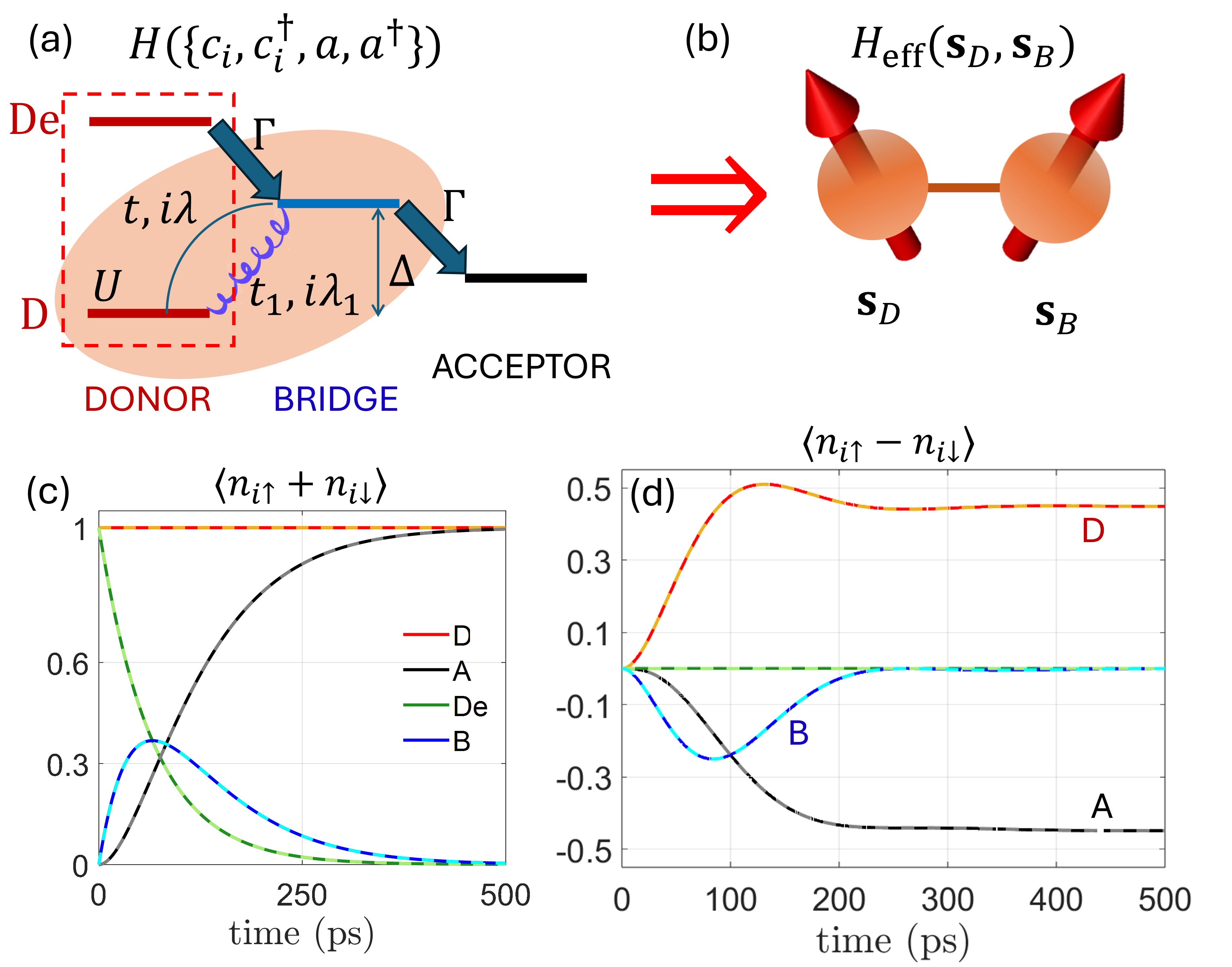
Figure 1: Minimal electron-transfer model and its mapping to an effective spin Hamiltonian, illustrating charge and local spin dynamics in the presence of fermionic and vibrational (bosonic) degrees of freedom.
The core Hamiltonian incorporates:
- Large energy gaps Δ,U separating donor and bridge LUMOs and their on-site repulsions,
- A tunneling term modulated by both static and vibrationally-dependent hopping (t,t1) and SOC (λ,λ1),
- Quantized vibrational modes (torsional), whose occupation serves as a temperature-dependent amplifier of spin interactions.
By a Schrieffer-Wolff (second order) treatment, the Hamiltonian reduces to an effective spin Hamiltonian on the intermediate D–B radical pair:
Heff=JsD⋅sB+JD(2sDzsBz−sDxsBx−sDysBy)+Dz(sDxsBy−sDysBx)
with J (isotropic superexchange), JD (axial anisotropy), and Dz (Dzyaloshinskii–Moriya). Crucially, each term obtains vibrational (boson) enhancements proportional to the thermal boson population and vibrational coupling strengths. Simulations show that these vibrationally-induced DMI terms can reach the same magnitude as J, in contrast to their negligible static values in the organic regime.
Dynamical Regimes and Spin Polarization Enhancement
The spin dynamics during ET is numerically treated within a Redfield quantum master equation, focusing on physically realistic couplings determined by ab-initio calculations. The vibrationally-assisted DMI enables substantial singlet-triplet coherences resulting in large final spin polarization and triplet yields after ET. Importantly, the model predicts:
- Significant spin polarization Pz on the acceptor, with the maximal values depending on the relative strengths of vibrationally-modulated hopping (t1) and SOC (t,t10) and the ET time t,t11.
- The effect is robust at elevated temperatures due to the increase in vibrational occupation, enhancing DMI and exchange couplings.
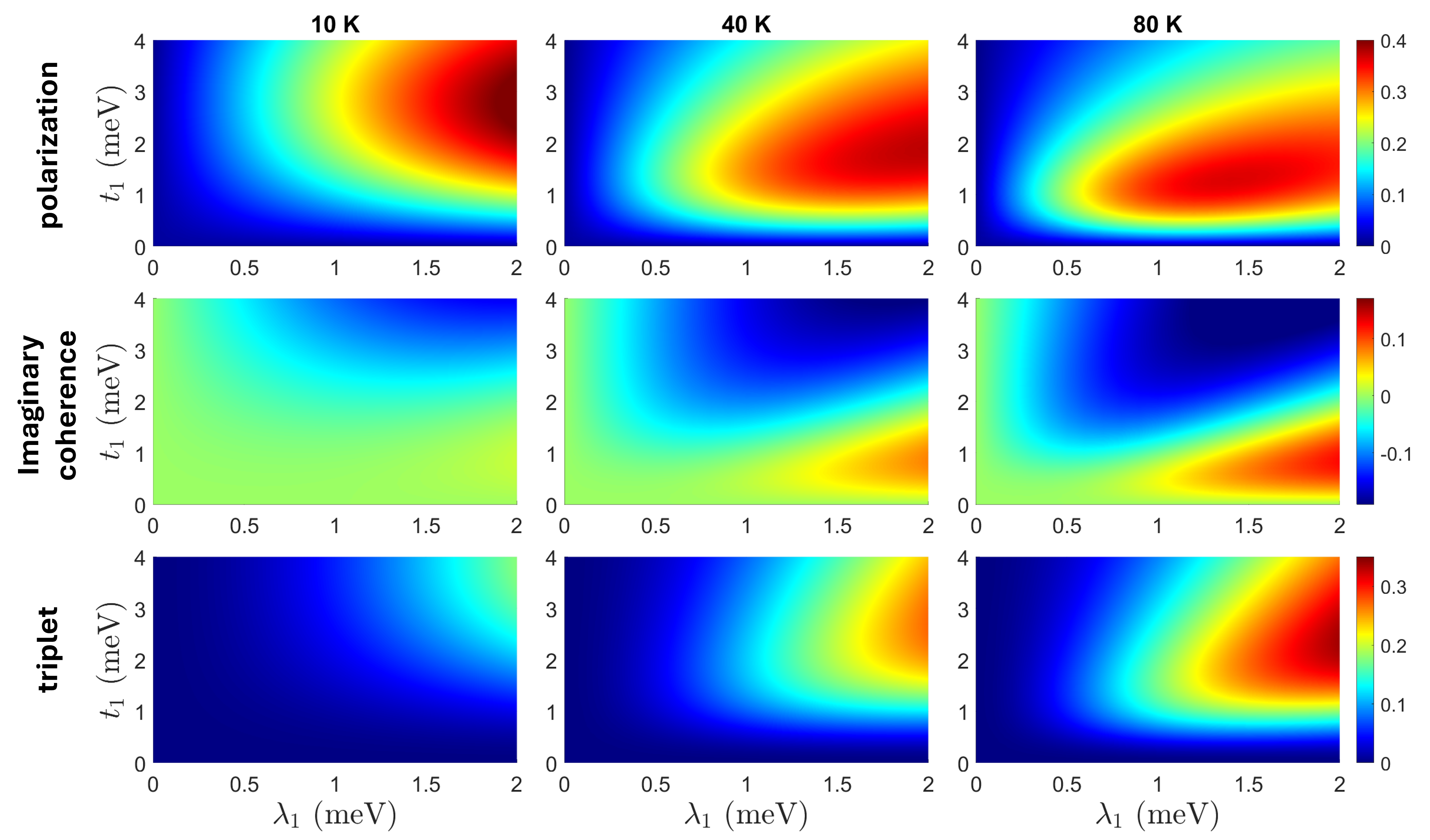
Figure 2: End-of-ET spin polarization, singlet–triplet imaginary coherence, and triplet population as functions of vibrationally modulated parameters t,t12 and t,t13 at different temperatures.
The temperature-dependent resonance between the ET timescale and the spin oscillation, controlled by DMI, yields a non-monotonic maximal polarization, exceeding t,t14 for non-trivial multi-site bridges.
Magnetic Field and EPR Response: Quantitative and Qualitative Agreement with Experiment
The DMI-induced singlet–triplet mixing is highly sensitive to external magnetic fields. Simulated energy diagrams reveal field-tunable avoided crossings (ACs) in the spin pair spectrum; these ACs control the field dependence of the CISS efficiency measured in EPR experiments.
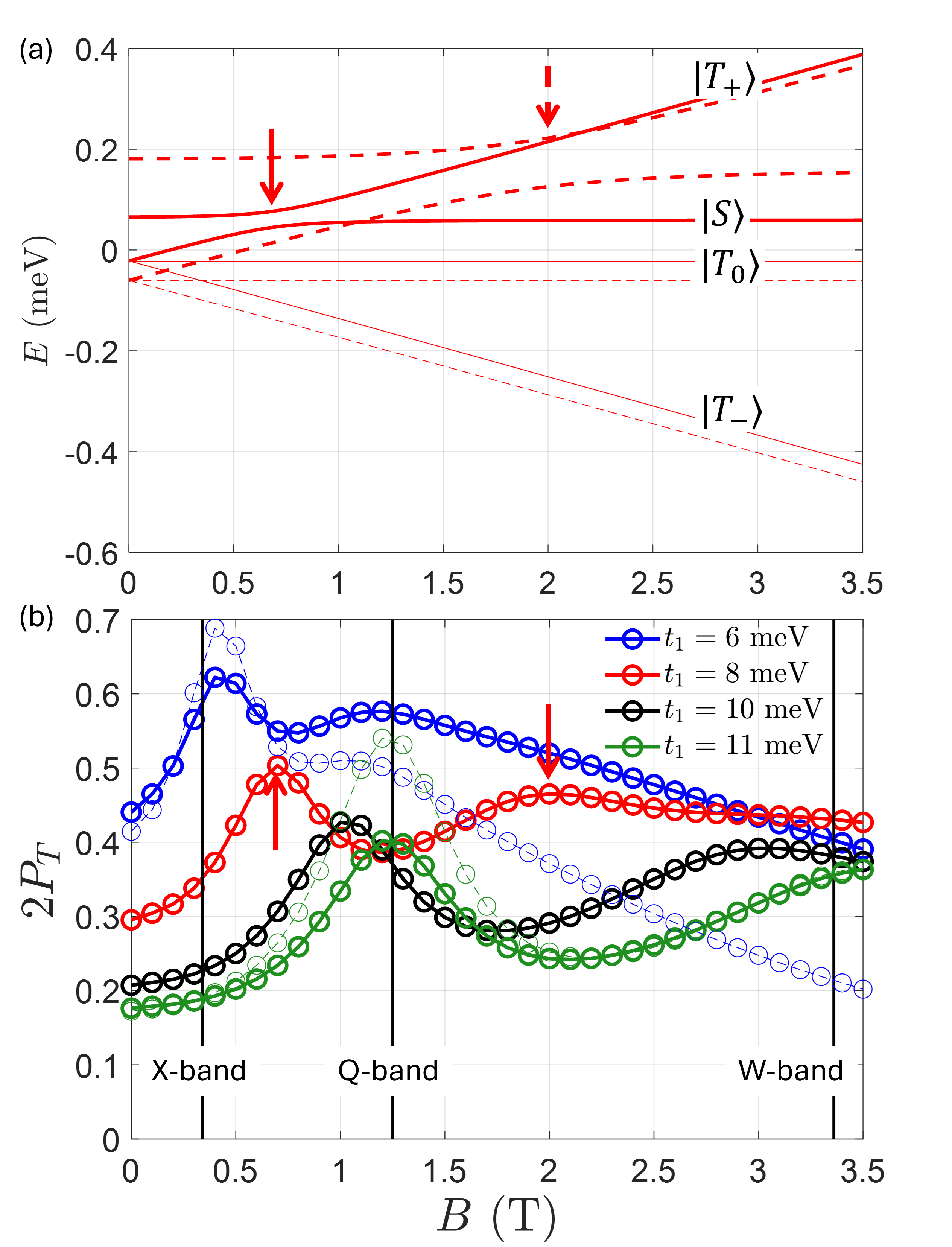
Figure 3: (a) Calculated energy levels as a function of applied magnetic field, showing DMI-induced ACs with vibrational occupation. (b) Simulated CISS efficiency curves as a function of magnetic field, highlighting variation with vibrational parameters and correspondence with experimental X-, Q-, and W-band EPR fields.
The model quantitatively reproduces several experimental findings:
- Triplet yields of 30–60% in the radical pair, compatible with experimental TREPR [Eckvahl et al., Latawiec et al.],
- Non-trivial, parameter-dependent evolution of CISS efficiency with the external field: peaks at the ACs, different saturation behaviors across spectrometer bands, and increased sensitivity with vibrational occupation.
Surpassing the 50% Spin Polarization Limit: The Role of Bridge Structure
The formalism clarifies the well-known t,t15 polarization ceiling for single-site bridges (monochromatic spin oscillations transferred by exponential decay), and establishes several mechanisms for exceeding this bound:
- Multi-site chiral bridges introduce polychromatic oscillations in the bridge spin polarization, leading to constructive multi-mode effects after incoherent ET (see below).
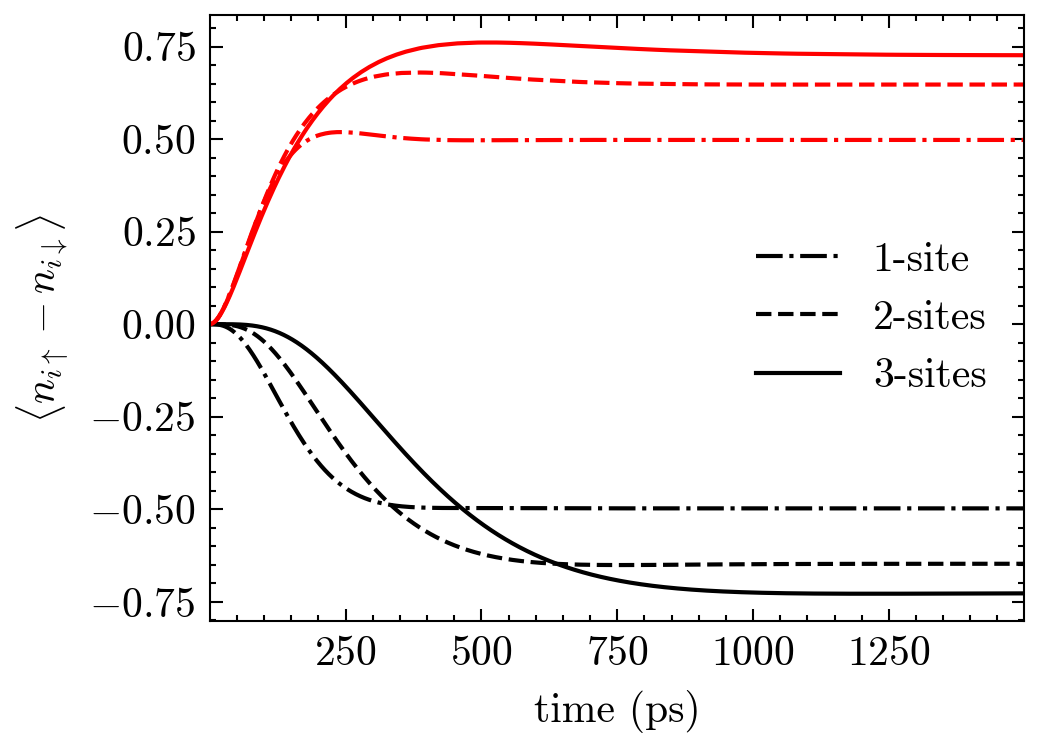
Figure 4: Evolution of spin polarization on donor and acceptor for one-, two-, and three-site bridge models, demonstrating polarization enhancement beyond the 50% limit with increasing bridge length.
Increasing the number of bridge sites, each coupled by DMI to the donor, enables systematically higher acceptor spin polarization (0.5, 0.65, 0.73 for 1, 2, 3 sites, respectively), in accordance with analytical predictions.
Implications, Theoretical Perspective, and Future Applications
This work confirms that vibrational–electronic coupling in chiral bridges is not a perturbative correction but a central element for CISS in organic molecular photophysics. It demonstrates:
- The introduction of low-energy spin dynamics via vibrationally-assisted DMI, reconciling the small energy scale required for magnetic field sensitivity with the large ET gaps and weak organic SOC.
- The amplification of spin selectivity via bridge engineering—offering synthetic levers for spintronics and molecular quantum technology—especially in the radical pair regime relevant to optically addressable spin qubits and quantum sensing.
- The potential for detailed spectroscopic tests: by varying temperature, vibrational mode spectrum, magnetic field direction, and bridge structure, the vibrational origin of DMI can be systematically interrogated.
Furthermore, the mechanistic link between vibrational DMI and spin selectivity is generic for any ET system lacking inversion symmetry, and is thus expected to apply beyond the studied D–χ–A class. The work encourages the development of magnetospectroscopic and temperature-dependent studies on designed molecular systems, as well as ab-initio parametrization for next-generation CISS materials.
Conclusion
The paper provides a comprehensive and quantitatively predictive microscopic theory for CISS in donor–acceptor molecules with chiral bridges. Through ab-initio-anchored modeling, it demonstrates that Peierls-type vibrationally mediated DMI provides the essential low-energy scale for large spin polarization and its field and temperature response, encompassing and explaining a broad class of experimental results. The results open viable pathways for rational bridge design and future applications in spintronics and quantum photochemistry based on organic building blocks.
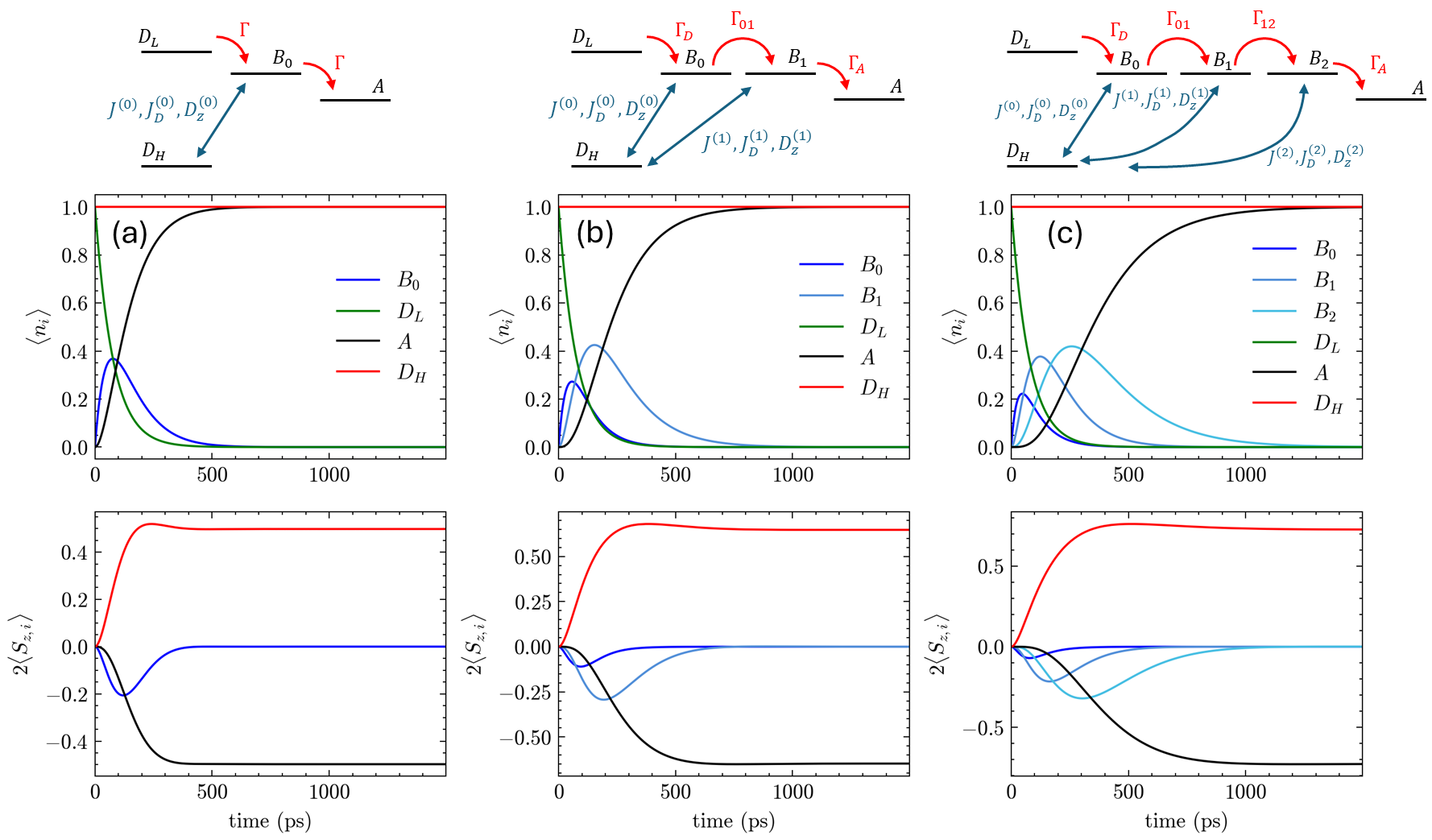
Figure 5: Illustration of population and spin polarization dynamics for bridge models with one, two, and three sites, showcasing scalable spin selectivity with bridge complexity.