- The paper introduces a novel SFFNet architecture that integrates a Multi-Scale Dynamic Dual-Domain Coupling module with a synergistic feature pyramid to enhance UAV object detection.
- It improves small object detection by combining spatial and frequency domain edge enhancements, achieving up to 36.8 AP on VisDrone while reducing model complexity.
- Experimental evaluations demonstrate SFFNet's superiority over state-of-the-art methods, effectively handling dense noise and background clutter in UAV imagery.
SFFNet: Synergistic Feature Fusion Network With Dual-Domain Edge Enhancement for UAV Image Object Detection
Introduction and Motivation
Object detection in UAV imagery is characterized by pronounced challenges stemming from dense background clutter, diverse environmental noise, and significant scale imbalance with a predominance of small targets. Prior approaches—ranging from multi-scale feature pyramids (e.g., FPN, BiFPN) to contextual scene modeling and frequency domain enhancements—have not sufficiently mitigated these issues. SFFNet addresses these limitations via a novel synergistic feature fusion network architecture that explicitly incorporates dual-domain edge enhancement and multi-scale feature coupling, improving the separation of object edges from noisy backgrounds and optimizing feature representation across scale and context.

Figure 1: Relationship between AP and model parameters on VisDrone. SFFNet achieves higher accuracy with fewer parameters compared to baselines.
Architecture Overview
The SFFNet framework integrates three key innovations: the Multi-Scale Dynamic Dual-Domain Coupling (MDDC) module, the Synergistic Feature Pyramid Network (SFPN), and the Wide-Area Perception Module (WPM).
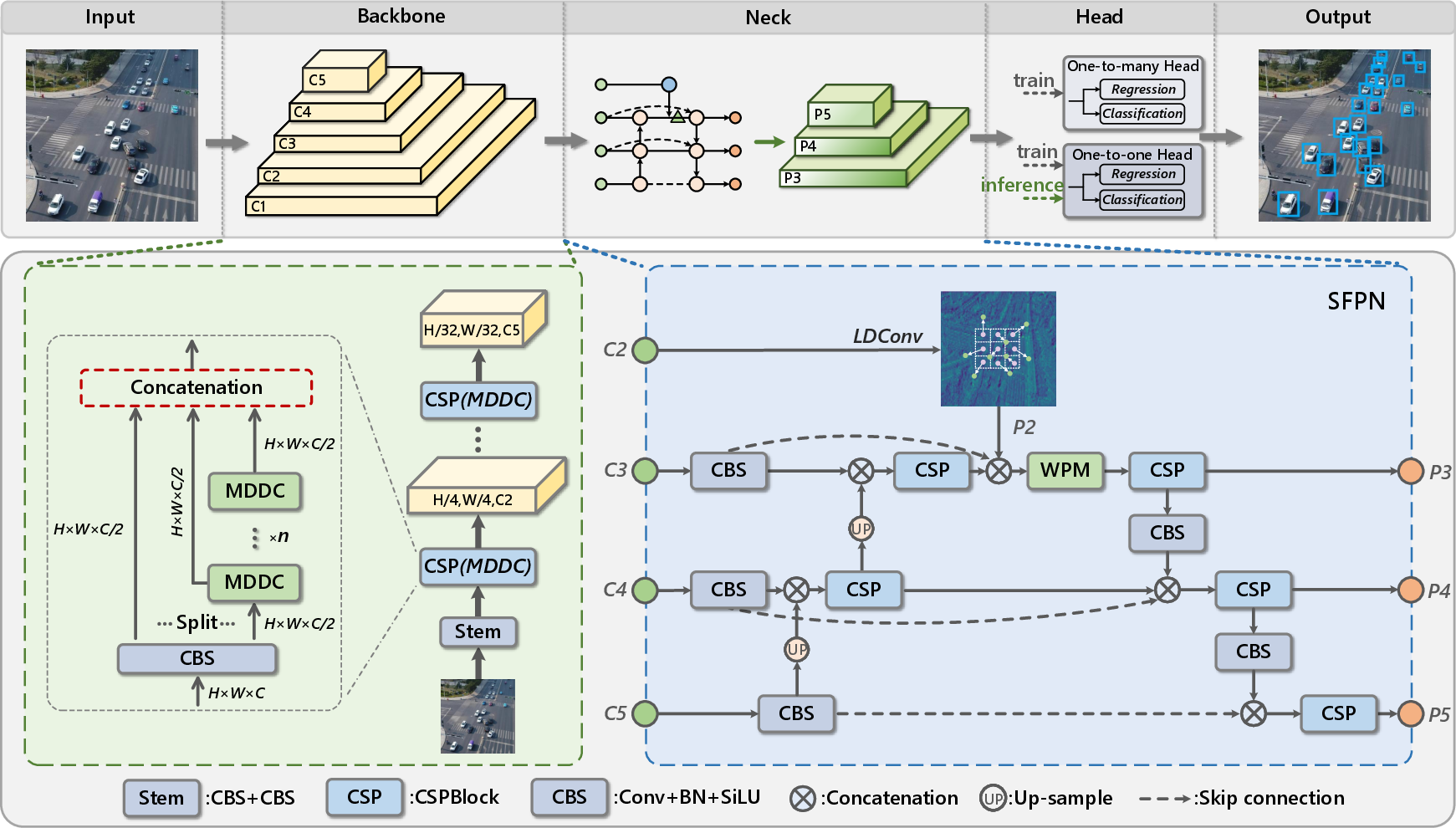
Figure 2: SFFNet framework overview, combining backbone (with MDDC) and neck (SFPN) for collaborative feature fusion and accurate small object detection.
MDDC Module
MDDC performs multi-scale decomposition followed by dual-domain edge extraction (DEIE). In this module, feature maps are adaptively pooled and convolved, generating multi-scale representations. DEIE combines spatial-domain high-frequency feature extraction (subtracting smoothed, low-frequency components) with frequency-domain edge enhancement via spectral decomposition and high-pass filtering. Edge strength maps guide frequency magnitude enhancement, followed by frequency sharpening and inverse Fourier transformation to recover spatial features. Learned adaptive weights integrate spatial and frequency branches, and a supplementary spatial-only branch preserves discriminative details.
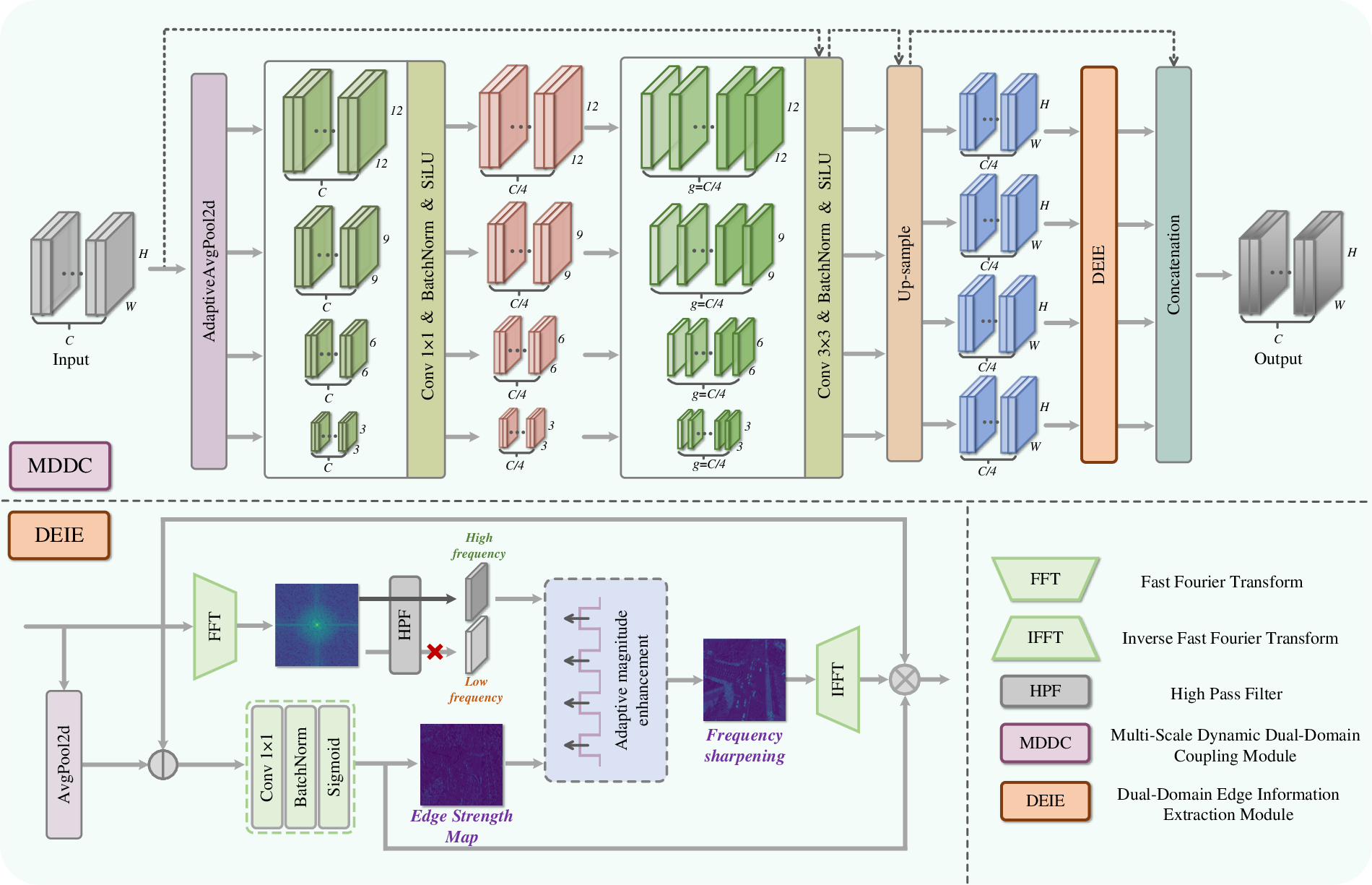
Figure 3: MDDC structure showing multi-scale decomposition and complementary spatial-frequency domain edge extraction, including spectral denoising and sharpening.
SFPN and WPM Modules
SFPN adopts linear deformable convolution (LDConv) at lower pyramid levels (specifically the C2 layer) to capture geometric variations and spatial details of small objects. The P3 layer incorporates the WPM, structured with parallel large kernel, small kernel, and strip convolutions, enabling efficient aggregation of isotropic and anisotropic context across receptive fields.
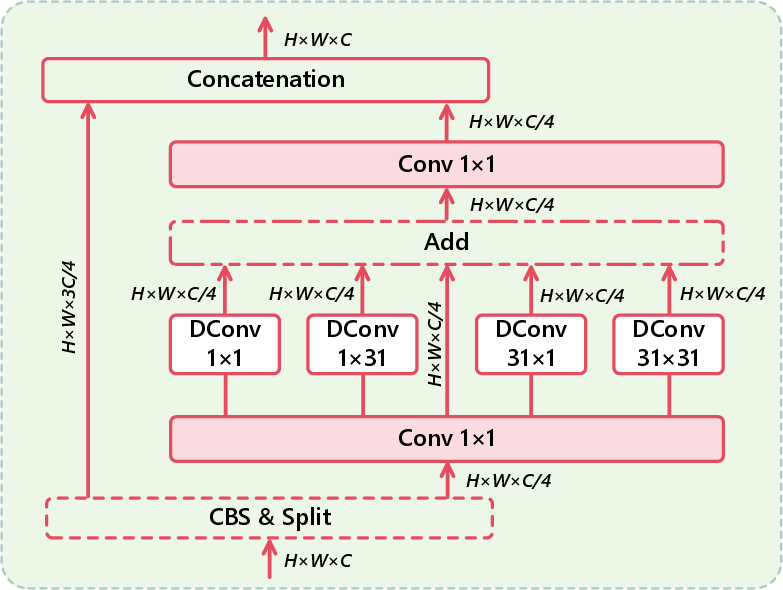
Figure 4: WPM structure, employing a parallel ensemble of large kernel and strip convolutions for heterogeneous context modeling.
SFPN fuses multi-scale features in a bottom-up fashion using concatenation, thereby preserving low-level spatial information and mitigating suppression typical in hierarchical architectures.
Experimental Evaluation
Datasets and Training
Evaluations are performed on VisDrone and UAVDT datasets, both challenging for dense and small object detection in UAV settings. Models are trained from scratch under PyTorch with no pretraining, using SGD optimization and extensive data augmentation.
Quantitative Results
SFFNet-X achieves 36.8 AP on VisDrone and 20.6 AP on UAVDT. Lightweight configurations (N/S) obtain competitive AP while maintaining significant parameter efficiency. Compared to YOLOv8/9/10/11 baselines, SFFNet consistently delivers superior AP for small and medium objects with up to 46% fewer parameters in lightweight models and substantial reductions in FLOPs for larger variants.
(Figure 1) [displayed above]
Comparison with State-of-the-Art
SFFNet outperforms general object detection frameworks (e.g., Faster-RCNN, Transformer-based DETR variants) and UAV-specific approaches (e.g., NE-CDMNet, clustering/density-map methods) in nearly all metrics on VisDrone and UAVDT. Notably, transformer-based detectors underperform due to insufficient preservation of high-resolution shallow features and inadequate adaptation to small object density, reinforcing the dominance of explicit multi-scale fusion and spatial-frequency edge enhancement.
Ablation Studies
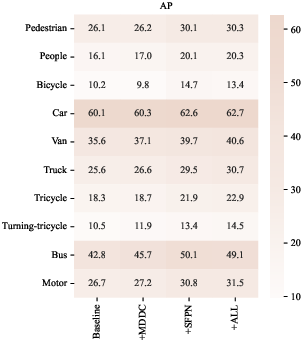
Component-wise ablation highlights:
Qualitative Analysis
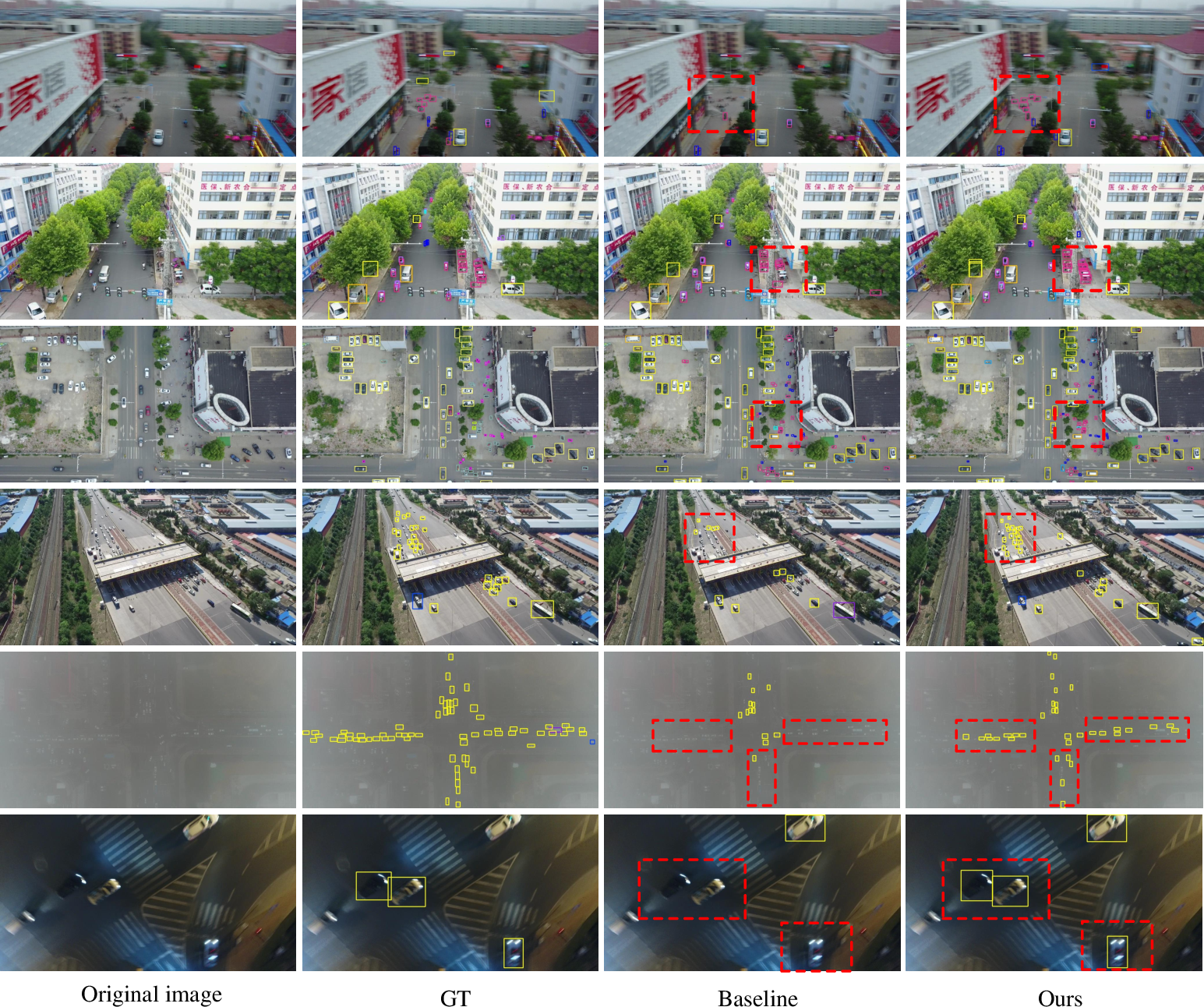
Figure 6: Detection visualization comparing SFFNet and baseline. SFFNet exhibits superior detection in dense, occluded, noisy, and blurred scenarios.
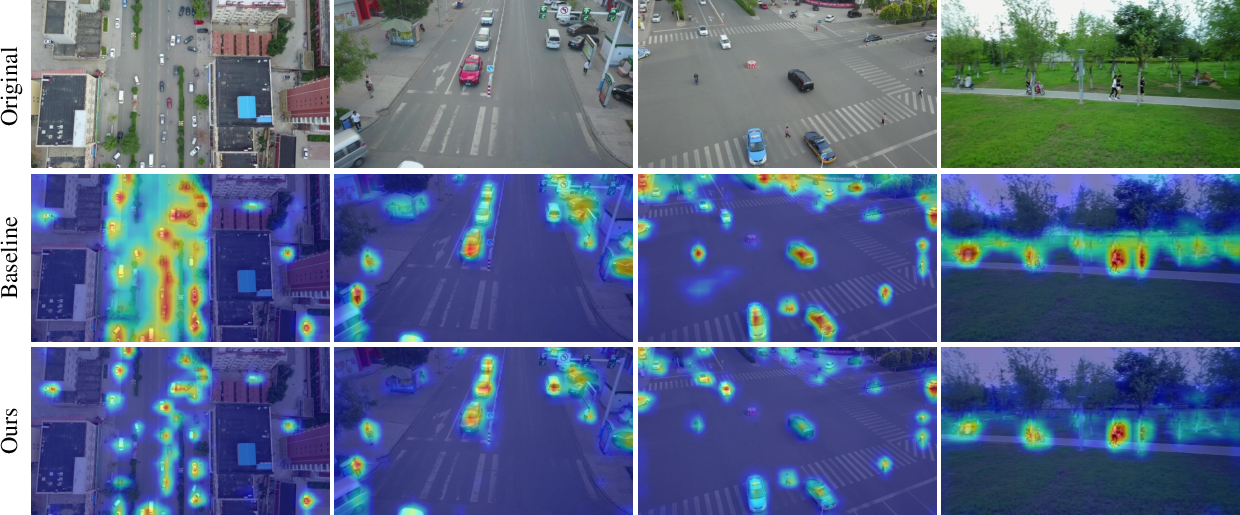
Figure 7: Heatmap visualization showing SFFNet's enhanced focus on targets and suppression of background noise relative to baseline.
Practical and Theoretical Implications
SFFNet systematically advances UAV image object detection by enabling precise edge discrimination and robust multi-scale feature coupling. The dual-domain approach ensures resilience to background clutter and noise, and the integrated large-kernel/strip convolution paradigm in WPM addresses anisotropic context requirements inherent in aerial imagery. The efficiency of lightweight variants underscores SFFNet's suitability for deployment in resource-constrained environments such as onboard UAV hardware.
Theoretically, the joint spatial-frequency modeling expands capacity for fine-grained feature disentanglement and elucidates the complementary nature of domain-based representation learning in dense, low-resolution scenes. The modular backbone-neck structure, scalable across six model sizes, further demonstrates flexibility for adaptive inference.
Future Directions in AI and UAV Detection
While SFFNet's improvements are significant, detection weaknesses for large objects remain. Prospective research could target dynamic anchor box generation and hybrid Transformer-CNN strategies to unify global context modeling with explicit shallow feature preservation. Advancements in frequency domain guidance, adaptive kernel selection, and long-range query mechanisms could close residual performance gaps and generalize SFFNet to new UAV sensor modalities.
Conclusion
SFFNet introduces a scalable, synergistic architecture for UAV image object detection, leveraging multi-scale dynamic dual-domain coupling and context-aware feature aggregation to achieve leading performance in dense, noisy aerial scenes. Extensive empirical and ablation studies substantiate its efficacy, particularly for small object detection under complex backgrounds. The techniques presented herein establish a robust foundation for future UAV detection frameworks and expose promising avenues for domain-specific architectural optimization (2604.03176).