- The paper establishes that the second Neumann eigenfunction can exhibit a closed interior nodal line in doubly-connected planar domains.
- It employs a sliding handle framework in graph-like, thin domains to transfer nodal properties from limiting metric graphs to the continuous setting.
- The work refines convergence techniques by proving strong transversal convergence, thereby extending spectral geometry insights to new topological regimes.
Neumann Nodal Lines Closed in Doubly-Connected Planar Domains
Introduction and Historical Context
The paper "Neumann's nodal line may be closed on doubly-connected planar domains" (2604.03169) investigates the fundamentally topological character of nodal lines associated with the first nontrivial (second) Neumann eigenfunction on planar domains. The principal result establishes, for the first time, that closed nodal lines entirely contained in the interior of a planar domain can occur for Neumann eigenfunctions, as long as the domain is at least doubly connected. This finding fills a significant gap in the existing corpus—the impossibility of closed nodal lines in simply connected settings (Pleijel, 1956) contrasts with the subtle permissibility in multiply-connected geometries.
The arguments are developed within the context of spectral geometry, elliptic PDE theory, and recent advances in the convergence of spectral data from "graph-like" thin domains towards metric graphs. The authors extend strategies originally designed for the Dirichlet Laplacian to the Neumann setting, navigating the additional analytic and topological challenges that arise.
Main Results and Construction
Theorem: There exists a doubly-connected, bounded, open subset of R2 with a second Neumann eigenfunction whose nodal line is closed and does not touch the boundary.
This result is optimal in the sense that such a phenomenon is impossible for simply-connected planar domains. The construction and proof fundamentally exploit the change in comparison principles for eigenvalues under Neumann and Dirichlet boundary conditions—for multiply-connected domains, earlier monotonicity and comparison-based obstructions do not apply.
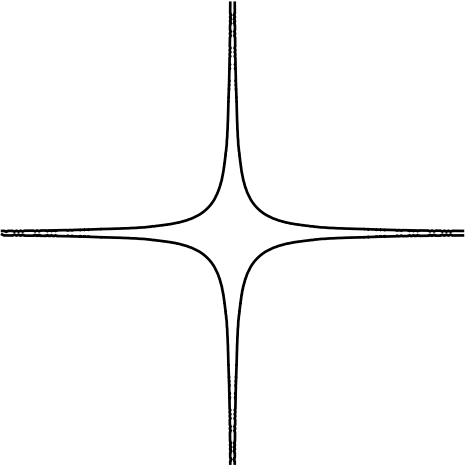
Figure 2: Unbounded domain for which there exists a first non-trivial Neumann eigenfunction whose nodal line does not touch the boundary.
Key Aspects of the Construction
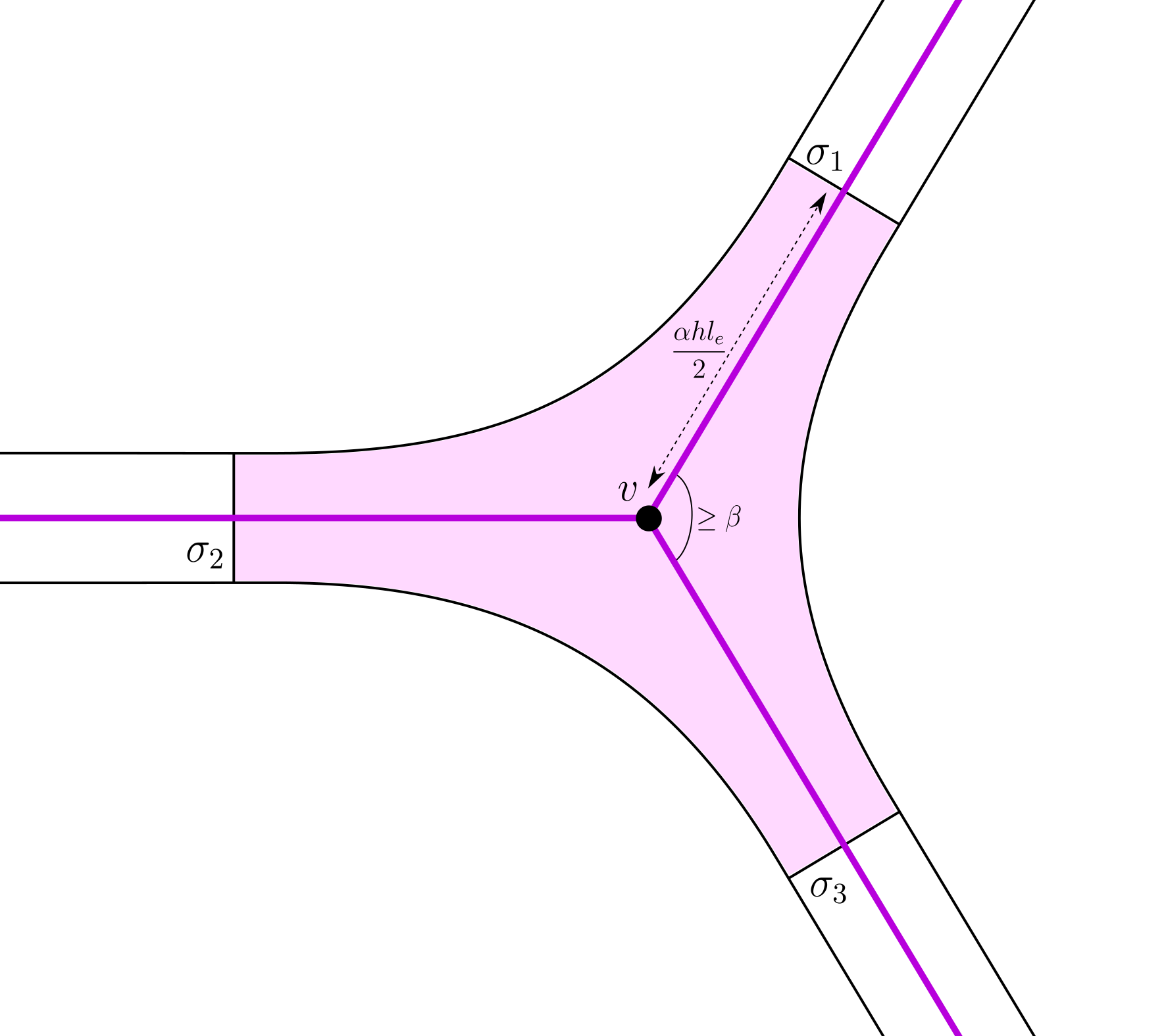
The proof constructs a carefully engineered family of planar, doubly-connected domains with a one-parameter "sliding handle" (termed a Neumann FDSH—Family of Domains with Sliding Handle). The analytic backbone is a convergence framework: as the domain becomes thinner along certain graph-like subregions, its Neumann spectral data converges to that of a limiting metric graph equipped with Neumann-Kirchhoff boundary conditions. This technique ultimately allows the authors to access explicit control over the nodal set in the limit and then transfer these properties back to the original domains.
Notably, the authors establish:
Analysis of the Sliding Handle Mechanism
Unlike the Dirichlet case (for which the sliding-handle argument was previously understood) the Neumann problem requires new constructions due to differences in where eigenfunctions localize. Neumann eigenfunctions tend to oscillate along elongated structures, in contrast to the Dirichlet case where mass localizes in bulk regions away from thin handles. To manipulate the spatial configuration of the nodal set under such constraints, the authors design "caterpillar trees with a loop" as their underlying metric graphs, which are embedded into the plane with a high degree of geometric control.
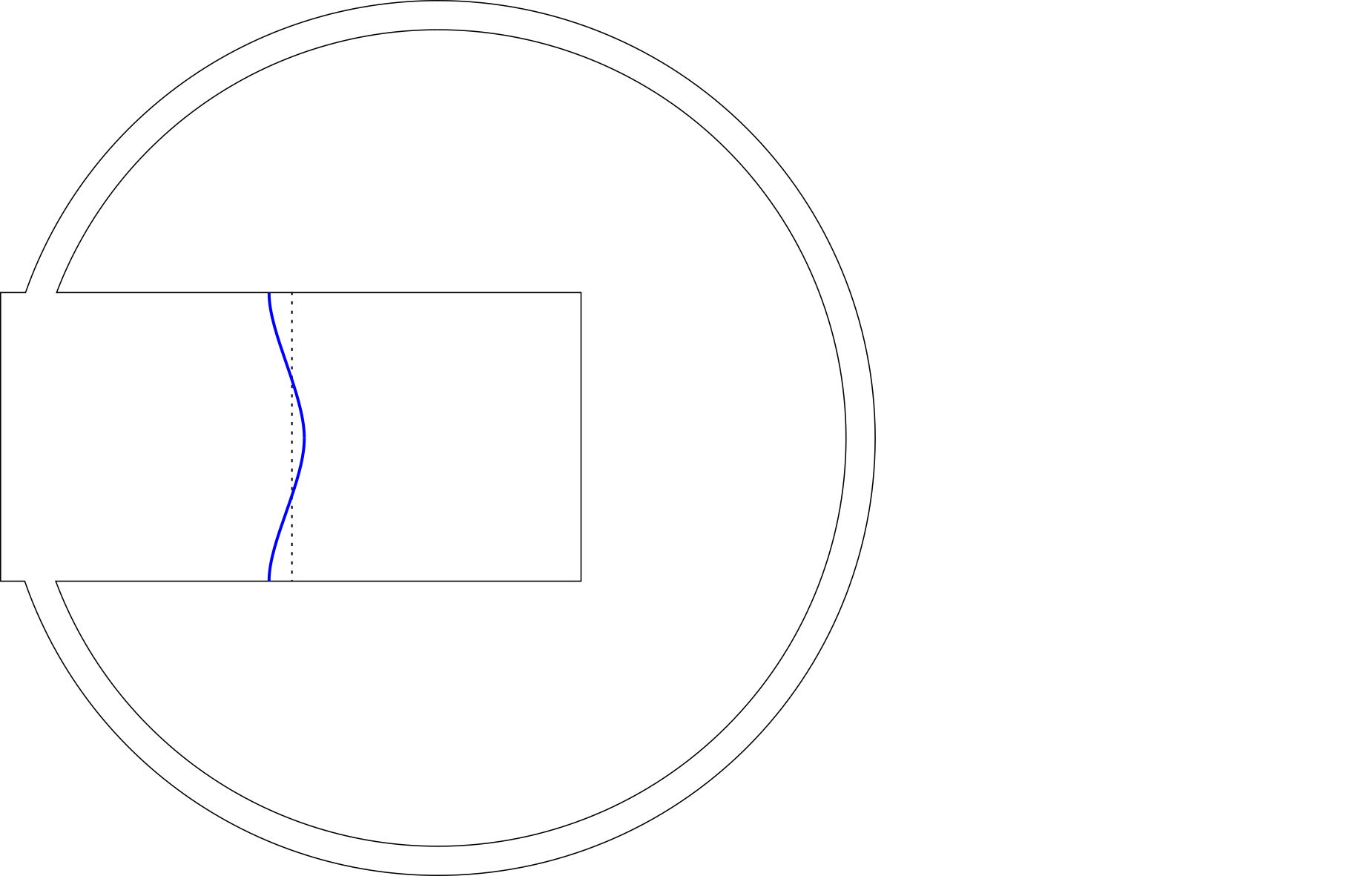
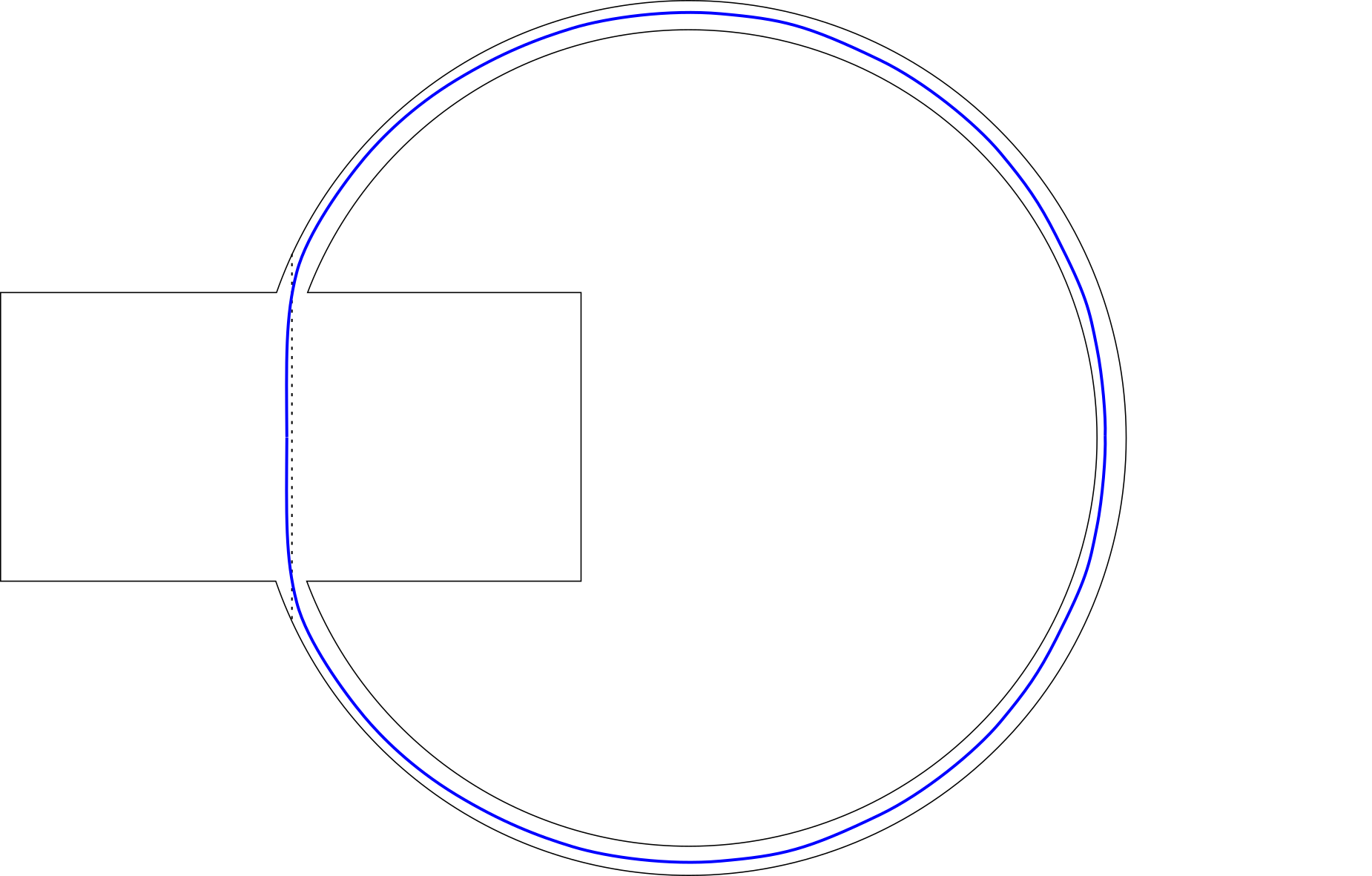
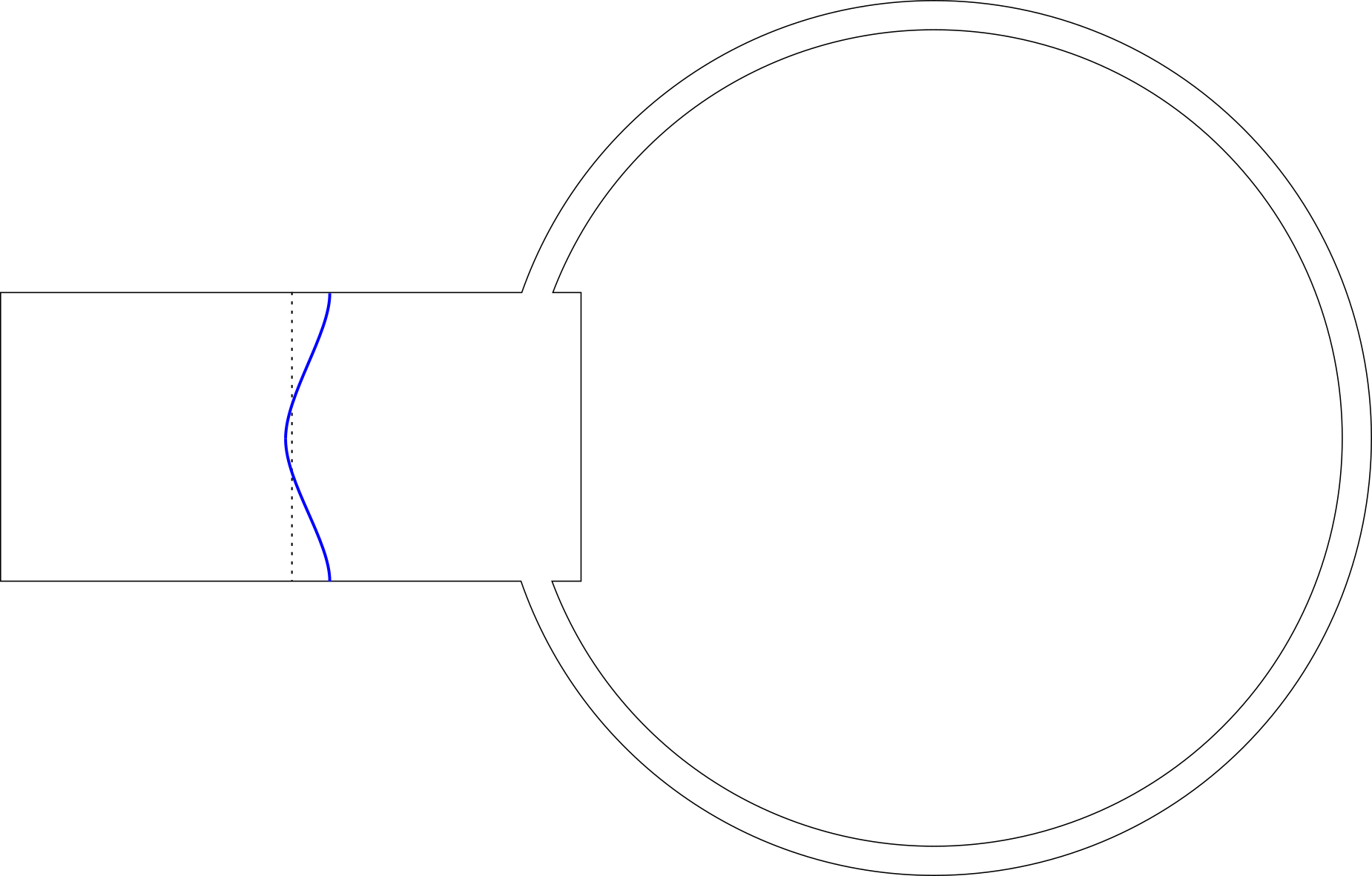
Figure 5: Illustration of the Dirichlet FDSH constructed in the prior work, motivating the sliding handle paradigm.
The sliding parameter interpolates between configurations where the nodal line touches distinct boundary components, so by continuity it must be disjoint from the boundary at some intermediate value—yielding a closed, interior nodal line.
Strong Transversal Convergence
A technical highlight is the introduction and proof of strong transversal convergence for eigenfunctions on graph-like domains converging to metric graphs. This result significantly strengthens prior L2-based convergence, effectively ensuring that nodal information is preserved in the thin domain limit not just in measure but slice-wise, which is essential for controlling the location of the nodal line.
Analytically, this requires careful elliptic estimates and handling degenerate geometries. The convergence is proven to hold in Ck+1,α for almost every transversal fiber, enabling a transplantation of nodal topology from the abstract graph to planar domains.
Implications and Theoretical Consequences
This work underscores the deep interplay between spectral geometry, analysis, and domain topology. The main result aligns the Neumann case with known phenomena in the Dirichlet and Robin settings, suggesting that the existence of closed interior nodal lines is a topological property depending on the connectedness of the domain rather than on the specific boundary condition.
The authors conjecture that for the Laplacian with Dirichlet or Robin boundary conditions, closed nodal lines for the second eigenfunction are impossible for simply-connected domains but may occur for doubly-connected ones—a broad topological conjecture likely applicable to other mixed or Steklov-type problems.
Practically, their construction methods and convergence results can be leveraged for the design and analysis of whispering-gallery or quantum graph systems, as well as for the control of wave localization in planar microstructures or photonic devices where nodal domain configuration is critical.
Future Directions
Several open problems emerge from this analysis:
- Quantitative bounds on the minimal size of the hole required for a closed nodal line, especially in the Neumann case.
- Extension of the strong convergence paradigm to higher eigenfunctions or to more general topologies.
- Analytical characterization of possible degeneracies when the domain approaches "fracture-like" connectivity.
The convergence theory for spectral data, especially when refined to ensure the topological persistence of nodal sets, will continue to inform both theoretical spectral geometry and applications in mathematical physics.
Conclusion
This paper elucidates the precise topological prerequisites for closed Neumann nodal lines in planar domains, extending and clarifying the classical results of Pleijel and contemporary Dirichlet problem literature. By synthesizing nodal set topology, metric graph limits, and strong analytic convergence, the authors resolve long-standing ambiguities in the Neumann context and chart a roadmap for further exploration of spectral-topological invariants in PDEs on variable domains.