- The paper presents an exact closed-form mapping from a stationary Gaussian fading process to a binary GE Markov chain using Owen’s T-function and the arcsine law.
- It quantifies how slot correlation, threshold levels, and kernel smoothness (squared-exponential vs. exponential) directly influence link-layer burst statistics and error persistence.
- The results reveal that first-order GE models may inadequately capture long burst behavior, suggesting higher-order FSMCs for applications like ARQ, queuing, and network control.
Introduction and Problem Statement
Modeling time-varying wireless channels requires balancing richness and tractability. At the physical (PHY) layer, temporal evolution is naturally captured by a stationary Gaussian process, as is standard for log-normal shadow fading or correlated SNR evolution. At the link layer, analysis, simulation, and protocol design typically rely on simplified, finite-memory stochastic models—most ubiquitously, the two-state Gilbert-Elliott (GE) Markov chain abstraction, which distills rich PHY dynamics into a binary "good" versus "bad" decodable sequence with quantifiable burst memory.
Historically, practitioners require an explicit relationship between statistical parameters in the underlying Gaussian model—especially its covariance structure and slot duration—and the transition probabilities in the link-layer GE abstraction. Prior approaches rely on continuous-time approximations such as level-crossing rates (LCR) and average fade duration (AFD), or on heuristic fitting. These methods neither yield discrete-slot GE probabilities in closed-form nor appropriately capture the discrete-time pathologies inherent to realistic digital systems.
This paper presents, for the first time, an exact, closed-form mapping from a stationary, time-correlated Gaussian fading process to its corresponding GE binary Markov chain upon threshold crossing at discrete slot boundaries (2604.03160). The formulas connect key parameters, including slot duration, process covariance, thresholding level, and resulting link burstiness, via special function representations with substantial implications for communication theory, network modeling, and stochastic systems underpinning ARQ, estimation, and queueing protocols.
Let X(t) be a stationary, zero-mean Gaussian process with marginal variance σ2 and autocovariance kernel K(τ). Sampling in discrete slots of duration D, with binary quantization at threshold S, induces a sequence B(n)=I[X(nD)≥S]. The key insight is that the sequence of bivariate correlations across one slot, ρ=K(D)/K(0), encapsulates all necessary memory in the first-order Markov approximation constructed for the post-thresholded process.
The paper derives exact expressions for the GE transition probabilities,
p01=Pr(B(n+1)=1∣B(n)=0),p10=Pr(B(n+1)=0∣B(n)=1),
as closed-form functions of the slot-by-slot correlation ρ and normalized threshold s=S/σ. For general thresholds, the answer is given in terms of Owen's σ20-function; for symmetric thresholding (σ21), it reduces to the elementary arcsine law from classical probability.
Elementary case (σ22):
σ23
This minimal form is immediately evaluable, and all GE statistics reduce to functions of the slot correlation.
General threshold:
σ24
where σ25 is Owen's σ26-function and σ27.
These formulas are exact for the one-step conditionals of the binary process obtained by thresholding a stationary Gaussian. They are applicable for any stationary kernel, any slot separation, and any threshold.
Influence of Covariance Kernel Smoothness on Link-Layer Dynamics
Crucially, the authors expose a qualitative dichotomy in burst memory at the link layer, governed by kernel smoothness at the physical layer. If the kernel is smooth at the origin (e.g., squared-exponential), sample paths are smooth, slot-to-slot changes are small (σ28), and state persistences scale linearly with the physical correlation time σ29. For a rough kernel such as the exponential (Ornstein-Uhlenbeck), non-differentiability causes larger slot-wise increments, and link-layer persistence scales only as K(τ)0. This is formalized in asymptotic expansions for large K(τ)1:
- Squared-exponential (smooth): K(τ)2
- Exponential (rough/OU): K(τ)3
This implies that physical-layer regularity translates directly to the practical link property of error burstiness, with substantial predictive and design consequences.
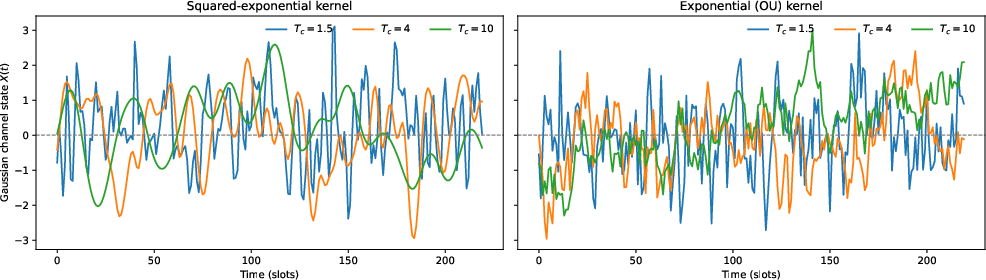
Figure 2: Sample paths for the stationary Gaussian process with varying K(τ)4 and different kernel smoothness, illustrating path regularity.
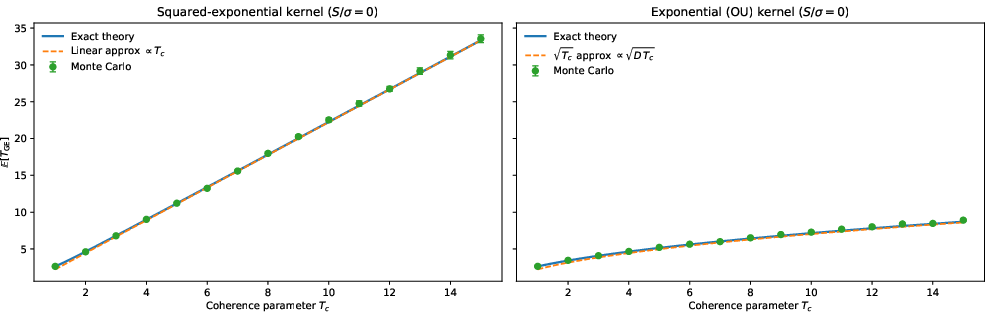
Figure 1: Expected GE persistence time as a function of K(τ)5 for two kernels; confirming theory (lines/asymptotes) and simulations (symbols).
Fidelity of the First-Order GE Approximation
Thresholding a time-correlated Gaussian process yields a binary process with intractable, higher-order memory. The paper analytically and empirically quantifies, for the first time, two critical diagnostics:
- Markov gap: Measures the difference between true two-step and approximated one-step conditional probabilities.
- Run-length total variation (TV) distance: Assesses the deviation of empirical run-length statistics from the geometric law predicted by GE.
A particularly revealing phenomenon is that for the squared-exponential kernel, as K(τ)6 increases, the Markov gap (a local diagnostic) decreases, reflecting decaying non-Markovian dependence, but the run-length TV distance (a global diagnostic) increases, signaling increasingly non-geometric, bursty behavior. For the exponential kernel, the Markov gap increases with K(τ)7, despite the underlying Gaussian being exactly first-order Markov; thresholding amplifies "initial condition" effects, transferring non-Markovity to the binary process.
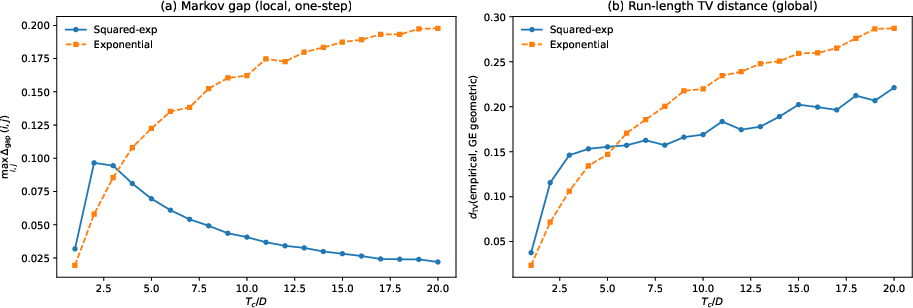
Figure 4: Opposite trends for Markov gap and run-length TV error for two kernels: for squared-exponential, local non-Markovity falls while global statistics deviate more; for exponential, local gap widens with K(τ)8.
The results show that the first-order GE model, while always matching one-step transition rates, can be a poor generator for long-burst statistics at large K(τ)9. Second-order Markov models mitigate this effect for the exponential kernel but not for the squared-exponential.
Visualization of Transition Probabilities and Dwell Statistics
The study systematically visualizes transition probabilities and dwell times for several thresholds and kernel types, validating closed-form predictions with large-scale Monte Carlo simulation.
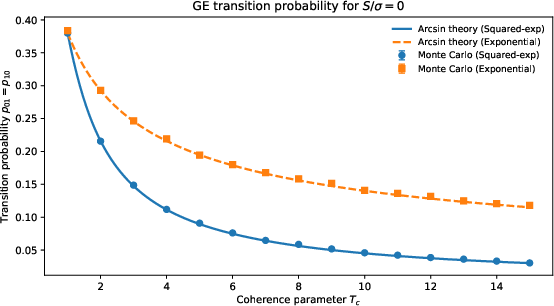
Figure 3: Matched GE transition probabilities vs. D0 for symmetric thresholding; solid (squared-exponential) and dashed (exponential) theory and simulation markers.
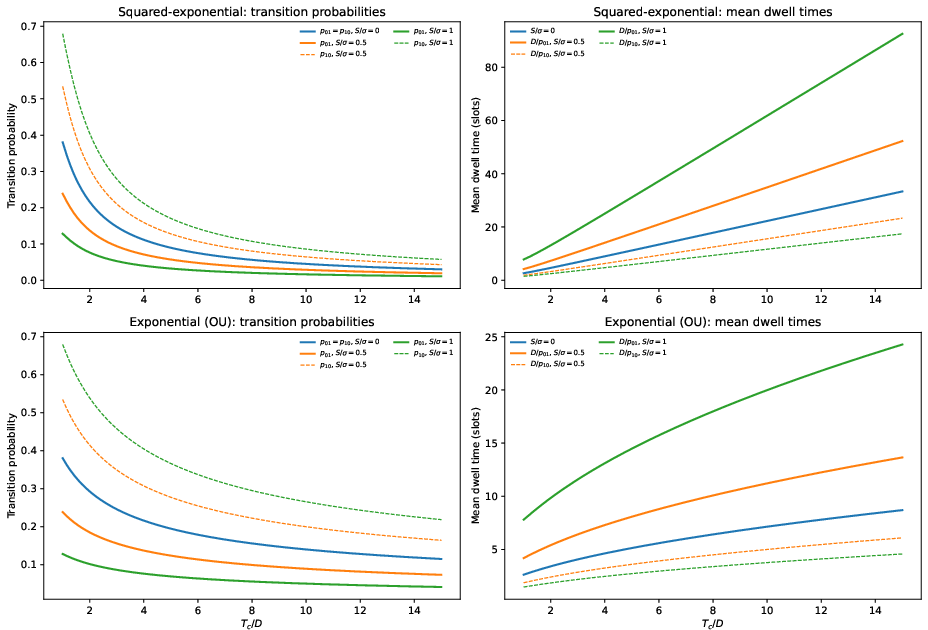
Figure 6: Transition probabilities and mean dwell times for multiple thresholds and kernels, demonstrating higher burstiness for smoother (squared-exponential) kernels.
Implications and Future Directions
The closed-form bridge enables principled, analytic parameterization of GE (and, by extension, higher-order FSMC) models for arbitrary stationary physical fading models. The dichotomy between slot-level and burst-level model fidelity highlights the limitations of GE simplifications for applications—such as ARQ, queueing, and networked control—where error burst length, rather than just one-step transition rates, determines user-perceived quality. The insights suggest:
- Higher-order Markov models may be required when accurate modeling of error burst distributions is necessary, especially for physically smooth fading (large D1).
- For the exponential kernel (common in practical link scenario fits), most non-Markovity resides at second order, supporting the sufficiency of modest-order FSMCs.
- Analytical predictions of link burstiness and error persistence for given system parameters are now accessible, obviating Monte Carlo-based fitting.
Potential directions include generalizing to nonbinary quantization (M-state models), nonstationary kernels, or inclusion of additional physical-layer effects such as Doppler or spatial correlation. The formulas can be integrated into cross-layer design tools, simulators, and standards for stochastic wireless modeling, improving both modeling fidelity and design transparency.
Conclusion
This work rigorously establishes the formal, exact mapping between a stationary Gaussian fading process and its binary GE Markov abstraction in discrete time. The use of special function closed forms, asymptotics, and systematic diagnostic evaluation provides a comprehensive platform for bridging physical and link-layer perspectives in communication theory. The explicit dependence of link burst statistics on kernel smoothness offers both practical guidelines for FSMC fitting and theoretical insight into the propagation of physical-layer randomness into higher-layer performance models.

