- The paper introduces an entropy correction approach by allocating multiple artificial viscosities to enforce stability in DG simulations.
- It formulates viscosity coefficients via a constrained quadratic optimization problem, ensuring localized, selective dissipation per flow feature.
- Numerical experiments demonstrate high-order accuracy and effective stabilization for challenges like receding flows and Kelvin-Helmholtz instabilities.
Entropy Correction Artificial Viscosity Using Multiple Artificial Viscosities for High-Order DG Methods
Introduction and Motivation
High-order discontinuous Galerkin (DG) methods provide a pathway for accurately resolving complex compressible flows in computational fluid dynamics (CFD). Robustness and stability in the presence of shocks or under-resolved phenomena remain central challenges, particularly with entropy conservation and shock capturing. Traditional approaches often rely on computationally intensive entropy-conservative fluxes or empirically tuned artificial viscosities, which may degrade accuracy or introduce heuristic dependencies. This paper introduces a systematic framework for entropy correction artificial viscosity (ECAV) that extends to multiple viscosity mechanisms. The intent is to optimize physical fidelity and robustness in an entropy-stable fashion, allowing the method to more precisely target specific flow phenomena.
Entropy-Stable DG and Viscous Regularization
The authors formulate the entropy stability condition for nonlinear conservation laws through cell-integrated entropy inequalities. Rather than enforcing entropy inequality via conservative flux differencing, their approach corrects entropy violations by locally introducing artificial viscosity terms. The generic conservation law for variable u and its fluxes fi(u) is augmented by viscous regularization:
∂t∂u+i=1∑d∂xi∂fi(u)=m=1∑Mgviscm,
where each gviscm denotes a distinct artificial viscosity model (e.g., Laplacian, thermal, or spectral vanishing).
The central idea is to choose the viscosity coefficients ϵkm(uh) per element by solving a quadratic optimization problem with a linear constraint—that the sum of entropy dissipation contributions equals the local entropy residual. The explicit, parameter-free solution assigns dissipation according to the entropy-violating content and sensitivity of each mechanism.
Multiple Viscosity Models and Optimization
Two primary viscosity models are discussed in detail:
- Svärd Thermal Viscosity Model: This model augments the standard Laplacian viscosity with a thermal diffusivity term dependent on the temperature gradient, specifically formulated to address overheating errors and improve entropy stability.
- Spectral Vanishing Viscosity (SVV): Following Tadmor’s paradigm, SVV targets high-frequency content using modal filtering, effectively damping only the unresolved, oscillatory components while minimally affecting resolved features.
The viscosity coefficients are determined by minimizing a quadratic functional subject to an entropy dissipation constraint, allowing the method to allocate dissipation across the different models based on the instantaneous local solution properties.
Numerical Results and Analysis
High-Order Accuracy and Convergence
The ECAV framework with multiple artificial viscosities was tested for a 1D density wave using the compressible Euler equations. The results verify optimal rates of convergence for polynomial degrees up to N=4, confirming that the approach preserves formal high-order accuracy.
Receding Flow and Overheating
A significant practical challenge addressed is the receding flow (Riemann) problem, historically plagued by spurious temperature (false heating) phenomena that persist regardless of mesh refinement. Inclusion of the Svärd thermal viscosity term reduces temperature spikes and improves fidelity of the thermal profile, as illustrated below:
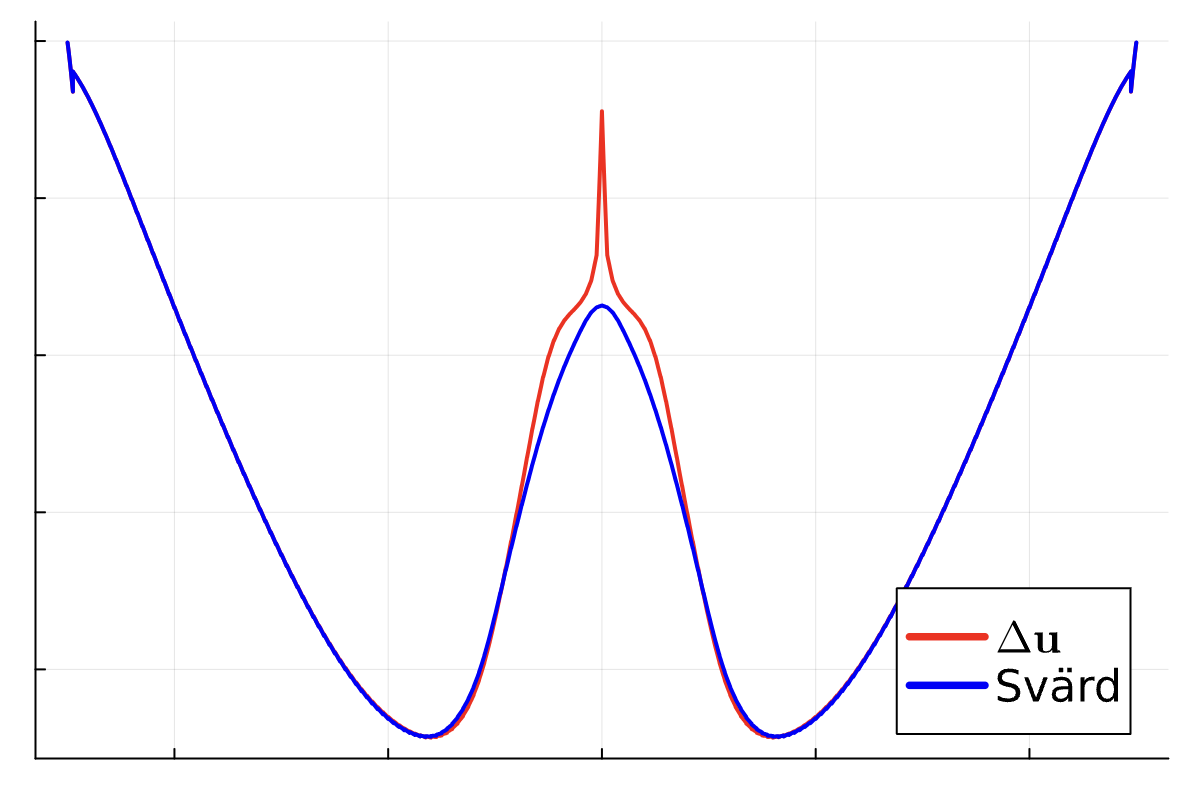
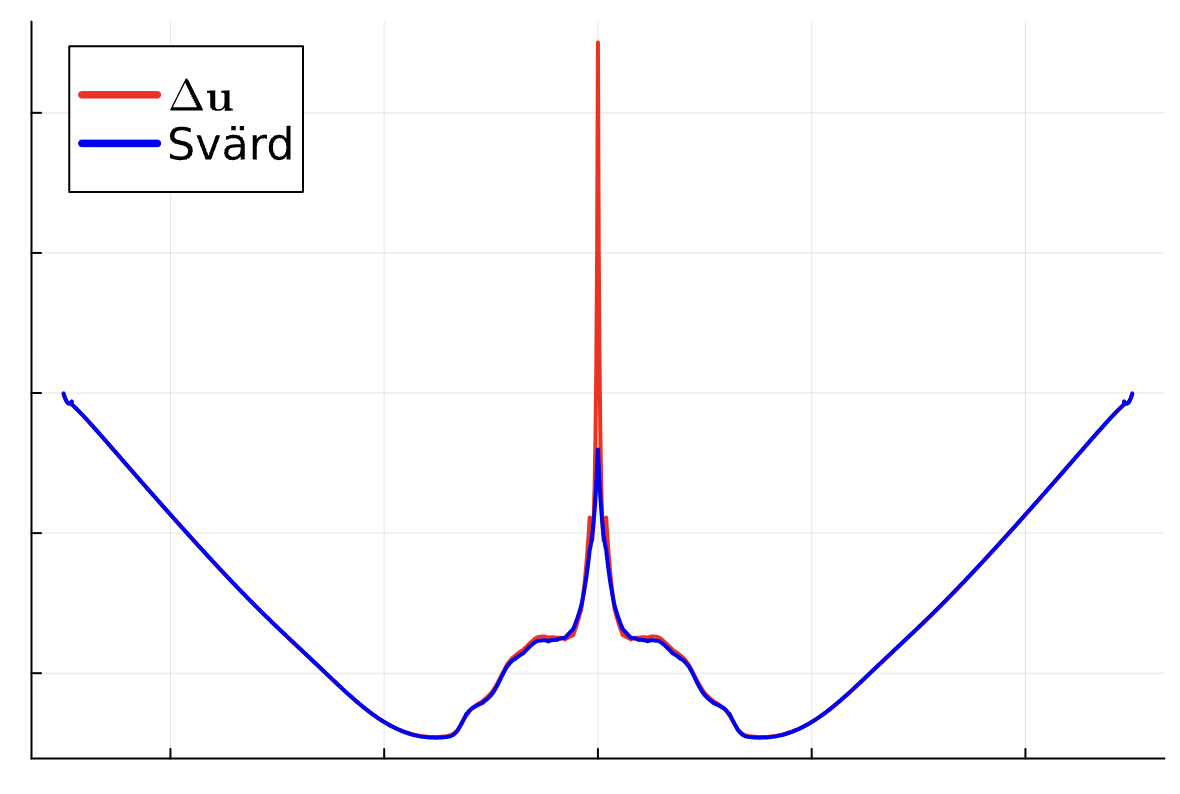
Figure 2: Temperature profile for the receding flow at T=0.18, demonstrating the effect of Svärd thermal viscosity on temperature overshoots.
The corresponding density and pressure fields remain sharp, indicating that the additional dissipation does not blur essential features.
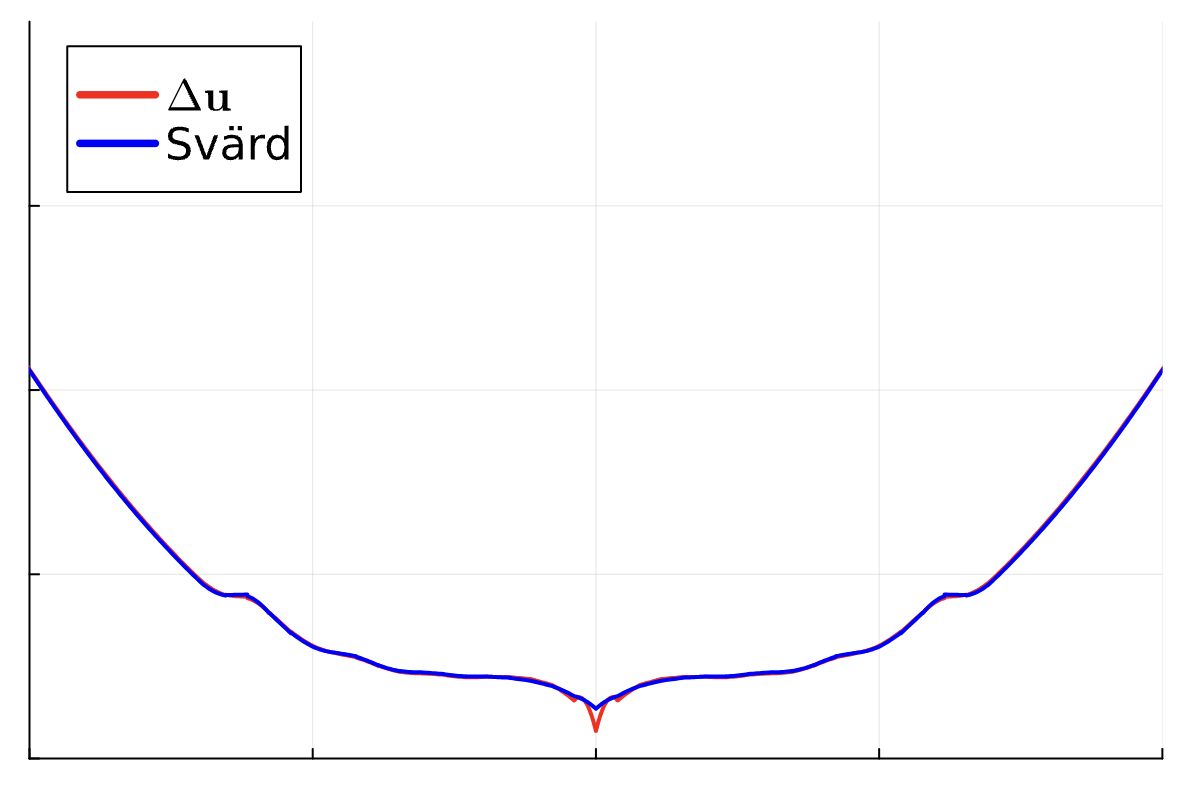
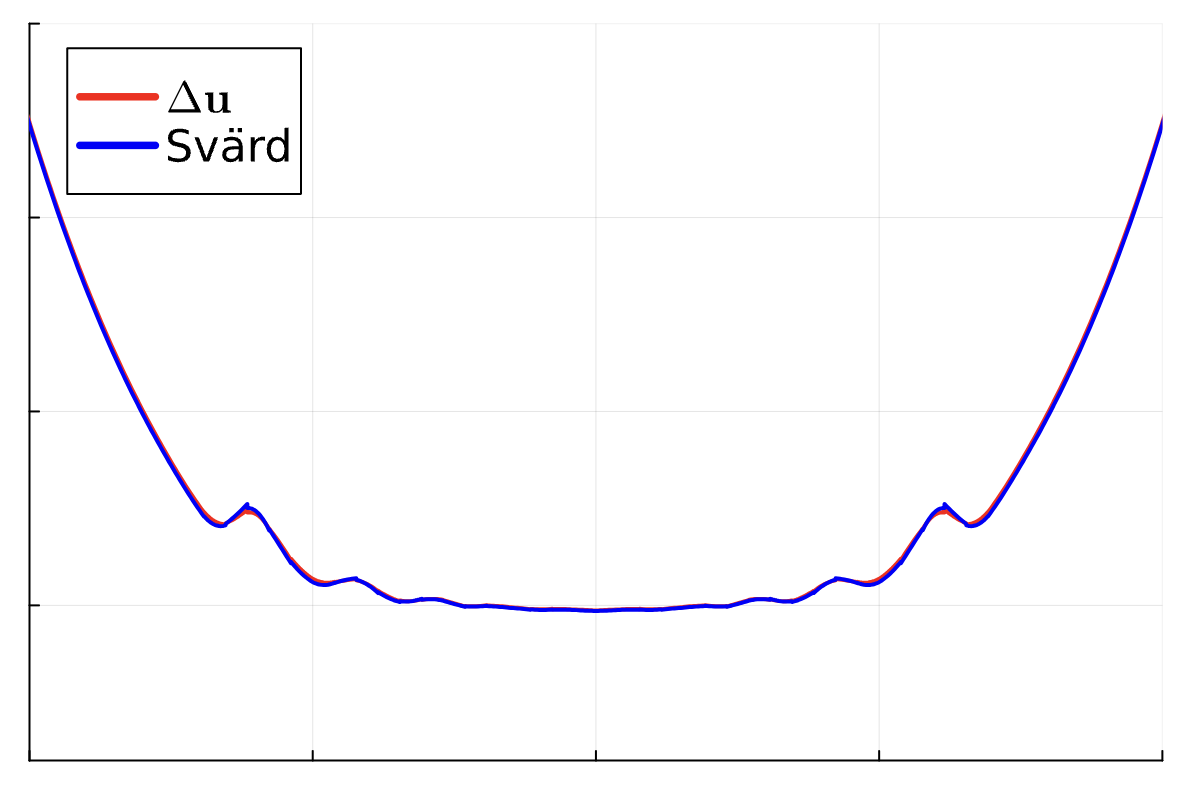
Figure 1: Receding flow with N=2,M=130, density and pressure profiles validate non-degradation of principal solution quantities with added thermal viscosity.
Kelvin-Helmholtz Instability and SVV Activation
The Kelvin-Helmholtz instability provides an archetype of turbulent, shear-driven evolution. The combined SVV and Laplacian viscosity model is able to stabilize these simulations without physical inconsistencies (e.g., negative density or pressure), while the SVV coefficient is observed to be non-negligible and spatially localized in regions of high shear:
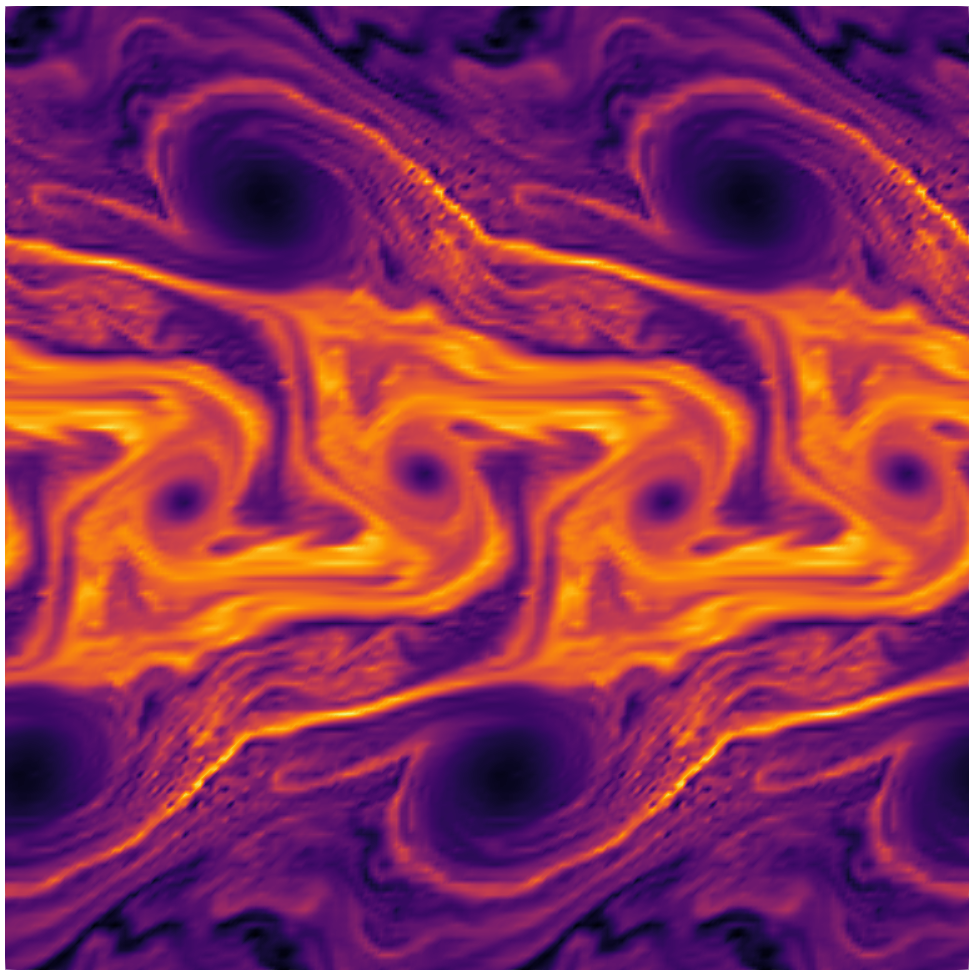
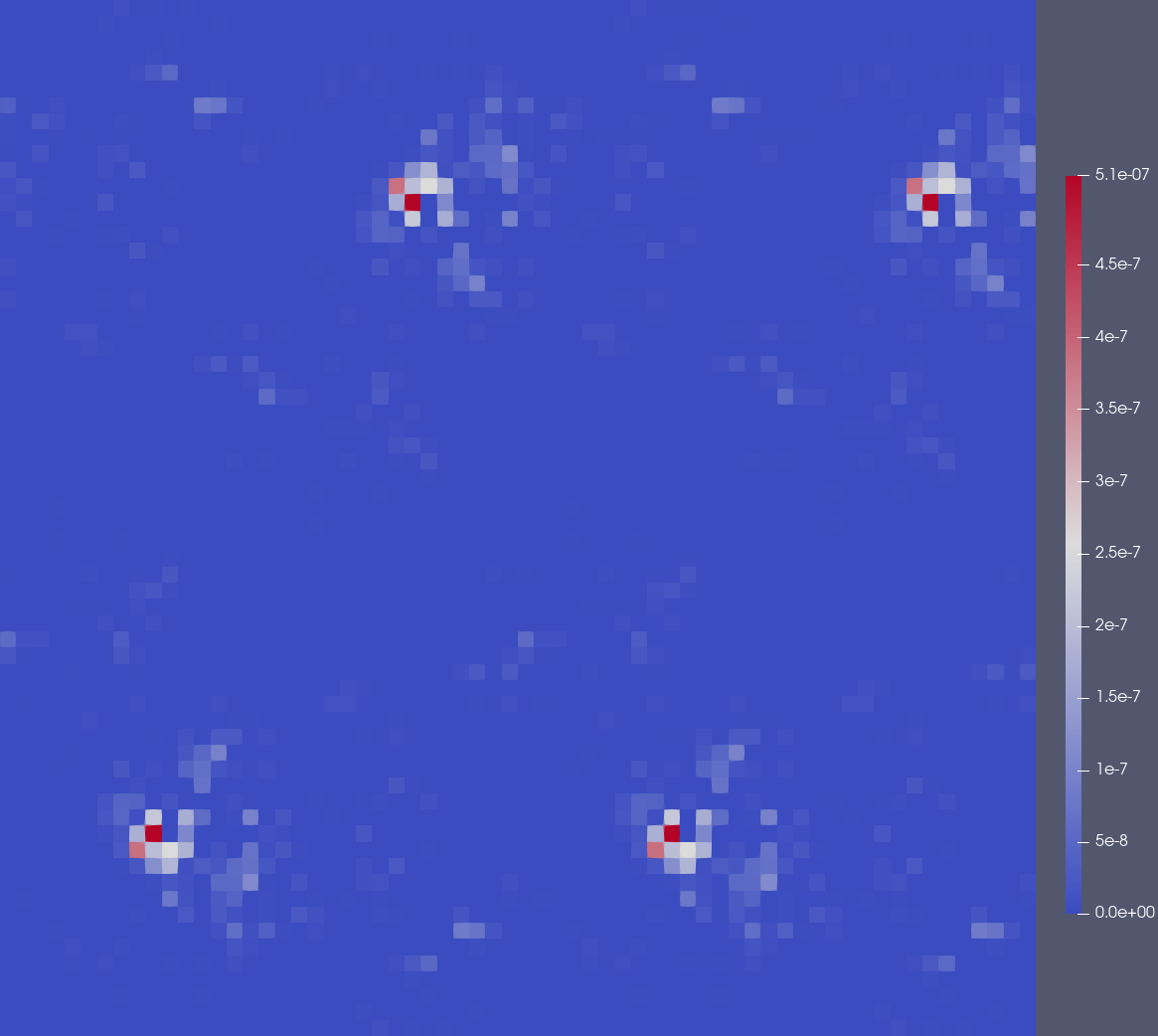
Figure 3: SVV and Laplacian viscosity solution for Kelvin-Helmholtz at T=25, illustrating density evolution and activation of the SVV coefficient in turbulent regions.
Riemann Problem and Selective Dissipation
For a 2D Riemann problem lacking significant shear or vortex formation, the method demonstrates that SVV activation is negligible, underscoring the method's ability to minimize unnecessary dissipation where not required:
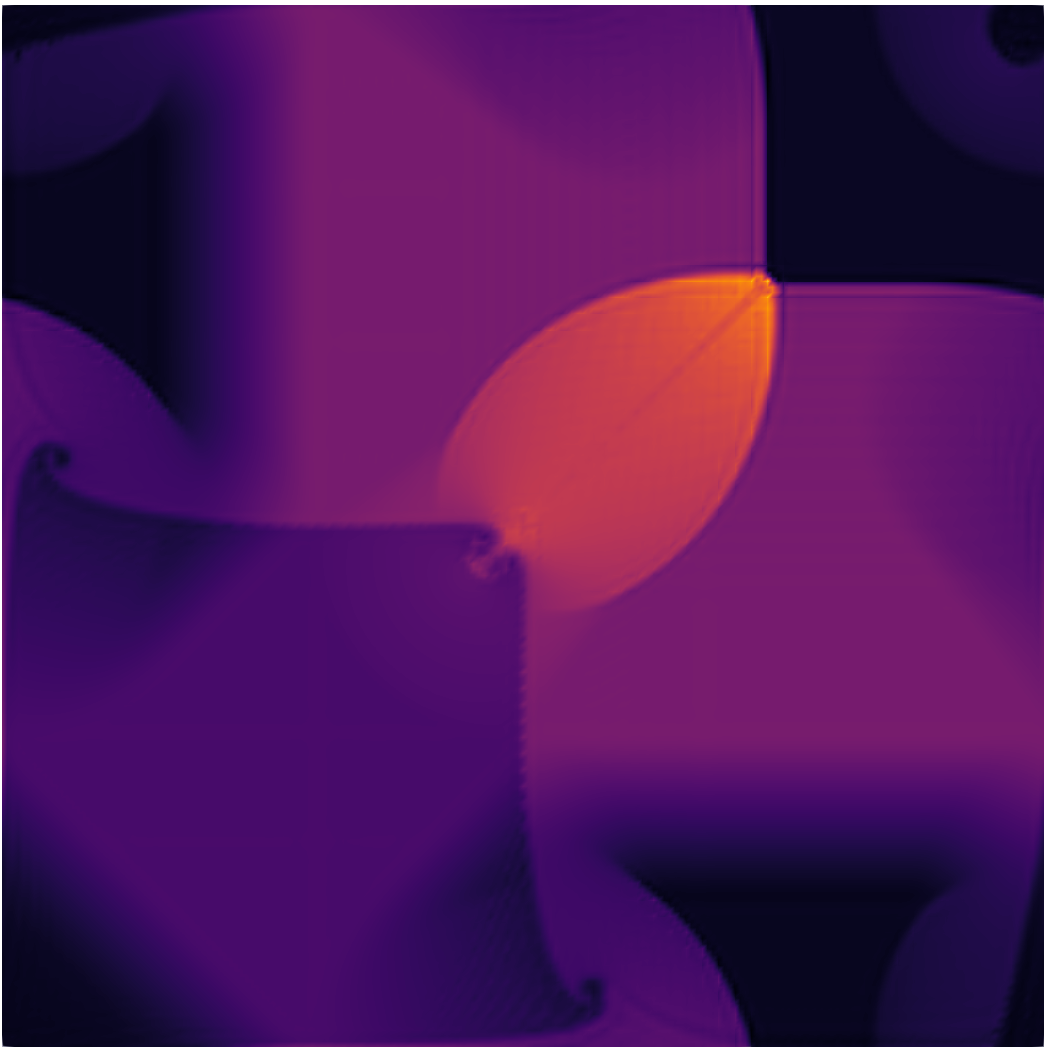

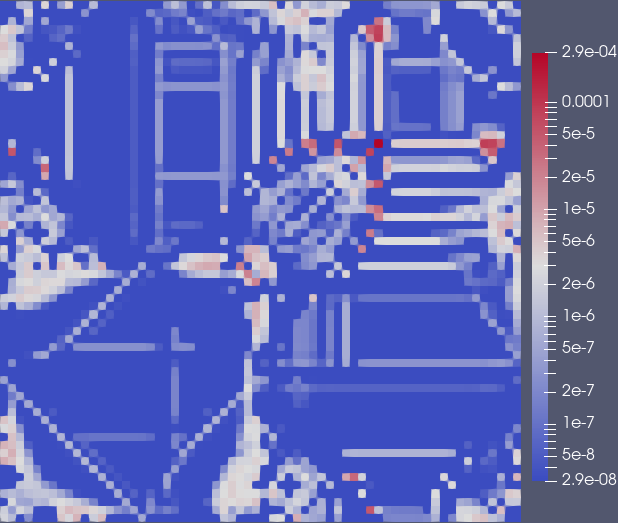
Figure 4: SVV and Laplacian viscosity coefficients (log scale) for the Riemann problem; the SVV coefficient remains near zero, confirming selectivity of dissipation.
Implications and Future Developments
The presented ECAV framework addresses several practical limitations inherent to standard entropy-stable DG methods and traditional artificial viscosity. The method’s core strength is its flexibility: dissipation is targeted and minimal, distributed optimally over multiple physically motivated viscosity models. The result is robust performance for under-resolved flows, complex shock/turbulence interactions, and longstanding numerical anomalies (such as overheating), without sacrificing accuracy or introducing empirically tuned parameters.
Future theoretical and practical implications include:
- Provably Dissipative Modular Construction: The analysis provides criteria for augmenting the system with additional viscosity mechanisms as long as their projection operators are individually entropy dissipative.
- Turbulence and Large-Eddy Simulations: SVV activation characteristics suggest utility for under-resolved high-Reynolds-number flows, as required by turbulence modeling.
- Automated Viscosity Design: The parameter-free, optimization-based allocation sets a stage for further automation and even machine-learning-guided discovery of optimal viscosity blends.
- Extension to Other Physics: The mathematical structure is extensible to MHD, combustion, and multi-physics, assuming suitable entropy structures and dissipative mechanism formulations.
Conclusion
This work delivers a systematic generalization of entropy correction artificial viscosity to encompass multiple, physically meaningful viscosity models within the DG framework. By posing coefficient selection as a constrained minimization problem, the method enforces entropy stability while tailoring dissipation to local solution features and underlying physics. Numerical experiments confirm high-order accuracy, robustness to classical failure modes, and selective activation of artificial viscosity. The approach opens immediate avenues for scalable, high-fidelity simulations of complex flows and provides a theoretical foundation for further advances in entropy-stable CFD algorithms.

