- The paper introduces synthetic isochrone-cloud fitting combined with grid-based asteroseismology to robustly determine NGC6866's age, extinction, and rotation.
- Isochrone-cloud fitting with MIST and PARSEC models exposes systematic differences in derived parameters, highlighting challenges in stellar population modelling.
- Ensemble asteroseismic analysis of γ Dor pulsators provides critical insights into core overshoot and angular momentum transport, refining stellar evolution models.
Isochrone-Cloud Fitting and Asteroseismology of NGC 6866: An In-Depth Analysis
Introduction
NGC 6866 is a key intermediate-age open cluster situated within the Kepler field. This paper presents a comprehensive investigation of its stellar population using advanced isochrone fitting techniques and ensemble asteroseismology. By constructing "isochrone clouds"—synthetic CMD populations sampling variations in age, extinction, and a distribution of initial stellar rotation—the study offers new insight into the challenges of deriving cluster parameters. Critically, the work combines these isochronal determinations with grid-based asteroseismic modelling of individual γDoradus pulsators in the cluster, allowing a direct comparison between surface-parameter-based and interior-physics-based diagnostics. The approach highlights the persistent discrepancies and systematics inherent in population modelling and provides cluster-based constraints on stellar evolutionary physics, particularly addressing core overshoot and angular momentum transport.
Membership Determination and Cluster Demographics
Using Gaia DR3 astrometry and a Gaussian Mixture Model (GMM) clustering approach, the study identified 180 high-probability members of NGC 6866. Membership probabilities were assessed through a Monte Carlo sampling of input uncertainties, providing robust statistical validation of the sample.
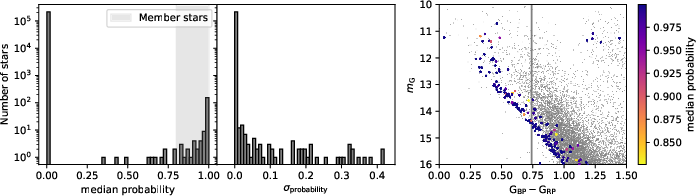
Figure 1: Clustering membership results for NGC 6866 and the corresponding CMD, with member probabilities colour-coded and the field-star/background population evident.
The CMD constructed from the membership analysis underpins all subsequent synthetic population comparisons.
Isochrone-Cloud Construction: Methods and Systematics
Isochrone-cloud fitting in this work departs from traditional single-isochrone matching by generating synthetic CMDs sampled over a wide grid of ages, extinction values (A0), and distributions of initial critical rotation (v/vcrit). Both the MIST and PARSEC isochrone families are employed, chosen for their distinct treatments of convective core overshoot and rotational mixing prescriptions. This dual-model approach directly exposes input-physics-driven systematics in age and mass inference.
CMD comparisons leverage a binned multiplicative sum statistic over a rectangular grid, optimised for the density and morphology of the NGC 6866 CMD.
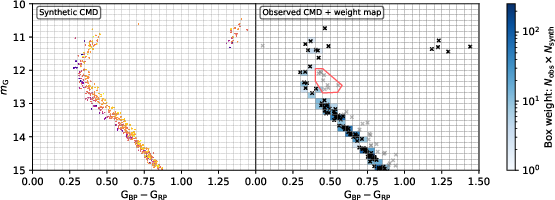
Figure 2: CMD binning and multiplicative sum comparison between a synthetic isochrone cloud (left) and the observed CMD (right), with removal of binaries and blue straggler populations for accurate single-star comparison.
The optimal fit and associated uncertainties are obtained by iteratively perturbing the observed photometric data and repeating the whole fitting process, quantifying fit robustness beyond photon noise limits.
Numerical Results: Age, Extinction, and Rotation Distribution
Strong model dependencies in the cluster parameters are evident. The best-fit PARSEC isochrone cloud yields an age of 690−30+140Myr and A0=0.42−0.04+0.05, while the MIST isochrone cloud indicates a younger age, 467−50+70Myr, coupled with a higher extinction, A0=0.62−0.04+0.03. The distribution of initial rotation rates inferred from both model sets peaks at v/vcrit=0.6, implying a high fraction of rapid rotators on the upper main sequence compared to field A–F stars.
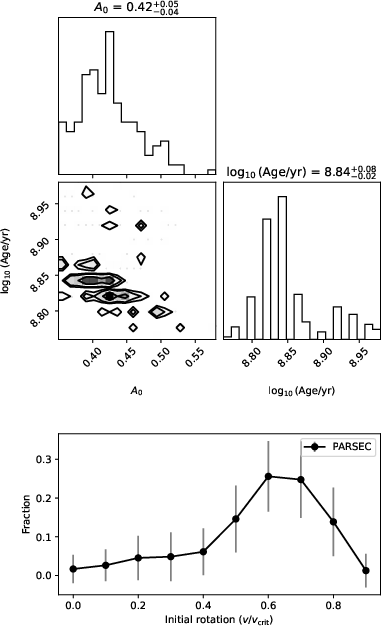
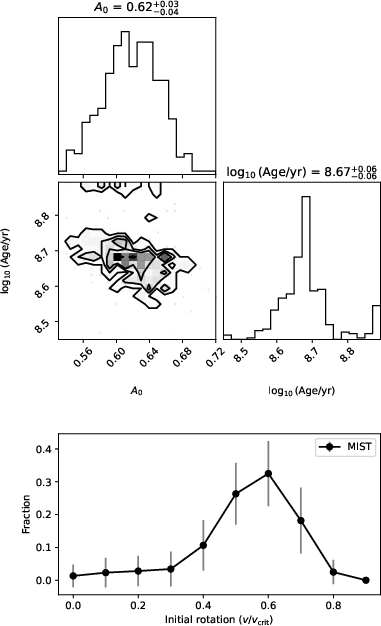
Figure 3: Corner plots of cluster age and extinction and the derived initial critical rotation distribution for PARSEC (left) and MIST (right) isochrone fits.
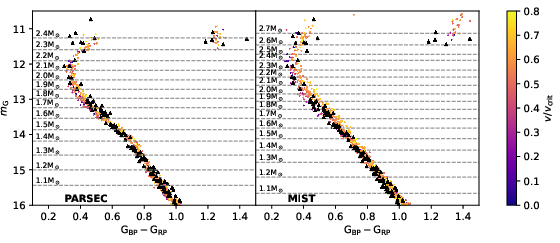
Figure 4: Synthetic CMD overlays for PARSEC and MIST isochrone clouds, colour-coded by initial stellar rotation, demonstrating the differential fit quality in evolved and main sequence populations.
The simultaneous fitting for age, extinction, and a rotation distribution provides a multidimensional benchmark for stellar evolutionary libraries, revealing tensions that persist due to differences in model implementations of internal mixing and angular momentum transport.
Stellar Variability Census
High-cadence Kepler photometry is utilised to identify and classify variable cluster members. A catalogue of 68 variable stars is assembled, dominated by γDoradus pulsators, δScuti stars, and hybrid types. Nineteen g-mode pulsators are of primary interest for asteroseismic modelling, especially those displaying clear period spacing patterns, as these provide direct probes of their internal structure and rotation.
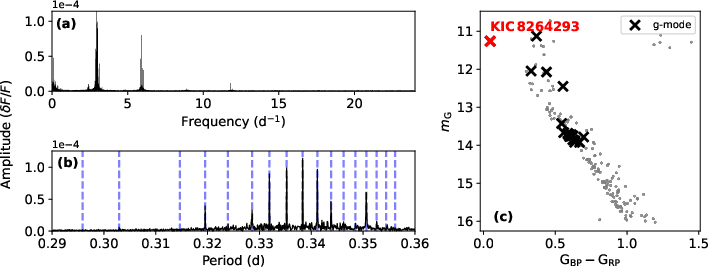
Figure 5: Amplitude spectrum, period spacing diagram, and CMD position of blue straggler KIC 8264293, a pulsator identified as an evolved merger product with SPB-like properties.
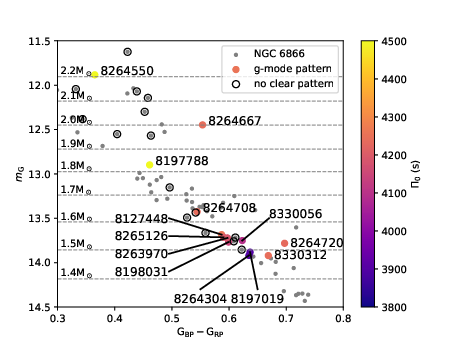
Figure 6: G-mode pulsators in the CMD, colour-coded by measured A00, illustrating their distribution relative to the main isochronal turnoff mass.
The peculiar presence of g-mode pulsators bluer than the canonical A01Dor instability strip and the identification of a hot blue straggler with strong pulsations are notable empirical findings.
Ensemble Asteroseismic Modelling of A02Doradus Stars
Twelve cluster A03Dor pulsators with unambiguous CMD positions and period spacing patterns are forward-modelled using a dedicated MESA grid. Four observables—A04, A05, A06, and near-core rotation—are fit using two approaches: individual-age (field star-like) and enforced common-age (coevality) methods.
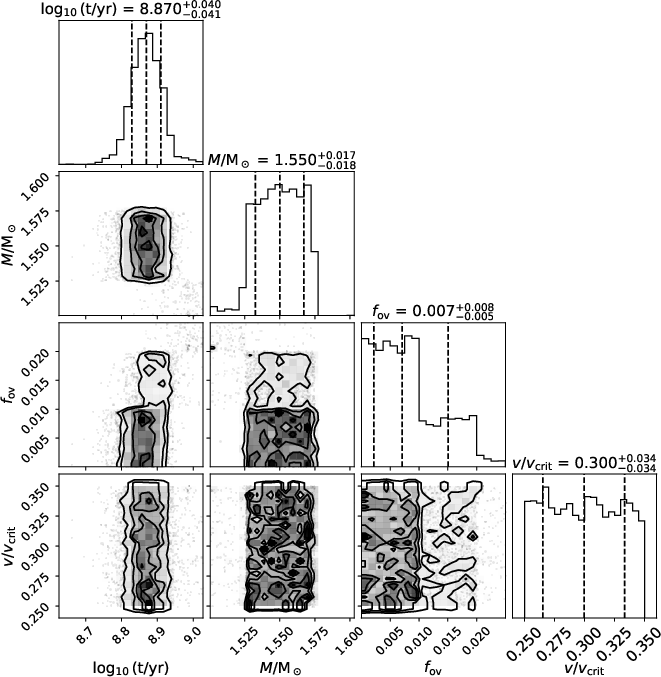
Figure 7: MCMC corner plot for seismic modelling of a representative pulsator, demonstrating the precision in parameter estimation.
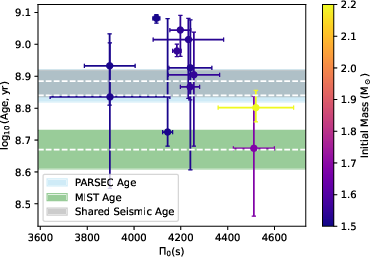
Figure 8: Comparative ages derived from various methods, plotted against A07, with isochronal and seismic age intervals indicated.
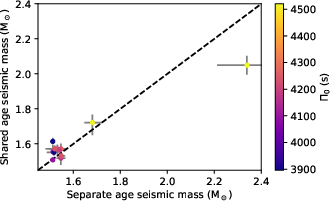
Figure 9: Asteroseismic mass comparisons across fitting approaches, revealing overall consistency with isochronal masses for in-strip pulsators.
The enforced common-age fit yields A08, aligning with the PARSEC isochrone-cloud age despite substantial discrepancies with the MIST-based value and literature estimates from red giant stars.
The initial A09 distribution derived from asteroseismology, however, peaks at v/vcrit0, substantially lower than the isochronal IMF-weighted distribution, highlighting ongoing limitations in modelling rotational evolution and transport.
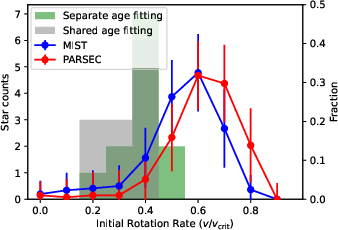
Figure 10: Initial rotation rate distributions at ZAMS from isochrone and seismic approaches, with clear systematic offsets.
Interior Mixing: Core Mass and Overshooting
Asteroseismic constraints on the convective core mass ratio (v/vcrit1) and overshoot mixing (v/vcrit2) are derived and compared to isochronal model predictions. The shared-age fit approach, motivated by cluster coevality, yields broader distributions of v/vcrit3 and v/vcrit4, interpreted as both a function of lost degrees of freedom and intrinsic star-to-star mixing variability.
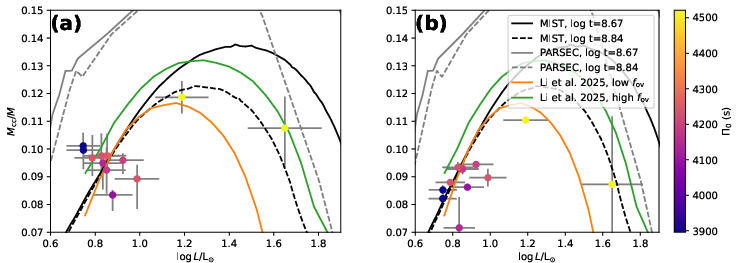
Figure 11: Convective core mass ratios versus luminosity for the modelled g-mode pulsators, set alongside isochrone predictions.
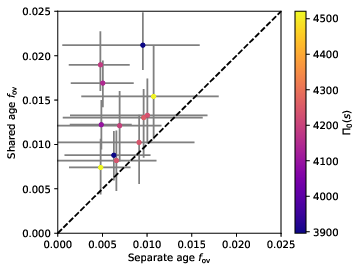
Figure 12: v/vcrit5 comparisons for both modelling methodologies, indicating increased spread in overshoot for the shared-age population fit.
Implications and Prospects
The synthesis of isochrone-cloud and asteroseismic results underscores multi-faceted systematics in open cluster age-dating arising from both theoretical input physics and population diversity. The inconsistency between rotation rates inferred from surface-parameter-based CMD fitting and interior-physics-based asteroseismology highlights deficiencies in angular momentum transport modelling, as well as possible mass-range-dependent biases.
Cluster-level seismic ages agree best with models employing step overshoot (as in PARSEC), while internal mixing and rotational transport remain pivotal uncertainties for both mass and age determination. The empirical demonstration that coevality-based asteroseismic priors are feasible and justified suggests that ensemble asteroseismology in rich clusters can break key degeneracies left by single-star population modelling, albeit with non-negligible star-to-star scatter in core properties.
Practically, these findings inform the calibration of evolutionary grids and the construction of next-generation cluster diagnostics for the Gaia, Kepler, and TESS eras. The methodology is directly extensible to other clusters with suitable astrometric and time-domain coverage.
Conclusion
This study presents a thorough population and individual-star analysis of NGC 6866, integrating isochrone-cloud fitting and state-of-the-art asteroseismic modelling. Strong model dependencies in derived ages, evidence for significant uncertainties in rotational transport prescriptions, and systematic spreads in core mixing parameters are all revealed by this cluster sample. The results advocate for continued development of multi-dimensional stellar population modelling techniques incorporating both CMD and asteroseismic constraints, as well as for empirical calibration of angular momentum and mixing processes across stellar evolution. NGC 6866 emerges as a crucial benchmark for probing the interplay between rotational evolution, cluster parameter determination, and core mixing physics in the intermediate-mass regime.
Reference: "Isochrone-cloud fitting and asteroseismology of the Kepler open cluster NGC6866" (2604.03142)

