- The paper introduces a unified construction of C^r finite elements on the Alfeld split, reducing polynomial degree requirements for prescribed smoothness.
- It employs refined intrinsic decompositions and explicit DOF placements at vertices, subsimplices, and interiors to ensure unisolvence.
- Adaptive minimal degree analyses for 2D, 3D, and higher dimensions support more efficient high-order PDE solvers and geometric modeling approaches.
Background and Motivation
The construction of Cr conforming finite element (FE) spaces for arbitrary smoothness r in general dimensions d is a problem of longstanding interest due to its foundational importance in higher-order PDE discretization, geometric modeling, and numerical analysis. For general unstructured simplicial meshes, sharp smoothness-versus-degree bounds were previously established [hu2024construction], with supersmoothness and high-degree requirements that are, in general, provably unimprovable [hu2025sharpness]. However, macro-elements arising from specific domain splits indicate the potential for strictly better degree bounds by exploiting intrinsic structure.
The Alfeld split offers a minimal macro-element refinement for a simplex, pivotal in constructing smooth splines and Cr conforming FE spaces. In two dimensions, it coincides with the classical Clough–Tocher split; in three and higher dimensions, its relevance for constructing low-degree, high-smoothness spline spaces has been successively elucidated, but a general, unified d-dimensional construction had remained open. This paper provides such a construction for arbitrary r and d, giving new degree-of-freedom (DoF) assignments and minimality results, grounded in an intricate combinatorial framework.
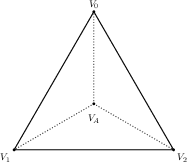
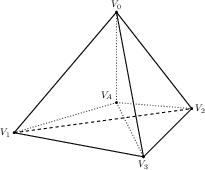
Figure 1: Alfeld split in two and three dimensions, including the classical Clough–Tocher (left) and Alfeld split of a tetrahedron (right).
Alfeld Split Geometry and Notation
The Alfeld split subdivides a d-simplex K with vertices Cr0 by connecting every simplex vertex to an interior point Cr1 (typically the barycenter), yielding Cr2 Cr3-simplices, each formed by replacing one vertex of Cr4 with Cr5. The notation for generalized barycentric coordinates and the systematic use of multi-index sets for accounting DoFs on lower-dimensional subsimplices are key to the general construction.
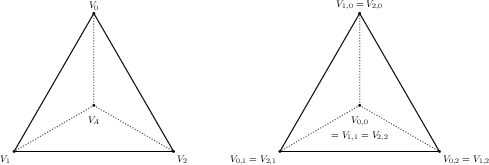
Figure 2: Notation for Alfeld split vertices and induced barycentric systems in 2D.
Main Results: Construction of Cr6 Macro-Elements
The core contribution is a DoF assignment and function space construction for Cr7 (Cr8, with smoothly decreasing continuity on lower-dimensional subsimplices) FE spaces over the Alfeld split in any dimension Cr9, and for arbitrary prescribed smoothness vector r0 and polynomial degree r1.
Shape Function Space: A "superspline" space r2 is described, consisting of r3-variate piecewise polynomials of degree r4 on each subsimplex of the split, with prescribed continuity at the Alfeld point r5 and increasing smoothness at lower-dimensional faces.
Assumptions: The construction is valid under explicit, relaxed combinatorial constraints on r6, r7, and r8 (the split point continuity). These constraints improve substantially over those in the fully general, unsplit case:
r9
where d0 is a "boundary layer" number ranging between d1 and d2.
Comparative numerical results (see Table 1, Table 2 of the paper) highlight the degree reductions achieved for d3 conforming spaces relative to unsplit elements—e.g., in d4D, the minimal d5 degree is d6 for the Argyris element without split (requiring d7 DoFs), but only d8 with Alfeld splitting.
Degrees of Freedom: Three main DoF sets are defined:
- At vertices: derivatives up to order d9 at each vertex.
- On Cr0-faces, Cr1: face moments involving certain derivatives up to order Cr2.
- On the interior: integrals against projected monomials using a Cr3-operator, encoding interior bubble-like polynomials vanishing at boundaries.
These DoFs are carefully organized via a system of multi-index sets and intrinsic decompositions, ensuring strict local minimality and unisolvence (linear independence).
Refined Intrinsic Decomposition and Basis Construction
A major technical component is the refined intrinsic decomposition of multi-indices. This enables the division of basis functions into two classes: those associated with boundary conditions (on vertices/faces) and those interior to the simplex. The paper introduces, for the first time in arbitrary Cr4, two decompositions (see Sections 4–5) mapping multi-indices to either boundary or bubble DoFs, using combinatorial bijections.
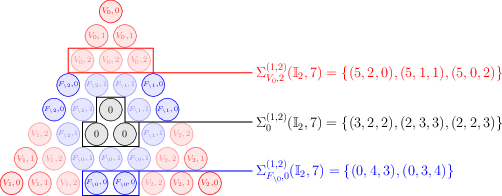
Figure 3: Refined intrinsic decomposition of the multi-index set Cr5 in 2D; colors indicate association with vertices, edges, or interior.
Basis Structure: The resulting space admits a basis explicitly described as the union of:
- Classical Bernstein polynomials indexed by "boundary" multi-indices.
- Projected polynomials (via Cr6-operator) indexed by "interior" multi-indices (bubble-like functions).
This structure generalizes and strictly extends known constructions for Cr7, e.g., as studied in [lai2007, lai2013], by removing degree restrictions found necessary for generic meshes.
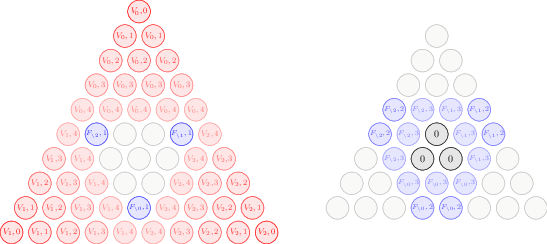
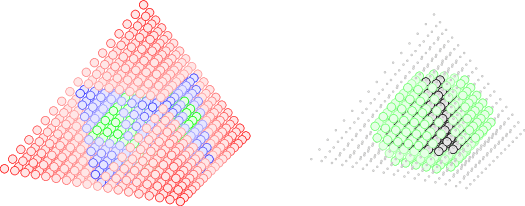
Figure 4: Decomposition of Cr8 (left: boundary components) and Cr9 (right: interior bubble components) for d0 and d1.
Unisolvence, Continuity, and Dimension Results
Unisolvence: Rigorous proofs are given that the proposed DoFs are linearly independent, using induction and partial orderings on simplex inclusion, and leveraging properties of the d2-operator and combinatorial decompositions. Nontrivial interaction between boundary and bubble parts is managed by separating contributions and using orthogonality of moments.
Continuity: The FE assembly process establishes that continuity conditions propagate naturally across adjacent split simplices in the triangulation, ensuring global d3 conformity as per the assigned smoothness vector. This is critical for higher-order PDEs.
Dimension Formulae: Detailed recursive combinatorial expressions are provided for the dimension of the superspline space, refining classical spline dimension computations and extending them to high dimensions. The dimension agrees with, and in the d4 cases generalizes, expressions found in prior work (see explicit formulas and tables in the text).
Implications and Future Directions
This construction allows practically minimal-degree, high-smoothness FE spaces for use in d5-dimensional numerical PDEs, especially in contexts requiring d6 or higher inter-element continuity—e.g., biharmonic problems, thin-shell models, and isogeometric analysis.
The main theoretical implication is that the Alfeld split preserves the potential for improved smoothness-degree tradeoffs, and intrinsic combinatorics can be used effectively to characterize and construct such spaces. The refined intrinsic decomposition technique introduced is anticipated to have further applications in the combinatorial and dimension-theoretic analysis of multivariate spline spaces, particularly in dimensions d7, where direct dimension counting has been historically difficult.
Practical implications include the potential for low-degree d8 or d9 FE spaces in 3D without restrictive geometric assumptions, providing significant advantages in engineering and scientific computing, especially for next-generation isogeometric and structure-preserving discretizations.
Conclusion
This work provides a general and unified construction of r0 conforming finite elements over the Alfeld split in arbitrary dimension r1, establishing new bounds for minimal polynomial degree, explicit DoF assignments, and dimension formulae. The techniques developed—most notably, refined multi-index decompositions—open the path for further advances in the theory and practical implementation of smooth FE spaces on simplicial meshes, with both theoretical and computational impacts on numerical analysis and geometric modeling.
References:
- (2604.03077)
- hu2024construction, hu2025sharpness, lai2007, lai2013, lyche2025, schenck2014