- The paper presents the FREDINO framework that models both linear and nonlinear contractive integral operators using neural networks to ensure fixed-point convergence.
- It establishes universal approximation theorems that guarantee robust operator learning in arbitrary dimensions, addressing both integral equations and boundary-integral PDE formulations.
- The methodology integrates contractivity-preserving regularization and block coordinate minimization, achieving low prediction errors and stable learning in high-dimensional settings.
Fredholm Integral Neural Operators for Contractive Operator Learning
Introduction
This paper introduces the Fredholm Integral Neural Operator (FREDINO) framework, targeting the learning and approximation of linear and nonlinear contractive integral operators—specifically those arising in Fredholm Integral Equations (FIEs) of the second kind—in arbitrary dimensions. Distinct from black-box neural operator approaches, FREDINOs enforce key mathematical properties such as contractivity, a vital requirement for fixed-point-based solution algorithms. The authors establish theoretical guarantees for universality, demonstrate contractivity-preserving regularization, and systematically extend the architecture to learning solution operators for both high-dimensional integral equations and nonlinear elliptic PDEs via boundary integral formulations.
Fredholm Neural Operators: Architecture and Methodology
The FREDINO framework generalizes earlier Fredholm Neural Network paradigms to directly learn both linear and nonlinear (non-expansive or contractive) integral operators by parameterizing the kernel and nonlinearity with neural networks. Rather than approximating the solution operator in a black-box fashion, FREDINO leverages the functional structure of the underlying integral equation to:
- Model the unknown integral kernel K(x,z) and pointwise nonlinearity G with neural networks Kθ and Gϑ.
- Embed these parameterizations into a custom neural architecture that mirrors the discretized successive approximation (or Picard–Krasnosel’skii–Mann) scheme.
- Guarantee that the learned operator remains contractive (i.e., is a strict contraction or non-expansive), ensuring the convergence of the fixed-point scheme and solution operator.
- Construct loss functions and regularization strategies that directly encode contractivity and integral equation satisfaction.
The following schematic, referenced as (Figure 1), succinctly illustrates the FREDINO framework for learning a parametric family of FIEs.
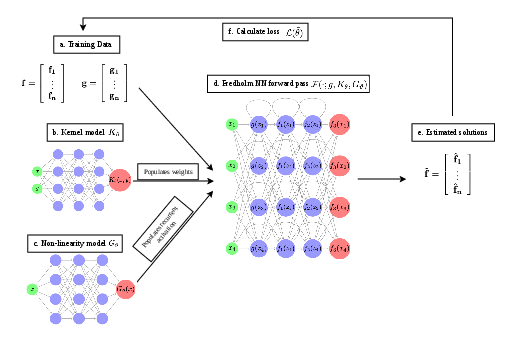
Figure 1: Overview of the FREDINO architecture—training data couples functions gi and corresponding FIE solutions fi; the framework models the kernel and nonlinearity with neural networks, and saturates a Fredholm NN with these models during training.
Crucially, the architecture can be specialized: for linear IEs, the induced network is feedforward, whereas for nonlinear IEs, the architecture becomes recurrent, with the nonlinearity G injected as a pointwise operation between iterations. The depth and structure are dictated by the required number of Picard iterates to achieve the desired accuracy.
Theoretical Results: Universality and Contractivity
A major contribution of the paper is establishing rigorous universal approximation theorems for both linear and nonlinear contractive integral operators and the associated solution operators within the FREDINO framework, extending earlier Fredholm Neural Network universality results to arbitrary dimension and operator type. Formally, the authors prove:
- For any contractive (linear or nonlinear) integral operator T on L2(D), the space of FREDINOs parameterized by neural networks Kθ and G0 is dense with respect to the strong operator topology.
- The learned operator G1—with appropriately regularized and norm-constrained parameterizations—preserves contractivity, a property critical for fixed-point convergence and solution continuity.
- The corresponding Fredholm NN approximations converge to the fixed-point solution operator up to arbitrary precision, with explicit error bounds quantifying the contribution of approximation, discretization, and network depth.
This construction provides a functional-theoretic analogue to classical universal approximation theorems for NNs, but at the level of operator-valued mappings, with rigorous handling of the solution operator's stability and the role of contractivity.
FREDINO learning is cast as an optimization over kernel and nonlinearity parameterizations, with a composite loss:
G2
subject to G3 to enforce contractivity. The Fredholm NN G4 acts as a surrogate for the fixed-point solution map, populated by the current models G5 (and G6). Key methodological nuances include:
- The connection between the contractivity constraint and the architecture: exceeding the contractive region leads to forward-pass instability.
- The use of regularization (Tikhonov, integral operator norm) to break the non-uniqueness of inverse operator learning, select among infinitely many admissible kernels, and promote smoothness.
- For nonlinear operators, alternating (block coordinate) minimization is employed to decouple the kernel and nonlinearity optimization, mitigating bias and improving convergence in the recurrent architecture.
Extension to Nonlinear Elliptic PDEs via Potential Theory
A central extension in the paper is applying the FREDINO framework to nonlinear elliptic PDEs in 2D by leveraging their boundary integral representations. The Potential Fredholm Neural Network (PFNN) is constructed by:
- Modeling the double layer potential integral (the solution to the PDE) as a final layer following a Fredholm NN that solves the associated nonlinear BIE.
- Parameterizing the fundamental solution (or its correction term) with neural networks to accommodate noncanonical elliptic operators and nonlinearities.
The PFNN schematic is shown as follows.
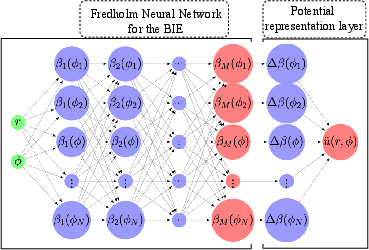
Figure 2: Schematic of the PFNN—first component is a Fredholm NN solving the Boundary Integral Equation, with a final hidden layer computing the double layer potential and returning the PDE solution G7.
This framework tackles the numerical challenges associated with singularities in the kernel and the weak formulation of the fundamental solution, providing an interpretable, mathematically informed operator-learning approach that ensures contractivity.
Numerical Experiments: High-dimensional and Nonlinear IEs, Elliptic PDEs
The efficacy and flexibility of FREDINOs are demonstrated in several challenging computational scenarios:
- High-dimensional Linear FIEs: In dimensions up to G8, FREDINOs are shown to learn non-separable, anisotropic kernels with strong accuracy, achieving mean relative G9 errors on unseen test functions below Kθ0. The learned operators maintain the contractivity property throughout training, as evidenced by the rapid decay of successive Picard iterates.
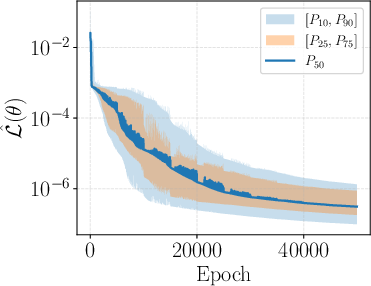
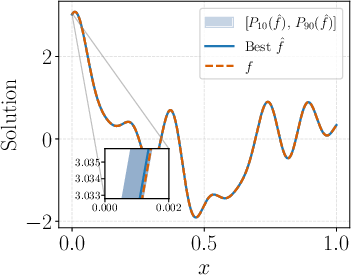
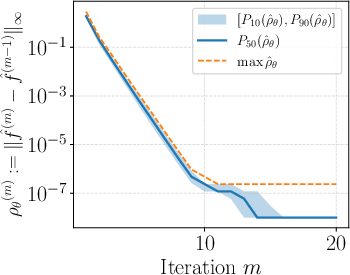
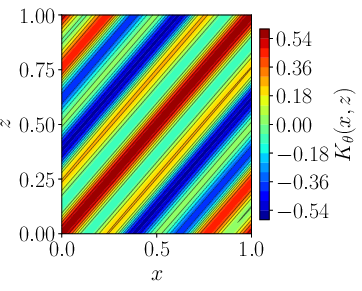
Figure 3: Example linear FIE results—training loss evolution, solution prediction with error bands, operator contractivity metrics, and learned kernel contour.
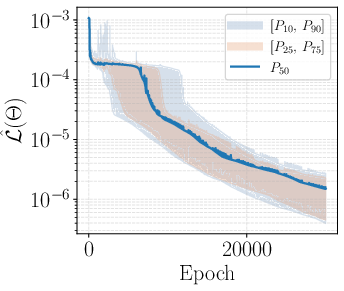
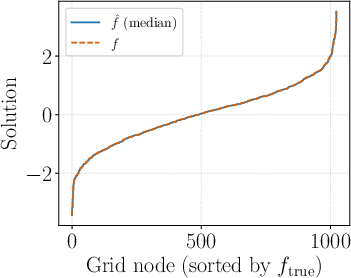
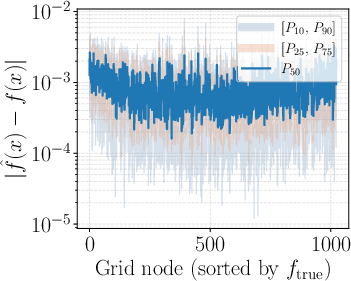
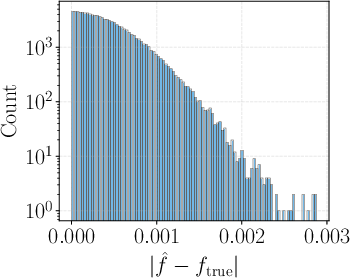
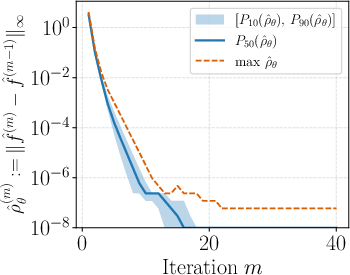
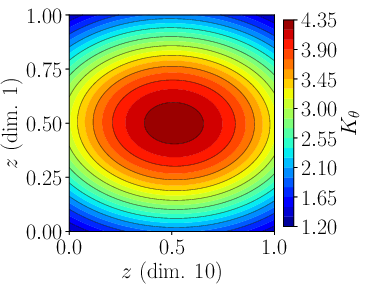
Figure 4: High-dimensional linear FIE—solution alignment, error histograms, contractivity validation, and slices of the learned kernel in Kθ1.
- Nonlinear FIEs: The recurrent FREDINO architecture efficiently learns both kernel and complex nonlinearity (e.g., multi-modal Gaussian peaks), yielding median relative Kθ2 test errors as low as Kθ3, with the contractivity preserved over the operator family and robust generalization to unseen input functions.
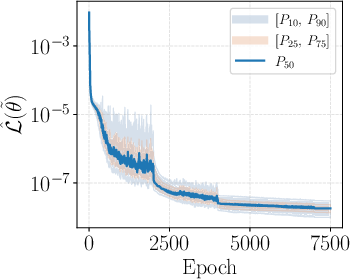
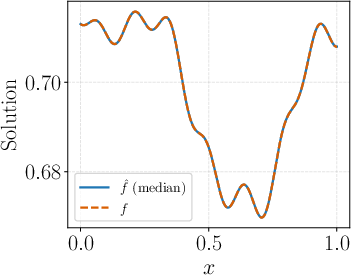
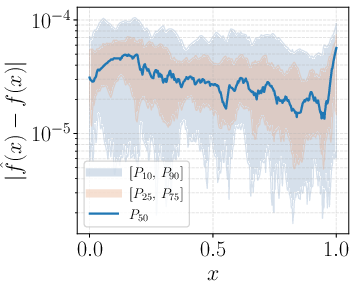
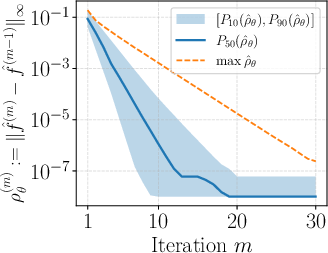
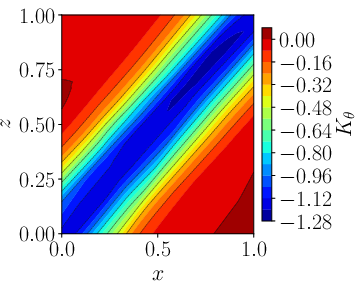
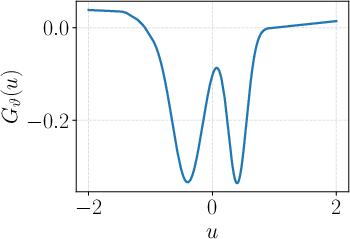
Figure 5: Nonlinear FIE—training loss, solution and absolute error comparisons, contraction demonstration, kernel recovery, and learned nonlinearity profile.
- High-dimensional Nonlinear FIEs: Extending to Kθ4, the approach maintains robust accuracy and stable learning, with a slight increase in error due to the increased input complexity.
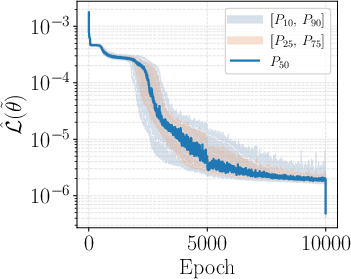
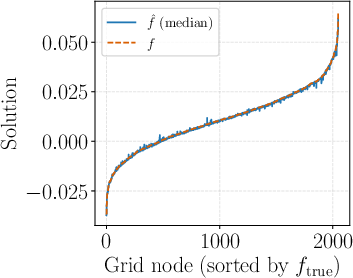
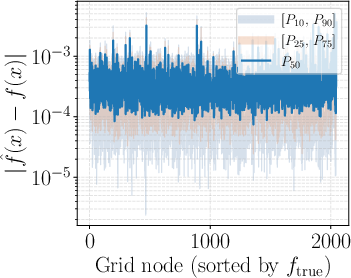
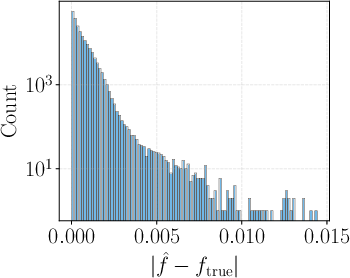
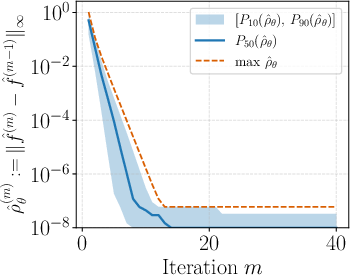
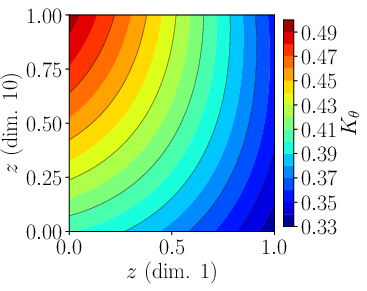
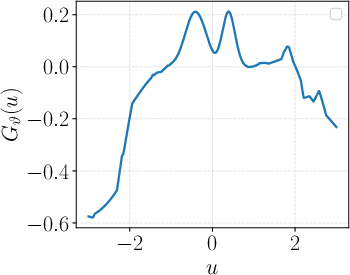
Figure 6: High-dimensional nonlinear FIE—loss, prediction, error, contraction, and slices of learned kernel and nonlinearity in high-dimensions.
- Nonlinear Elliptic PDEs (2D): The PFNN readily captures the fixed-point structure of nonlinear PDE solution operators, including the singularity structure of the double layer potential, while maintaining contractivity and predictive accuracy on solution fields.
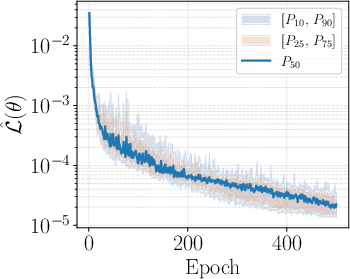
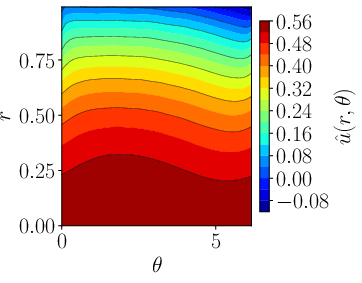
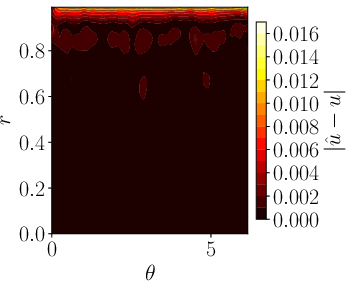
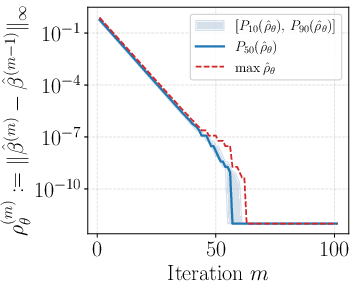
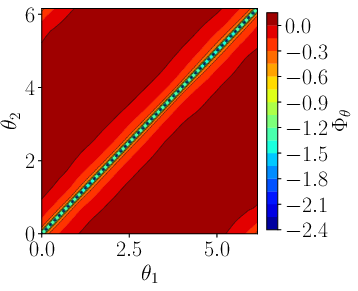
Figure 7: Nonlinear PDE—training loss, solution and error contours, contractivity behavior, and boundary kernel structure.
Implications, Discussion, and Future Directions
The FREDINO framework represents a mathematically interpretable neural operator paradigm that systematically embeds well-posedness and convergence into operator learning architectures. By ensuring contractivity via architectural constraints and regularization, FREDINOs provide robust approximators of both linear and nonlinear integral operators and solution maps, with explicit error control and stable generalization properties.
Key implications include:
- Operator Stability: Contractivity guarantees are crucial for scientific computing applications where solution stability, invertibility, and iterative convergence are non-negotiable.
- Interpretable Network Design: The explicit mapping between operator theory and neural network architecture offers insight into the learned models and facilitates diagnosis and adaptation in scientific ML contexts.
- Scaling to High Dimensions: Demonstrated numerical performance in Kθ5 spaces indicates practical applicability to parameter-to-solution mappings arising in uncertainty quantification and multiscale modeling.
- Extension to PDEs: The PFNN instantiation exhibits the power of this framework to encode physics and well-posedness in operator surrogates, opening avenues for data-driven, physics-informed PDE solvers.
Future work as indicated by the authors includes generalizations to higher-dimensional PDEs with singular kernel structures, further analysis of optimization dynamics in constrained operator learning, and scalable implementation in large-scale scientific computing.
Conclusion
Fredholm Integral Neural Operators offer a theoretically grounded and computationally practical approach to learning contractive linear and nonlinear integral operators, with strong universal approximation properties and embedded enforcement of solution stability. These architectures blur the line between numerical analysis-inspired design and neural operator learning, providing a foundation for reliable, interpretable, and high-dimensional operator modeling in scientific computing and beyond.