- The paper presents a proper-time flow approach that calculates universal gravitational corrections to the beta functions of gauge and Yukawa couplings.
- It shows that gravitational effects render the gauge sector asymptotically free while exponentially suppressing Yukawa contributions in regimes with negative cosmological constants.
- The study systematically maps out the scheme and gauge-fixing dependencies, comparing its findings with traditional ERG methods to assess asymptotic safety scenarios.
Quantum Gravity Contributions to Gauge and Yukawa Couplings via Proper Time Flow
Introduction and Motivation
The analysis of quantum gravity effects on the renormalization group (RG) evolution of fundamental matter couplings is central for understanding the ultraviolet (UV) completion of the Standard Model (SM) and potential extensions. In the framework of asymptotic safety (AS), a non-Gaussian UV fixed point for the gravitational sector induces universal, group-independent corrections to matter coupling beta functions. This work investigates quantum gravity-induced contributions (fg, fy) to the RG running of gauge and Yukawa couplings using the Schwinger proper-time (PT) flow equation, with explicit focus on gauge-fixing and regulator dependence. The findings are compared to canonical exact RG (ERG) approaches and benchmarked against phenomenological criteria for AS in and beyond the SM.
Theoretical Framework
The PT flow equation, formulated for the Wilsonian effective action, introduces an explicit one-parameter family of Schwinger regulators, labeled by m. This family allows controlled interpolation between smooth and sharp cutoff regimes. The cutoff-parameter dependence offers a systematic analysis of scheme-dependence.
For a generic matter theory with gauge (gi) and Yukawa (yj) couplings, the gravity-corrected one-loop RG equations are: dtdgi=βi(matter)−fggi,dtdyj=βj(matter)−fyyj,
where fg and fy encode the universal, leading-order gravitational contributions, determined by the fixed-point values of dimensionless Newton (G~) and cosmological (Λ~) constants. Both fy0 and fy1 are expected to exhibit non-universality under scheme and gauge-fixing transformations due to their unphysical origin (not observables).
The action is treated under the Einstein-Hilbert truncation. Contributions are computed both for generic minimal matter content and for the SM.
Quantum Gravity Corrections: Analytical Results
Gauge Coupling
The gravitational correction fy2 to the gauge coupling beta function is computed by extracting the anomalous dimension of the gauge field two-point function from the heat kernel expansion. The result, for the regulator parameter fy3 and gauge-fixing fy4, reads: fy5
In the sharp regulator limit (fy6), this simplifies to: fy7
fy8 is strictly positive for fy9, with mild dependence on m0 already for m1. Notably, this expression is independent of m2 in flat background, since symmetry constraints enforce the masslessness of gauge bosons, precluding cosmological constant insertions.
Yukawa Coupling
For the Yukawa coupling, the corresponding gravitational correction m3 is more intricate: m4
In the sharp limit,
m5
Thus, m6 is exponentially sensitive to negative m7, in contrast to m8. The analysis of regulator (m9) and gauge-fixing dependence reveals gi0 to be highly suppressed when gi1 as observed for the SM fixed point.
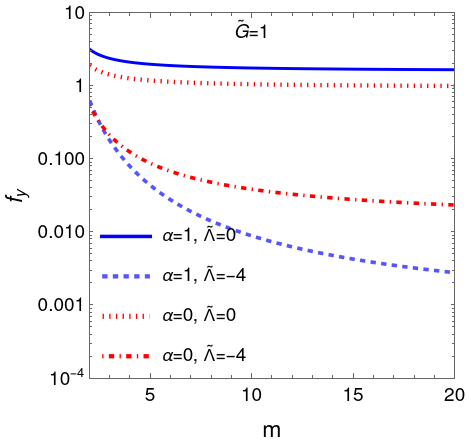
Figure 1: gi2 as a function of the regulator parameter gi3 for fixed gi4, displaying strong dependence on gauge-fixing parameter gi5 and cosmological constant gi6.
Fixed-Point Structure, Parametric Studies, and Phenomenology
The fixed-point values of gi7 are obtained from the PT flow itself, including contributions from matter. The gauge and regulator dependence is systematically mapped:
- For minimal matter (gi8), both gi9 and yj0 are positive, of comparable magnitude, and display moderate dependence on unphysical parameters.
- In the SM (yj1), yj2 leads to exponential suppression of yj3 while yj4 remains large—an explicit decoupling of gravitational effects in the gauge and Yukawa sectors. This effect is accentuated for BSM scenarios (e.g., yj5, yj6 GUT), where large negative yj7 persists.
These values are contrasted with phenomenological thresholds for AS. For the SM, a value of yj8 is associated with marginal safety of the hypercharge coupling, while sizable yj9 can hinder UV safety in the top Yukawa sector. In the proper-time scheme, dtdgi=βi(matter)−fggi,dtdyj=βj(matter)−fyyj,0 is typically dtdgi=βi(matter)−fggi,dtdyj=βj(matter)−fyyj,1 for SM-like matter, driving the abelian gauge couplings toward asymptotic freedom rather than safety. By contrast, for the Yukawa sector, the exponential suppression of dtdgi=βi(matter)−fggi,dtdyj=βj(matter)−fyyj,2 by negative dtdgi=βi(matter)−fggi,dtdyj=βj(matter)−fyyj,3 can align gravitational corrections with the typical matter anomalous dimensions, supporting (in principle) the existence of UV-interactive or free fixed points.
Regulator and Gauge-Fixing Dependence
A systematic exploration demonstrates that dtdgi=βi(matter)−fggi,dtdyj=βj(matter)−fyyj,4 is robust under changes of the Schwinger regulator parameter dtdgi=βi(matter)−fggi,dtdyj=βj(matter)−fyyj,5 and only mildly sensitive to the choice of gauge-fixing parameter dtdgi=βi(matter)−fggi,dtdyj=βj(matter)−fyyj,6. In contrast, dtdgi=βi(matter)−fggi,dtdyj=βj(matter)−fyyj,7 displays much sharper dependence: it is highly sensitive to the combined effect of dtdgi=βi(matter)−fggi,dtdyj=βj(matter)−fyyj,8 (itself regulator and gauge dependent) and the gauge-fixing parameter.
The residual dependence on unphysical parameters is expected at the level of coupling beta functions involving dimensionful parameters; however, critical exponents (physical predictions) are anticipated to be more robust.
Implications and Future Directions
The PT flow yields results for dtdgi=βi(matter)−fggi,dtdyj=βj(matter)−fyyj,9 and fg0 in close agreement with functional RG (ERG) results for minimal matter content but signals potential tension with the AS scenario for the SM abelian sector. Specifically:
- AS in the gauge sector: Large-fg1 solutions suggest asymptotic freedom for the abelian gauge couplings, which limits the parameter space for predictive, interacting UV fixed points in the SM and necessitates phenomenological reinterpretation.
- Yukawa sector safety: Exponential suppression of fg2 by large negative fg3 supports the feasibility of AS or free UV behavior for SM and GUT Yukawa couplings.
- Scheme comparison: The scheme dependence highlighted here requires further scrutiny, particularly using extended truncations, RG improvements, and inclusion of higher-order gravitational operators.
Conclusion
This work extends the methodology for extracting universal gravitational corrections to matter sector RGEs within the PT flow framework. The resulting fg4 and fg5 corrections provide an informative cross-scheme comparison to functional RG analyses, expose the residual scheme and gauge dependencies, and facilitate quantitative assessment of AS in the gauge and Yukawa sectors. The observed exponential suppression in the Yukawa sector for negative cosmological constant regimes is a striking feature. These results set important benchmarks for future investigations addressing extended truncations, scheme stability, and observable critical exponents in asymptotically safe gravity-matter systems.

