Quantum mutual information, coherence and unified relations of top quarks in QCD processes
Published 3 Apr 2026 in quant-ph and hep-ph | (2604.03005v1)
Abstract: As the most massive particle in the Standard Model, the top quark's exceptionally short lifetime preserves its spin polarization information through direct decay, making it an ideal system for probing quantum correlations in high-energy physics. In this letter, we presents a comprehensive investigation of quantum correlations in top quark-antiquark pairs produced through QCD. We employ multiple quantum information theoretic measures including quantum mutual information, relative entropy of coherence, complete complementarity relations, and the intrinsic relationship, establishing their dependence on kinematic variables. Furthermore, we find that for quarks and gluons initial mixing, as the probability of gluons Wgg increases, the maximum of the left-hand side of the intrinsic relation also increases. We thus believe the current findings are beneficial to insight into the systemic quantumness in QCD.
The paper introduces a comprehensive framework linking quantum mutual information to correlations in top quark pair production.
It applies analytical and systematic parameter scans to reveal kinematic dependencies in QCD processes for both gluon and quark initiated channels.
It demonstrates how unified complementarity and intrinsic relations quantitatively benchmark quantum coherence and correlations in collider events.
Quantum Mutual Information, Coherence, and Unified Quantum Information Relations in Top Quark Pair Production
Introduction
This work provides a comprehensive analysis of quantum correlations in top quark-antiquark (ttˉ) production in QCD, leveraging contemporary quantum information theoretic tools including quantum mutual information (QMI), relative entropy of coherence (REC), complete complementarity relations (CCR), and a recently established intrinsic relation among these observables. The theoretical framework employed extends the utility of these quantum information measures beyond conventional collider observables (e.g., spin correlation) by probing both quantum and classical correlation structure, quantumness, and resource-related quantities in high-energy physics systems. Through analytical calculations and systematic parameter scans, the paper elucidates the scaling behavior and interplay of quantum observables over a broad kinematic range and for varying admixtures of initial-state QCD partonic channels.
Theoretical Framework and QCD Production Mechanisms
The study considers ttˉ production initiated by both qqˉ annihilation and gg fusion at leading order in QCD, formalized in terms of invariant mass Mttˉ and the production angle Θ in the center-of-mass frame. The spin density matrix formalism is utilized to capture the complete polarization and spin correlation content of the final state. The explicit forms for the production spin density matrices ρ^qqˉ and ρ^gg are derived, parameterized by Lorentz-invariant coefficients with analytic dependence on β=1−4mt2/Mttˉ2 and Θ. The admixture of partonic initial states is governed by the gluon weight parameter ttˉ0, thereby interpolating between Tevatron-like (ttˉ1 dominance) and LHC-like (ttˉ2 dominance) conditions.
Quantum Mutual Information and Kinematic Dependence
QMI quantifies the total correlation—classical plus quantum—between the top and anti-top quark spins:
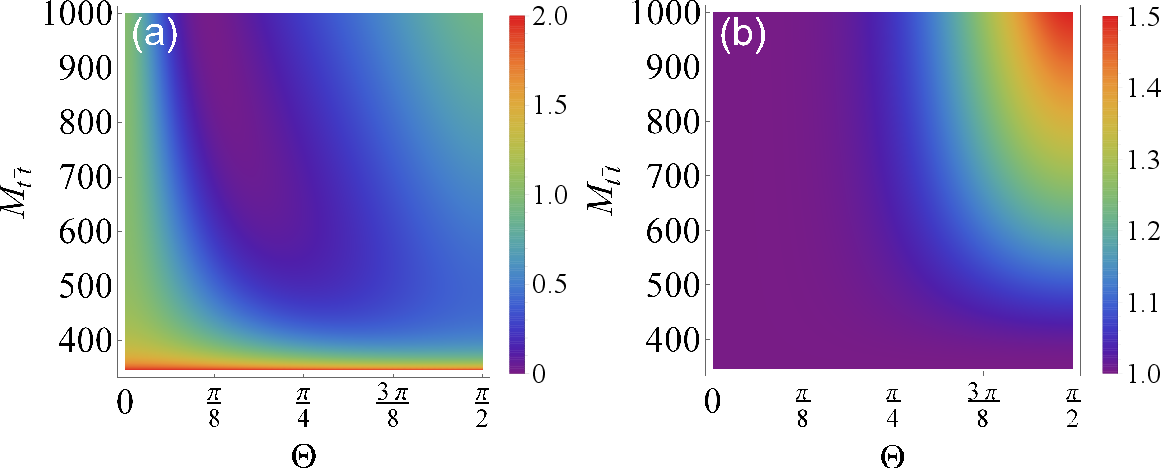
Figure 1: QMI as a function of invariant mass ttˉ3 and scattering angle ttˉ4 for pure ttˉ5 and pure ttˉ6 initiated ttˉ7 production.
Analysis demonstrates pronounced model and kinematic dependence. In ttˉ8 fusion, QMI exhibits a strong maximum near production threshold at ttˉ9 GeV and decays with increasing qqˉ0. For qqˉ1 annihilation, the inverse trend is observed with QMI increasing as both qqˉ2 and qqˉ3 increase, supporting high-energy, large-angle preference for stronger correlations.
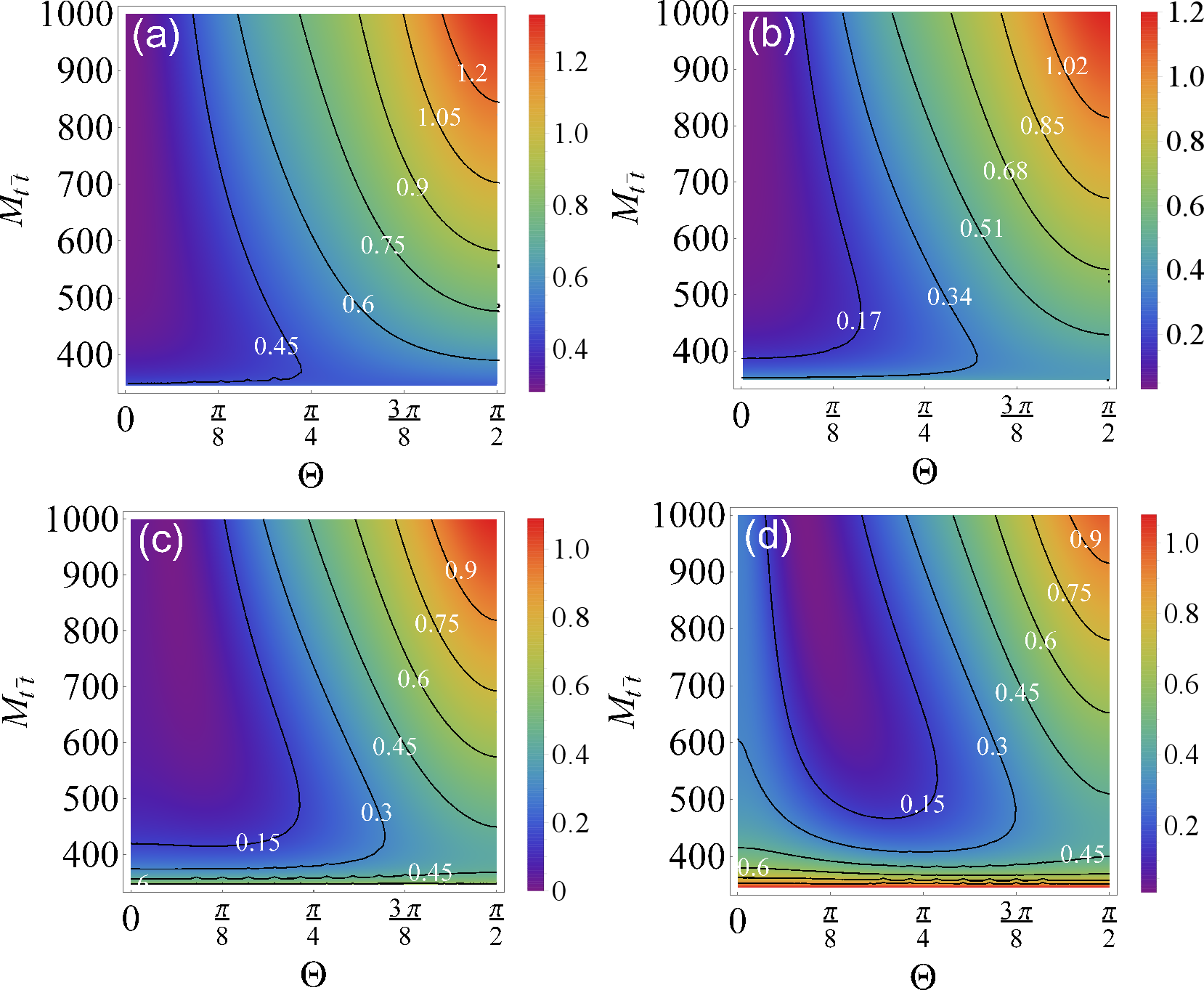
Systematic studies for mixed initial states underscore the continuity of QMI as a function of qqˉ4, with the observable converging to the qqˉ5-dominated regime at high qqˉ6.
Figure 2: QMI in qqˉ7 pairs for varying gluon admixture qqˉ8 shows a shift in maximum correlation structure toward the low-mass/large-angle region.
Quantum Coherence as Quantified by REC
The relative entropy of coherence (REC) captures basis-dependent quantum coherence inherent to the total qqˉ9 state:
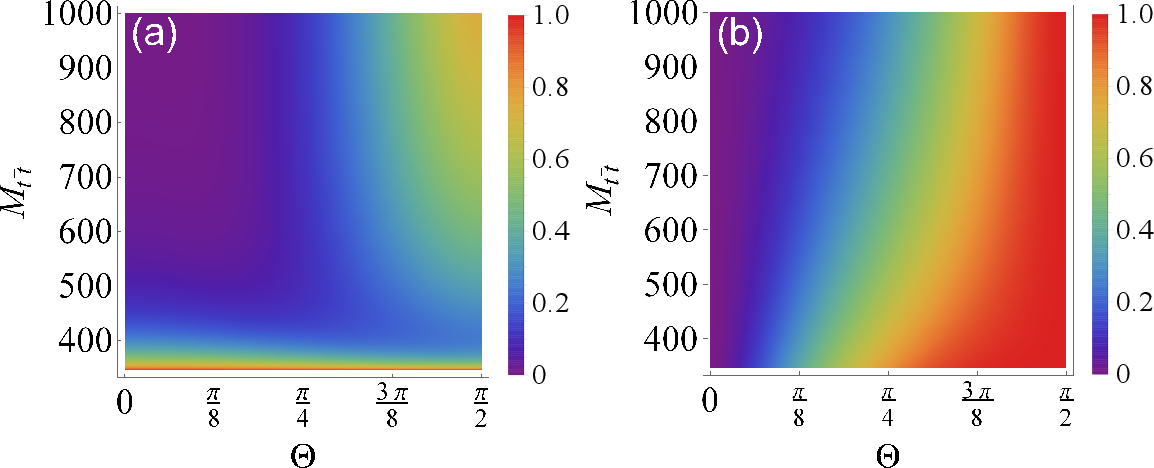
Figure 3: REC as a function of gg0 and gg1 for pure gg2 and gg3 production.
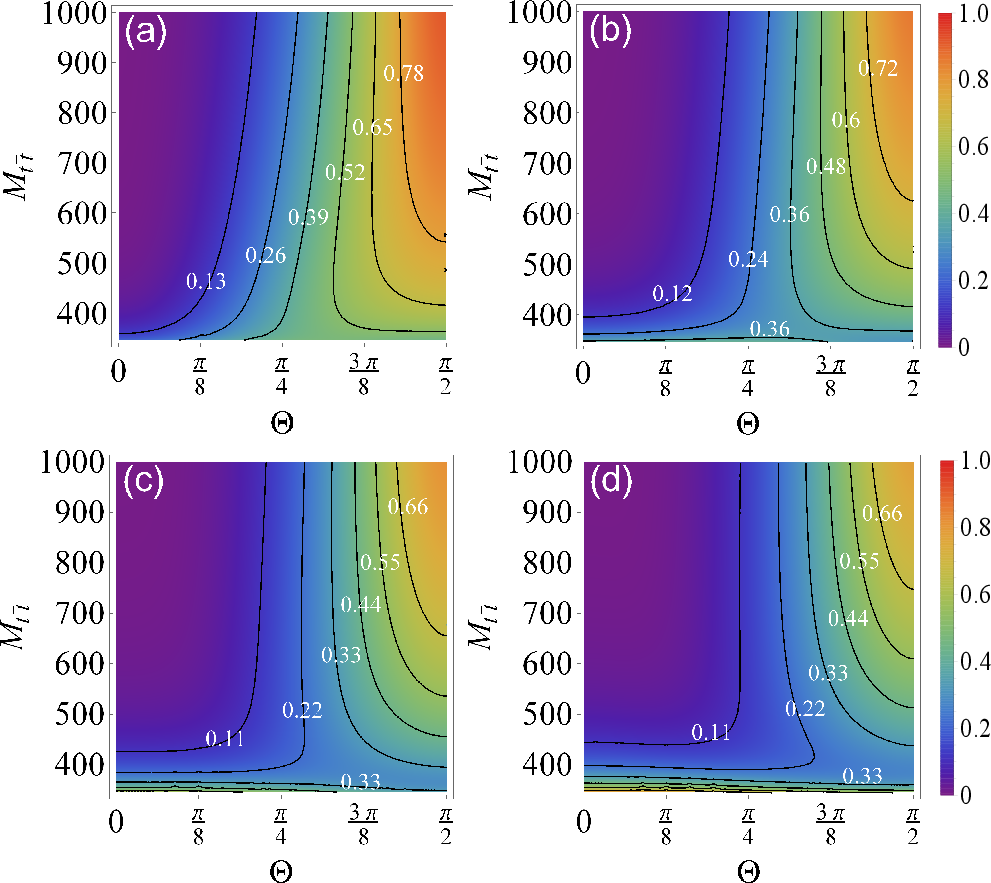
The REC exhibits clear qualitative distinction between initial channels. In gluon fusion, coherence is maximized at threshold and for small angles, subsequently decaying with gg4. In contrast, the gg5 channel yields monotonic enhancement with gg6 at fixed mass. The admixture of gg7 and gg8 allows detailed interpolation, highlighting the nontrivial interplay between kinematic and initial-state effects.
Figure 4: REC for varying gg9, demonstrating the expansion of high-coherence regimes with increasing gluon fusion contribution.
Complete Complementarity and Mutual Constraints
The CCR combine QMI, conditional entropy, REC, and predictability measures, enforcing the constraint
Mttˉ0
For the case at hand, with vanishing predictability and coherence for single subsystems, the relation reduces to a conservation law:
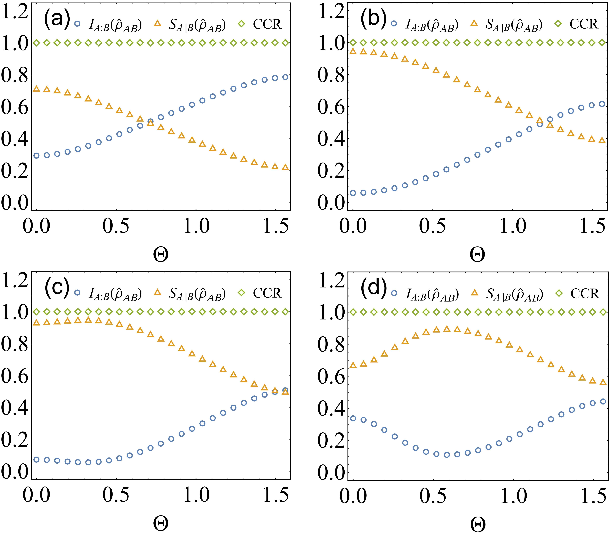
Figure 5: QMI, conditional entropy, and their sum (CCR) as functions of Mttˉ1 for fixed Mttˉ2 and various Mttˉ3. The sum remains unity across parameters.
This conservation directly reflects total decoherence of subsystems in the reduced description—a property enforced by environmental tracing inherent to collider measurement and quantum state reduction in QCD.
Intrinsic Relations Among Quantum Information Measures
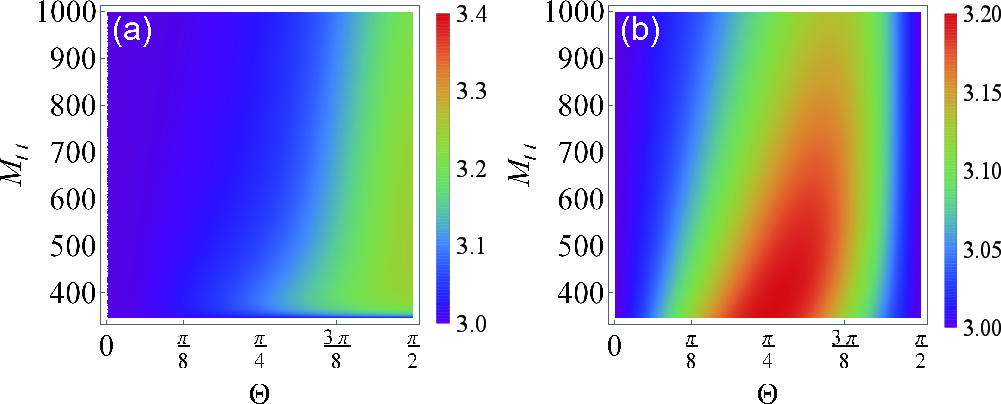
A central result is the derivation and validation of an intrinsic relation involving conditional entropies, REC, and predictability, offering a nontrivial lower bound (e.g., Mttˉ4 for two-qubit systems):
Figure 6: Left-hand side of the intrinsic relation as a function of Mttˉ5 and Mttˉ6 for pure channel production.
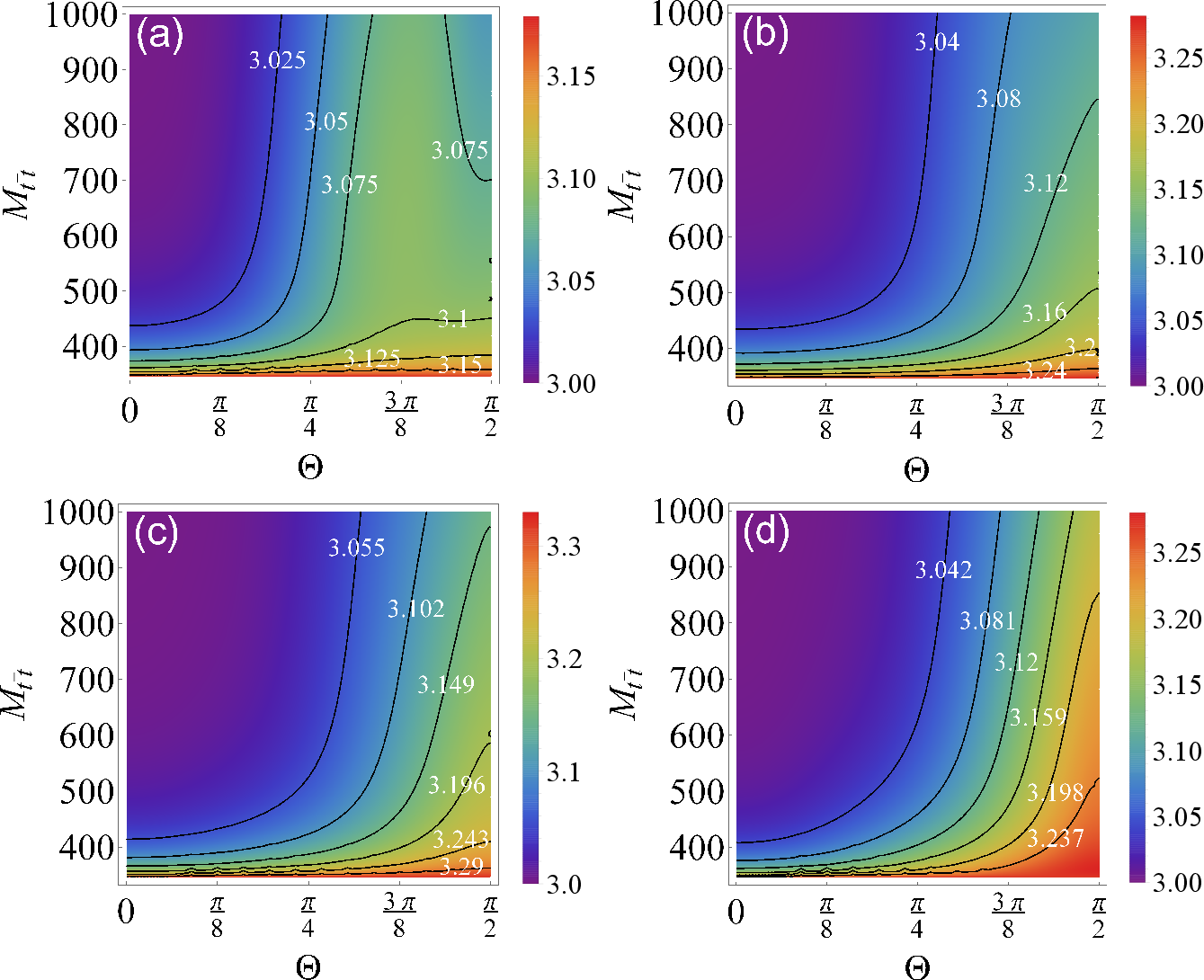
Figure 7: Left-hand side of the intrinsic relation for varied Mttˉ7. Higher gluon admixture enhances the lower-bound saturation near threshold at large Mttˉ8.
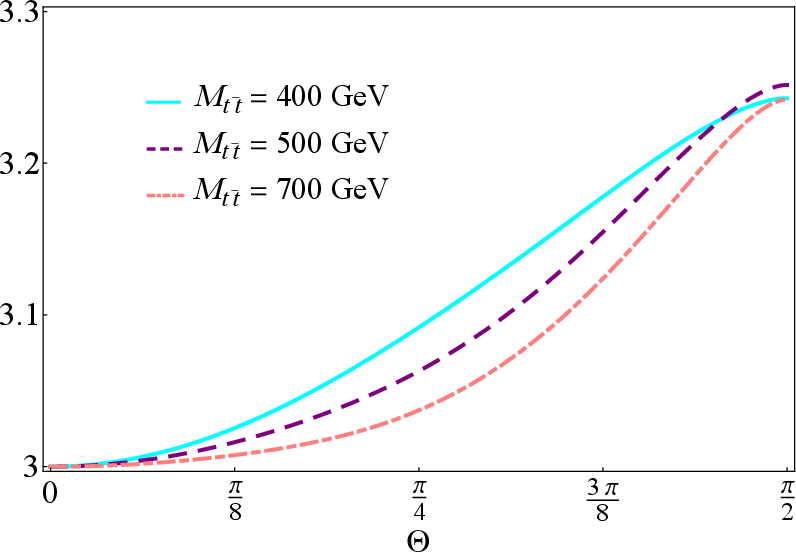
Figure 8: Intrinsic relation as a function of Mttˉ9 for fixed Θ0; larger masses reduce the observable’s magnitude at all angles.
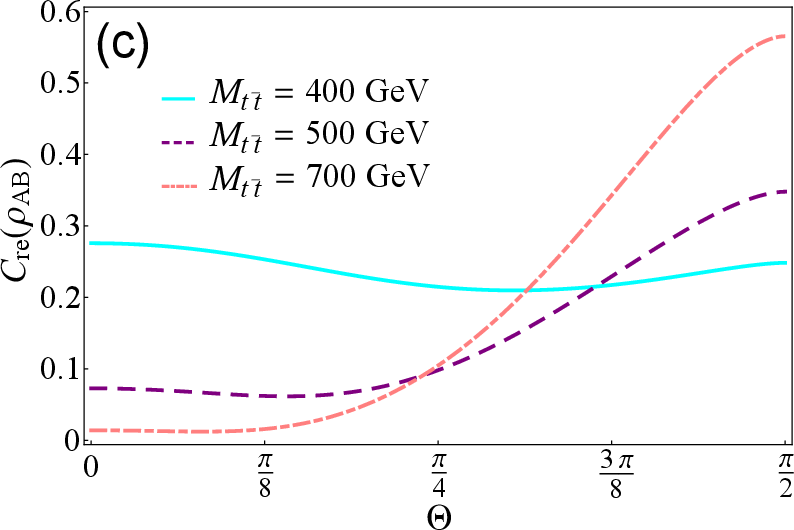
Decomposition of the intrinsic relation into conditional entropy, predictability, and REC contributions reveals distinct angle and mass dependence, with coherence predominantly enhanced at large Θ1 and low Θ2.
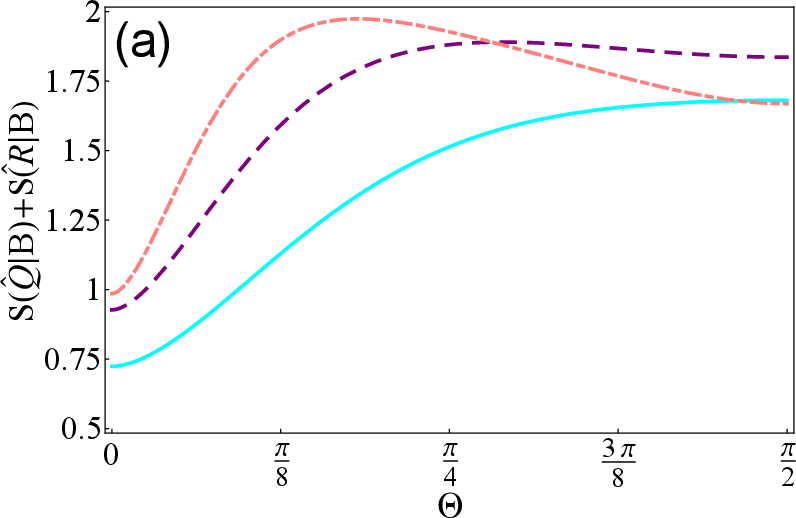
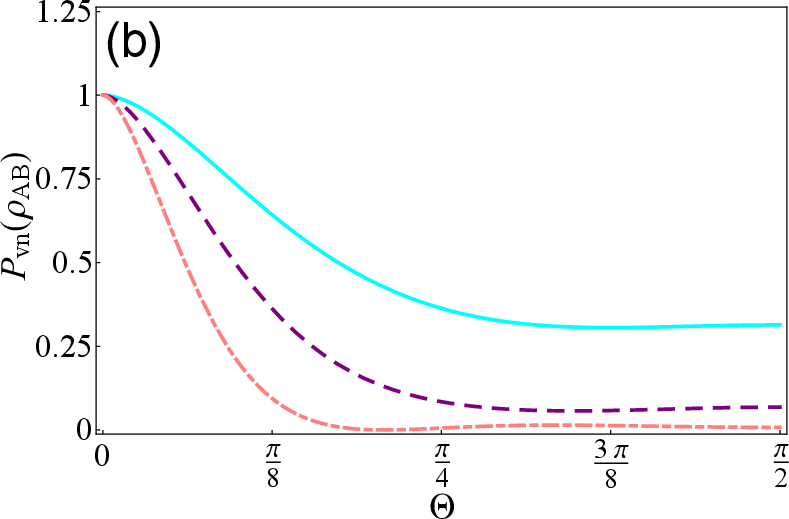
Figure 9: Decomposition of the intrinsic relation: (a) conditional entropy sum, (b) predictability, (c) REC, as functions of Θ3 for representative invariant masses.
Implications and Outlook
The analytic mapping of quantum information observables onto QCD Θ4 production delivers refined, basis-independent probes of the quantum correlation structure in high-energy processes. The independence of CCR and the universal scaling of the intrinsic relation with initial-state mixing provide tools for distinguishing quantum versus classical sources of correlation and coherence at colliders, with immediate relevance for experimental analyses seeking to characterize entanglement, decoherence, and new physics signals at reconstructed events.
Practically, these results set the stage for systematically benchmarking quantum resource theory observables across hadron collider datasets, extending to differential measurements and systematic scans over BSM-sensitive kinematic regions. Theoretically, the framework invites generalization to other multipartite systems and facilitates the cross-fertilization of quantum resource quantification and particle phenomenology, including in the presence of beyond-the-Standard Model couplings or decohering environments.
Conclusion
This work achieves a rigorous connection between quantum information measures and high-energy collider observables in Θ5 production. By embedding QMI, REC, and unified CCR/intrinsic relations into a systematic QCD calculation, it both elucidates the quantum structure of top quark events and provides analytic and numerical tools for future experimental and theoretical explorations of quantumness in the Standard Model and beyond.