Hamiltonian learning for spin-spiral moiré magnets from electronic magnetotransport
Published 3 Apr 2026 in cond-mat.mes-hall | (2604.02959v1)
Abstract: Two-dimensional noncollinear magnetic states, such as spin-spiral magnets, offer an excellent platform for investigating fundamental phenomena, with potential for advancing stray-field-free spintronics. However, detection and characterization of noncollinear magnetic states in two-dimensional systems remain challenging, motivating the development of alternative probing methods. Here, we present a methodology for extracting the spin-spiral q vector from lateral electronic transport measurements. Our approach leverages the magnetic field and bias dependence of the conductance to train a supervised machine learning algorithm, which enables us to extract the q vectors of arbitrary spin-spiral magnets. We demonstrate that this methodology is robust to the presence of impurities in the system and noise in the conductance data. Our findings show that the conductance pattern reveals a complex dependence on the q vector of the spin spiral, providing a new strategy to learn magnetic structures directly from transport experiments.
The paper introduces an ML-based Hamiltonian learning framework that accurately reconstructs spin-spiral q-vectors from transport measurements in moiré magnets.
A combination of PCA and a neural network enables near-perfect fidelity even under experimental noise, validating the approach.
This methodology offers a scalable, non-invasive route for probing noncollinear magnetic orders in 2D van der Waals heterostructures.
Hamiltonian Learning of Spin-Spiral Moiré Magnets via Electronic Magnetotransport
Introduction
The paper "Hamiltonian learning for spin-spiral moiré magnets from electronic magnetotransport" (2604.02959) addresses the precision identification of noncollinear magnetic order in two-dimensional (2D) moiré magnets, specifically spin-spiral magnets (SSMs), through a Hamiltonian learning framework based on electronic magnetotransport measurements. Characterizing 2D noncollinear ordering poses significant challenges, especially in van der Waals (vdW) heterostructures, where stray-field-free control is crucial for spintronic applications. This manuscript develops and validates a ML methodology that leverages transport signatures in the Hofstadter regime for reconstructing the fundamental spin spiral q-vector, which encodes both the wavevector magnitude and orientation of the spiral.
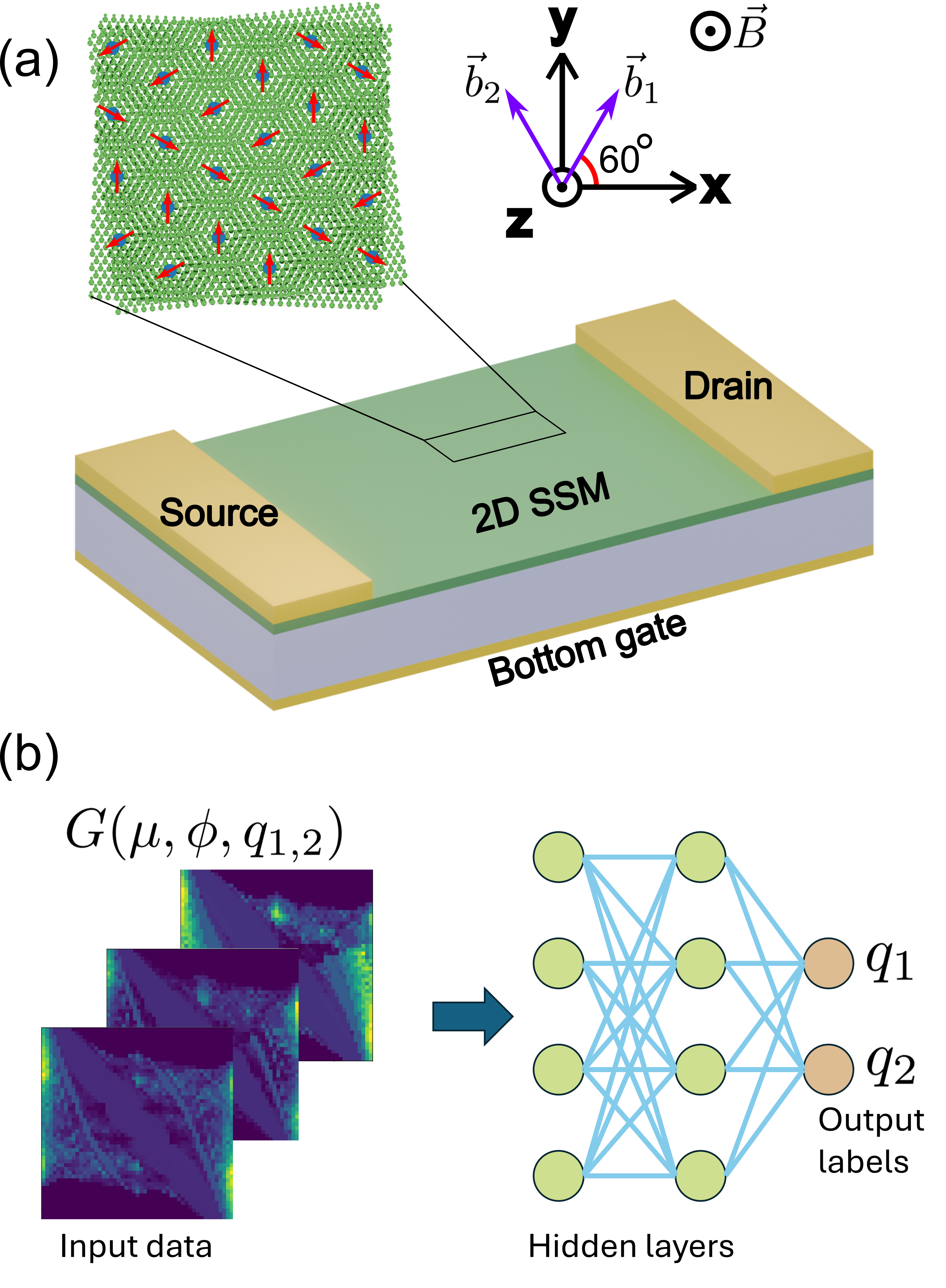
Figure 1: (a) Device schematic showing local moments on a twisted moiré lattice, with conductance probed via source/drain electrodes and perpendicular magnetic field. (b) Hamiltonian learning workflow extracting q from transport data.
Model and Physical Framework
The system consists of a twisted TMD bilayer structure comprising two functional layers: a Mott-insulating spin-spiral layer and a gate-tunable metallic probe layer. The hybridization between these layers results in a significant moiré superlattice, which magnifies magnetic-field-induced effects in electronic transport. The Hamiltonian captures nearest-neighbor hopping, spin-spiral exchange (proximity), chemical potential tunability, and disorder:
The proximity-induced exchange field Jα(q) is parameterized by a wavevector q, giving direct access to the spin-spiral order. The model incorporates random onsite disorder, emulating real device imperfections.
Hofstadter Signatures and Transport Analysis
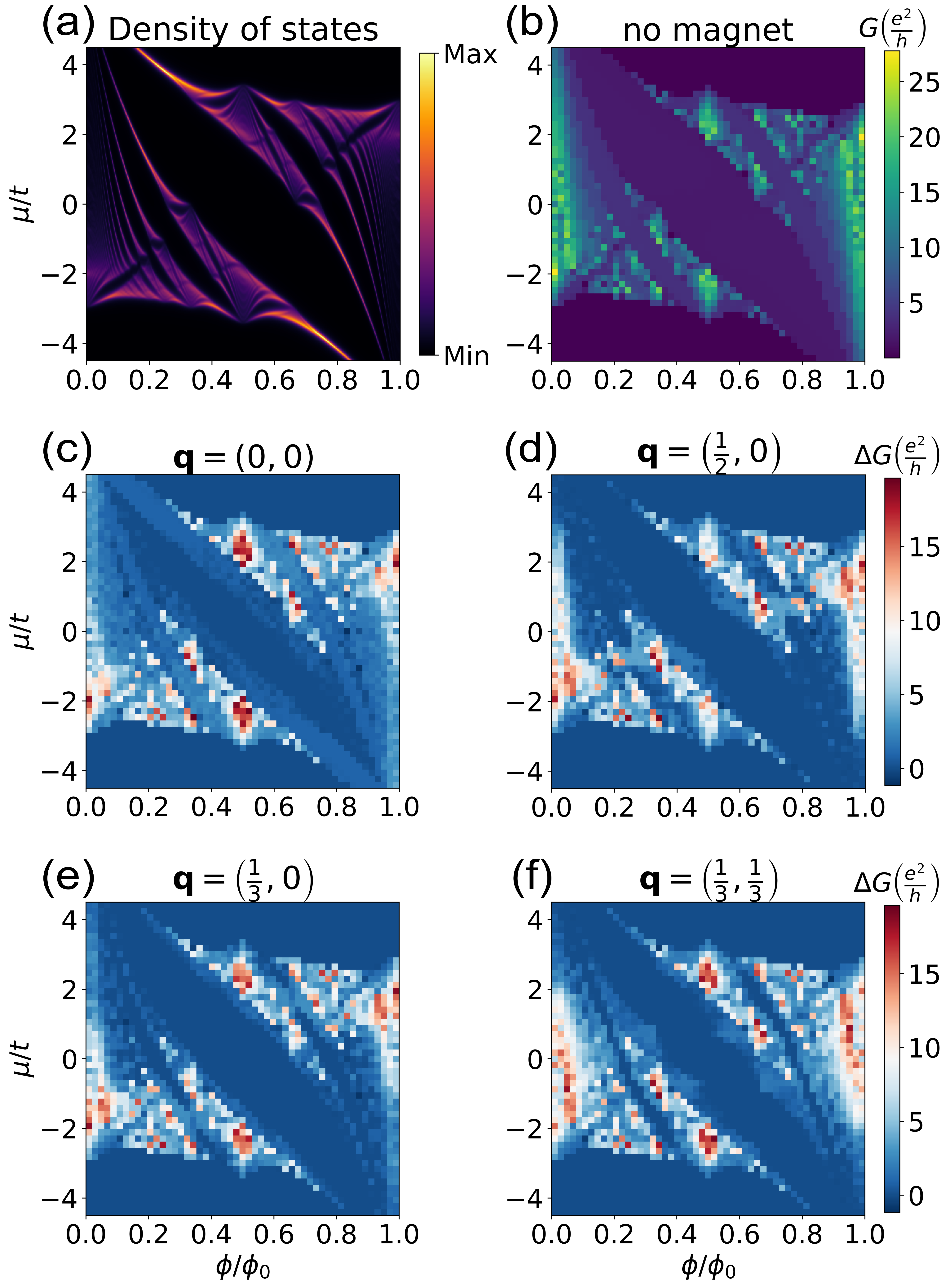
In the regime of phase-coherent, ballistic transport, the conductance spectra reflect the intricate interplay of moiré periodicity and external magnetic flux, realized in the much-studied Hofstadter butterfly. Modification of these patterns occurs due to exchange coupling with the SSM. The evaluation uses the Landauer formalism, with nonequilibrium Green's functions to compute G(μ,ϕ) as a function of chemical potential and normalized flux.
Figure 2: (a) Hofstadter butterfly in density of states as a function of μ and normalized flux. (b) Conductance without exchange proximity. (c)-(f) Conductance changes ΔG for various q, revealing strong dependence on spiral ordering.
Simulated datasets, capturing a range of q1,q2 spiral components, manifest distinct transport fingerprints for different spin-spiral states, allowing inference of the q0-vector from experimental data.
Machine Learning-Based Hamiltonian Inference
An ML pipeline is developed to reconstruct the spin-spiral q1-vector from transport data. The approach involves the following stages:
Dataset Construction: 10,000 conductance maps parametrized by random q2 vectors with realistic disorder and exchange parameters.
Supervised Learning: A feedforward neural network with two hidden layers (100 neurons each, ReLU activation) is trained to map the reduced conductance features to q4. Training uses Adam optimization and MSE loss minimization on both training and validation sets.
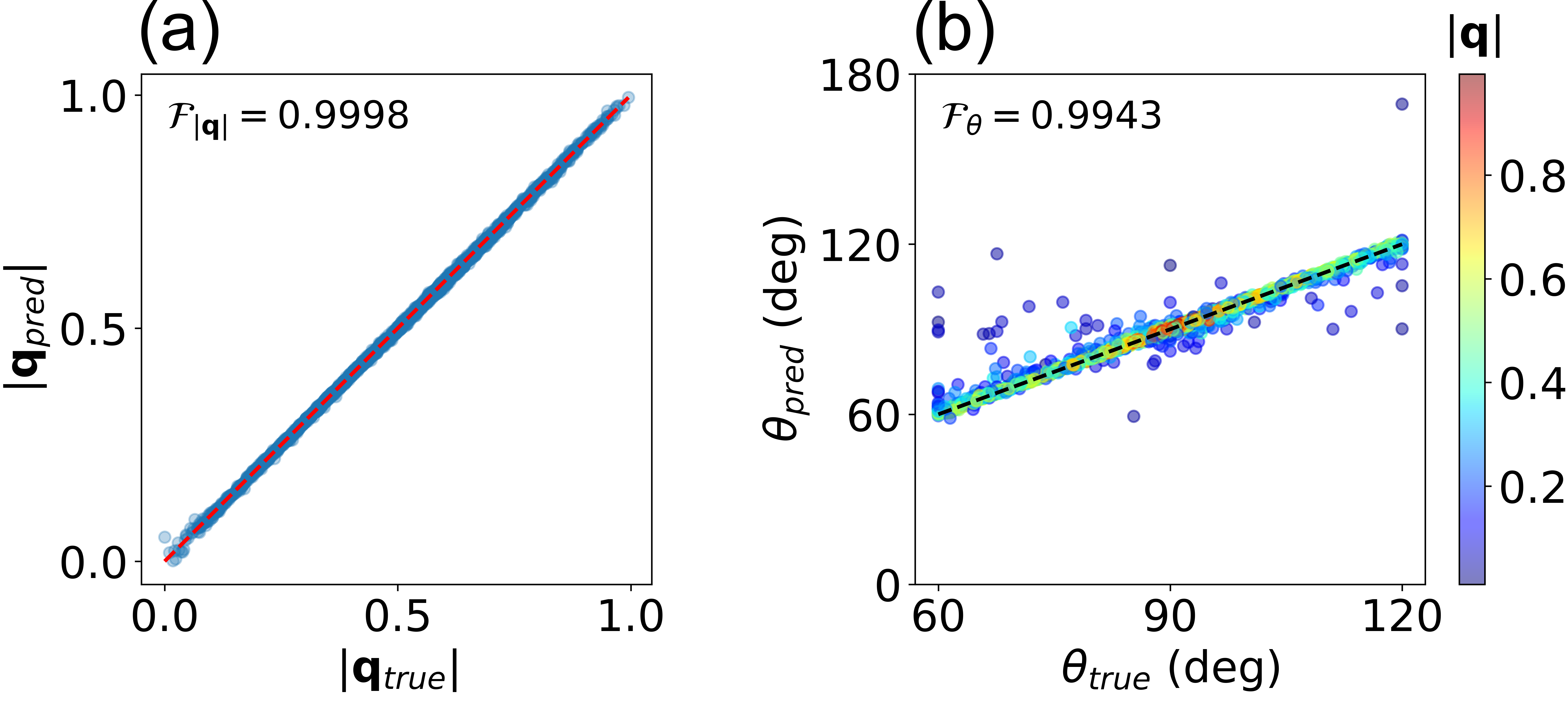
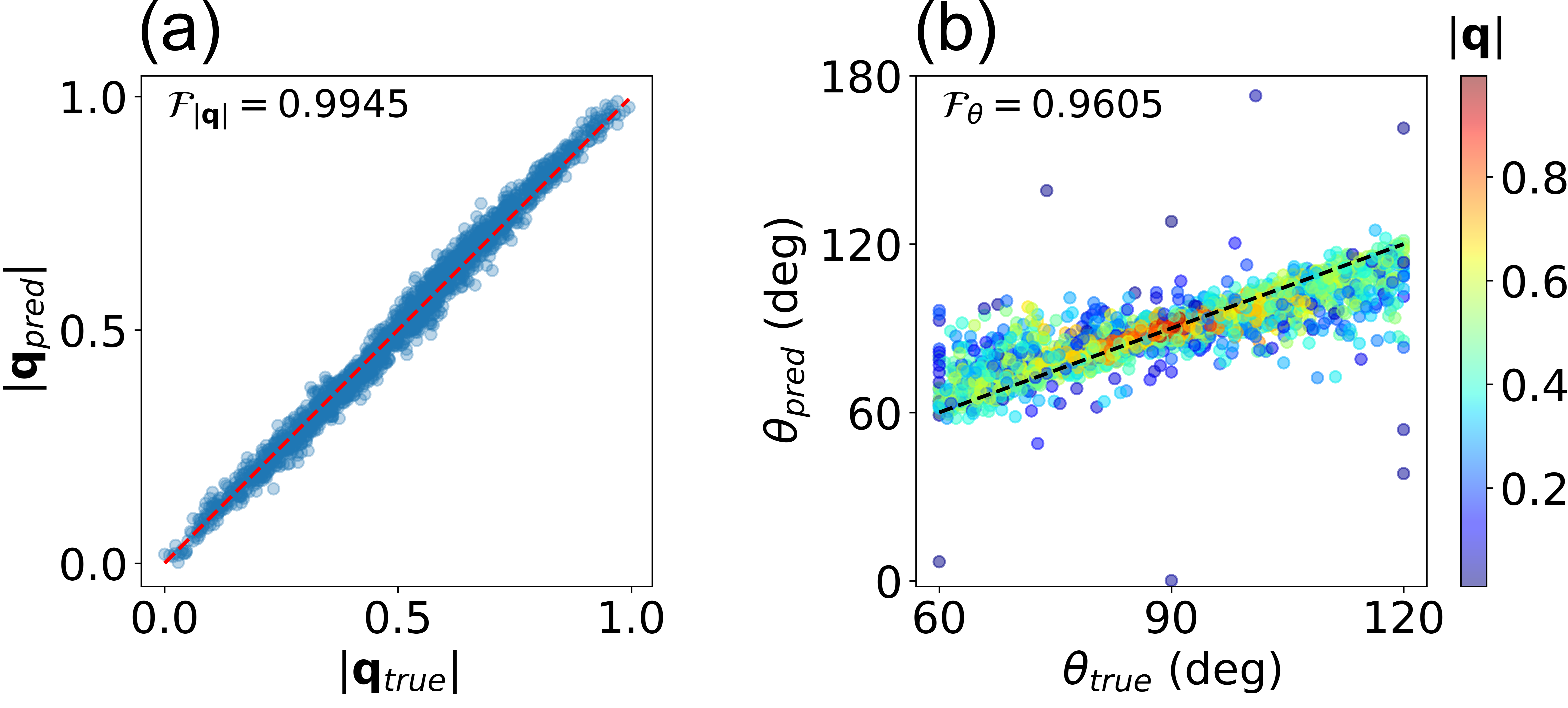
Figure 3: (a) Predicted vs. true q5 values. (b) Predicted vs. true q6 for previously unseen test data.
Quantitatively, the trained model achieves extremely high fidelity: q7 and q8 for test data unseen during training, highlighting the strong predictive mapping from transport observables to underlying spin-spiral order.
Robustness and Noise Analysis
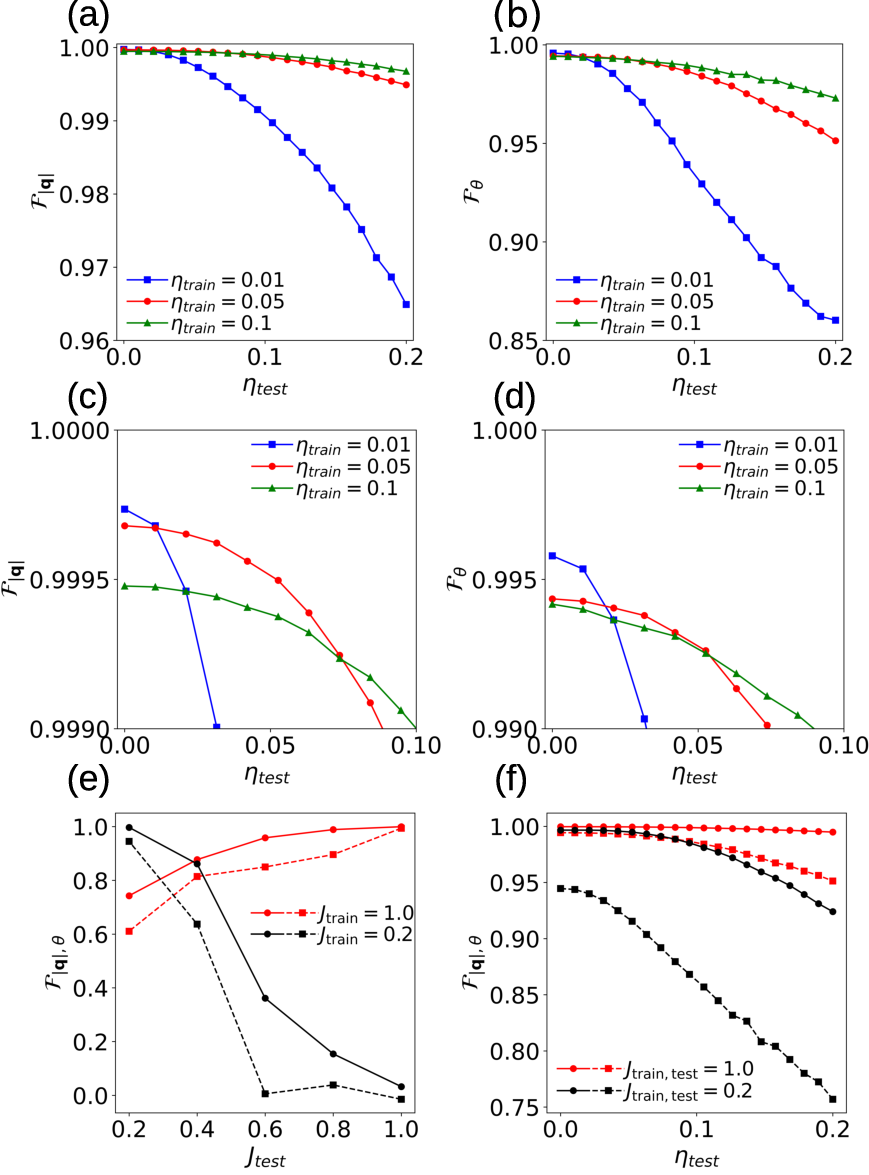
Assessment of the approach under experimental imperfections is conducted by adding controlled, bounded multiplicative noise to the conductance data, both during training and inference. The algorithm displays a nuanced tradeoff: higher training noise impairs performance on noiseless data but improves robustness against matching or higher noise levels at inference.
Figure 4: (a)-(d) Fidelity deterioration as function of test noise q9 for various training noise strengths. (e)-(f) Fidelity dependence on exchange coupling H=t⟨αβ⟩,s∑(eiϕαβcαs†cβs+h.c.)+μα,s∑cαs†cαs+α,ss′∑(Jα(q)⋅σ)ss′cαs†cαs′+α,s∑Wαcαs†cαs0 in the training and testing data.
Exchange coupling H=t⟨αβ⟩,s∑(eiϕαβcαs†cβs+h.c.)+μα,s∑cαs†cαs+α,ss′∑(Jα(q)⋅σ)ss′cαs†cαs′+α,s∑Wαcαs†cαs1 is another critical parameter. High H=t⟨αβ⟩,s∑(eiϕαβcαs†cβs+h.c.)+μα,s∑cαs†cαs+α,ss′∑(Jα(q)⋅σ)ss′cαs†cαs′+α,s∑Wαcαs†cαs2 values ensure prominent proximity effects, leading to reliable reconstruction of H=t⟨αβ⟩,s∑(eiϕαβcαs†cβs+h.c.)+μα,s∑cαs†cαs+α,ss′∑(Jα(q)⋅σ)ss′cαs†cαs′+α,s∑Wαcαs†cαs3 even at moderate mismatch between H=t⟨αβ⟩,s∑(eiϕαβcαs†cβs+h.c.)+μα,s∑cαs†cαs+α,ss′∑(Jα(q)⋅σ)ss′cαs†cαs′+α,s∑Wαcαs†cαs4 and H=t⟨αβ⟩,s∑(eiϕαβcαs†cβs+h.c.)+μα,s∑cαs†cαs+α,ss′∑(Jα(q)⋅σ)ss′cαs†cαs′+α,s∑Wαcαs†cαs5. For weak H=t⟨αβ⟩,s∑(eiϕαβcαs†cβs+h.c.)+μα,s∑cαs†cαs+α,ss′∑(Jα(q)⋅σ)ss′cαs†cαs′+α,s∑Wαcαs†cαs6, fidelity drops significantly, emphasizing the necessity of strong spiral-probe exchange in experimental realization.
Prediction results with both training and testing at finite noise remain robust:
Figure 5: Prediction results for H=t⟨αβ⟩,s∑(eiϕαβcαs†cβs+h.c.)+μα,s∑cαs†cαs+α,ss′∑(Jα(q)⋅σ)ss′cαs†cαs′+α,s∑Wαcαs†cαs7 and H=t⟨αβ⟩,s∑(eiϕαβcαs†cβs+h.c.)+μα,s∑cαs†cαs+α,ss′∑(Jα(q)⋅σ)ss′cαs†cαs′+α,s∑Wαcαs†cαs8 under H=t⟨αβ⟩,s∑(eiϕαβcαs†cβs+h.c.)+μα,s∑cαs†cαs+α,ss′∑(Jα(q)⋅σ)ss′cαs†cαs′+α,s∑Wαcαs†cαs9.
Optimization and Training Dynamics
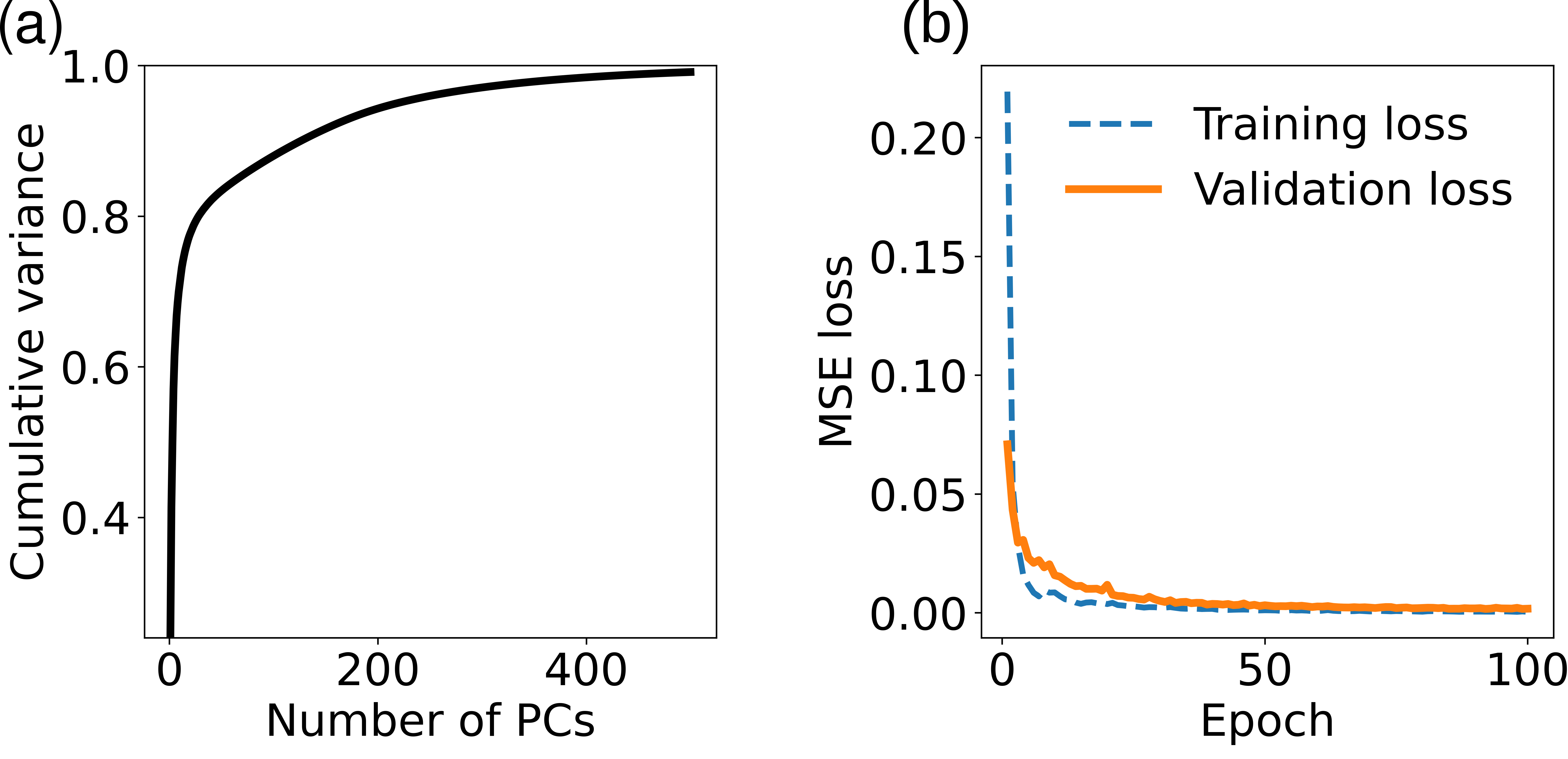
Dimensionality reduction via PCA is shown to retain essential information for learning, with Jα(q)0 achieving near-total variance capture. Model convergence during training exhibits monotonic decrease in MSE for both train and validation sets, with no overfitting observed.
Figure 6: (a) Cumulative explained variance vs. number of PCA components. (b) Train/validation MSE loss across epochs.
Implications and Future Directions
This methodology demonstrates that electronic transport, traditionally a probe for charge and topological phenomena, is sensitive enough to reveal the complex, noncollinear magnetic ordering in vdW moiré magnets via data-driven Hamiltonian learning. The possibility of reconstructing vectorial order parameters of magnetic textures from mesoscopic transport marks an important advance, particularly given the resilience to moderate noise and disorder.
Practically, this framework can be integrated into experimental platforms, enabling high-throughput, non-invasive probing of 2D magnetic phases. Theoretically, it suggests extensions to more complex, possibly topological or skyrmionic, spin-textures, and invites the integration of more sophisticated inference architectures (e.g. graph neural networks or invertible neural operators) for richer Hamiltonian extraction in correlated or interacting regimes.
Conclusion
The work establishes an ML-based Hamiltonian learning pipeline for extracting spin-spiral Jα(q)1-vectors in moiré magnets through carefully designed electronic transport experiments. The results demonstrate high fidelity, substantial robustness to various noise sources, and resilience to device imperfections, offering a viable blueprint for the direct identification of noncollinear magnetic orderings in 2D systems by electronic means (2604.02959). This approach provides a scalable route for the systematic study of emergent magnetism in low-dimensional materials and has broad implications for both spintronics and fundamental condensed matter research.
“Emergent Mind helps me see which AI papers have caught fire online.”
Philip
Creator, AI Explained on YouTube
Sign up for free to explore the frontiers of research
Discover trending papers, chat with arXiv, and track the latest research shaping the future of science and technology.Discover trending papers, chat with arXiv, and more.