- The paper introduces MHENet, which applies modality-specific hierarchical enhancement to strengthen both texture and geometry cues in camouflaged object detection.
- It utilizes a dual-stream encoder–enhancer–fusion design, deploying dedicated modules to separately process RGB and depth modalities before adaptive integration.
- Experimental results across multiple benchmarks demonstrate MHENet’s state-of-the-art performance and robustness in complex segmentation scenarios.
Modality-Specific Hierarchical Enhancement in RGB-D Camouflaged Object Detection
Introduction
Camouflaged object detection (COD) poses substantial challenges due to high foreground-background similarity, low target salience, and ambiguous boundaries. While prior RGB-D based methods leverage depth cues to complement RGB textures, most fuse these modalities directly after standard backbone extraction, precluding optimal exploitation of modality-specific features. This work introduces MHENet, a framework that hierarchically and adaptively enhances RGB (texture) and depth (geometry) features prior to fusion, thereby maximizing complementary representation power for accurate detection in camouflage scenarios (2604.02935).
Architecture Overview
MHENet consists of a dual-stream Pyramid Vision Transformer (PVT) backbone that separately encodes RGB and depth images into multi-scale features. Modality-specific enhancement is performed via two parallel modules:
- Texture Hierarchical Enhancement Module (THEM) for RGB, which refines multi-level texture cues using high-frequency modulation.
- Geometry Hierarchical Enhancement Module (GHEM) for depth, which amplifies structural and boundary information via learnable spatial gradients.
A Semantic Block, common to both modules, ensures cross-level semantic consistency via top-down contextual alignment. The Adaptive Dynamic Fusion Module (ADFM) then integrates the enhanced RGB and depth features using spatially varying, content-aware weighting.
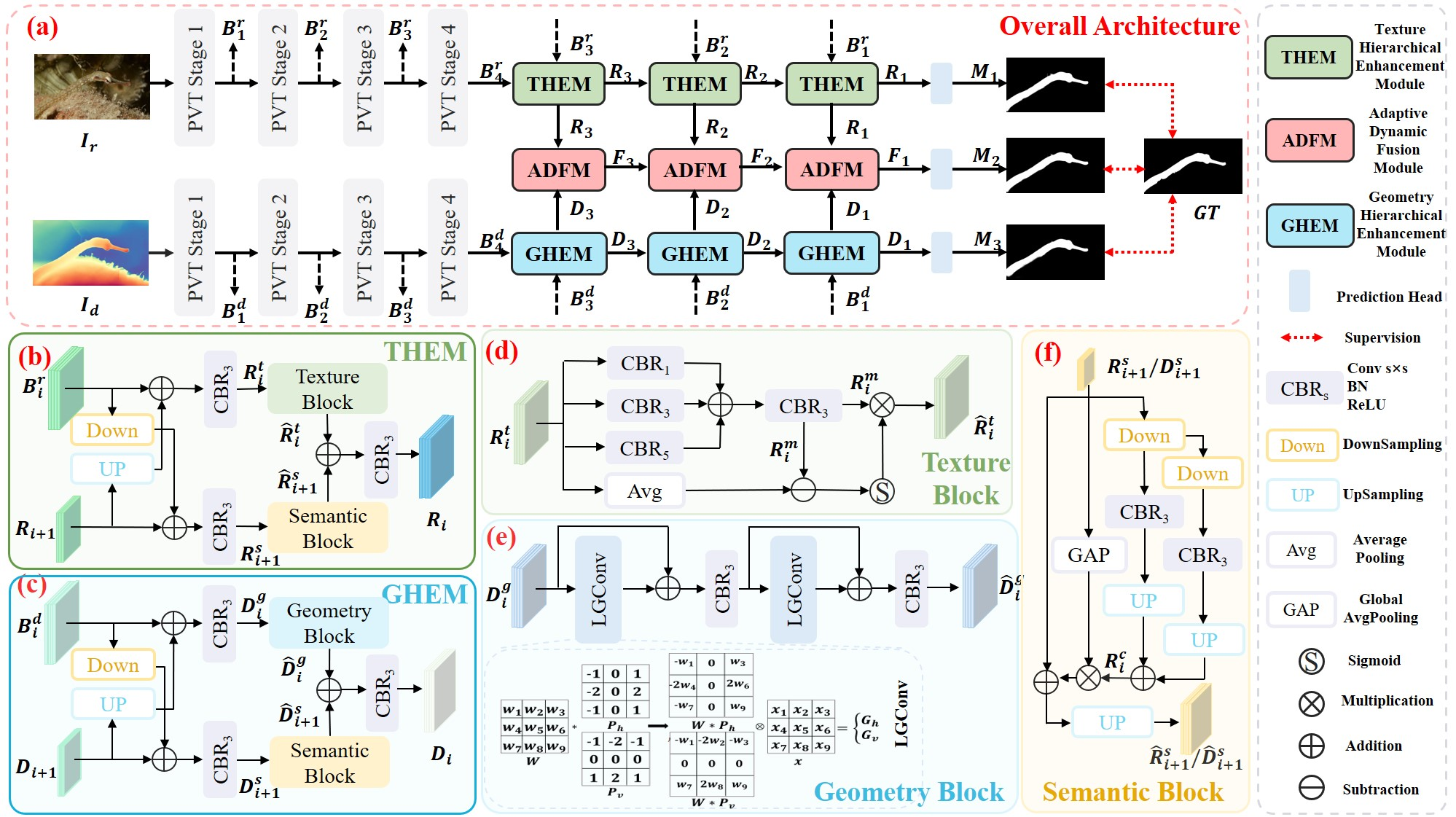
Figure 1: The overall architecture of the proposed MHENet, which consists of three key components, Texture Hierarchical Enhancement Module (THEM), Geometry Hierarchical Enhancement Module (GHEM), and Adaptive Dynamic Fusion Module (ADFM).
Modality-Specific Hierarchical Enhancement
Texture Enhancement for RGB
THEM operates on multi-level RGB features, leveraging cross-scale alignment to fuse high-resolution texture details with semantically enriched lower-resolution features. The Texture Block within THEM emphasizes target/background texture discrepancies using multi-kernel convolutions and adaptive gating, prioritized on high-frequency regions that may be decisive for camouflage separation.
Geometry Enhancement for Depth
GHEM utilizes a learnable gradient convolution (LGConv) to adaptively model spatial gradients and structural changes within depth features. This choice extracts geometry-relevant information—edges, contours, and shape boundaries—using parameterized Sobel-like kernels, followed by further context refinement via a parallel Semantic Block. The resulting features robustly encapsulate geometric salience even when RGB textures are suppressed under camouflage.
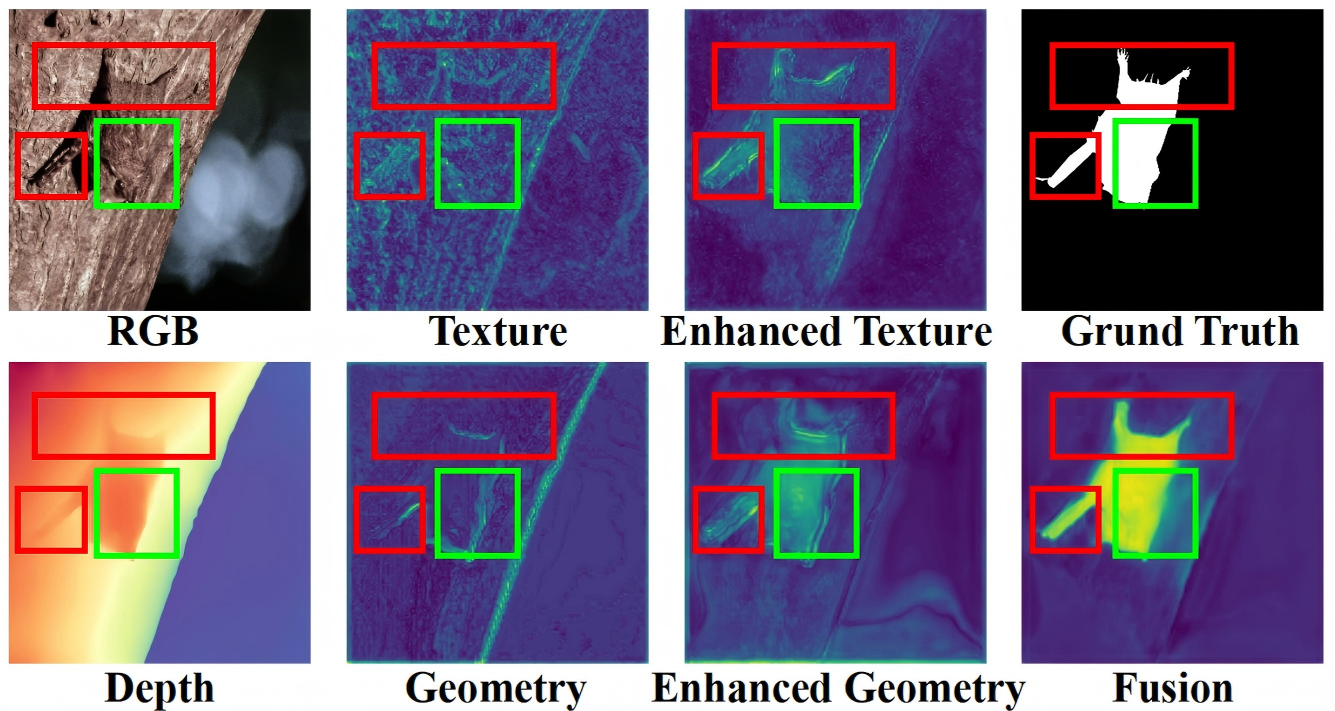
Figure 2: Texture enhancement enriches the texture details of the limbs (red boxes) and geometry enhancement strengthens the bat and its boundary activations (green boxes), enabling fusion to better combine complementary cues. RGB activates more on texture-rich limbs but less on the camouflaged bat, while depth complements the bat for complementary fusion.
Adaptive Cross-Modal Fusion
The Adaptive Dynamic Fusion Module adaptively fuses enhanced RGB and depth features by predicting pixel-wise modality selection weights, guided by inter-modality global and local context. Channel and spatial weighting, normalized via softmax, preserve modality dominance in regions where the data supports it (texture or geometry), while gating out conflicting or unreliable cues. Cross-scale skip connections and channel attention provide additional flexibility, boosting expressiveness in challenging local contexts.
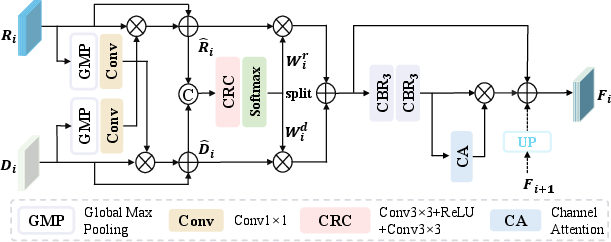
Figure 3: Overview of the Adaptive Dynamic Fusion Module.
Experimental Results
Benchmark Evaluation
MHENet is systematically benchmarked on CHAMELEON, CAMO-Test, COD10K-Test, and NC4K, totaling four datasets with diverse camouflage conditions. It is compared against 16 SOTA methods (12 RGB, 4 RGB-D). MHENet produces the top overall scores or is competitive in all primary metrics—structure-measure (Sα), enhanced alignment (Eφ), weighted F-measure (Fβω), and MAE (M).
Notable Numerical Outcomes:
- On COD10K-Test: Sα=0.889, Eφ=0.942, Fβω=0.817, M=0.019.
- On NC4K: Sα=0.902, Eφ=0.939, Eφ0, Eφ1.
These results surpass all RGB-D comparators and most RGB-only competitors. Ablation studies further confirm that each hierarchical enhancement module and the adaptive fusion module provide additive and statistically significant performance gains.
Qualitative Results
MHENet demonstrates superior delineation of ambiguous targets, accurate boundaries, robust handling of small objects, and resilience to background noise. When depth or RGB cues fail locally, the adaptive fusion often corrects with the superior modality.
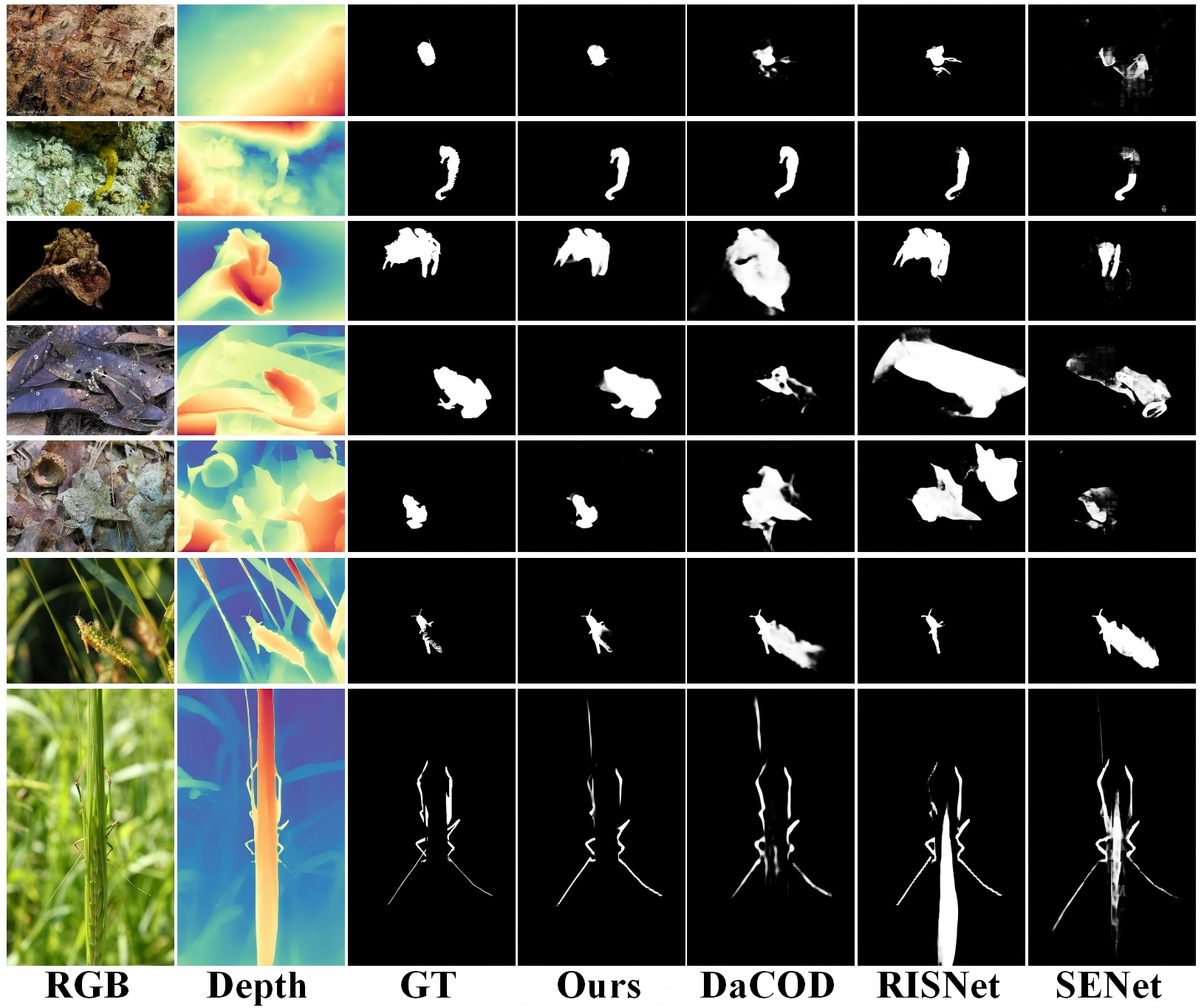
Figure 4: Visual comparisons of some recent COD methods and ours on different types of samples. More comparisons are provided in the supplementary material. Best viewed by zooming in for more details.
Failure Modes and Extensions
Failure analysis reveals that MHENet is sometimes challenged by strong occlusion, highly ambiguous boundaries, or noisy depth estimations. Proposed future extensions include reliability-aware depth refinement, background modeling to handle occlusion, and lightweight edge-aware supervision for boundary sharpening.
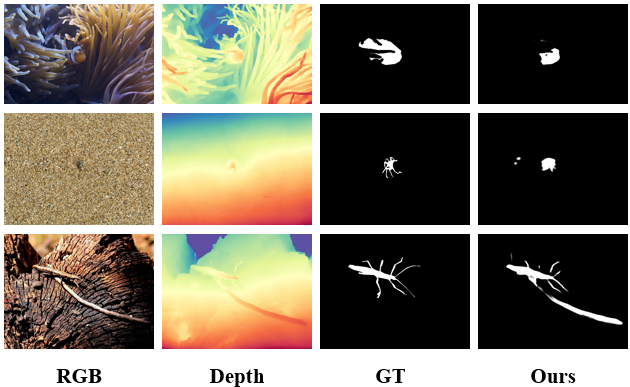
Figure 5: Failure cases and potential extensions of MHENet under occlusion, ambiguous boundaries, and noisy depth scenarios.
Implications and Future Directions
By decoupling modality-specific representation enhancement from cross-modal fusion, MHENet establishes a paradigm where each modality is first optimized for its unique cue set prior to integration. This formalism contrasts with end-to-end or monolithic fusion which disregards the statistical properties of the input spaces, and is ideally suited for tasks exhibiting heterogeneous signal redundancy and complementarity, including but not limited to COD, salient object detection, and medical segmentation.
Practically, MHENet's robustness to depth estimation technique, moderate inference complexity (low FLOPs), and high accuracy recommend it for real-world RGB-D deployment. Theoretically, it motivates future exploration of: joint modality reliability estimation; explicit uncertainty modeling in spatial fusion; dynamic multi-modal architecture search; and extension to additional cues (e.g., thermal, polarization).
Conclusion
MHENet advances the state of camouflaged object detection by combining modality-specific hierarchical enhancement and adaptive dynamic fusion for RGB-D data. The formal separation and enhancement of texture and geometric cues, followed by spatially adaptive, cross-modal fusion, result in both strong quantitative performance across benchmarks and qualitative robustness in challenging scenes. The approach advocates for explicit, modular handling of modality idiosyncrasies for all tasks where input cues exhibit substantial heterogeneity.