- The paper demonstrates that Mott splitting of a flat kagome band produces local moments which then hybridize with itinerant electrons via a Kondo mechanism.
- Integrated STM/STS and ARPES measurements resolve distinct energy scales and momentum-dependent features that confirm the two-stage electronic hierarchy.
- The findings highlight implications for low-carrier density Kondo lattices and potential novel quantum states in frustrated d-electron systems.
Mott-Derived Local Moments and Kondo Hybridization in a d-Electron Kagome Lattice
Introduction and Context
The paper "Mott-Derived Local Moments and Kondo Hybridization in a d-electron Kagome lattice" (2604.02922) addresses a fundamental outstanding question in the physics of Kondo lattice systems: the microscopic origin of local moments in d-electron compounds, specifically within geometrically frustrated kagome lattices. While conventional Kondo physics is anchored in the presence of robust f-electron local moments, realization of analogous phenomena in d-electron systems is substantially more challenging due to the increased itinerancy and broader bandwidths of d-electrons. Here, the focus is on CsCr6Sb6, a bilayer kagome metal, wherein the confluence of strong correlation effects and lattice geometry induces a two-step mechanism: Mott splitting of a kagome flat band yields local moments, which subsequently undergo Kondo hybridization with itinerant electrons.
This work integrates scanning tunneling microscopy/spectroscopy (STM/STS) and angle-resolved photoemission spectroscopy (ARPES) to resolve both the spectroscopic hierarchy and the temperature and energy scales associated with Mott and Kondo phenomena. The results provide a direct spectroscopic link between Mottness and Kondo hybridization in a d-electron system—invoking a qualitatively distinct mechanism from canonical f-electron Kondo lattices.
Structural and Transport Properties
CsCr6Sbd0 crystallizes in a double kagome bilayer structure (space group d1), with the Cr sites forming the essential kagome motif. STM topography reveals high-quality, atomically resolved surfaces, either Cs- or Sbd2-terminated, with the latter being optimal for spectroscopy of the underlying electronic structure. Transport measurements exhibit a low-temperature upturn in resistivity, and d3 reveals a kink near d4 K, consistent with frustrated short-range magnetic ordering.
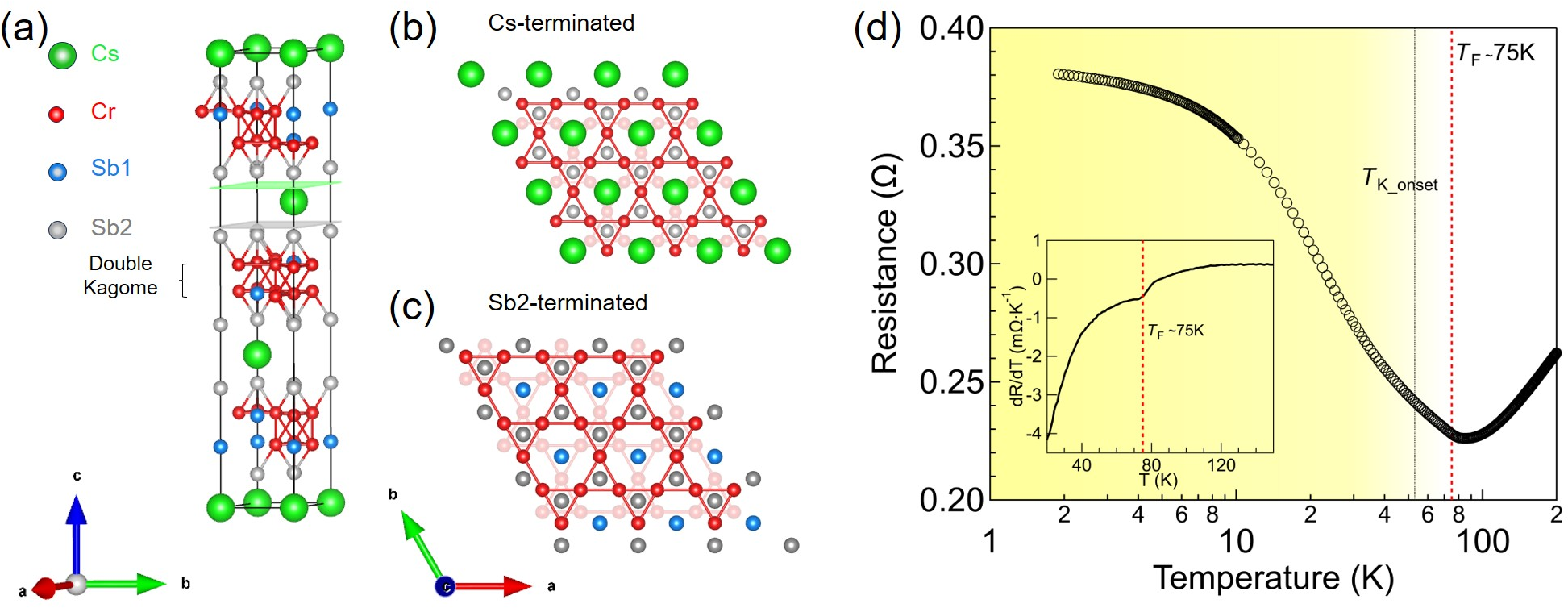
Figure 1: Crystal structure of CsCrd5Sbd6 and temperature-dependent resistivity, showcasing key features of the double kagome bilayer and the emergence of transport anomalies connected to magnetism and hybridization.
STM/STS Evidence for Kondo and Mott Physics
Low-temperature STS spectra on both terminations reveal two robust features: (i) a pronounced, asymmetric suppression of DOS near d7, which is well modeled by a Fano profile and (ii) symmetric, temperature-insensitive humps centered at approximately d8 mV. The Fano lineshape, a hallmark of Kondo hybridization due to interference between localized and itinerant electronic tunneling channels, yields a resonance width d9 corresponding to f0 K. Upon warming above this temperature, the asymmetric gap rapidly fills, in clear excess to simple thermal broadening, indicating the loss of Kondo-derived coherence.
Crucially, the f1 mV humps persist to temperatures far exceeding the Kondo scale, indicating their independence from hybridization physics. These humps are interpreted as Hubbard bands arising from strong correlation-driven Mott splitting of a flat kagome band, with the lower Hubbard band (LHB) being observed directly in both STM and ARPES spectra.
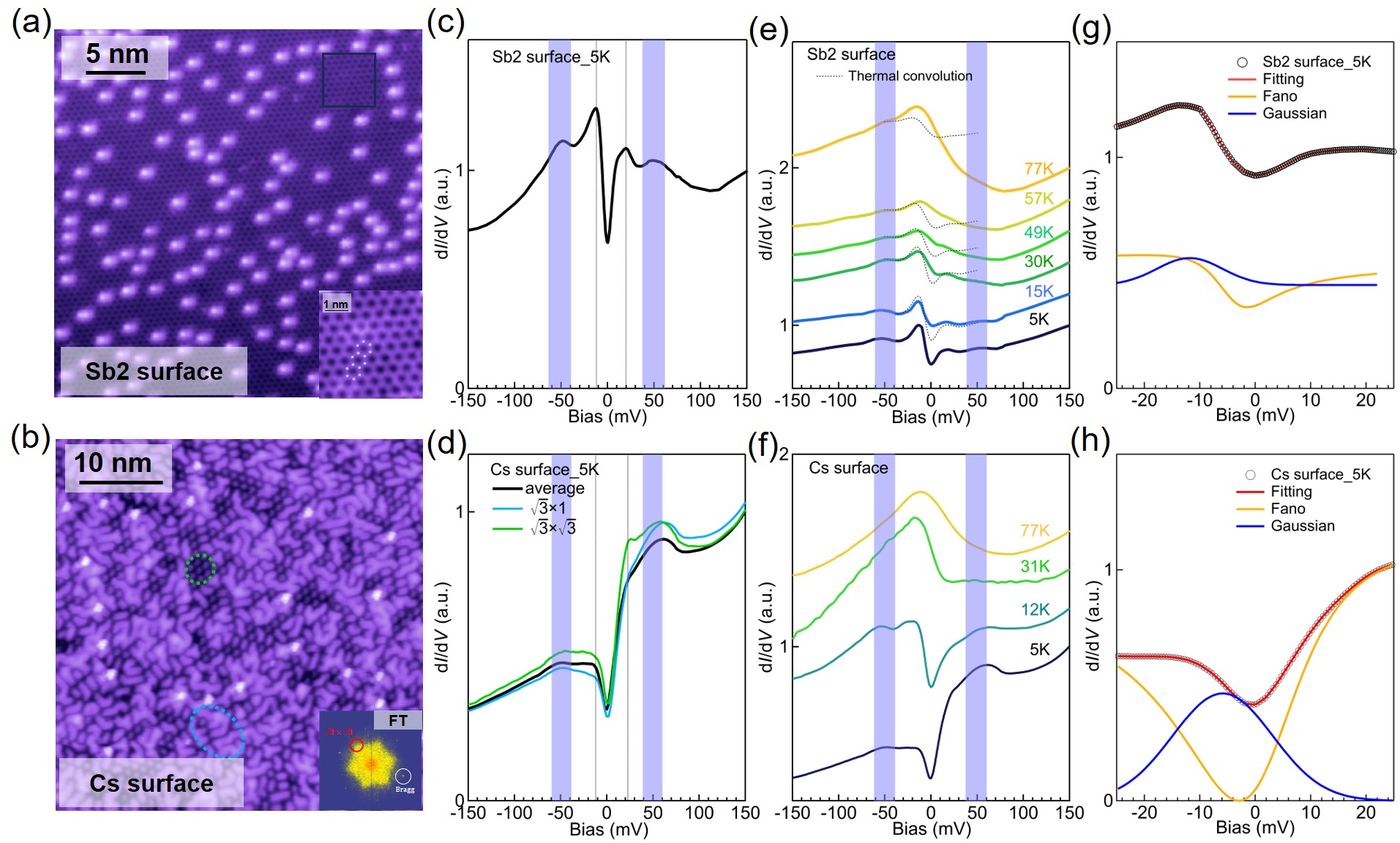
Figure 2: STM/STS topographies and spectra on Sbf2- and Cs-terminated surfaces, temperature evolution of the Kondo hybridization gap, and fitting of the DOS suppression by a Fano+Gaussian model.
Momentum-Resolved ARPES and the Two-Stage Electronic Hierarchy
ARPES measurements directly resolve the band structure across key regions of the Brillouin zone. Near f3, four low-energy bands of predominantly Cr 3f4 character (f5, f6, f7, f8) dominate the electronic landscape. The f9 band, weakly dispersive and located d0 meV below d1, is assigned as the LHB, corroborated by its energy alignment with the STS humps.
At low temperature and primarily at high-symmetry points M and K, a sharp, coherent quasiparticle peak is detected right at d2, which is strongly suppressed as temperature increases through d3. In contrast, at the d4 point, the spectral weight and band coherence remain unaffected by temperature, aligning with observations of persistent features in STS. This dichotomy directly links Kondo hybridization in momentum space to selected Fermi surface regions.
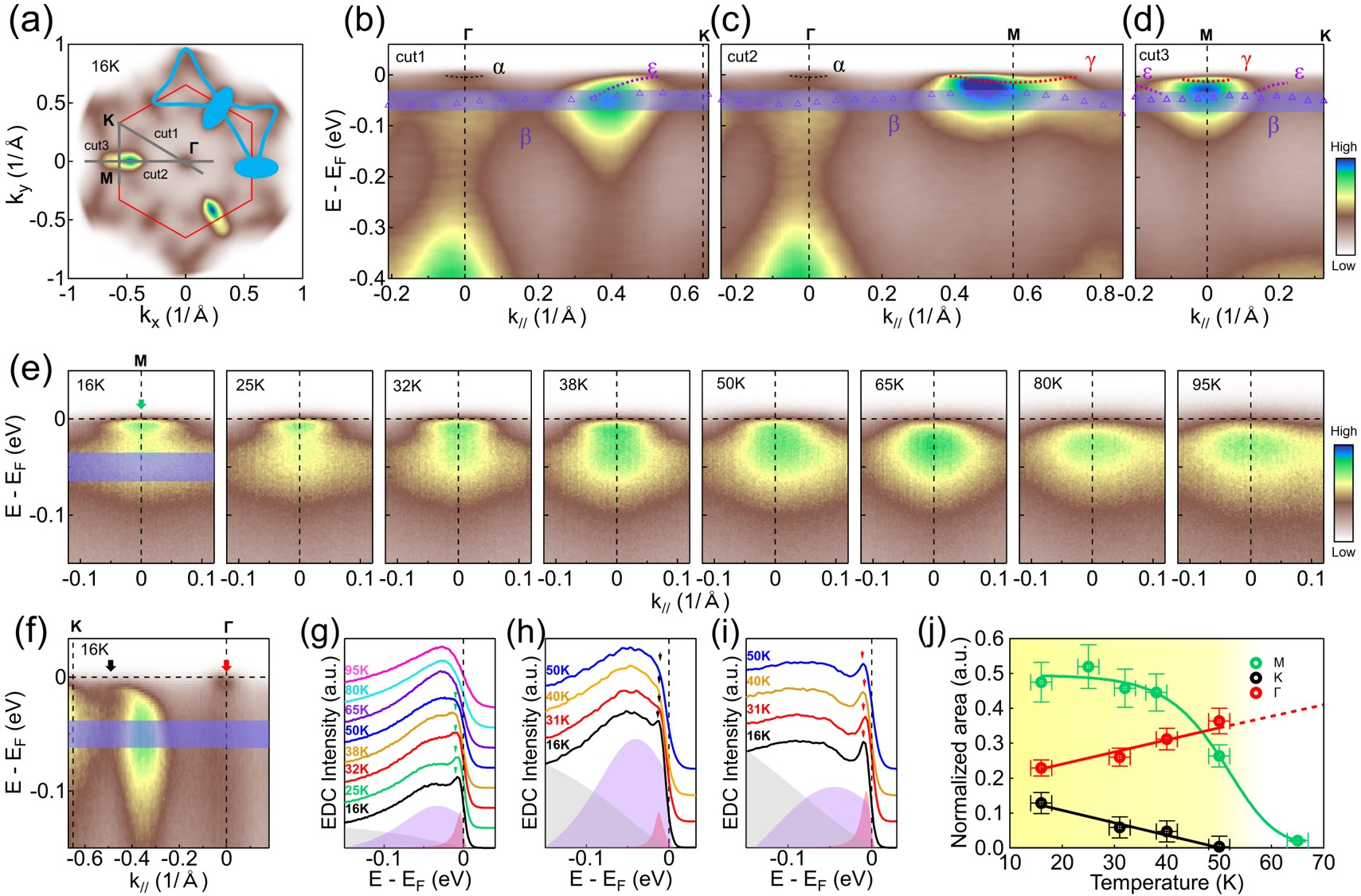
Figure 3: ARPES mapping of the Fermi surface, detailed band dispersions along high-symmetry directions, temperature evolution of quasiparticle peaks, and quantitative spectral weight extraction as a function of temperature at key momenta.
Microscopic Mechanism: From Mott Flat Band to Kondo Lattice
The integrated STM/STS and ARPES data reveal a clear separation of energy and temperature scales: (1) high-energy Hubbard features—robust against temperature and originating from correlation-induced splitting of the flat band, and (2) low-energy, thermally sensitive Kondo hybridization peaks at specific d5 points. This substantiates a two-stage scenario unique to kagome d6-electron systems:
- Mott Splitting of Flat Band: Kagome geometry produces a half-filled, narrow flat band near d7, highly susceptible to on-site Coulomb repulsion. This drives Mott splitting into UHB/LHB, with the occupied LHB serving as the source of localized moments.
- Kondo Hybridization: At lower temperature, these Mott-localized moments hybridize with itinerant conduction electrons, producing a Fano-profiled gap in STM and a coherent quasiparticle peak in ARPES.
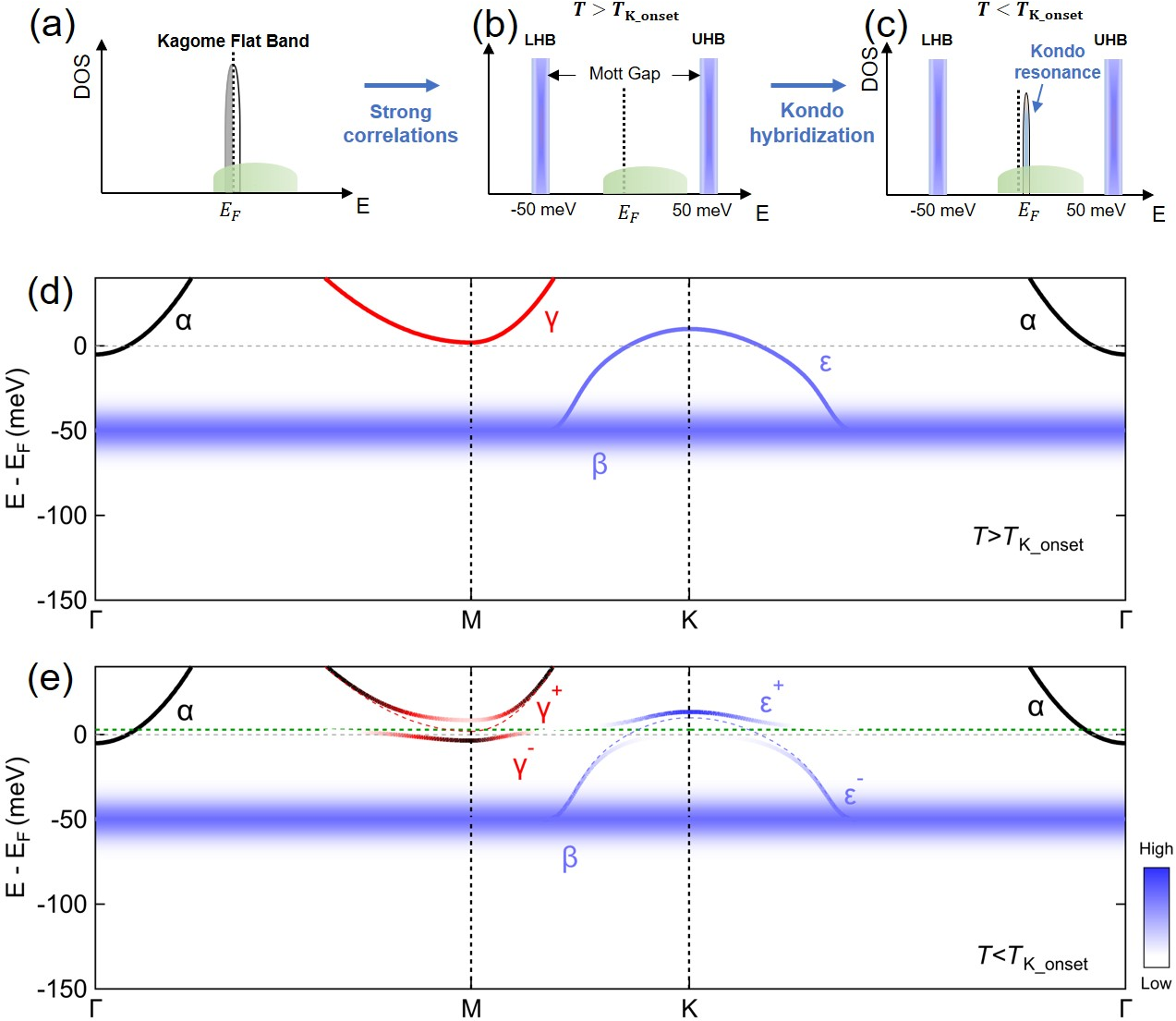
Figure 4: Schematic summary of the two-stage scenario—(a) initial flat band, (b) Mott-split flat band into UHB/LHB, (c) onset of hybridization with Kondo resonance, (d)-(e) momentum-selective band hybridization as mapped by experiment and modeled by the periodic Anderson framework.
Implications, Contrasts, and Future Directions
The demonstrated two-stage hierarchy—first Mottness in a non-d8 multiorbital context, followed by Kondo hybridization—establishes a general microscopic mechanism for Kondo lattice behavior in d9-electron kagome metals. This stands in contrast to both d0-electron Kondo systems and scenarios where pure atomic orbital localization is invoked. Alternative explanations via impurity Kondo scattering or magnetic order are systematically excluded based on a lack of substantial impurity content, the absence of long-range magnetic signatures below d1, and the persistence of the spectroscopic features across surface reconstructions and sample preparations.
The incomplete screening, inferred from residual low-temperature DOS at d2 and anomalous transport signatures, suggests that CsCrd3Sbd4 realizes a low-carrier density Kondo lattice where not all moments are fully screened. This could have broader implications for exotic non-Fermi liquid states and unconventional ordering phenomena in related materials.
The findings position CsCrd5Sbd6 as a platform for exploring the interplay of flat-band physics, Mottness, and Kondo lattice phenomena in non-d7-electron materials, directly relevant for quantum criticality, novel heavy-fermion states, and the emergence of unconventional superconductivity in kagome systems. Possible future directions include direct measurement of dynamic correlations via inelastic probes, mapping of the spin fluctuation spectrum, and studies under varying dimensional confinement or external tuning (e.g., pressure, doping).
Conclusion
The authors establish, via high-resolution STM/STS and ARPES, that CsCrd8Sbd9 embodies a unique 60-electron kagome Kondo lattice where strong correlations induce Mott localization within a flat band, subsequently enabling Kondo hybridization at low temperatures. The two-stage evolution—Mott splitting followed by momentum-selective hybridization—diverges from canonical 61-electron Kondo systems and sets a new paradigm for local moment formation in frustrated 62-electron materials. This work opens controlled spectroscopic access to the intertwined physics of Mottness and emergent heavy-fermion behavior in geometrically frustrated lattices, providing a template for future theoretical and experimental inquiries in correlated quantum materials.