- The paper establishes that incorporating spin reversal in Hamiltonian flock models preserves detailed balance via a generalized time-reversal symmetry.
- It employs Langevin dynamics and a Martin-Siggia-Rose generating functional to derive modified fluctuation-dissipation relations, including Onsager-Casimir reciprocity.
- Numerical simulations confirm standard Brownian translational diffusion while revealing Kramers-type transitions and oscillatory angular dynamics under strong coupling.
Hamiltonian Flocks: Time-Reversal Symmetry and its Consequences
Introduction and Theoretical Background
The study of time-reversal symmetry (TRS) and its associated fluctuation-dissipation theorems (FDTs) is foundational in nonequilibrium statistical mechanics, particularly for active and polar systems that break detailed balance. While active matter typically generates entropy via energy input from the environment, "Hamiltonian flocks" present a conservative framework where spontaneous collective motion arises in closed systems due to the coupling between spin and velocity, yet without explicit self-propulsion or external driving. The present work analyzes such a model and demonstrates that, despite breaking Galilean invariance, it possesses a generalized TRS yielding a nontrivial FDT that entangles spatial and spin degrees of freedom (2604.02914).
The core of the model is a two-dimensional system of N particles, where each particle's canonical variables include position ri, momentum pi, polarization (spin) si, and angular velocity ωi. The Hamiltonian is
H=i=1∑N[2pi2+2ωi2−Kpi⋅si]+21i=k∑[U(rik)−J(rik)si⋅sk].
Here, K quantifies the spin-velocity coupling, breaking Galilean invariance, while U and J control inter-particle repulsion and ferromagnetic coupling, respectively.
To study noise-averaged properties and TRS, the system is coupled to a momentum and angular-velocity thermostat ("tachostat") at inverse temperature β and mean velocity ri0. The resulting Langevin dynamics for each particle are
ri1
where the spin variable obeys
ri2
Stochastic noise stems from the environmental bath, constructed via a Zwanzig-Mori argument, ensuring consistency with equilibrium statistics.
The resulting trajectories capture a rich landscape of dynamical behaviors, including unbiased Brownian motion, persistent random walks, and directed motion depending on ri3 and ri4. These are clearly illustrated for the underdamped, overdamped, and fully conservative limits.
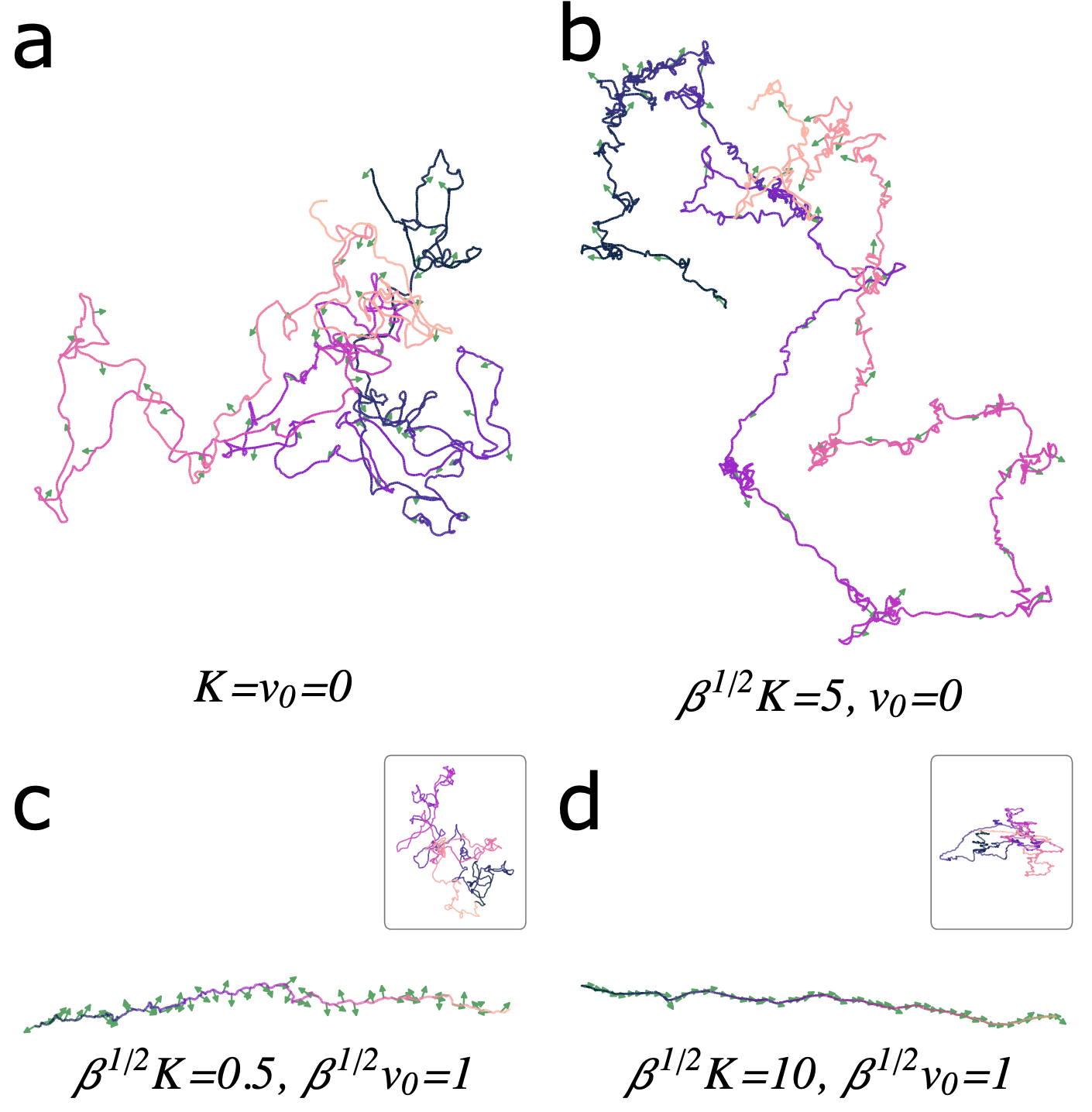
Figure 1: Single-particle trajectories for different regimes, demonstrating the influence of spin-velocity coupling ri5 and tachostat velocity ri6.
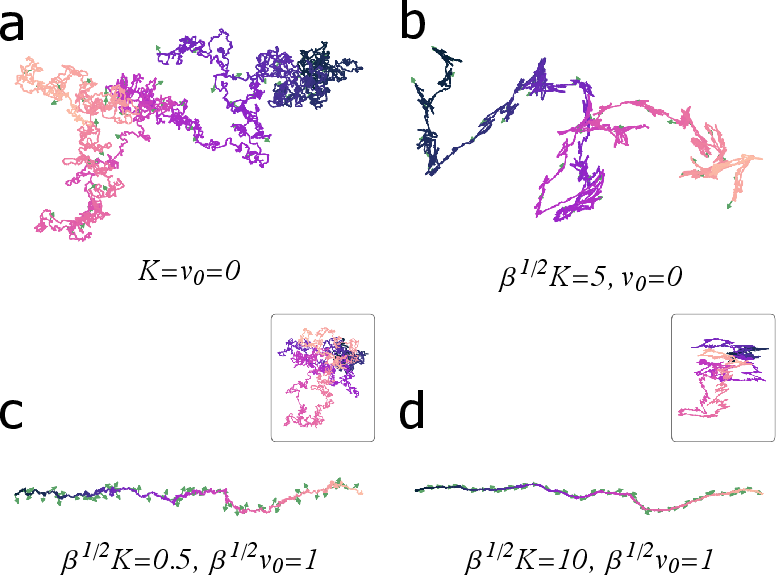
Figure 2: Overdamped trajectories highlight the persistent and directional behavior as ri7 and ri8 are varied.
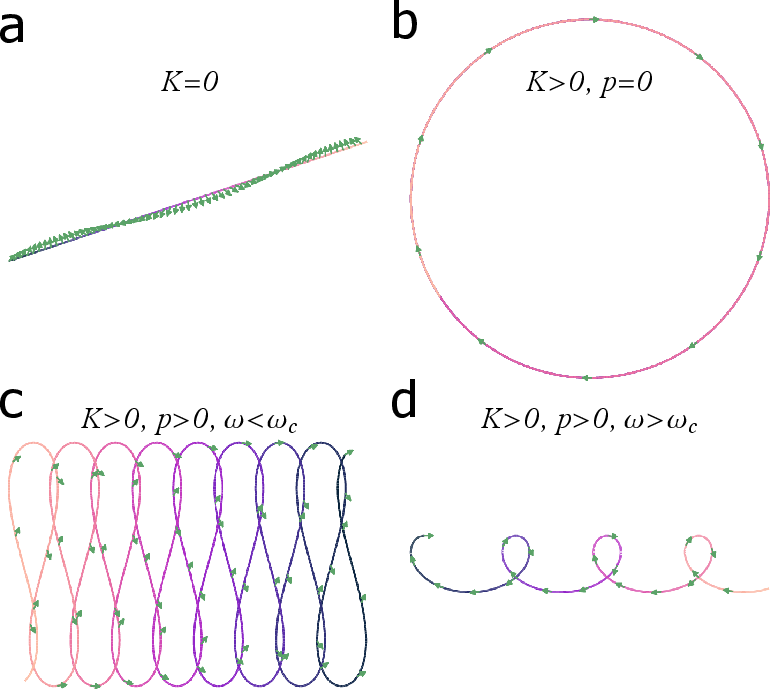
Figure 3: Conservative trajectories include straight, circular, and oscillatory paths depending on the values of ri9, pi0, and pi1.
Time-Reversal Symmetry and Generalized Fluctuation-Dissipation Relations
Utilizing a Martin-Siggia-Rose-Janssen-De Dominicis generating functional, the generalized time reversal is established as
pi2
This form respects the oddness of the spin under time reversal and leaves the path integral action invariant provided the initial distribution is taken from the canonical ensemble, confirming that the correct dissipative couplings are those constructed from the explicit bath.
A key insight is that this TRS is not the naive reversal employed in standard active matter analyses—neglecting the reversal of spins leads to a spurious entropy production assessment. The correct generalized TRS yields detailed balance even in the presence of spontaneous collective motion, as the system remains formally at equilibrium for the full set of degrees of freedom.
The FDTs arising from this symmetry are nonstandard, closely intertwining positions and spins:
pi3
where pi4 denotes connected correlations (i.e., measured in the comoving frame). The most striking feature is that, due to the oddness of spin, the cross-responses satisfy Onsager-Casimir (not Onsager) reciprocity:
pi5
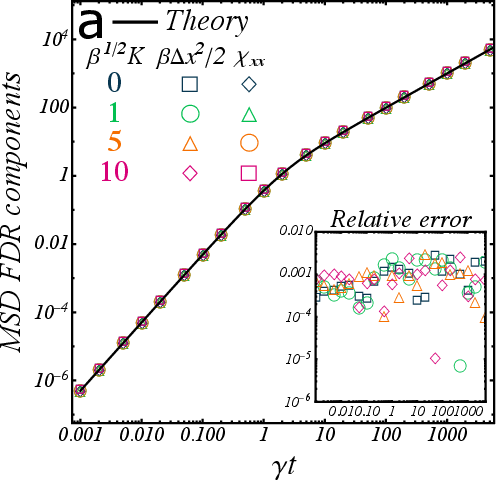
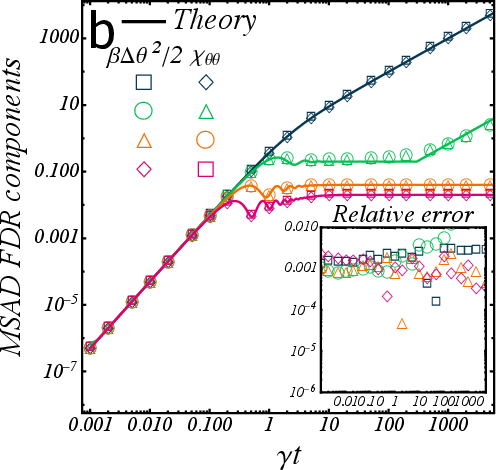
Figure 4: Position and angular FDTs; direct comparison of correlation and response functions validates the predicted relations.
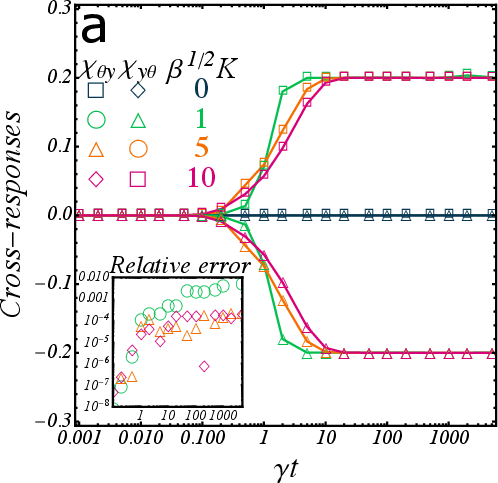
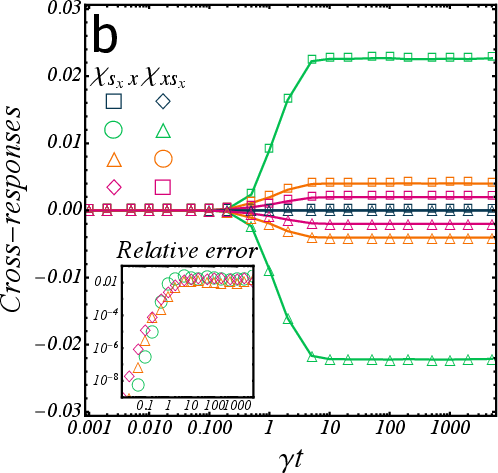
Figure 5: Demonstration of Onsager-Casimir reciprocity: integrated responses of spin and position to respective conjugate forces display the expected sign structure.
Dynamical Consequences: Diffusion, Oscillatory, and Kramers-Type Regimes
Despite the collective motion and non-Galilean structure, macroscopic observables such as the mean-square displacement (MSD) and angular mean-square displacement (MSAD) retain classic forms, but with significant modifications in angular dynamics:
Translational diffusion: The long-time MSD in the comoving frame obeys the Einstein-Smoluchowski relation as in classical Brownian motion, independent of pi6 or pi7. Numerical simulations confirm that the translational diffusivity is unaltered.
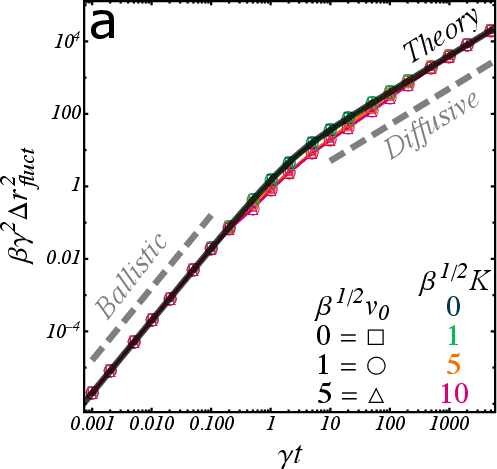
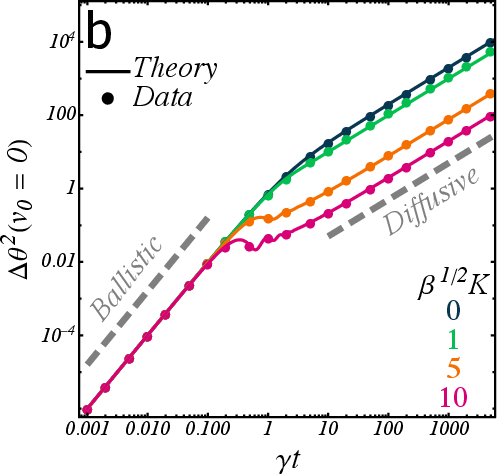
Figure 6: MSDs from numerics collapse onto the standard Brownian curve, confirming the universal long-time diffusion constant.
Angular dynamics: The MSAD exhibits Kramers-like crossovers: at low pi8 or pi9, the system transitions from initial ballistic to diffusive behavior, but for large si0 and/or si1, intermediate plateaus and oscillations emerge due to an effective confining potential in angular space,
si2
leading to a nontrivial dependence of the rotational diffusion si3 on si4 and si5. The general result is
si6
with an explicit closed form in certain limits. For si7, angular dynamics become activated, with MSAD plateaux and rare escapes giving rise to a suppressed terminal diffusivity, si8.
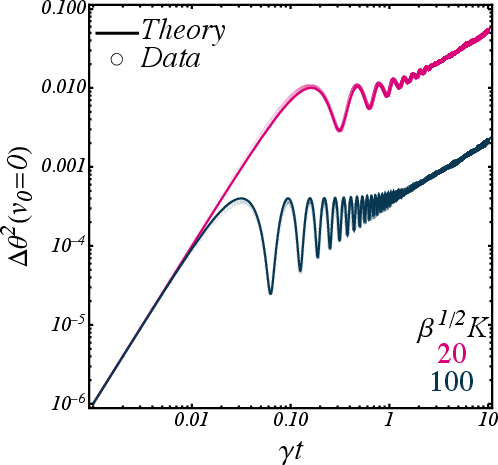
Figure 7: Oscillatory MSAD signifies underdamped angular dynamics associated with strong spin-velocity coupling.
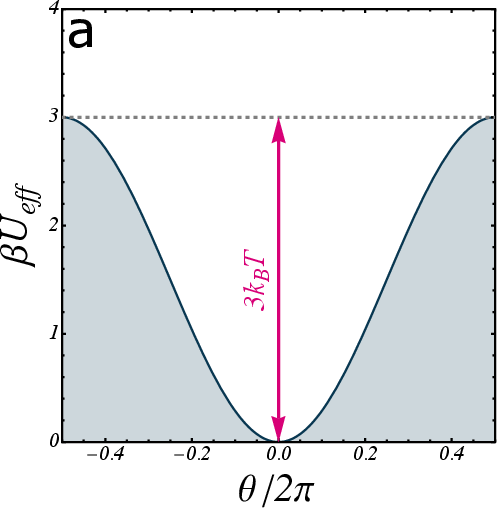
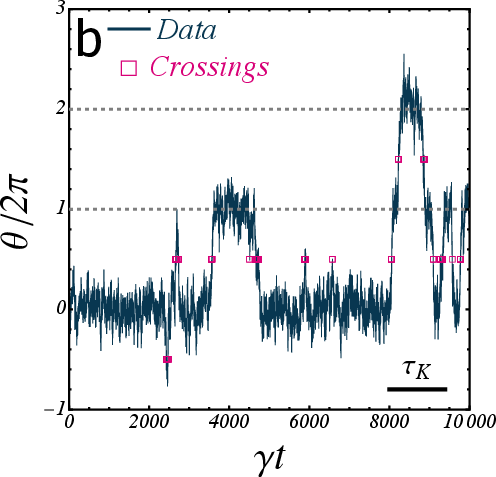

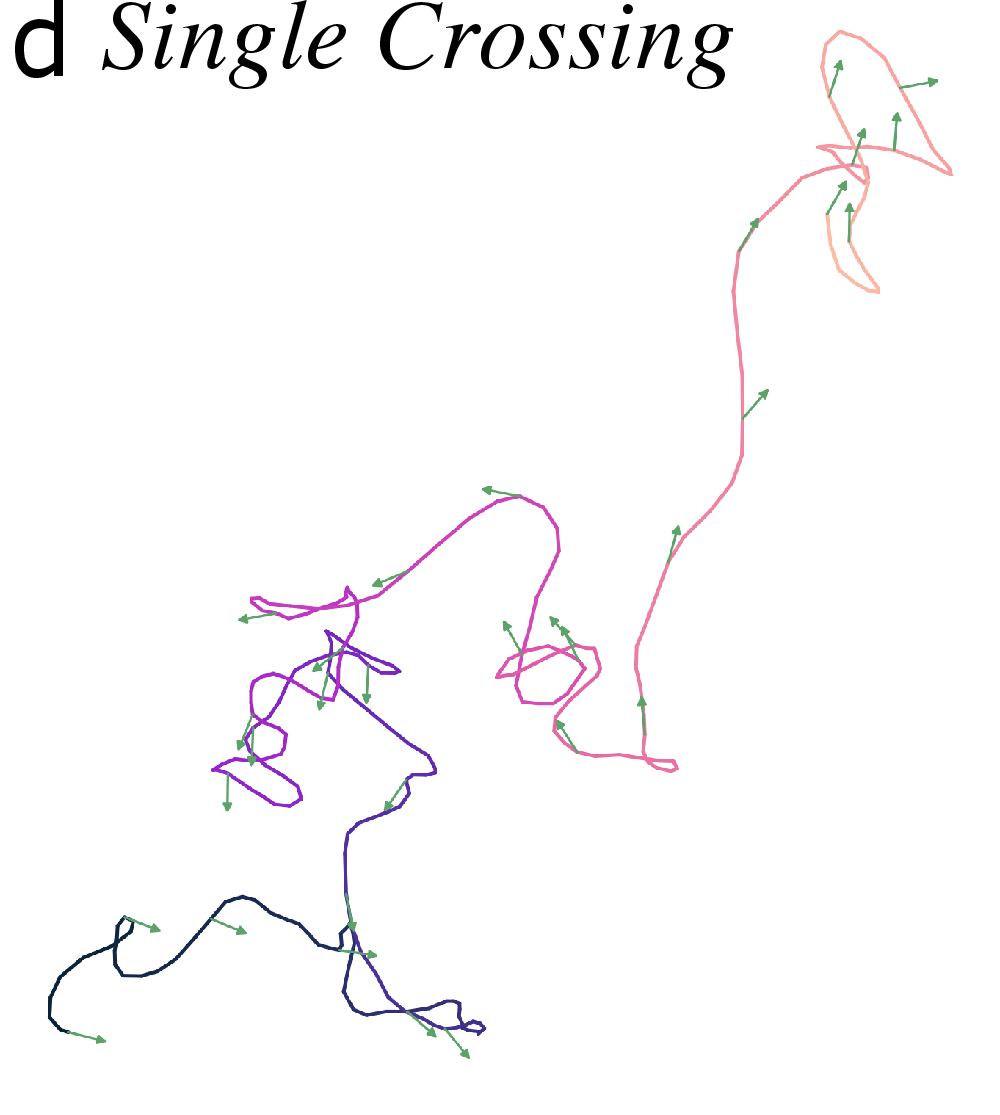
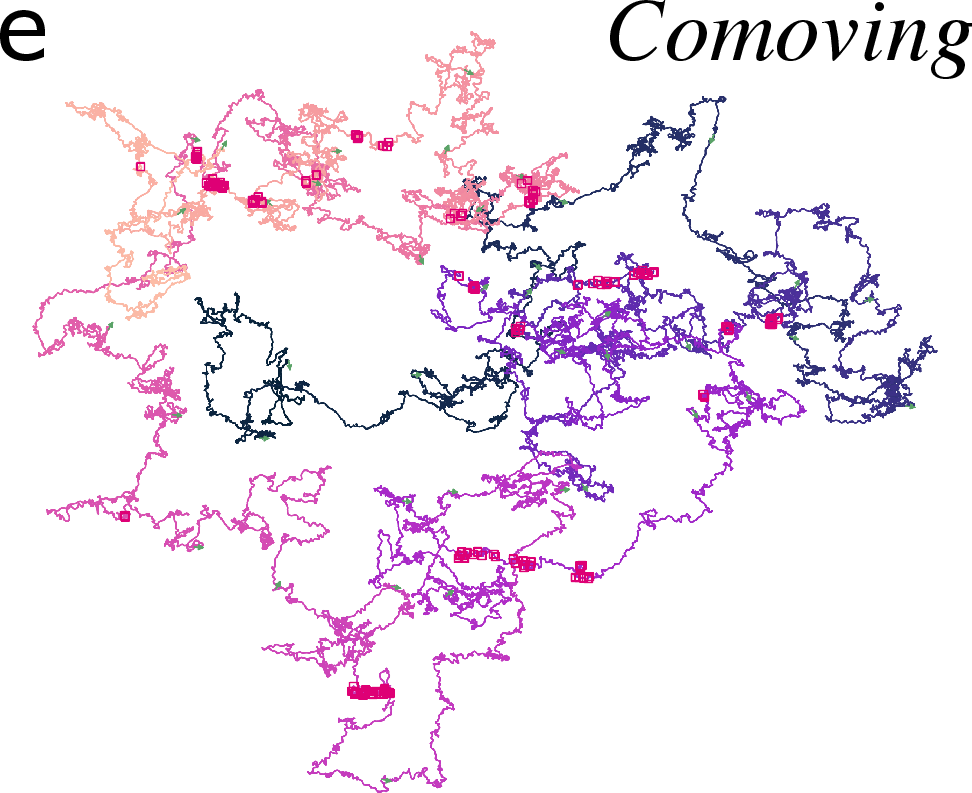
Figure 8: Confined angular dynamics in the Kramers regime; demonstration of barrier crossings and time scales for escape in the presence of a strong effective potential.
Entropy Production and Operational Implications
A crucial contribution of this work is the explicit calculation of entropy production under both the correct generalized TRS and the naive, "active-matter-style," time-reversal that neglects spin reversal. Only the former yields zero entropy production and detailed balance. Using the latter introduces nonzero entropy production proportional to si9, even at equilibrium. This result warns against the unqualified application of entropy production metrics or effective temperature estimation procedures in systems with hidden time-reversal symmetries.
Practical and Theoretical Implications
This analysis demonstrates that spontaneous collective motion, polar order, and persistent currents can coexist with detailed balance—when the correct symmetries are recognized and all relevant dynamical variables are included. These findings resonate with recent debates on extracting irreversibility from partial observations in active or glassy systems (2604.02914). They also have direct relevance to the operational detection of nonequilibrium behavior in synthetic and biological active materials, where certain internal variables may be unmeasured, and to interpretations of stochastic thermodynamics in non-Galilean systems.
The emergence of Onsager-Casimir relations—usually associated with magnetic or chiral systems—provides an unambiguous fingerprint of the spin's oddness under TRS, and could inspire experimental protocols explicitly testing such antisymmetric cross-responses.
Moreover, the approach outlined here is broadly extensible to more complex or strongly interacting active systems, where Galilean invariance is broken by design or effective interactions. This could catalyze the development of more accurate FDTs and thermodynamic bounds for engineered active materials where standard approaches fail.
Conclusion
Hamiltonian flock models, though displaying spontaneous order and flows reminiscent of active matter, conserve entropy given a full account of system symmetries and degrees of freedom. The generalized TRS ensures standard equilibrium structure for both the stochastic dynamics and response theory—albeit with modified, frame-dependent FDTs, and nontrivial Onsager-Casimir relations. The study underscores the need for caution in entropy production analyses and suggests that hidden symmetries may pervade other active-like or non-Galilean models. In a broader perspective, these results offer a precise framework for confronting experimental observations of polar and flocking phenomena with the principled predictions of nonequilibrium statistical physics.

