- The paper demonstrates that nonlinear tearing-driven reconnection converts magnetic energy into ion bulk flow and heating.
- It employs large-scale 2D hybrid PIC simulations with Möbius boundary conditions to efficiently capture tearing modes, island dynamics, and reconnection rates.
- The study finds that ion firehose instabilities regulate temperature anisotropy, suppressing recursive island formation and controlling energy dissipation.
Tearing-Driven Reconnection and Firehose Kinetic Instabilities: Energy Conversion in 2D Hybrid Möbius Simulations
Introduction
The study investigates energy conversion processes during tearing-driven magnetic reconnection in weakly collisional astrophysical plasmas, focusing on the interplay with ion firehose kinetic instabilities. This analysis is performed via large-scale, high-resolution two-dimensional hybrid particle-in-cell (PIC) simulations utilizing Möbius periodic boundary conditions, which significantly enhance computational efficiency. The aim is to elucidate how magnetic energy in reconnecting current sheets is partitioned between ion bulk flows and internal energy (heating), and the role of temperature anisotropy-regulating instabilities in this evolution. The outcomes are relevant to various astrophysical settings, from the heliosphere to relativistic outflows, where such processes govern macroscopic plasma heating and structure formation.
Simulation Approach and Möbius Boundary Conditions
The computational setup adopts a hybrid PIC approach—ions are treated kinetically, while electrons are modeled as an isothermal, massless neutralizing fluid. The initial condition is a Harris-type current sheet in total pressure equilibrium without a guide field, initialized with isotropic temperature. The simulation domain is discretized into 4096×2048 cells with $2048$ macroparticles per cell and employs a resistivity η=4×10⁻⁴μ0di2Ωci.
A critical methodological innovation is the use of Möbius periodic boundary conditions in the out-of-plane (y) direction, which, by exploiting a topological transformation, enables the simulation of a single current sheet, halving the computational load relative to standard periodic geometries.
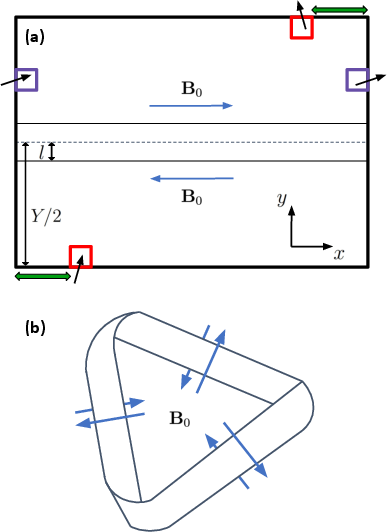
Figure 1: Schematic of the simulation domain and Möbius boundary conditions, which allow a single current sheet and cost reduction by removing the need for doubled sheets.
Evolution and Onset of Tearing Instability
The temporal progression begins with a linear growth regime dominated by multiple kx modes, as shown in the evolution of the By component in Fourier space. The linear phase is marked by exponential amplification of perturbations, succeeded by a strongly nonlinear regime characterized by the emergence, contraction, and coalescence of large-scale magnetic islands—the plasmoid phase.
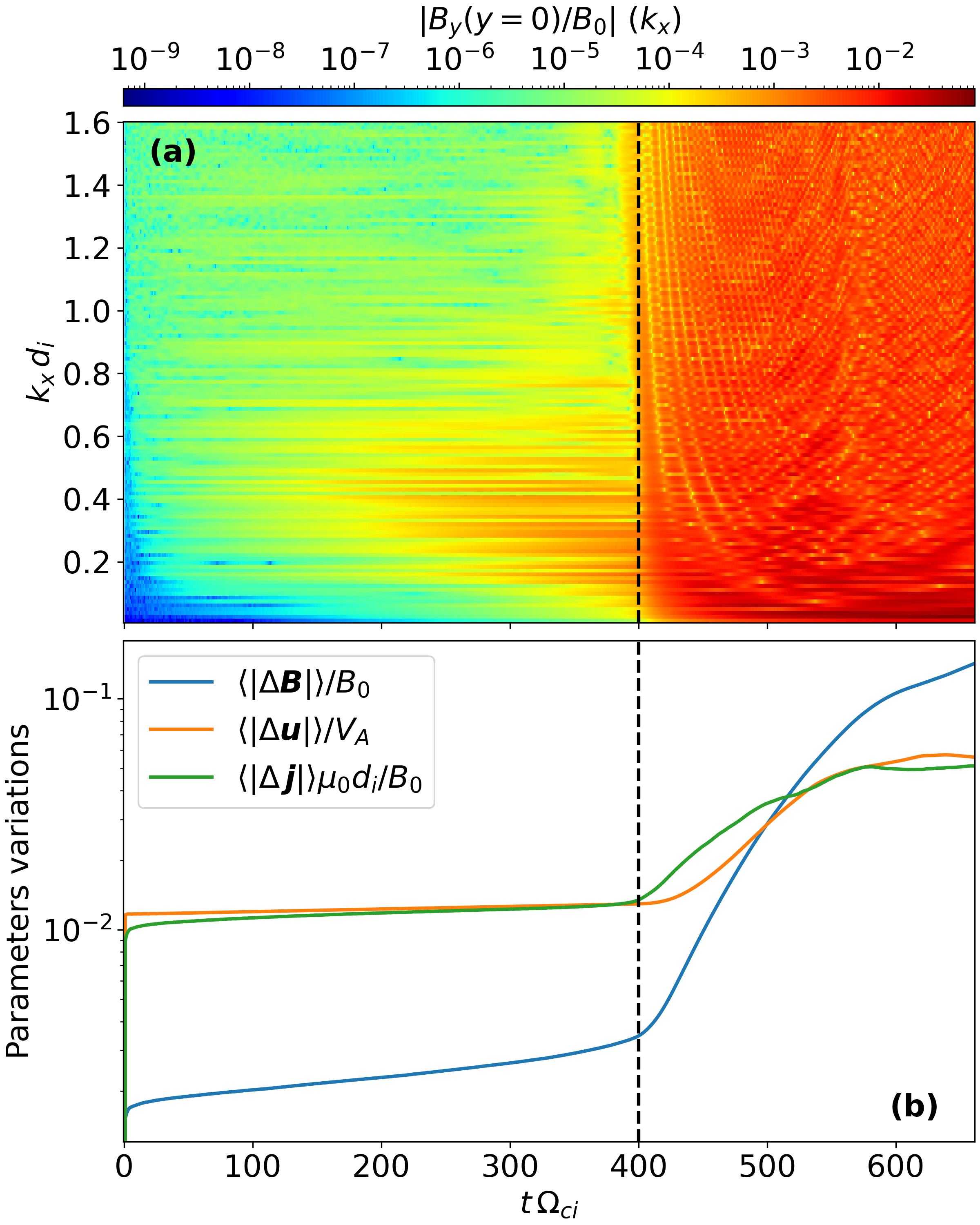
Figure 2: Temporal dynamics of magnetic field fluctuations and spatially averaged plasma variables; the transition to nonlinearity yields abrupt field and flow variations.
The growth rates for distinct tearing modes are determined via polynomial fits to the Fourier-transformed By amplitude. Maximal growth rates are observed at kxdi∼0.07 with γ∼0.25−0.3 Ωci.
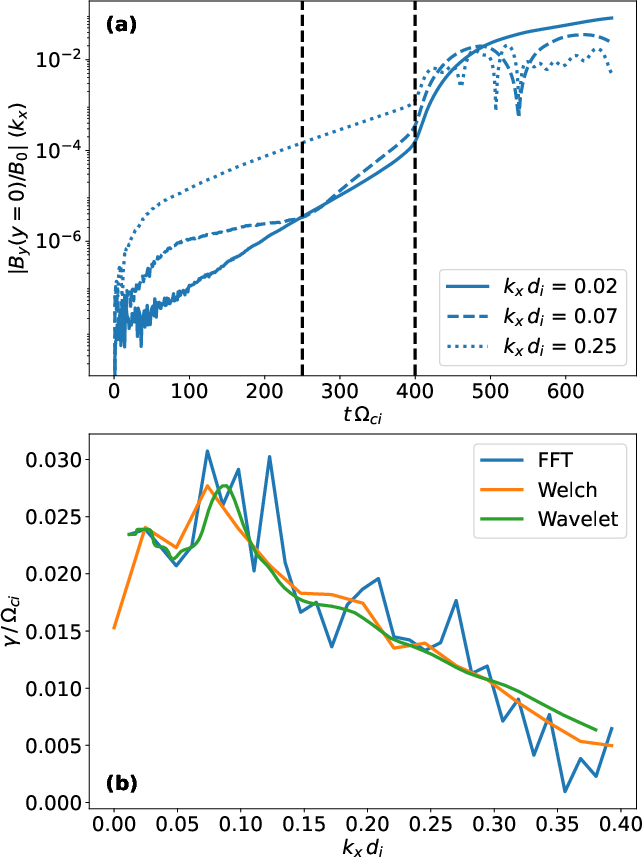
Figure 3: Mode-resolved linear growth rates for the tearing instability, exhibiting peak amplification around specific kxdi modes.
Nonlinear Evolution, Island Dynamics, and Reconnection Rates
As the nonlinear regime sets in, island contraction, coalescence, and secondary reconnection sites manifest. The evolution of vector potential $2048$0 on the sheet shows the spatial/temporal dynamics of principal X-points and associated flux ropes.
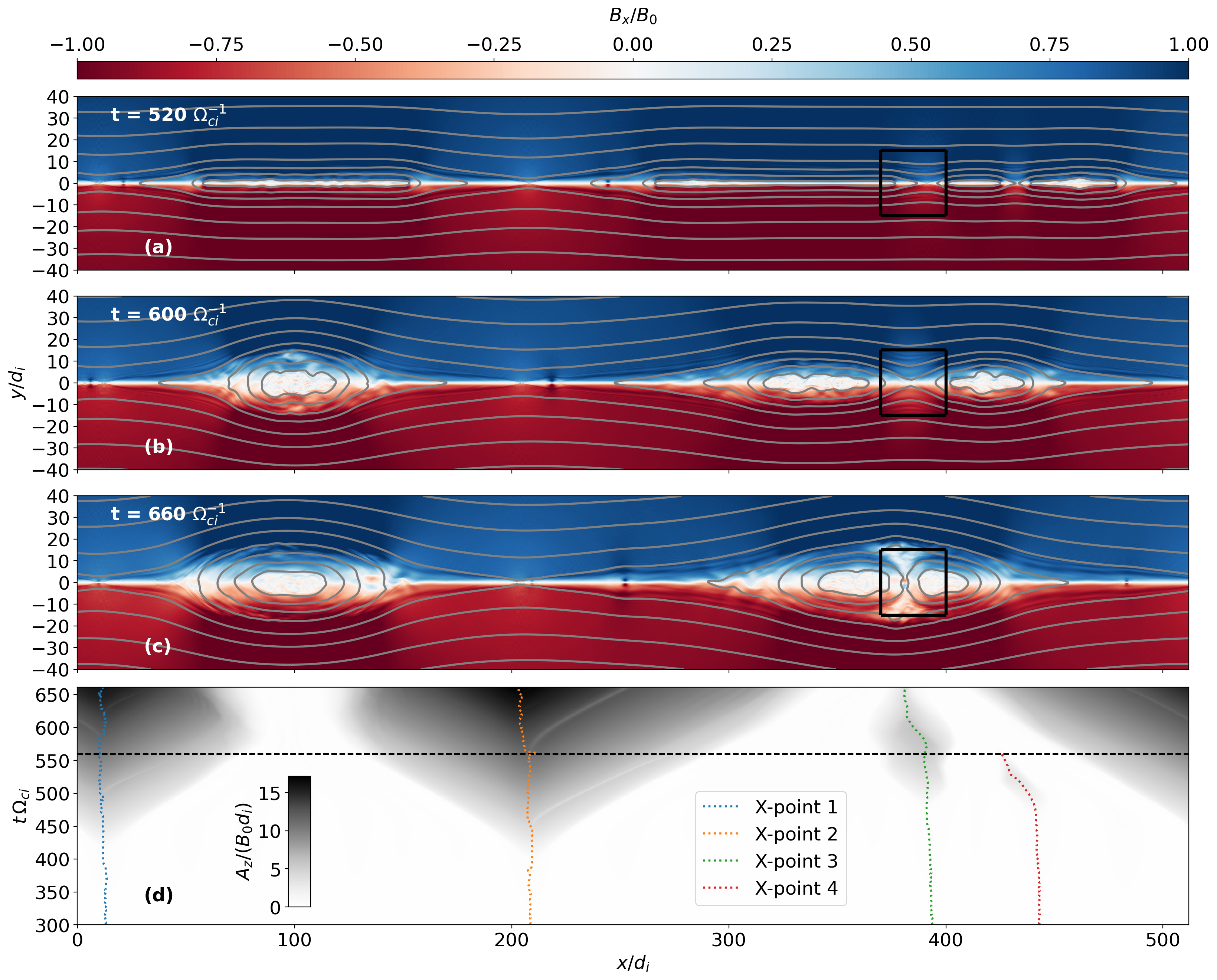
Figure 4: Real-space evolution of reconnecting field lines and islands; $2048$1 tracks the birth, merging, and motion of X-points and plasmoids.
Coalescence processes frequently invert inflow and outflow patterns and current direction, further redistributing energy.
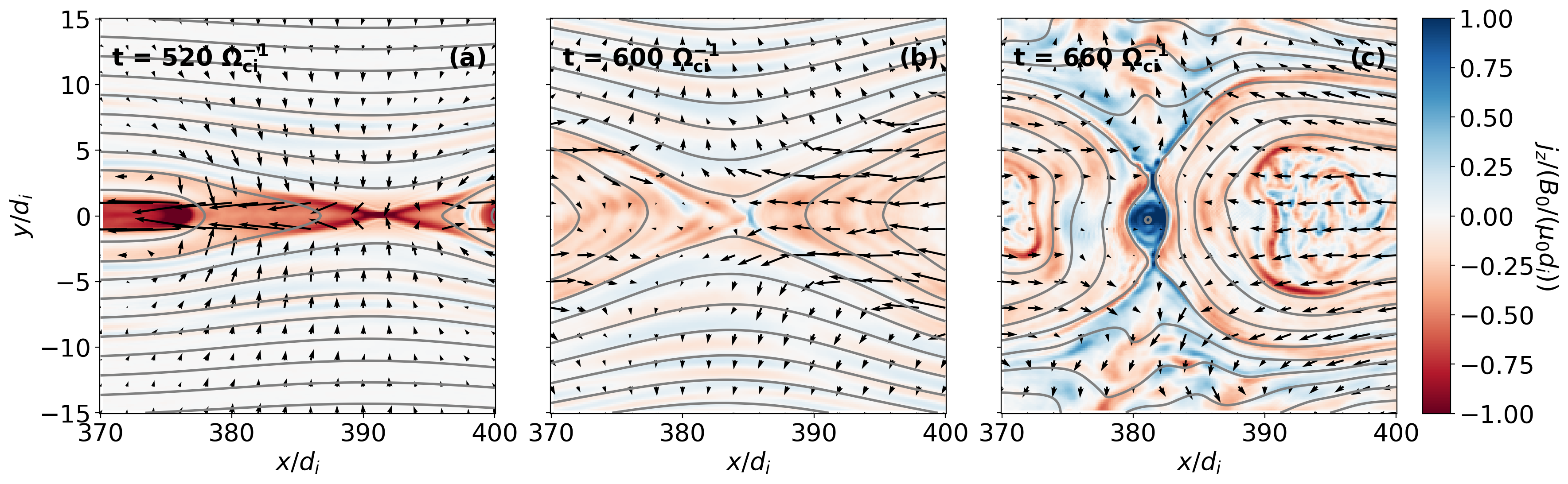
Figure 5: Local reversal of current and flow during magnetic island coalescence, demonstrating dynamic reconnection physics at X-point transitions.
Reconnection rate characterization uses both the normalized flux transfer rate $2048$2 and the local non-ideal electric field-based rate $2048$3.
- Linear regime: $2048$4.
- Nonlinear onset: All principal X-points reach $2048$5 and $2048$6, consistent with collisionless universal rates.
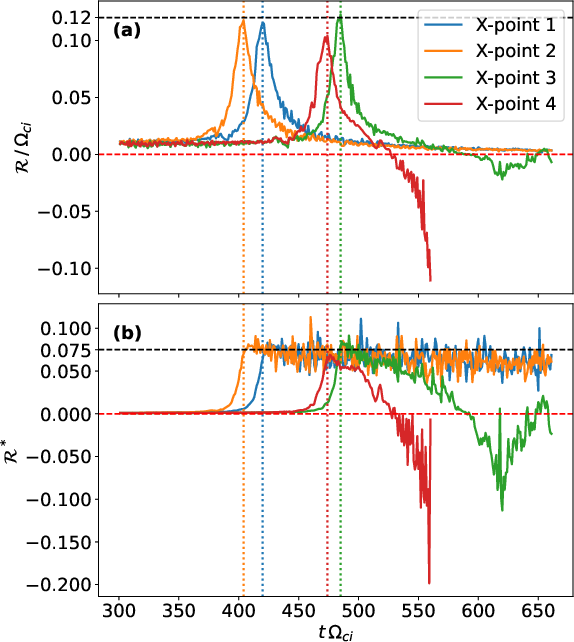
Figure 6: Comparative reconnection rates for major X-points; nonlinearity triggers enhanced reconnection before gradual decline.
Global Energy Conversion and Pressure-Strain Interactions
Energy partitioning is quantified via spatially averaged densities; the transition to the nonlinear regime (after $2048$7) triggers dominant conversion of magnetic energy into both ion bulk outflows and heating.
- At non-linear onset: $2048$8 decreases, while $2048$9 and η=4×10⁻⁴μ0di2Ωci0 increase.
- Pressure-strain and η=4×10⁻⁴μ0di2Ωci1: Magnitudes increase sharply at nonlinearity, with η=4×10⁻⁴μ0di2Ωci2–η=4×10⁻⁴μ0di2Ωci3.
Resistive dissipation is only significant in the linear phase; energy conversion in the nonlinear stage is almost exclusively collisionless.
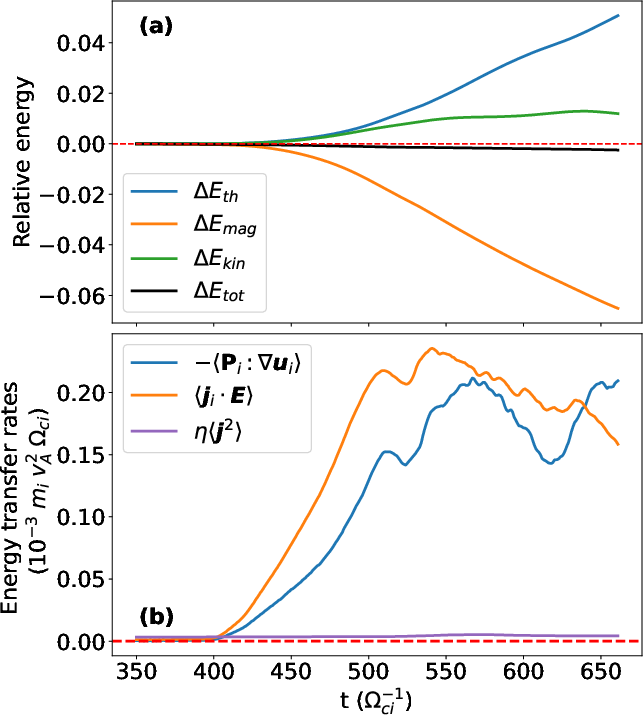
Figure 7: Temporal evolution of global energy budgets and conversion channels, underlining the primacy of collisionless processes during nonlinearity.
Spatially, energy conversion is highly inhomogeneous. Around X-points, both heating and bulk flow acceleration are significant; within islands, heating dominates and η=4×10⁻⁴μ0di2Ωci4 can become negative.
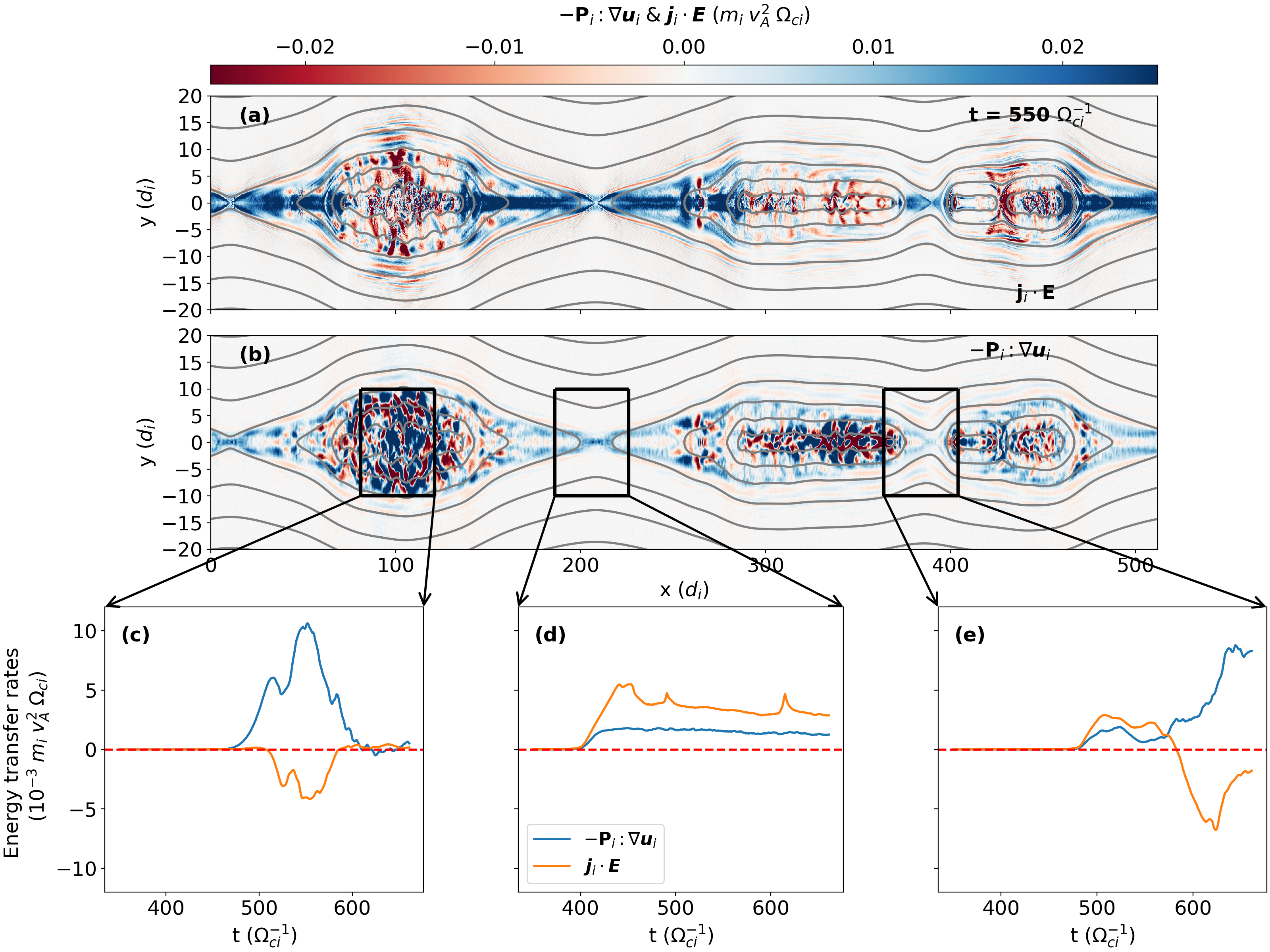
Figure 8: Local mapping of energy conversion rates during the nonlinear regime; heating and electromagnetic work maximize in different regions across the current sheet.
Temperature Anisotropy and Firehose Instability Regulation
Reconnected outflows systematically generate strong ion temperature anisotropy (η=4×10⁻⁴μ0di2Ωci5) via Fermi acceleration, which is sustained and amplified during island contraction. This anisotropy is subsequently regulated by the onset and evolution of firehose kinetic instabilities, which act to re-isotropize the ion temperature by transferring internal energy from the parallel to the perpendicular direction.
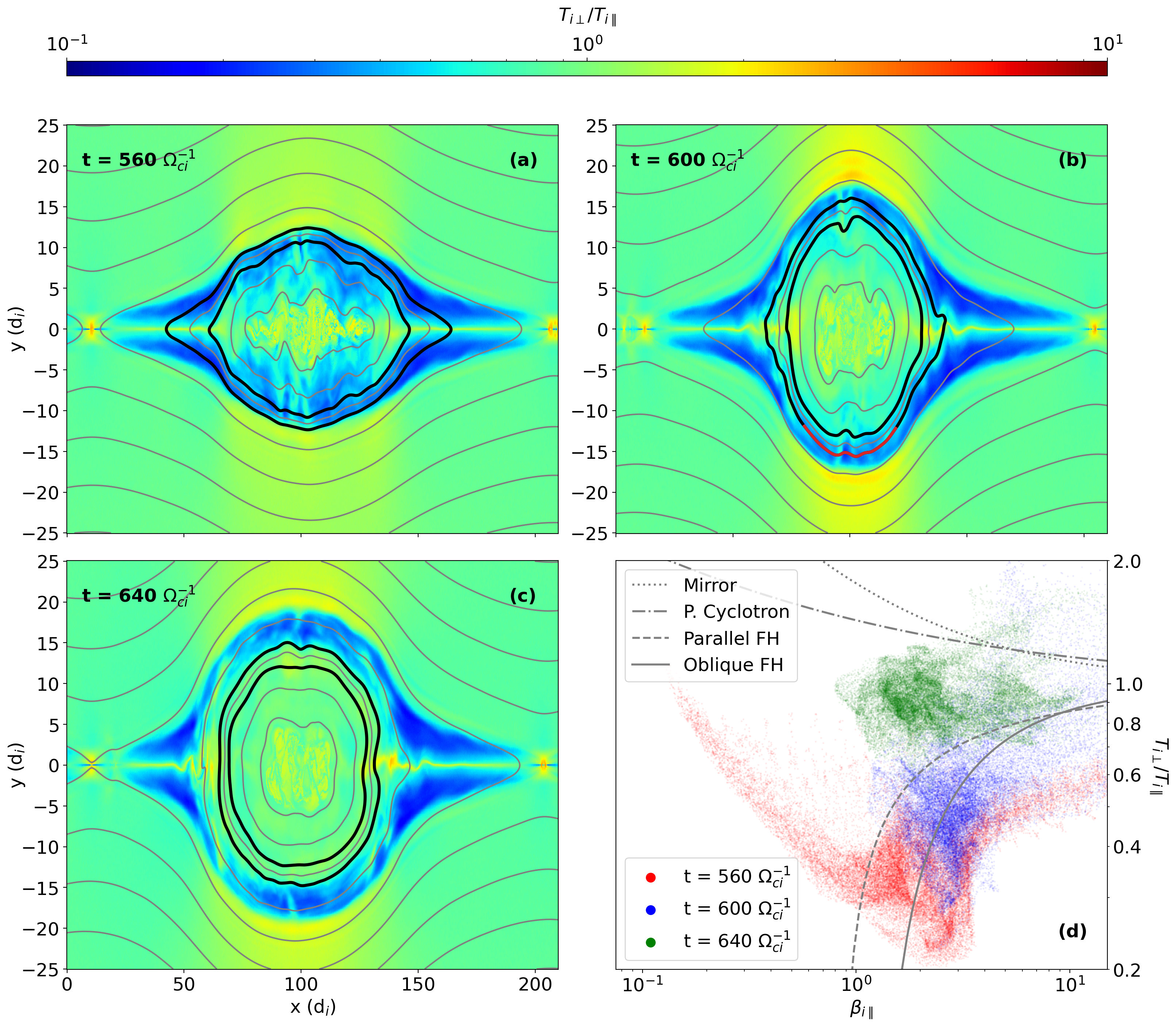
Figure 9: Spatiotemporal maps of η=4×10⁻⁴μ0di2Ωci6 and plotted trajectories in η=4×10⁻⁴μ0di2Ωci7 space, with comparison to firehose thresholds.
Detailed analysis of fluctuations along island field lines reveals dominant transverse magnetic perturbations, consistent with firehose-like modes embedded in a complex, inhomogeneous background.
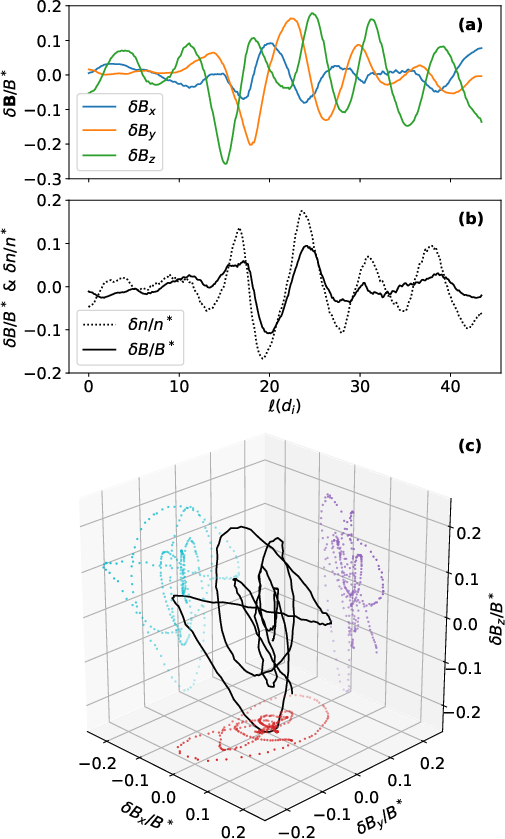
Figure 10: Profiles and polarization of magnetic and density fluctuations along plasmoid field lines, indicating coexistence of firehose-driven waves and compressive structures.
Quantitative assessment of how plasma parameters and adiabatic invariants evolve in individual islands shows:
- Quasi-adiabatic compression initially increases η=4×10⁻⁴μ0di2Ωci8.
- The firehose instability phase follows, marked by non-adiabatic decrease in η=4×10⁻⁴μ0di2Ωci9 and rise in y0.
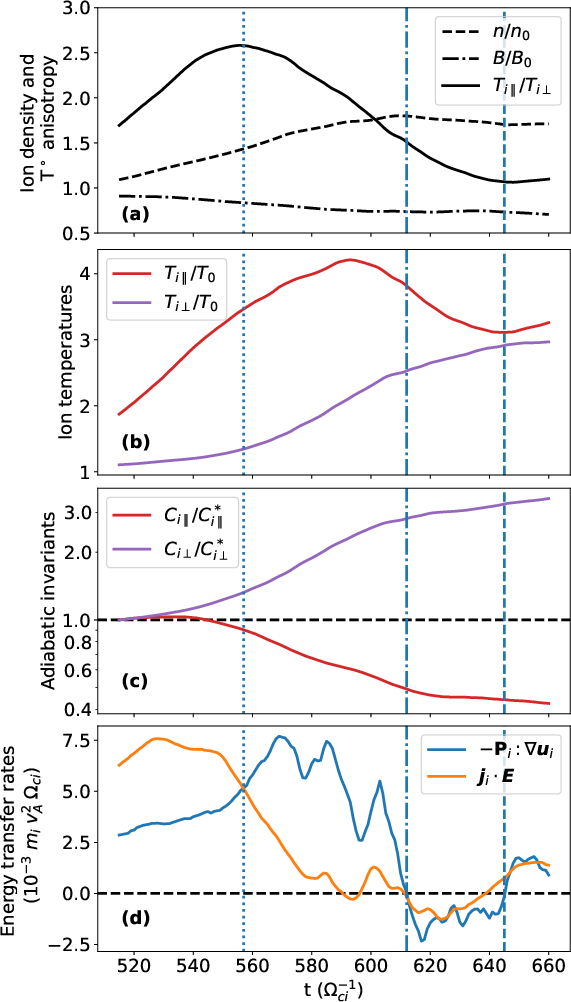
Figure 11: Time-resolved evolution of density, temperatures, adiabatic invariants, and local energy conversion within an island flux tube.
Supporting simulations of firehose instability in homogeneous plasmas corroborate the sequence of fluctuation growth and damping, together with the associated energy transfers and temperature isotropization, matching the inhomogeneous, driven case.
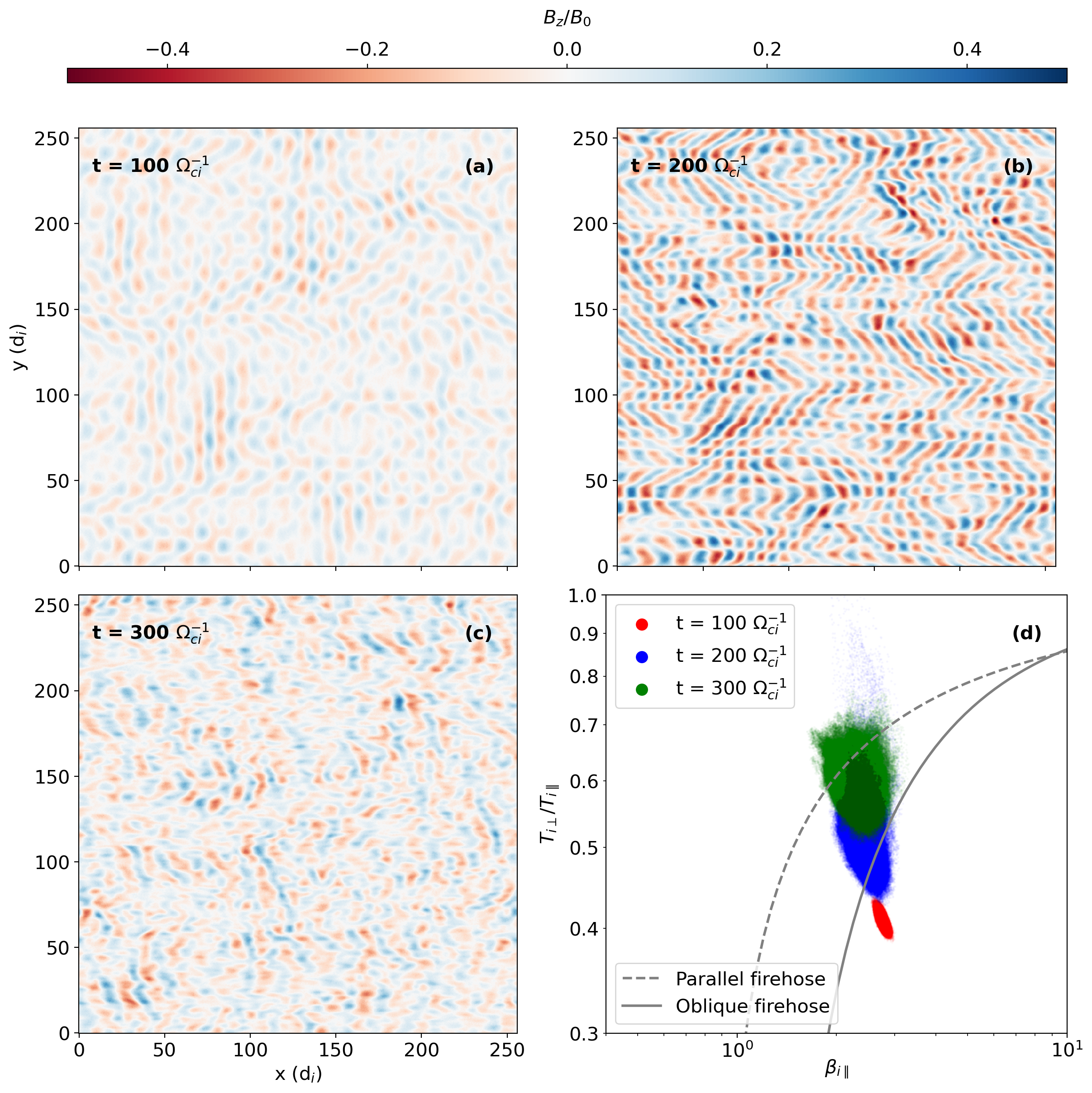
Figure 12: Snapshots of field fluctuations and phase-space position during firehose instability in a homogeneous control simulation.
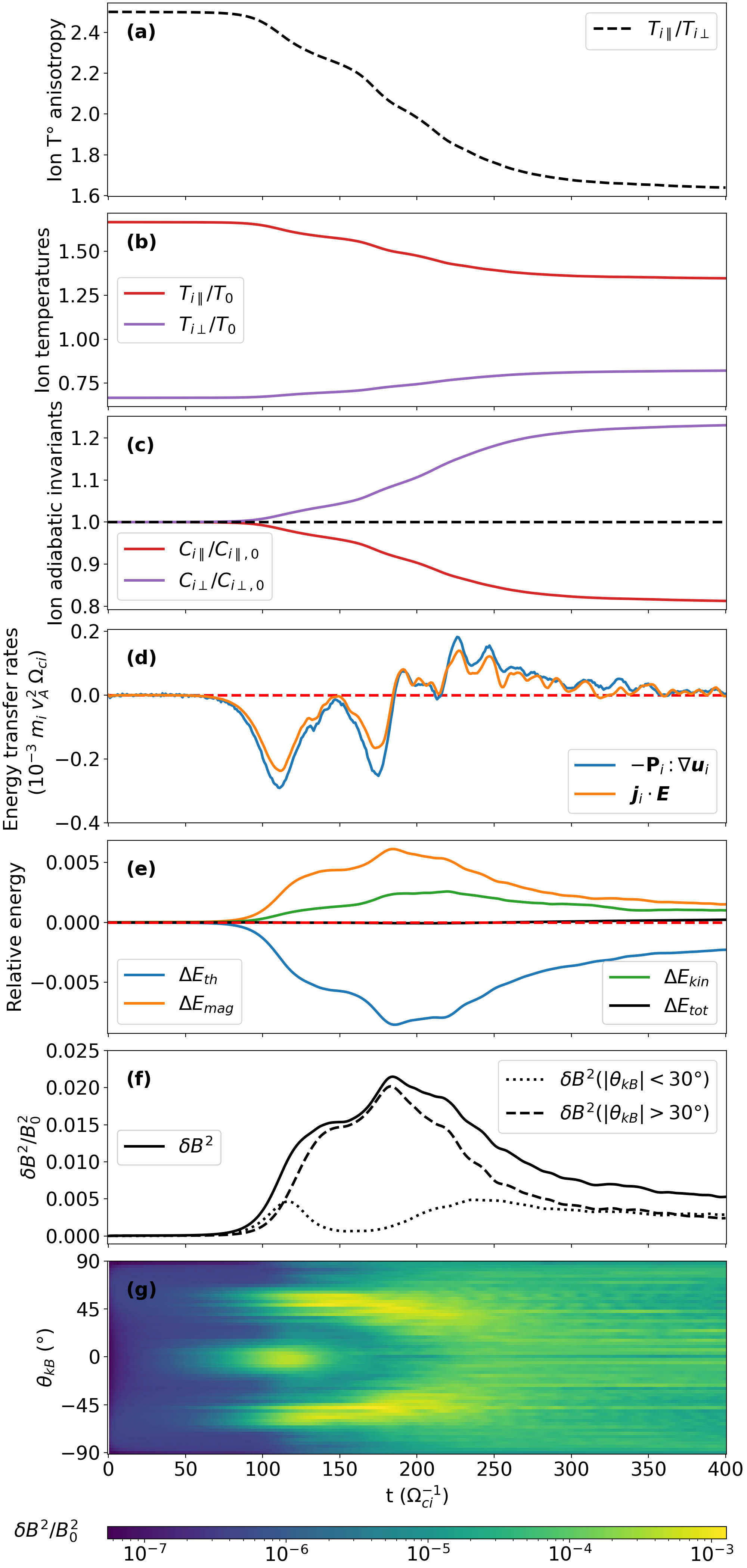
Figure 13: Domain-averaged evolution of energy conversion and fluctuation amplitudes in homogeneously driven firehose-unstable plasmas.
Implications and Outlook
The combination of high-resolution hybrid PIC modeling with Möbius boundary conditions yields a self-consistent description of energy conversion and temperature anisotropy regulation in tearing-driven reconnection under collisionless conditions. Central findings are:
- The nonlinear tearing phase is the primary locus of magnetic-to-thermal energy conversion, with most heating occurring in islands, not simply at X-points.
- Reconnection outflows generate y1, which drives ion firehose instability. This instability redistributes internal energy, regulates anisotropy, and limits further island contraction.
- Absence of fractal (recursive) island formation in this regime is attributed to the reduction of effective magnetic tension by temperature anisotropy—a result that acts as a kinetic constraint on secondary tearing, even prior to universal reconnection rates.
These results refine the understanding of the role of microinstabilities in shaping macroscopic energy dissipation and plasma structure formation in astrophysical contexts. The approach demonstrates that collisionless reconnection is a highly non-uniform, self-regulated process, and underscores the necessity of kinetic and multi-scale modeling to capture the resultant plasma states.
Future research should extend this work to 3D systems, include electron kinetic effects, and explore a broader parameter range (e.g., varying y2, guide field strength) to systematically map the regimes of island formation, heating localization, and the nature of multi-scale fluctuation spectra.
Conclusion
This study leverages Möbius boundary hybrid simulations to clarify the interplay of tearing instability, energy conversion, and firehose kinetic instabilities in weakly collisional plasma current sheets. The findings demonstrate that nonlinear reconnection drives most of the heating, with island dynamics and firehose-mode regulation playing essential roles in both local energy conversion and the suppression of recursive island formation. These insights provide a robust basis for interpreting in-situ measurements and motivate further kinetic studies of reconnection-driven dissipation in complex, natural plasma environments.