- The paper demonstrates that by including dynamic quantum reference systems, process matrices can be reparameterized to yield operationally meaningful frame perspectives.
- It employs quantum-controlled diffeomorphisms to enact unitary transformations that reshuffle event boundaries, as exemplified in the quantum switch.
- The work clarifies the distinction between coordinate parametrization and operational embedding, providing insights relevant to quantum gravity experiments.
Introduction
This work addresses a fundamental problem at the intersection of the process matrix framework and quantum reference frames (QRFs): how to systematically implement and transform "frame perspectives" for quantum processes and relate abstract, coordinate-dependent representations to genuine operational and spatiotemporal viewpoints. The central technical advance is the formalization of a distinction between perspective-neutral coordinate parametrizations (such as Causal Reference Frames—CRF—or Time-Delocalized Subsystems—TDS) and proper frame perspectives that include operationally meaningful foliation and reference data. The authors provide a comprehensive resolution of the tension arising from "no-go" results on unitarily switching perspectives by showing that such transformations are possible when the frame data, including spatiotemporal background scaffolds, are treated dynamically and quantum-mechanically.
Coordinate Parametrization and Frame Data: Theoretical Foundations
Classical general relativity and quantum theory both admit a crucial distinction between coordinates as passive labels and coordinates as instantiated by physical fields, the latter being subject to back-reaction and quantum effects. The process matrix formalism [Oreshkov et al., Nature Communications 2012] captures all multipartite quantum correlations without presupposing global causal order, generating abstract higher-order objects ("process matrices") encoding correlations among distinct local operations. In parallel, QRFs [Bartlett et al., Rev. Mod. Phys. 2007; vanrietvelde et al., Quantum 2020] and their spacetime generalizations provide dynamic, quantum-coherent versions of rods and clocks.
However, the link between these approaches is subtle. Pure process matrices admit multiple internal decompositions: CRFs parameterize processes via "local" operations for a chosen agent, while TDS decompositions reveal other agents as time- or event-delocalized. These are operationally equivalent at the level of process statistics, but represent distinct coordinate choices on the same object.
This equivalence is made explicit: the authors prove that CRF and TDS representations are simply alternative parameterizations of a perspective-neutral process, and their operational indistinguishability is a statement of coordinate invariance at the unfragmented level.
From Coordinate Parametrization to Operational Frame Perspective
A core claim is that a genuine frame perspective arises only when a particular foliation of the process is chosen, associating fragment boundaries with actual operational events (e.g., preparations, measurements, interventions). Here, labels acquire physical significance: they become clock readings or event markers, and the process matrix is "cut" into a specific sequence of events.
The authors formalize this operational "cut" and show, relying on earlier no-go results [Oreshkov 2019, Wechs et al., PRL 2025], that unitary transformations attempting to map one agent’s local foliation to another's, while keeping the foliation fixed, are impossible except in trivial cases. This is because such transformations only relabel the coordinates but do not affect the operational partition into events, and thus cannot account for the delocalization of operations as required for a true change of frame.
Unitary Perspective Changes and Time Foliation Reshuffling
The paper then demonstrates, focusing on the quantum switch—a canonical example of indefinite causal order [Procopio et al., Nature Comm. 2015]—that it is possible to realize unitary transformations that map one agent's perspective to another's, provided these transformations act jointly on both the process and the foliation data, dynamically reshuffling the identification of “past” and “future”. Such a transformation does not preserve the original assignment of event boundaries and therefore alters the operational meaning of the circuit fragments.
The construction employs coherently controlled unitaries that act globally across event boundaries, demonstrating the explicit reshuffling of the temporal structure. Notably, this resolves the contradiction highlighted by previous no-go theorems: perspective changes are possible, but only if one allows the boundaries (i.e., the operational cut) to be transformed as well.
Extension: Embedding in Spacetime via Quantum Reference Frames
The limitations of the above scenario become apparent when seeking operational equivalence between complementary agent perspectives that share a common global past and future, as is often required in physical realizations of the quantum switch. The solution advanced is the explicit extension of the process via the inclusion of quantum reference systems—quantum rods and clocks—that form a spatiotemporal scaffold or background upon which the principal systems evolve.
In this enlarged framework, quantum-coherent diffeomorphisms (quantum-controlled superpositions of coordinate charts) implement proper perspective changes without altering the global input/output partition. These reference systems correlate operational fragments—preparation, intervention, and measurement—with physical parameters, thereby providing a fully relational spatiotemporal description.
After such an extension, unitary transformations can map between agent-localized and agent-delocalized forms of the process, with shared global event boundaries preserved. Thus, the relational instantiation of spacetime as a quantum variable realizes the necessary structure for fully general frame perspective changes.
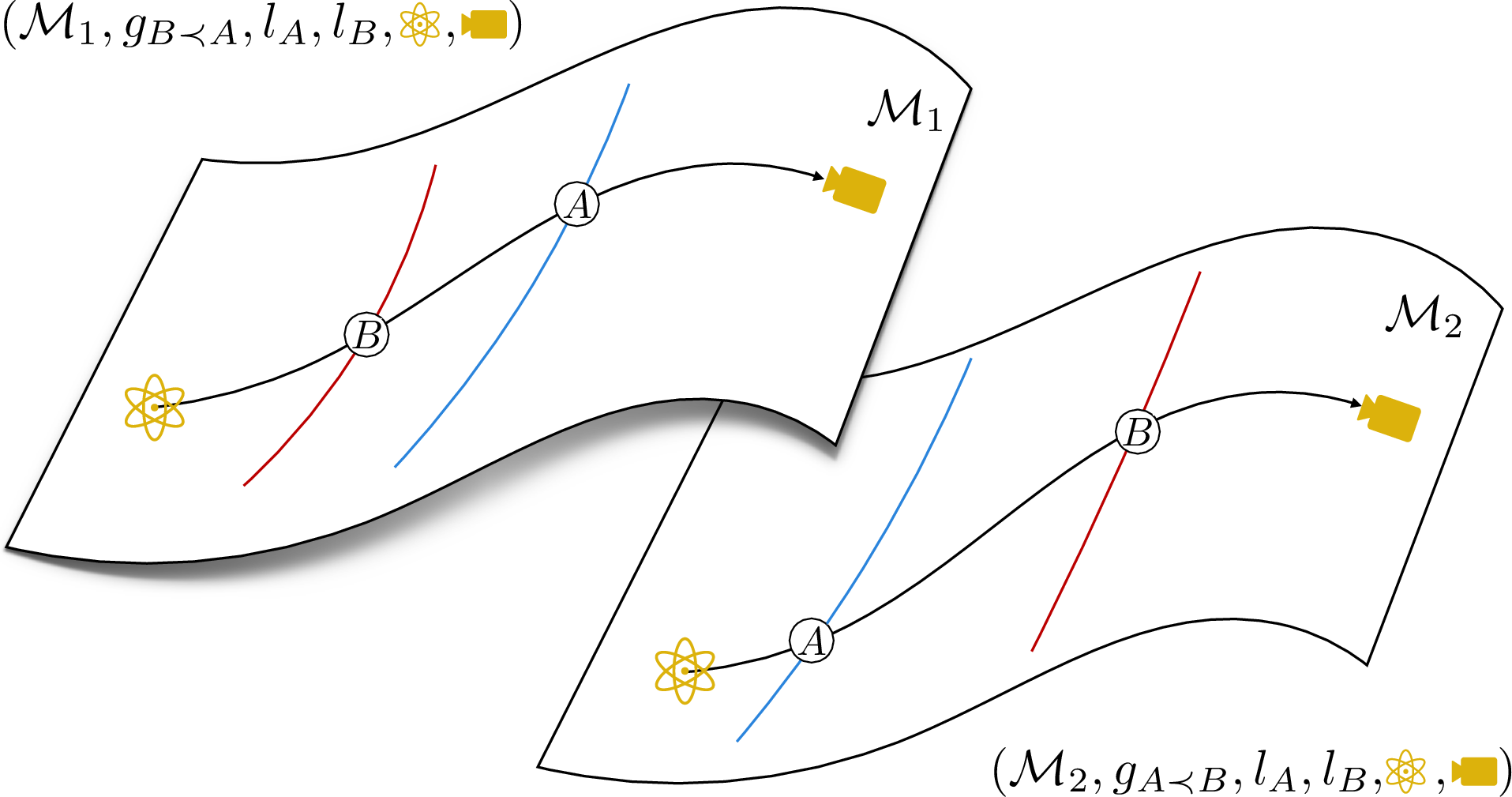
Figure 1: Superposition of physically inequivalent configurations in spacetime, illustrating indefinite causal order between events A and B.
The technical implementation relies on the concept of quantum-controlled diffeomorphisms: transformations acting on both system and reference frame Hilbert spaces, mapping between different quantum coordinate charts. This action induces a transformation between operationally local and delocalized descriptions, depending on the quantum state of the reference fields.
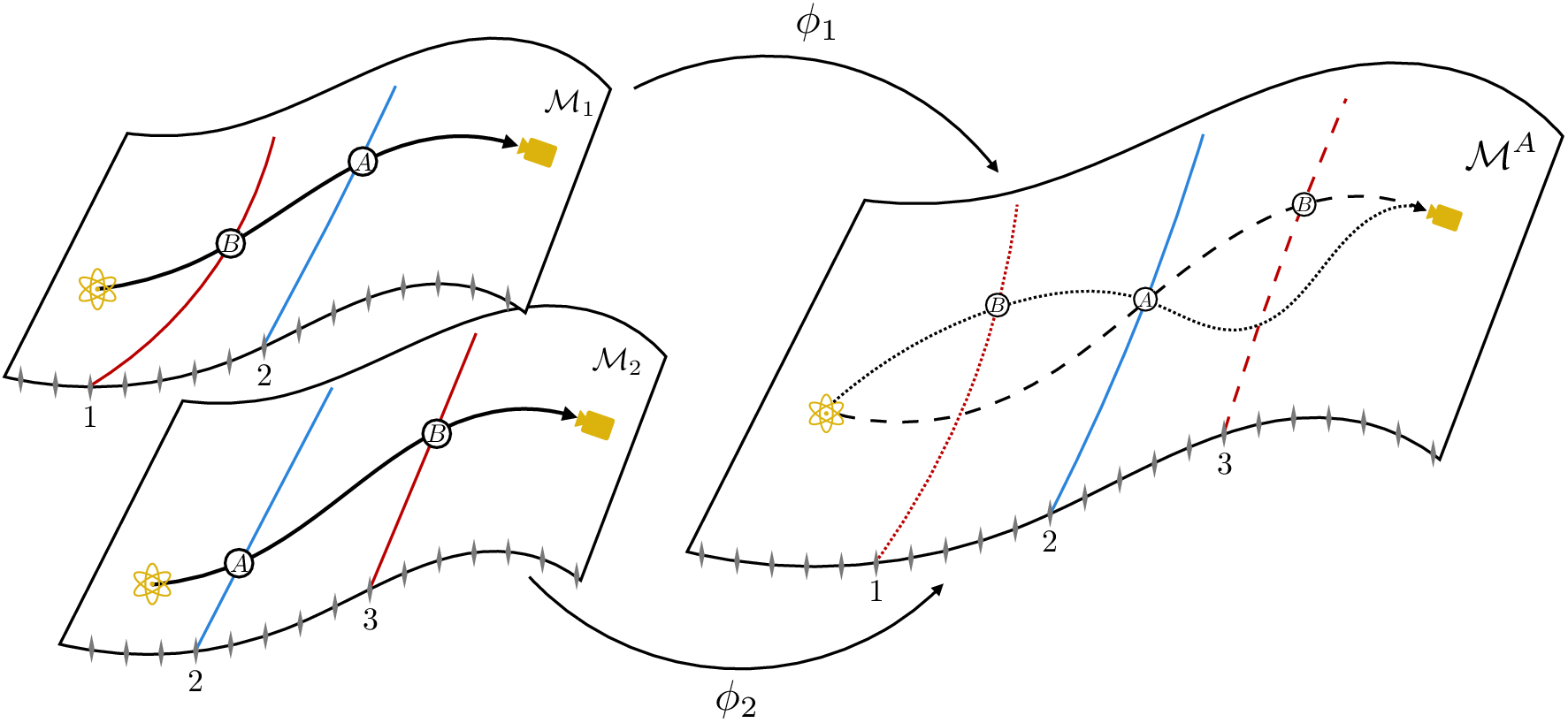
Figure 2: Quantum coordinatization and transformation to a frame in which Alice's laboratory is localized while Bob's worldline is delocalized.
With at least two quantum coordinates available, both "Alice-localized" and "Bob-localized" perspectives can be realized and mapped unitarily onto each other through a suitable transformation acting on the combined system+frame Hilbert space.
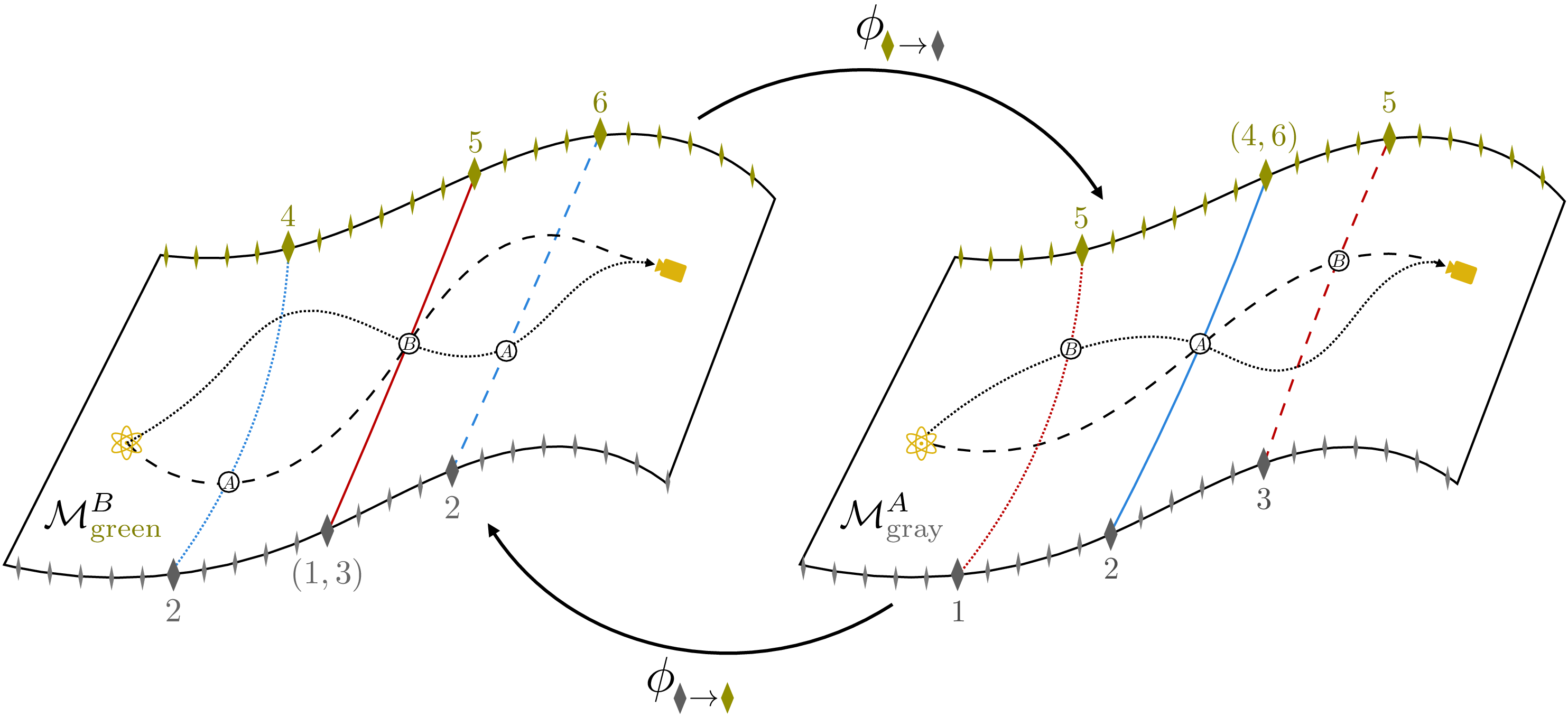
Figure 3: Dual representations of the same process in Bob's and Alice's causal reference frames, interrelated via quantum-controlled diffeomorphisms.
Implications, Contradictions, and Outlook
The authors emphasize the physical and interpretive consequences:
- Process matrix implementations: Results clarify which abstract processes are physically realizable, especially in gravitational and indefinite-causal-order experiments [Rubino et al., Science Advances 2017; Zych et al., Nature Comm. 2019].
- Necessity of frame data: The explicit inclusion of reference systems is essential for realizing complementary frame perspectives with a shared spacetime embedding, circumventing the no-go limitations when only the "bare" process is considered.
- Relational spacetime and quantum gravity: The work provides a blueprint for embedding indefinite causal processes into a fully quantum-mechanical relational spacetime, potentially illuminating the operational foundations of quantum gravity.
- Prospects for extending to noncausal processes: The methodology invites future examination of noncausal and causally inequivalent processes (e.g., those that violate causal inequalities), aiming to understand their empirical realizability within standard quantum theory as opposed to requiring exotic spacetime structures.
Conclusion
This paper advances the process matrix and quantum reference frame paradigms by distinguishing between coordinate parametrization and operational frame perspectives. By embedding the process in an extended Hilbert space containing quantum reference systems, the authors show that unitary transformations between frame perspectives are possible, provided one includes the transformation of both system and frame data. This result clarifies the physical meaning and limitations of "perspective changes" in indefinite causal structures and has direct relevance to experimental investigations and the conceptual underpinnings of quantum spacetime (2604.02873).