Number fluctuations distinguish different self-propelling dynamics
Published 3 Apr 2026 in cond-mat.soft and cond-mat.stat-mech | (2604.02872v1)
Abstract: In nonequilibrium suspensions, static number fluctuations $N$ in virtual observation boxes reveal remarkable structural properties, but the dynamic potential of $N(t)$ signals remains unexplored. Here, we develop a theory to learn the dynamical parameters of self-propelled particle models from $N(t)$ statistics. Unlike traditional trajectory analysis, $N(t)$ statistics distinguish between models, by sensing subtle differences in reorientation dynamics that govern re-entrance events in boxes. This paves the way for quantifying advanced dynamic features in dense nonequilibrium suspensions.
The paper demonstrates that number fluctuation statistics can discern distinct reorientation mechanisms in ABP, RTP, and AOUP models.
It employs a grid-based 'Countoscope' to quantify time-dependent occupancy variance, revealing diffusive, advective, and enhanced dynamical regimes.
Autocorrelation analysis uncovers unique signatures in reorientation behavior, enabling label-free characterization of motility in complex active systems.
Number Fluctuation Statistics Reveal Distinct Self-Propulsion Dynamics
Introduction
The dynamic behavior of self-propelled systems, both biological and synthetic, exhibits notable diversity due to underlying motility mechanisms. Traditional characterization methods often focus on individual trajectories or their Fourier-space correlates, yet these approaches can suffer substantial limitations in dense, non-equilibrium suspensions due to trajectory ambiguity or interpretational complexity. This work develops and analyzes real-space number fluctuation statistics in virtual observation volumes as a robust alternative to distinguish self-propelling dynamics, especially focusing on their sensitivity to underlying reorientation mechanisms.
Theoretical Framework and Model Systems
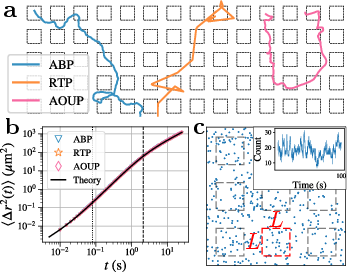
The study investigates and contrasts three canonical stochastic models of self-propulsion in dilute conditions: Active Brownian Particles (ABP), Run-and-Tumble Particles (RTP), and Active Ornstein-Uhlenbeck Particles (AOUP), each encoding distinct reorientation statistics at constant or fluctuating propulsion velocities. Despite yielding indistinguishable mean squared displacement (MSD) profiles and velocity autocorrelations under matched parameters, these models fundamentally differ in the statistical features of reorientation events. Figure 1 demonstrates the visual and statistical similarity of their individual and collective trajectories under these metrics.
Figure 1: Simulated trajectories for ABP, RTP, and AOUP models with overlayed observation boxes, demonstrating indistinguishable ensemble MSDs under matched motility parameters.
The "Countoscope" procedure is employed: partitioning the spatial domain into a grid of observation boxes and analyzing the time-dependent occupancy signals N(t). This approach circumvents the need for full trajectory resolution, providing direct statistical access to collective behaviors directly from positional data, suitable for dense or noisy data regimes.
Time-Dependent Number Fluctuations
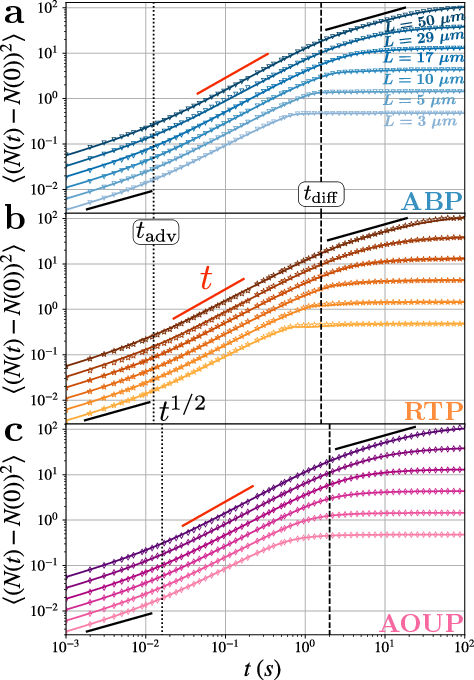
Number fluctuations, quantified as the variance ⟨ΔN2(t)⟩, are shown to evolve through three characteristic dynamical regimes corresponding to diffusive, advective, and enhanced diffusive motion. Figure 2 presents these regimes across all three models, with theory yielding precise quantitative fits to simulation for a range of box sizes:
Figure 2: Temporal evolution of number fluctuations for ABP, RTP, and AOUP models, showing three universal time regimes; theoretical predictions closely match simulation results.
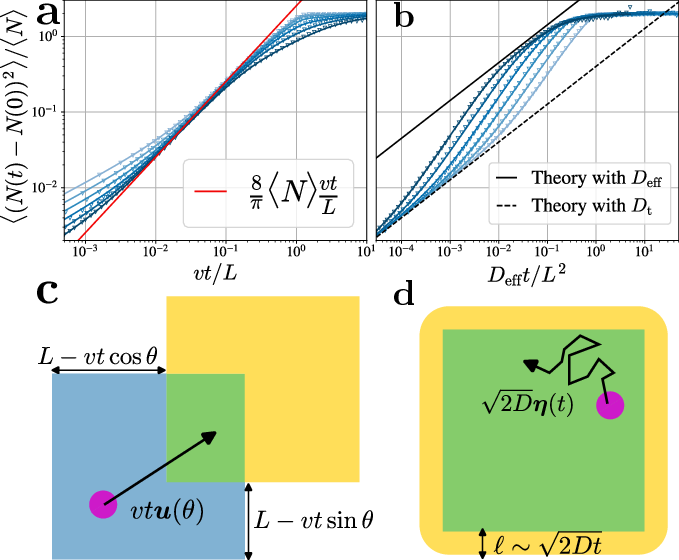
A scaling analysis probes the physical origin of these regimes. In the limit of short timescales, fluctuations scale as t due to local diffusion; at intermediate scales, advection dominates with a t dependence; eventually, long-time correlations return to the diffusive t scaling but with an enhanced effective coefficient encapsulating the impact of persistent motion. Figure 3 underscores this collapse via appropriate advective and diffusive rescalings, confirming universal scaling but different amplitude prefactors between models.
Figure 3: Scaling collapse of box occupancy variance for different box sizes in ABPs under (a) advective and (b) diffusive time rescalings; schematic panels delineate domain exploration for both advection and diffusion.
Crucially, analytical examination reveals that the prefactors of the intermediate regime directly depend on the stochastic attributes of the velocity and angular reorientation processes, with RTP, ABP, and AOUP yielding different scaling constants due to variance in their angular noise and relaxation timescales.
Discriminating Reorientation Dynamics via Correlation Functions
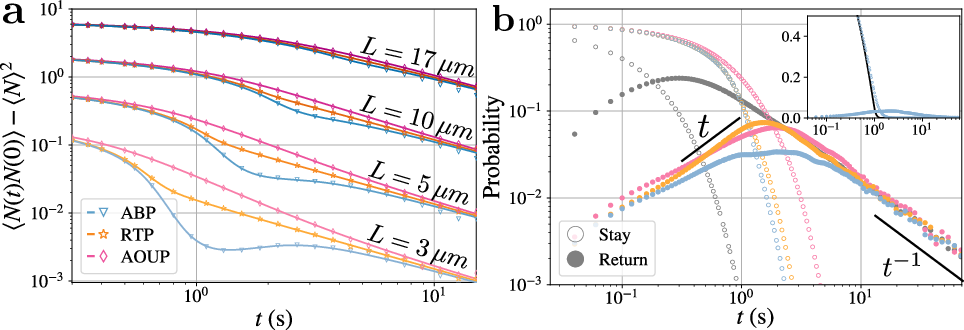
While the overall structure of ⟨ΔN2(t)⟩ exhibits model-sensitive prefactors and slight shifts in crossover times, a more sensitive probe is the number autocorrelation function CN(t). Distinctive signatures emerge: for sufficiently small boxes and appropriately chosen time windows (comparable to the mean reorientation time), ABPs, RTPs, and AOUPs exhibit marked differences in the decay and transient features of CN(t). Figure 4 illustrates that while the rapid decay of CN(t) is generic, the presence, depth, and temporal position of non-monotonic dips in CN(t) are model-specific, with the sharpest decorrelation occurring for ABPs due to smooth angular diffusion and more pronounced recurrences in RTPs enabled by abrupt, stochastic direction reversals.
Figure 4: Time autocorrelation of number signal ⟨ΔN2(t)⟩0, illustrating sharp, model-specific differences; decomposition into stay and return probabilities illuminates the physical origin of these differences.
Decomposition of the autocorrelation into "stay" and "return" probabilities, ⟨ΔN2(t)⟩1 and ⟨ΔN2(t)⟩2, further reveals mechanistic insights. AOUPs, due to velocity amplitude fluctuations, display slower box exit and return kinetics, while the rare return events in ABPs result in a deep temporary correlation dip. RTPs, with frequent sharp reorientations, demonstrate rapid and frequent re-entrances. These features are not accessible via time-independent number statistics or simple displacement-based analyses.
Implications and Future Directions
This analysis establishes dynamic number fluctuations and their correlations as sensitive diagnostic tools for distinguishing between self-propelling dynamics in active suspensions. The work demonstrates that even in scenarios where conventional metrics fail to differentiate between propulsion mechanisms, subtle distinctions in reorientation—integral to phenomena such as chemotactic exploration, swarming, or clustering—are quantifiable through simple positional measurements and robust statistical machinery.
Theoretical implications extend to the development of inference schemes for reorientation statistics in complex experimental settings, particularly in dense, optically ambiguous, or high noise environments where individual trajectory tracing is impractical. Practically, this framework opens avenues for real-time, label-free identification of motility mechanisms in living or synthetic active matter, with applications in microbiology, colloidal science, and soft condensed matter. Looking forward, extending these approaches to systems exhibiting collective effects (giant number fluctuations, phase separation, etc.), or more complex reorientation laws (run-reverse, intermittent dynamics), could further enrich our understanding of emergent macroscopic transport phenomena in active media.
Conclusion
Number fluctuation statistics, accessible directly from real-space measurements without trajectory reconstruction, furnish a powerful and model-sensitive probe of self-propelled particle dynamics. This approach distinctly discriminates between canonical self-propulsion models via their differing reorientation statistics, enabling quantitative inference of underlying dynamical parameters and mechanisms. These findings advocate for the broader adoption of number-based observables in the characterization of active, nonequilibrium suspensions and motivate further theoretical and experimental investigation into the interplay between single-particle dynamics and emergent collective phenomena.