- The paper introduces a paradigm shift by reformulating single-view hair reconstruction into a calibrated multi-view task using synthesized orbital views.
- It employs a neural orientation extractor and a hybrid implicit field to ensure accurate strand-level geometric synthesis and computational efficiency.
- Empirical evaluations demonstrate significant improvements in metrics like PSNR, LPIPS, and orientation accuracy compared to state-of-the-art methods.
Multi-View Aware 3D Hair Modeling from Single Portraits: An Authoritative Analysis of HairOrbit
HairOrbit proposes a paradigm shift in strand-level 3D hair modeling from single-view portraits. The methodology departs from previous approaches—typically reliant on limited frontal cues and synthetic databases with sparse diversity—by leveraging deep 3D priors inherent in large-scale video diffusion models. The framework first synthesizes calibrated orbital multi-view images from a frontal portrait, transforming the fundamentally ill-posed single-view reconstruction problem into a calibrated multi-view task. This reformulation enables rigorous exploitation of multi-view constraints for high-fidelity 3D strand geometries, surpassing the limitations inherent to frontal-view-only reconstructions.
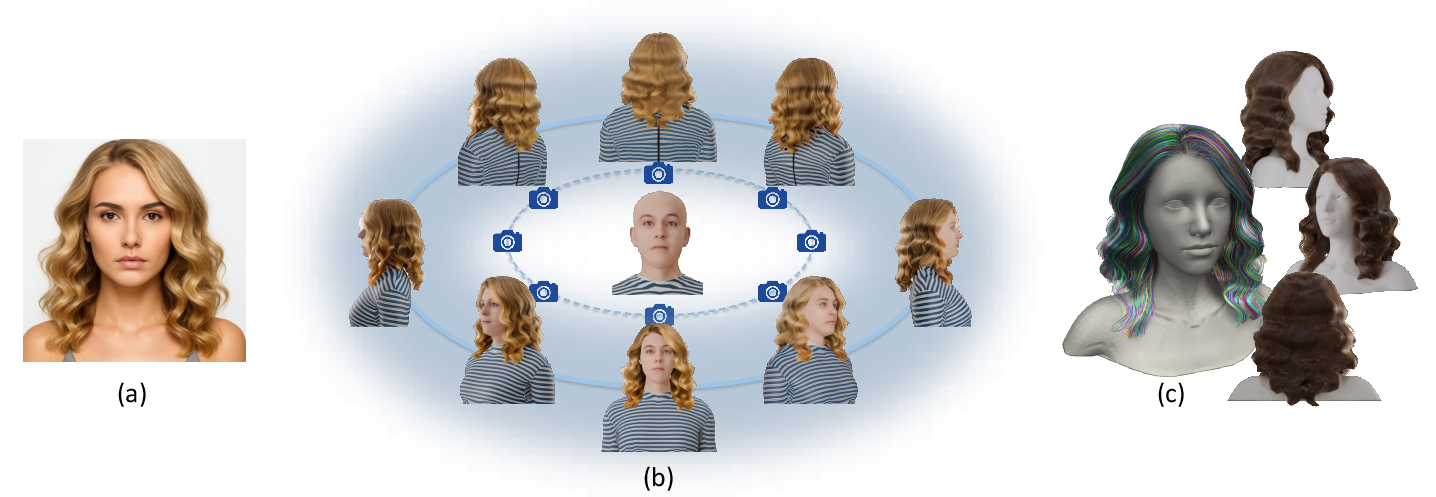
Figure 1: Strand-level single-view 3D hair reconstruction reformulated as a multi-view problem, facilitating strand-wise geometry synthesis via video diffusion-based orbit generation.
System Architecture and Methodological Innovations
The pipeline, outlined in HairOrbit, consists of three main stages: multi-view generation, neural orientation extraction, and hybrid-field-driven strand growth. Multi-view generation is accomplished by fine-tuning a video diffusion model—specifically WAN—using LoRA adapters and expertly curated synthetic 3D hair data. The generated multi-view sequences, enhanced by a latent-space super-resolution module, exhibit high texture and geometrical consistency, serving as robust intermediate views for subsequent reconstruction.
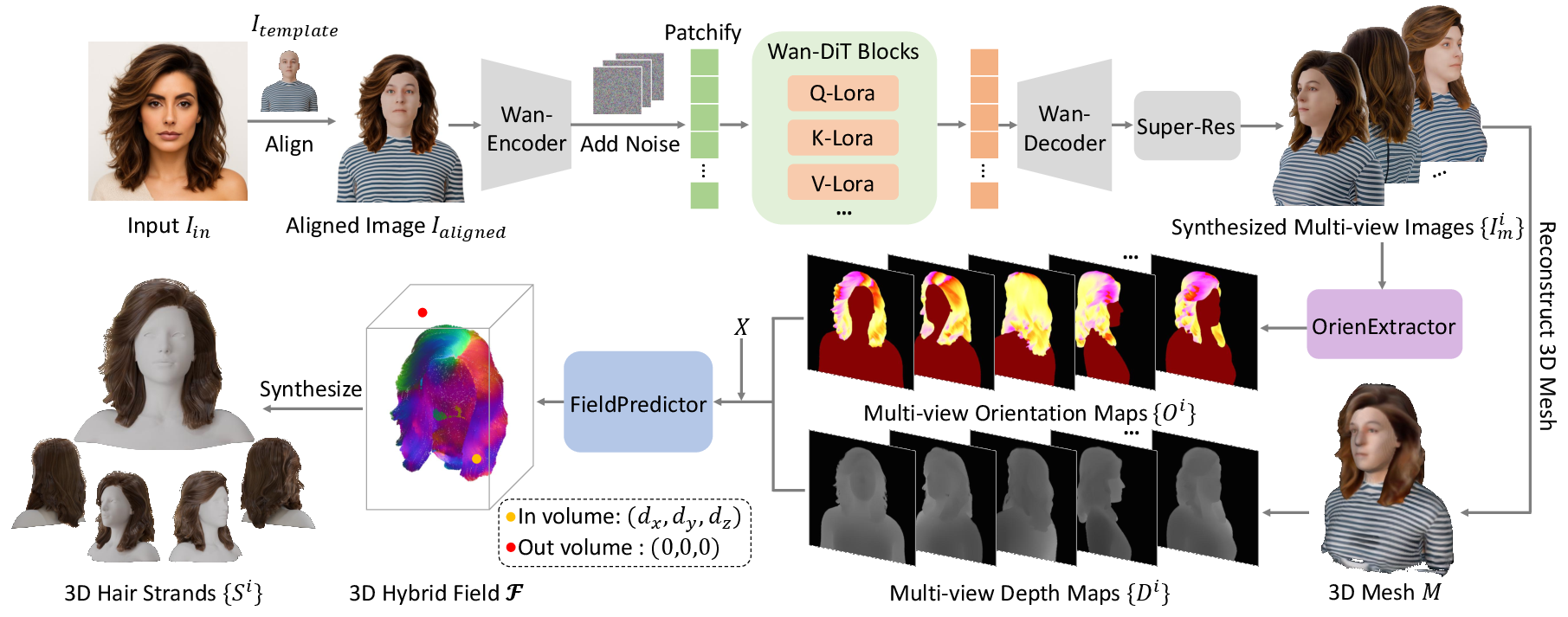
Figure 2: HairOrbit pipeline overview—converting single-view hair modeling into a calibrated multi-view task, enabling downstream 3D reconstruction.
Orientation extraction is addressed by training a full-view-aware neural estimator, yielding orientation maps with significantly reduced noise and improved structural consistency over filtered-based (e.g., Gabor) or global-directional networks (e.g., HairStep). The extractor’s learning target is reformulated from directional strand maps to undirectional local orientation maps, enhancing generalizability to side and back views.
A hybrid implicit field is introduced, jointly encoding orientation and occupancy. This design obviates the need for discrete query- and ray-based occupancy checks, enabling efficient parallel strand growth. The strand generation mechanism is further refined via a scalp-rooted/segment-hybrid growth strategy, ensuring completeness and accuracy even in boundary and buzz-cut regions.
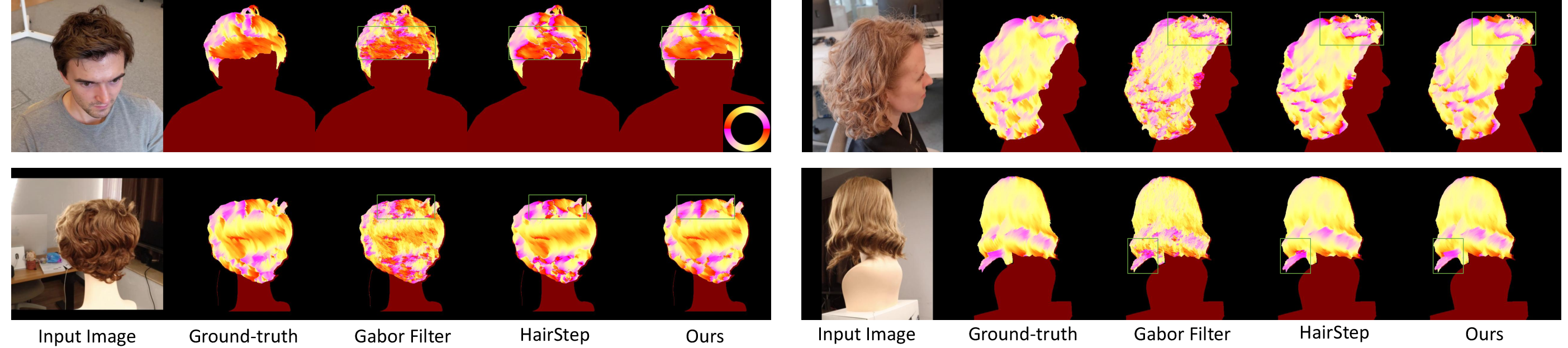
Figure 3: Qualitative comparisons on full-view orientation extraction—HairOrbit’s neural estimation achieves superior directional coherence.
Empirical Evaluation and Comparative Analysis
HairOrbit’s empirical results indicate substantial gains in reconstruction quality and efficiency. Multi-view generation, measured in L1, PSNR, LPIPS, and CLIP similarity, demonstrates perceptually consistent synthesized views (PSNR: 20.897; LPIPS: 0.162; CLIP: 0.834). The neural orientation extractor achieves a mean angular error of 5.13°, outperforming Gabor (16.05°) and HairStep (10.88°) across a large annotated dataset. The hybrid field delivers orientation accuracy (MSE: 0.018) and occupancy metrics (IoU: 0.986, precision: 0.997).
The reconstruction module achieves superior single-view alignment and multi-view consistency compared to state-of-the-art approaches, as seen in quantitative metrics: HairSale (12.83°), HairRida (80.52%), and IoU (0.847), all outperforming HairStep, Difflocks, and Im2Haircut.
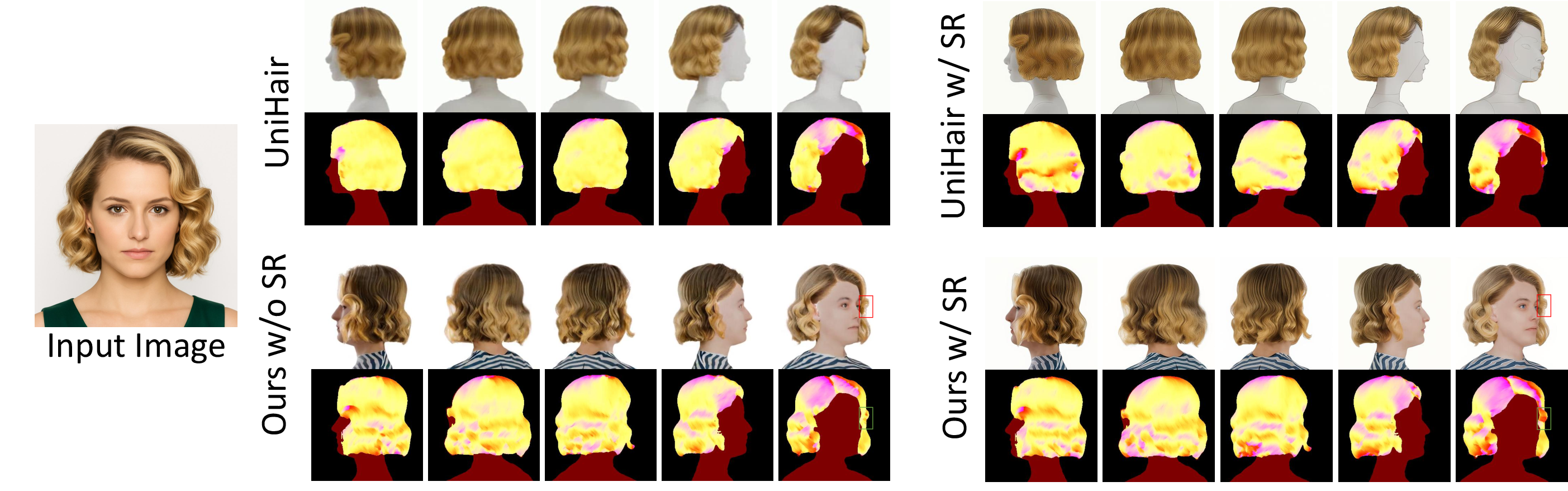
Figure 4: Visual comparison of multi-view generation—HairOrbit’s outputs present texture-rich, style-consistent views outperforming prior work.
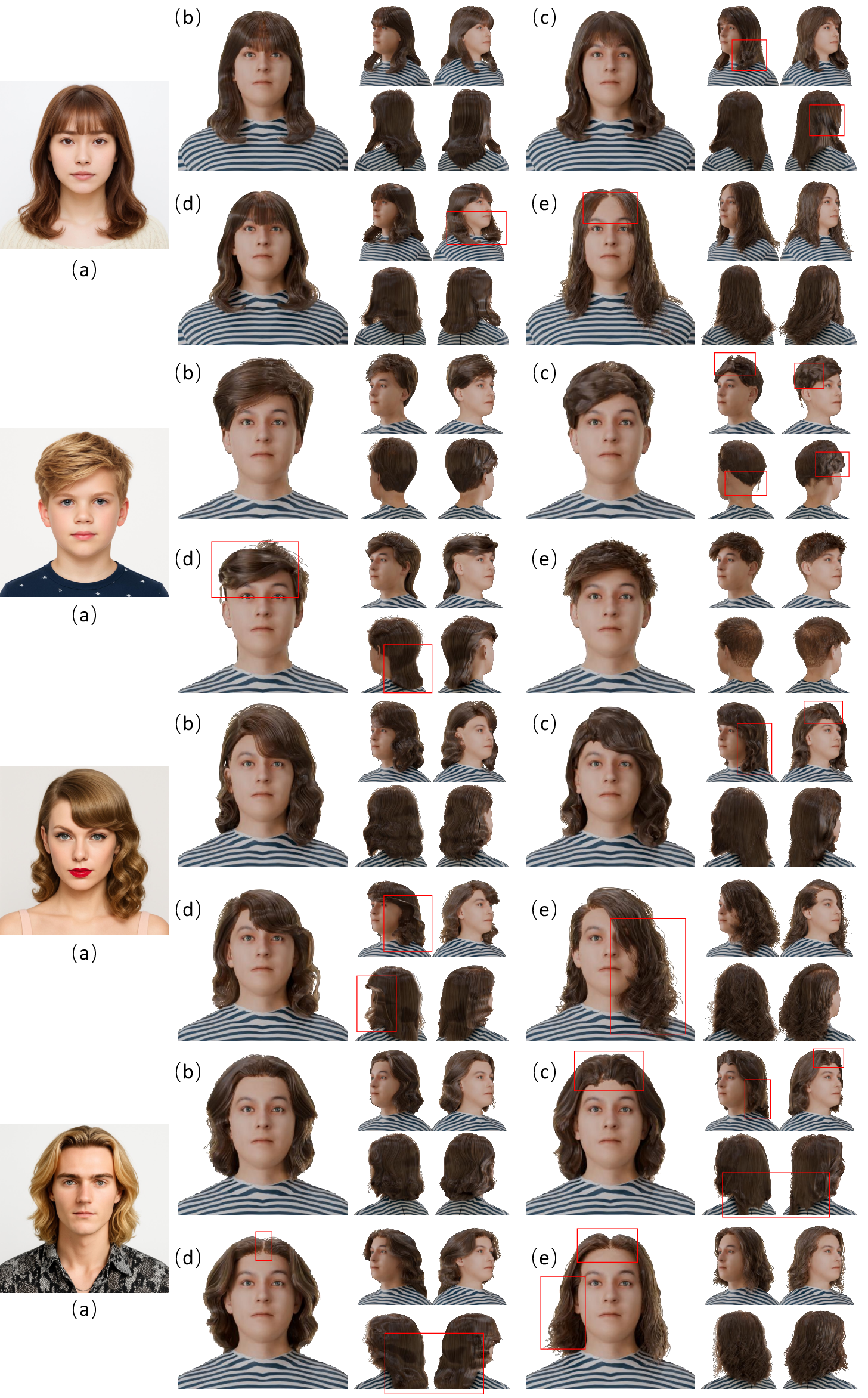
Figure 5: Qualitative comparison on single-view 3D strands reconstruction—HairOrbit exhibits accurate, geometrically plausible strands across unseen viewpoints.
Ablation studies underscore the critical impact of each module: replacing the orientation extractor with a Gabor filter results in significant performance degradation, while reducing to single-view inference or omitting segmental growth disrupts completion and consistency, especially for boundary and buzz-cut hair.
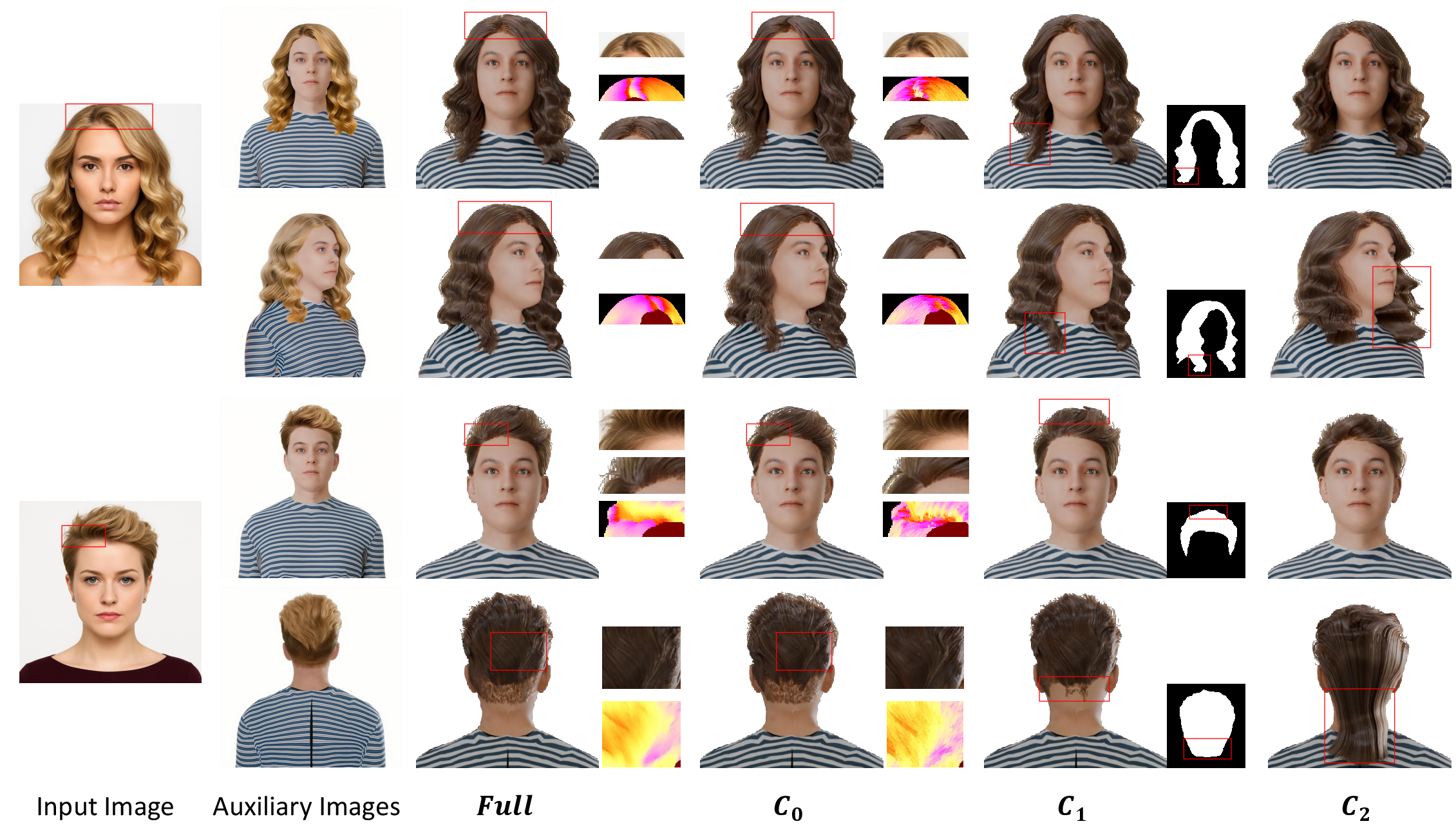
Figure 6: Ablation study—demonstrating the impact of each pipeline component on strand fidelity and completeness.
Implications and Future Perspectives
HairOrbit effectively addresses longstanding limitations in single-view 3D hair modeling by introducing a calibrated multi-view bridge rooted in video diffusion priors. The neural orientation extractor and hybrid field architecture constitute significant technical advances for both reconstruction accuracy and computational efficiency. Notably, this work demonstrates that synthesizing multi-view observations via generative models can overcome intrinsic visibility and prior data constraints, suggesting broader applicability for avatar modeling and AR/VR systems.
Theoretically, the method's joint representation of occupancy and orientation is extensible to other strand- or fiber-based geometry domains. Practically, the efficient pipeline and full-view consistency position HairOrbit as a scalable solution for consumer-facing avatar and content creation tasks. Further developments may expand to fully unsupervised real-view generalization, adaptive strand modeling beyond the scalp, and integration into end-to-end generative avatar pipelines.
Conclusion
HairOrbit advances the state-of-the-art in strand-level 3D hair modeling from single portraits by converting single-view constraints into a calibrated multi-view reconstruction problem, exploiting video diffusion-induced 3D priors. With innovations in neural orientation extraction, hybrid implicit fields, and efficient strand synthesis, the framework demonstrates robust numerical superiority and qualitative consistency across real and synthetic datasets. The implications are wide-ranging for both practical avatar generation and future research in generative geometry modeling (2604.02867).