- The paper introduces a robust lattice Hamiltonian construction that realizes Type-IV ’t Hooft anomalies, unveiling emergent 2-group and higher-categorical symmetry structures.
- Methodologically, it employs qubit-based triangular lattice models and controlled gauging of multiple ℤ2 subgroups to derive non-invertible operator fusion rules.
- The findings have significant implications for classifying symmetry-protected phases in LSM systems and advancing fault-tolerant quantum information operations.
Emergent Higher-Categorical Symmetries from Type-IV ’t Hooft Anomalies on the Lattice
Overview and Motivation
The study systematically investigates explicit lattice realizations of type-IV 't Hooft anomalies—anomalies corresponding to 4-cocycles in group cohomology, involving four distinct global symmetries. The analysis focuses on the interplay between such higher-order anomalies and the resultant non-trivial emergent symmetry structures that appear upon gauging subgroups of the symmetry group on the lattice. The paper articulates both microscopic lattice model constructions and field-theoretic arguments, demonstrating the emergence of 2-group, non-invertible, and higher fusion categorical symmetries, and explores their concrete realization and constraints, with a particular emphasis on Lieb-Schultz-Mattis (LSM) systems where translation symmetries are intertwined with internal ones.
Lattice Realization of Type-IV Anomalies
The central lattice construction is based on a triangular geometry, partitioned into three sublattices and decorated with qubits on each site. Four Z2-valued global symmetries are implemented with specific actions:
- UA,UB,UC are sitewise spin-flip symmetries on distinct sublattices,
- UD is an SPT entangler implementing a nontrivial $3$-cocycle, using controlled-controlled-Z (CCZ) gates over the elementary triangles.
The fundamental mixed anomaly for these four symmetries is captured by the group cocycle action SIV=∫M4A∧B∧C∧D, with A,B,C,D denoting the background gauge fields. This structure realizes a robust lattice analog of the type-IV anomaly, with an explicit commuting projector Hamiltonian constructed to respect the entire symmetry group and the anomaly structure.
Symmetry Gauging and Emergent Structures
Gauging a Single Subgroup: 2-Group Symmetry
Upon gauging one Z2 subgroup, explicit auxiliary gauge qubits are introduced on appropriate links, and both the Gauss law and flatness conditions are imposed. The gauged system exhibits a dual 1-form symmetry and leftover global 0-form symmetries. The interplay between defect insertions—enforced by branch cuts or boundary twists—and symmetry operations yields a projective algebra characteristic of a nontrivial Postnikov class, manifesting as a 2-group symmetry. Notably, the symmetry algebra only closes projectively in the presence of symmetry defects, explicitly confirming the 2-group structure predicted by field theory (2604.02856).
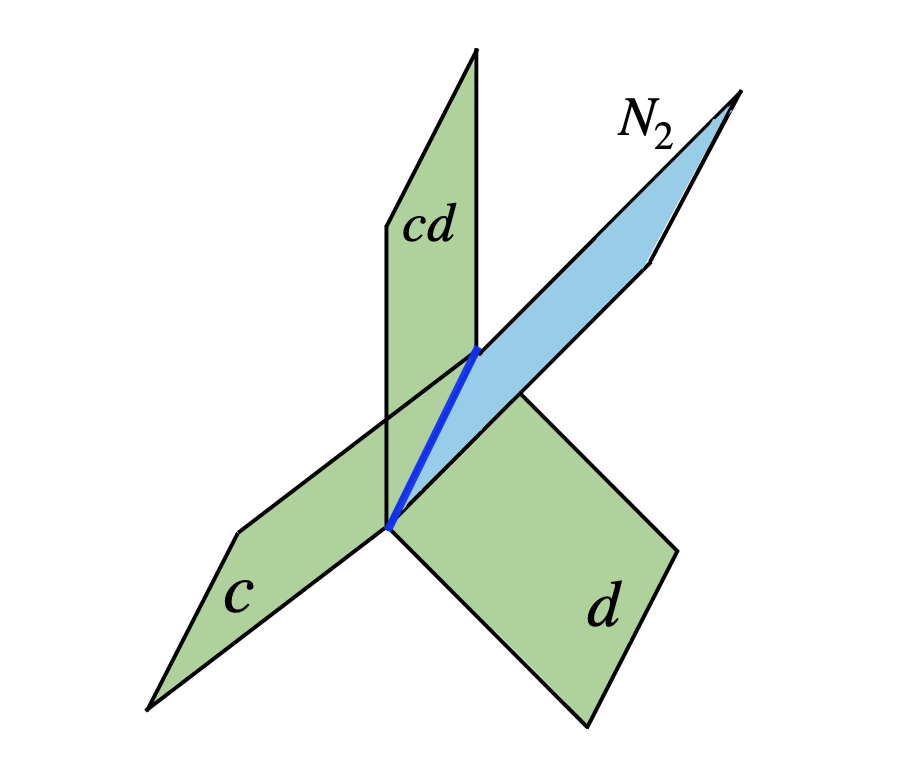
Figure 2: Junction (blue line) of two 0-form symmetry defects labeled by c and d. An SPT phase defined on UA,UB,UC0 is attached to the junction.
Gauging Multiple Subgroups: Emergent Non-Invertible and Higher Fusion Categorical Symmetries
Successively gauging additional UA,UB,UC1 subgroups introduces more auxiliary gauge degrees of freedom. For two subgroups, the Hamiltonian structure enforces mutual commutativity up to defect insertions (via twisted boundary conditions), resulting in non-invertible symmetries localized along symmetry defect lines. Fusion rules are explicitly derived, and non-invertible operators are shown to fuse into condensation defects, an explicit instance of the correspondence between anomaly inflow and non-invertible domain walls [Roumpedakis:2022aik, Choi:2024rjm].
When three subgroups are gauged, the leftover symmetry becomes a non-invertible operator characterized by a higher fusion category (specifically, the 2-Rep category associated with a 2-group). The corresponding Hamiltonian admits three dual 1-form symmetries, and the non-invertible operator fuses according to condensation defects constructed from these symmetries, matching field-theoretic expectations for higher categorical symmetry [douglas2018fusion, Bartsch:2022mpm, Bhardwaj:2022yxj].
Field-Theoretic Correspondence
A cohomological field theory analysis confirms the universality of these emergent symmetry algebras. The partition functions after successive gauging operations exhibit the predicted 2-group and fusion category structures, and the interplay between symmetry defects and topological manipulations (stacking, partial gauging) leads to non-invertible and defect-dependent operator fusion, matching the explicit lattice construction. For example, stacking SPT phases and higher-form gauging on submanifolds (sometimes referred to as "higher gauging" or half-space domain wall gauging) precisely reproduces the non-invertible fusion rules and reveals their fundamental connection to the underlying mixed anomaly.
Application to LSM Anomalies and Modulated Symmetries
The framework is extended to LSM settings, where some internal symmetries are replaced by lattice translations. Models with combined internal and translation symmetries exhibit mixed type-IV anomalies of the form UA,UB,UC2, corresponding to crystalline realizations. Explicitly gauging internal symmetries in these systems results in “modulated” (dipole-type) symmetry operators, whose algebra is intrinsically sensitive to system size parity and the presence of translation defects. The algebra and commutation structures again match those predicted by crystalline equivalents of the type-IV anomaly.
Crucially, the presence and structure of these modulated symmetries are shown to depend not only on the bulk symmetry but also on backgrounds involving translation or internal symmetry defects—this "defect-dependency" is a qualitatively novel prediction not captured by previous analyses [Aksoy:2023hve, Pace:2025hpb]. The lattice models under analysis interpolate between “weak” and strong SPT phases, with the appearance of crystalline modulated symmetries providing a diagnostic for the underlying anomaly type.
Implications and Future Directions
This work unifies the understanding of exotic symmetry structures—such as 2-groups, non-invertibles, and higher-categorical fusions—in quantum many-body systems with higher order anomalies, both from a lattice and field-theoretic perspective. The explicit composition and operator algebra of these systems demonstrates the intrinsic connection between mixed anomalies and defect-dependent emergent symmetry. In particular, it elucidates the nontrivial extensions and condensation rules that characterize categorical symmetry and informs approaches to SPT phase classification beyond standard group cohomology.
These results have potential implications for quantum information, e.g., symmetry-protected logical gates and generalized fault-tolerant logical operations [YOSHIDA2017387], and for condensed matter, in the classification of topological and fractonic phases wherein higher-form and non-invertible symmetries are central. Moreover, the explicit lattice realization of fusion 2-categories related to 2-group symmetries opens up practical avenues for constructing Hamiltonians with robust, nontrivial logical operator algebras rooted in categorical symmetry.
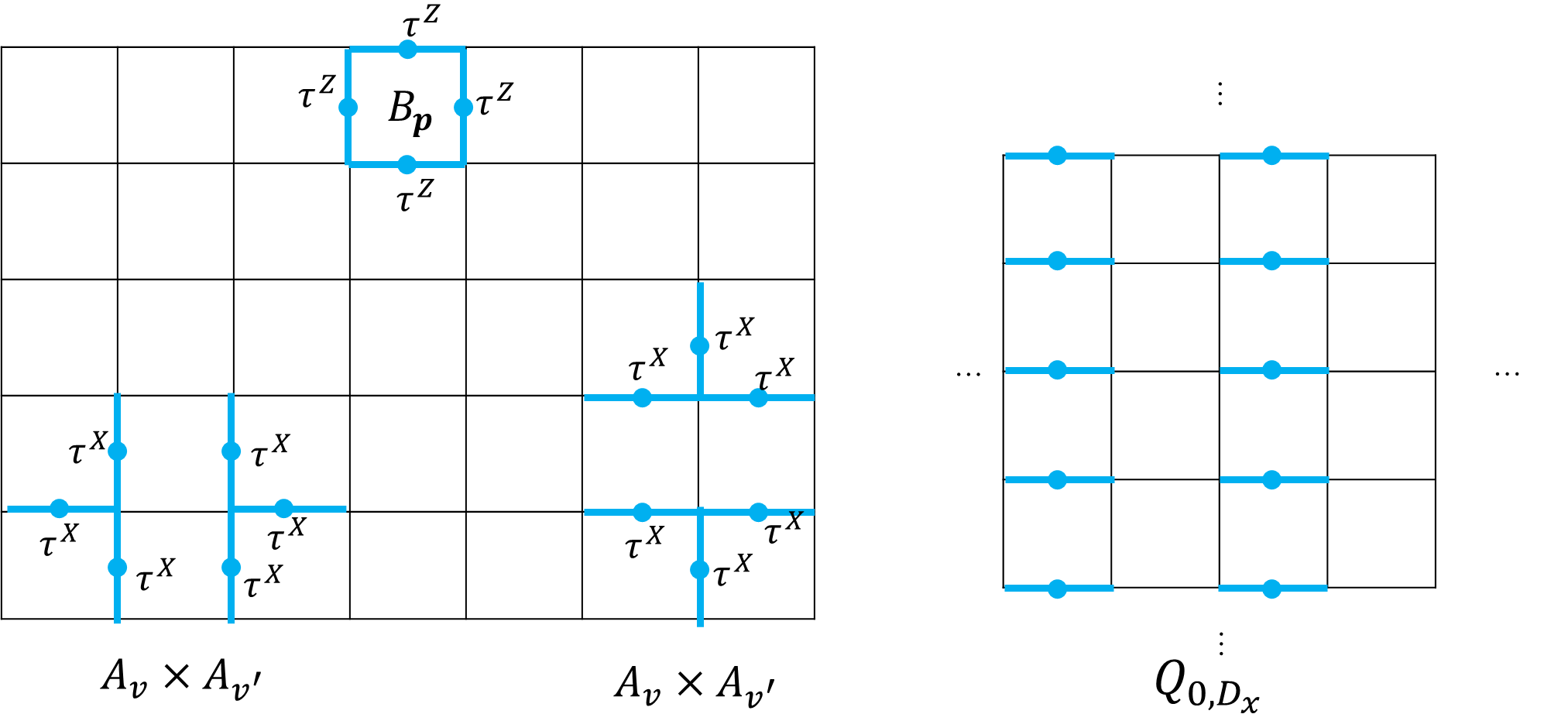
Figure 4: (Left) The first two terms that constitute the Hamiltonian relevant for the gauged models, controlling electric and magnetic flux constraints in the emergent gauge theory.
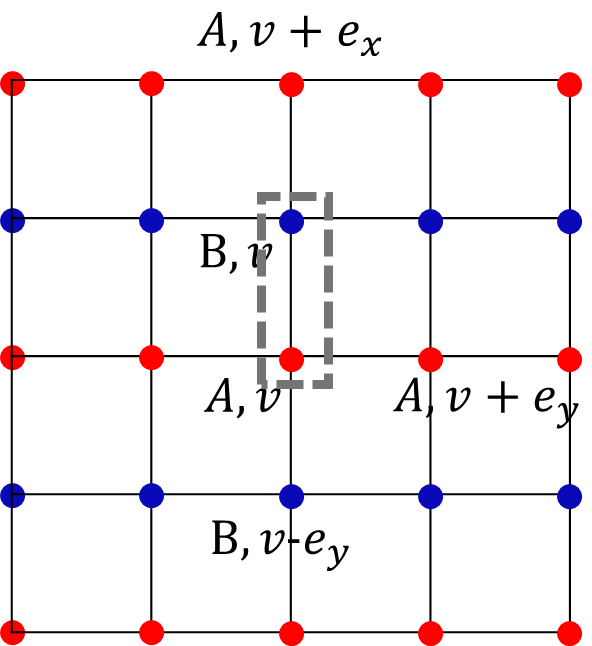
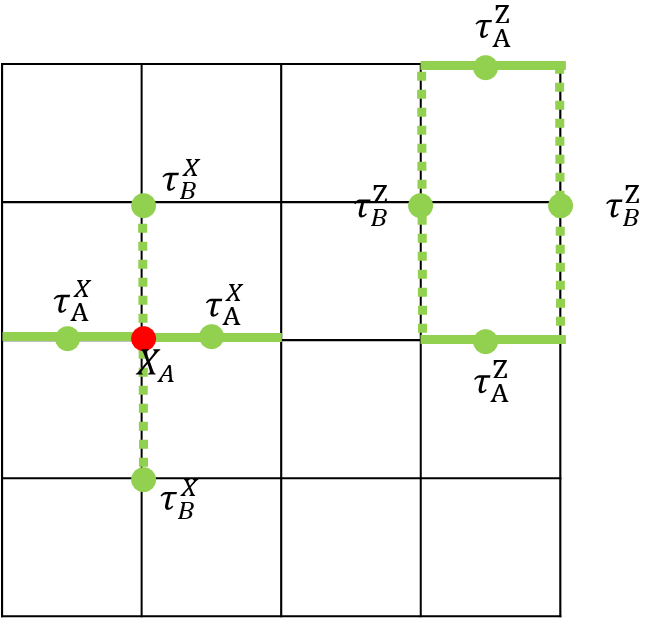
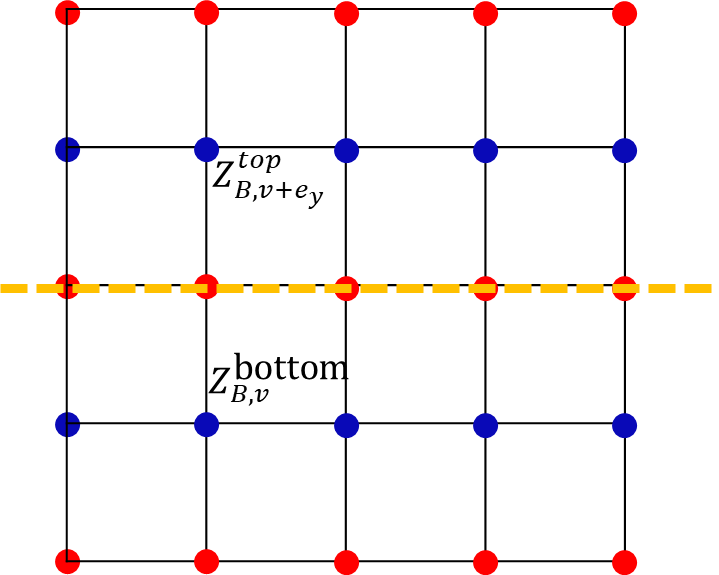
Figure 6: Real-space configurations illustrating the action and interplay of modulated symmetry operators and translation defects in crystalline LSM systems.
Conclusion
The paper provides a detailed lattice and field-theoretic construction of type-IV 't Hooft anomalies, explicitly demonstrating the emergence of higher-categorical, non-invertible, and modulated symmetries upon partial or full gauging of constituent symmetries. The results reveal that not only do higher order anomalies unify various forms of generalized symmetry in condensed matter and quantum information systems, but also that such symmetry structures are fundamentally sensitive to defect backgrounds—a key insight for future studies on quantum phases of matter and categorical symmetries.
References (selection):
- T. Oishi and H. Ebisu, "Type-IV 't Hooft Anomalies on the Lattice: Emergent Higher-Categorical Symmetries and Applications to LSM Systems" (2604.02856)
- L. Bhardwaj et al., "Lectures on generalized symmetries" (Bhardwaj et al., 2023)
- K. Roumpedakis et al., "Higher Gauging and Non-invertible Condensation Defects" (Roumpedakis et al., 2022)
- C. L. Douglas and D. J. Reutter, "Fusion 2-categories and a state-sum invariant for 4-manifolds" [douglas2018fusion]
- S. Aksoy et al., "Lieb-Schultz-Mattis anomalies and web of dualities induced by gauging in quantum spin chains" (Aksoy et al., 2023)
- S. D. Pace et al., "(SPT-)LSM theorems from projective non-invertible symmetries" (Pace et al., 2024)