- The paper introduces a log-depth-embedded DDPM that jointly reconstructs temperature, salinity, and velocity fields from sparse surface data.
- It employs continuous depth embedding to enable zero-shot vertical generalization, accurately recovering field structures at untrained depths.
- Comprehensive spectral and statistical analyses confirm enhanced reconstruction fidelity and physics-consistent recovery under extreme observational sparsity.
High-Resolution 3D Ocean State Estimation via Depth-Aware Diffusion Models from Sparse Observations
Introduction and Problem Statement
This work addresses the ill-posed problem of reconstructing high-resolution, three-dimensional (3D) ocean states—temperature (T), salinity (S), zonal (U), and meridional (V) velocities—in the Gulf of Mexico, using only extremely sparse surface satellite observations of sea surface height (SSH) and temperature (SST). Conventional subsurface measurement networks are spatially and temporally sparse, and satellite retrievals are restricted to the uppermost layer, fundamentally underdetermining the ocean interior. Classical dynamical and statistical approaches, while effective under moderate sparsity or idealized regimes, show limited accuracy and robustness under realistic high sparsity and non-uniform sampling, especially in regions with complex bathymetry and multiscale circulation.
Recently, generative deep learning approaches—especially diffusion-based models—have demonstrated advantage in probabilistic surface field reconstruction and super-resolution. However, explicit depth-awareness, physical consistency across vertical profiles, and robust generalization to unseen depths have remained unaddressed for regional 3D states at scale.
Depth-Aware Conditional Diffusion Framework
The proposed methodology is a log-depth-embedded conditional Denoising Diffusion Probabilistic Model (DDPM). The architecture (Figure 1) incorporates:
- Sparse SSH and SST, with explicit masking, as conditioning channels.
- A log-normalized, continuous depth coordinate, enabling learning of vertical structure as a continuous representation rather than as independent discrete depth slices.
- Unified training on data from nine vertical levels (≈25–1062 m), learning joint horizontal and vertical representation of the ocean state as a conditional distribution over T, S, U, V.
During inference, the model is capable of reconstructing the full 3D field not restricted to trained depths, but also for intermediate (previously unseen) depths within the vertical domain—a critical feature enabling vertical interpolation and robust probabilistic mapping unconstrained by discretization.
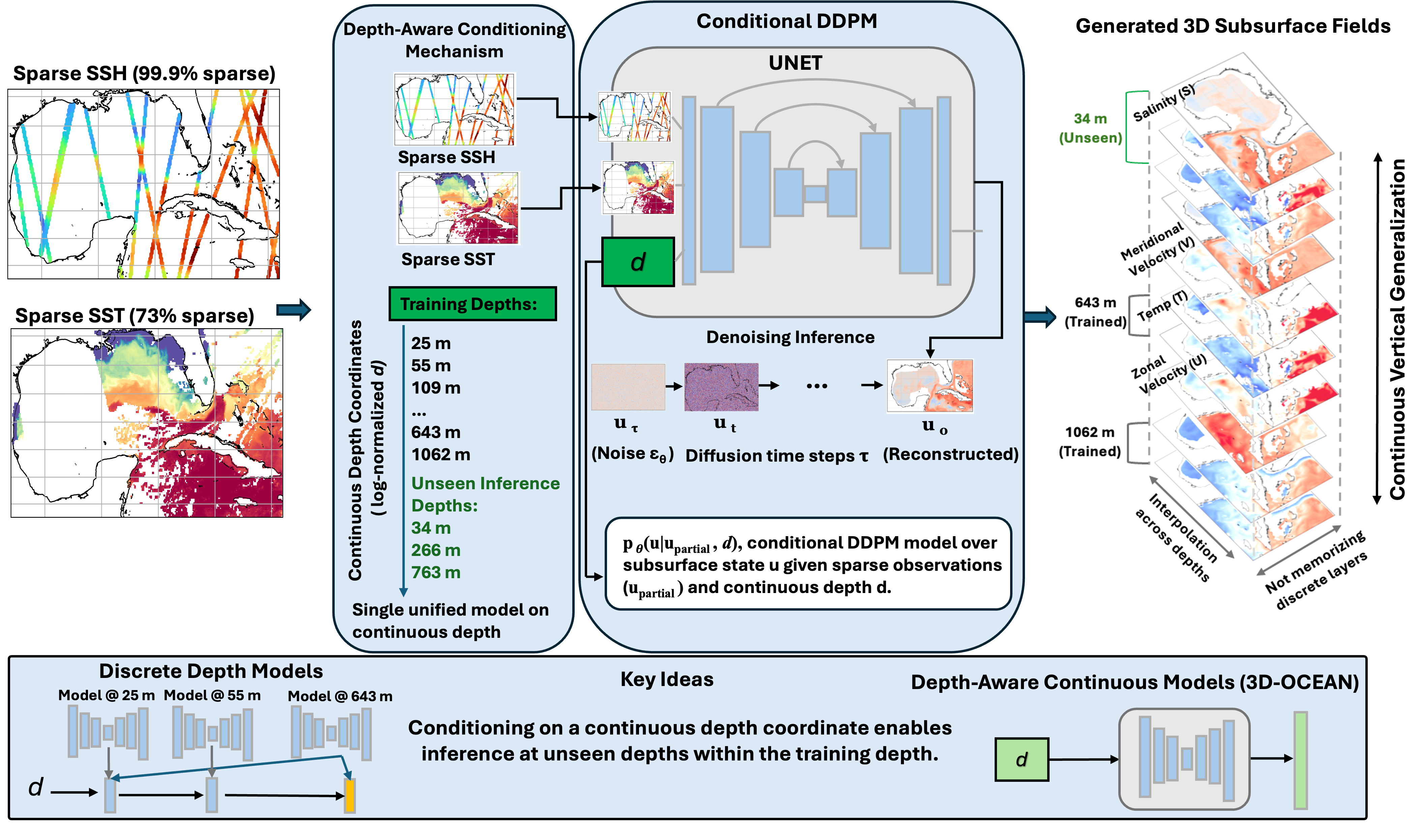
Figure 1: Schematic of the depth-aware conditional DDPM, highlighting log-depth embedding and unified probabilistic inference for all marine variables.
Subsurface Recovery under Extreme Sparsity
The method demonstrates physics-consistent field recovery for realistic cases (Figure 2). Using February 13, 2023 as an example, the network reconstructs T, S, U, V at 55 m, 318 m, and 1062 m. Even with >99% SSH and 73% SST sparsity, dominant mesoscale and large-scale features, including the Loop Current and associated eddies, are retained in DDPM reconstructions with minimal deviation from the GLORYS reanalysis ground truth.
Deterministic and hybrid deterministic–diffusion baselines (UNet, FNO, UNet+DDPM, FNO+DDPM) are systematically outperformed by the unified DDPM. The hybrids, while capturing coarse patterns, introduce artificial noise and fail to recover multiscale velocity structures with fidelity.
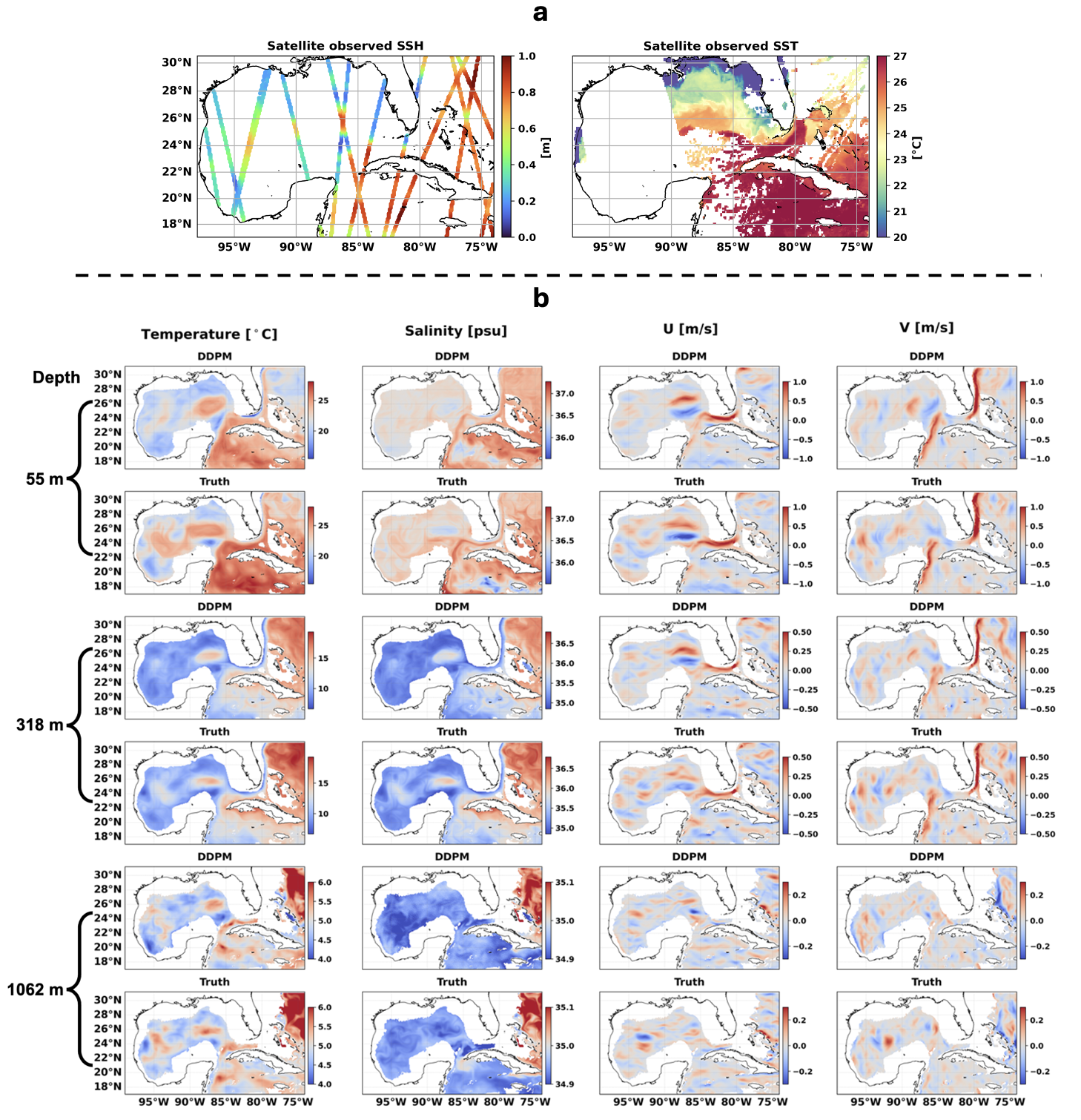
Figure 2: Recovery of oceanic variables at depth by the DDPM, conditioned only on sparse surface inputs.
Spectral and Statistical Validation
Spectral analysis (Figure 3) on T, S, U, V indicates that DDPM-based inference accurately reconstructs the energy-containing range, as well as a substantial fraction of mesoscale/submesoscale variability. For T and S, spectral agreement persists across all depths, while velocity spectra show modest underrepresentation at high wavenumbers, reflecting greater flow complexity with depth and weaker SSH/SST–velocity coupling.
Quantitative validation over 100 held-out temporal samples (Figure 4) using NRMSE, correlation coefficient (CC), and SSIM corroborates these results—T and S reconstructions achieve higher CC, lower NRMSE, and superior SSIM compared to those for U, V. Depth-aware DDPM shows limited further gains when conditioned on deterministic FNO/UNet outputs, confirming the centrality of continuous depth representation.
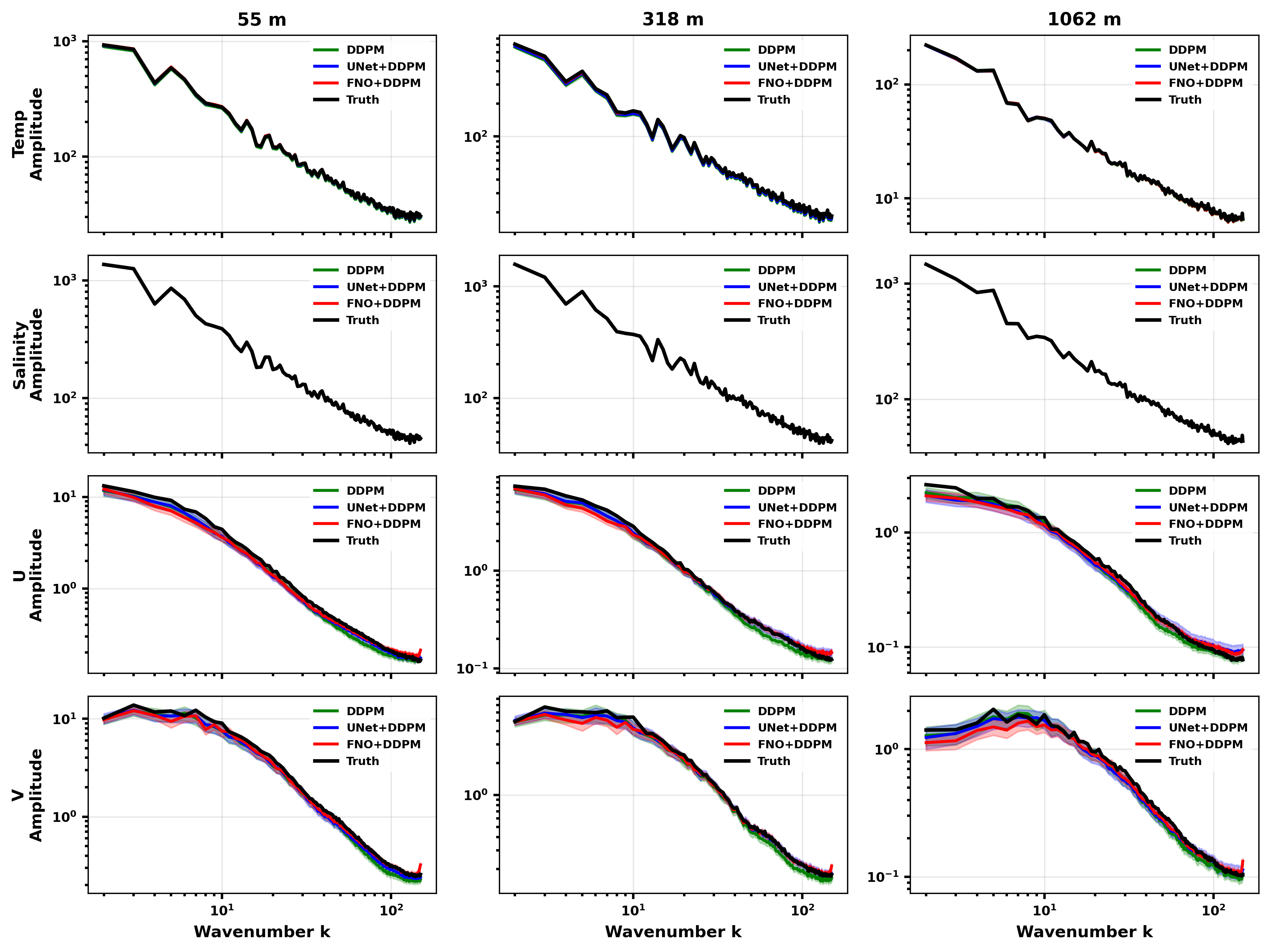
Figure 3: Fourier power spectra averaged across 100 samples at three representative depths, comparing DDPM and GLORYS reference.
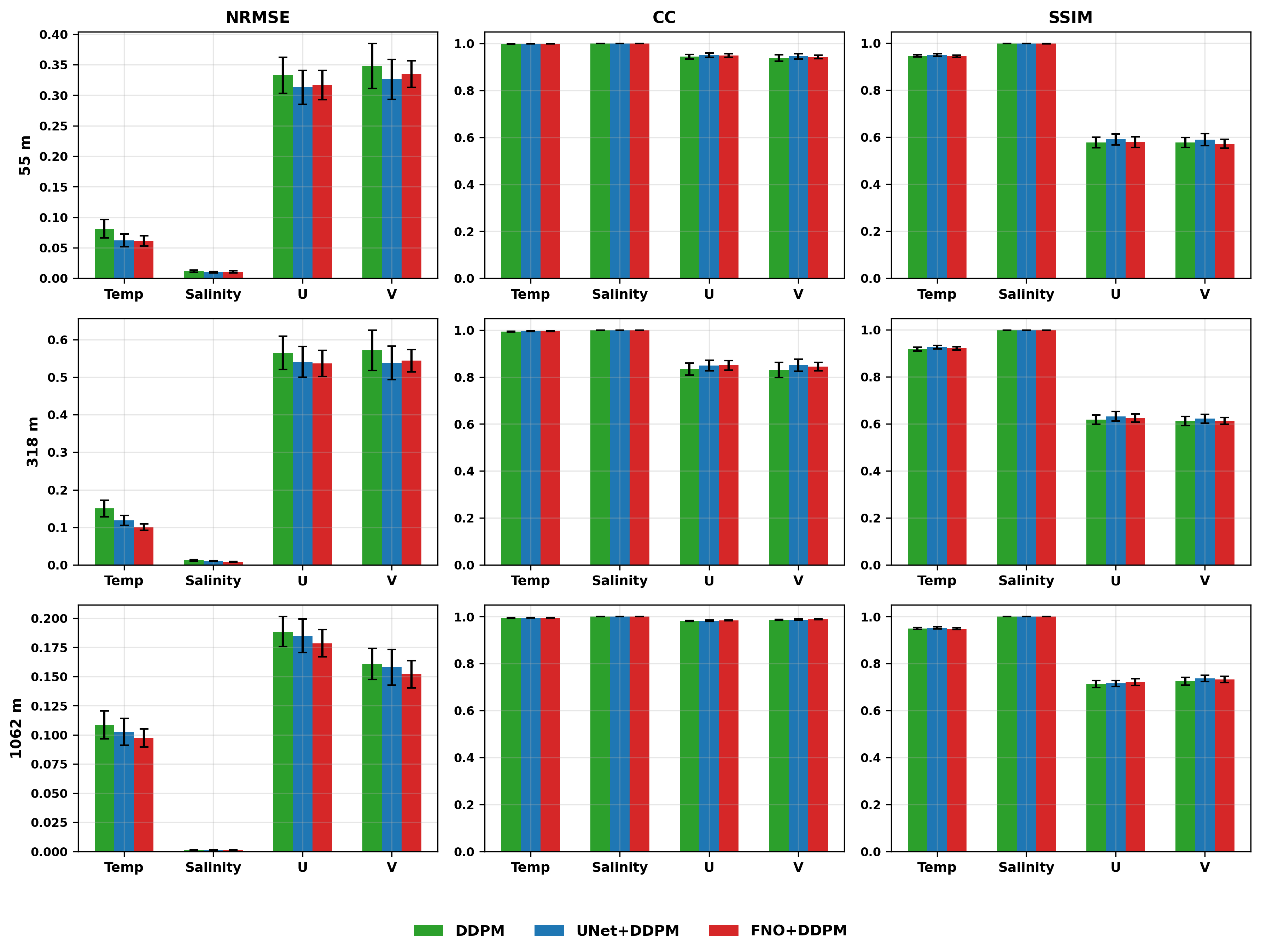
Figure 4: Distribution of NRMSE, CC, and SSIM for T, S, U, V, across methods and depths.
Conservation and Physical Consistency
Physical diagnostics—especially meridional heat-flux transects at 26°N (Figure 5)—demonstrate that the DDPM captures the magnitude, sign, and vertical structure of oceanic heat transport, a stringent requirement unmet by unconstrained generative models. Conservation and coupling between fields are retained without explicit dynamics-based regularization.
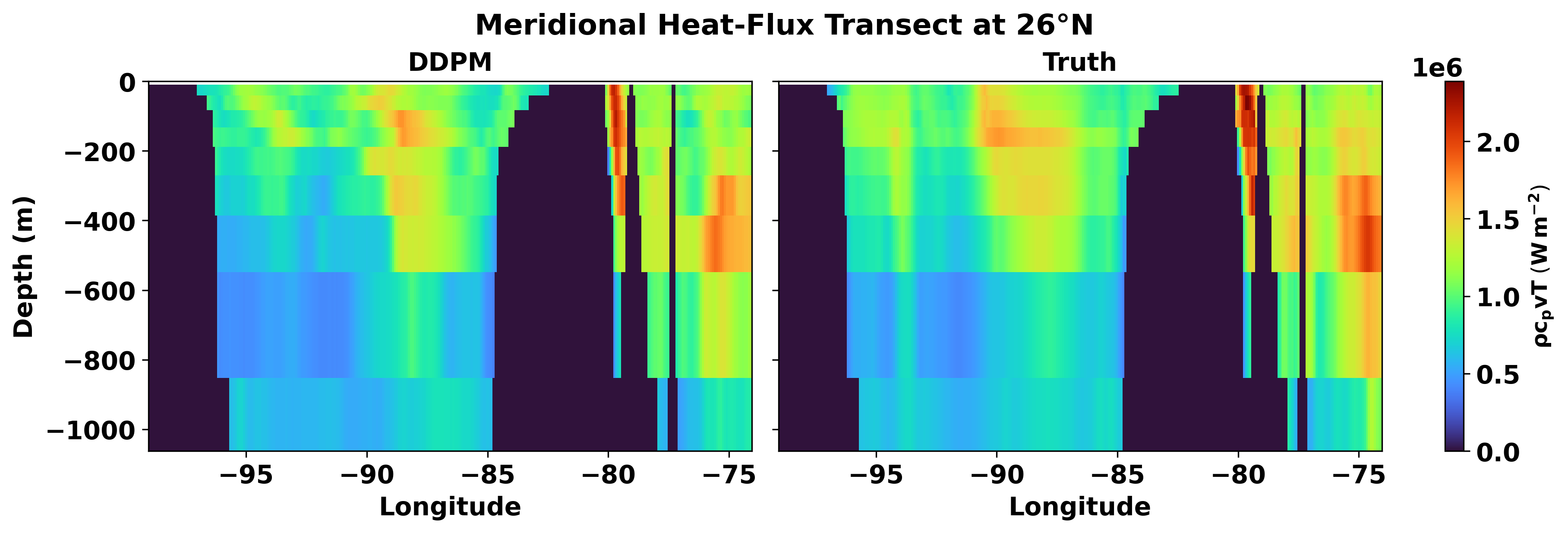
Figure 5: Heat-flux section from DDPM (right) aligns with GLORYS (left), demonstrating dynamical and thermodynamical coherence.
Generalization to Unseen Depths
A key property of the continuous depth embedding is zero-shot vertical generalization: the capability to reconstruct state at arbitrary depths within the training range. Tests at three never-trained intermediate depths (34, 266, and 763 m) (Figure 6) show the model recovers dominant structures in T and S and, to a lesser extent, in velocity components; spectral validation (Figure 7) indicates fidelity in line with ground truth for T/S, and controlled divergence at high wavenumbers for U/V.
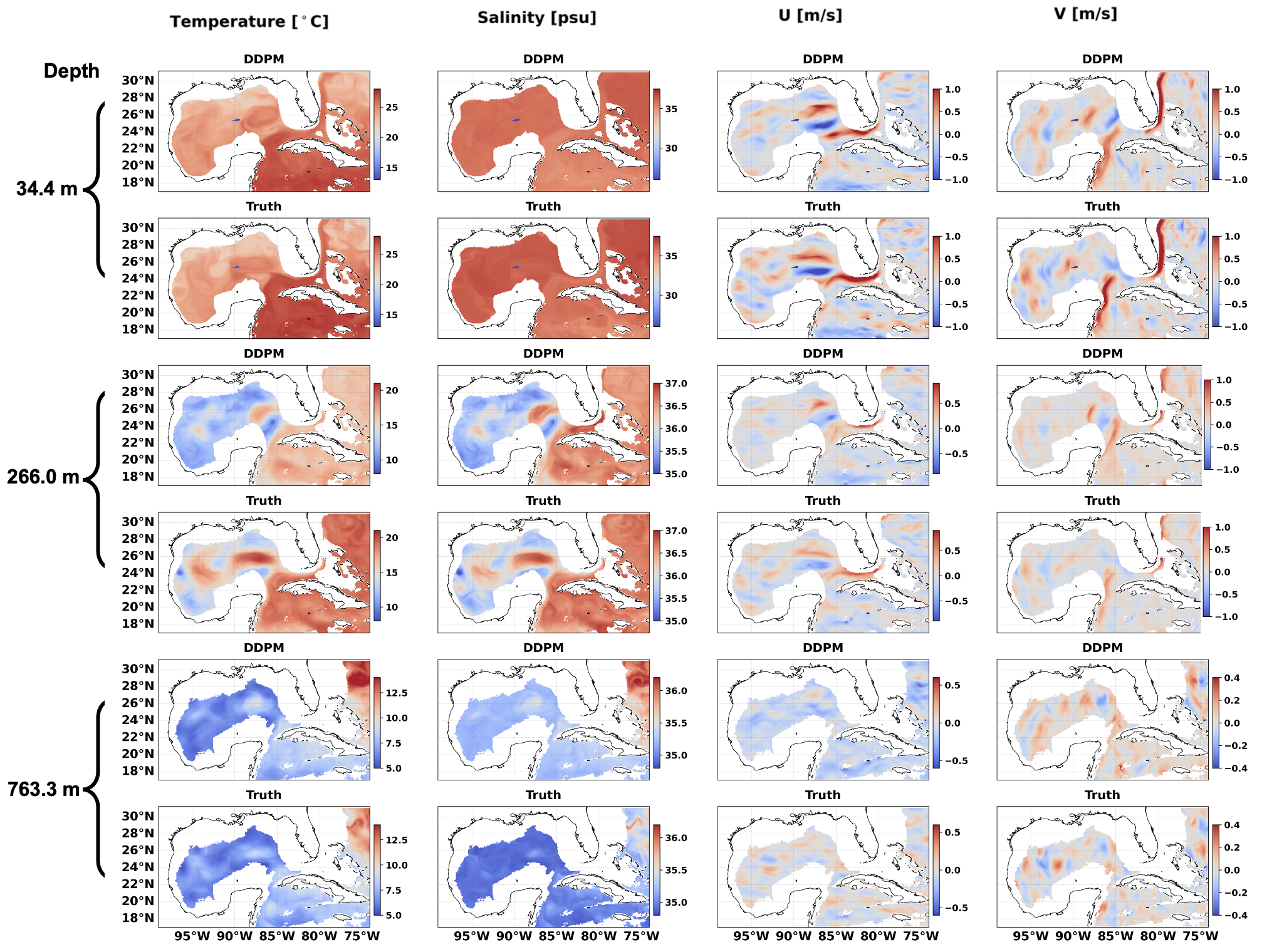
Figure 6: DDPM reconstructions at previously unseen intermediate depths.
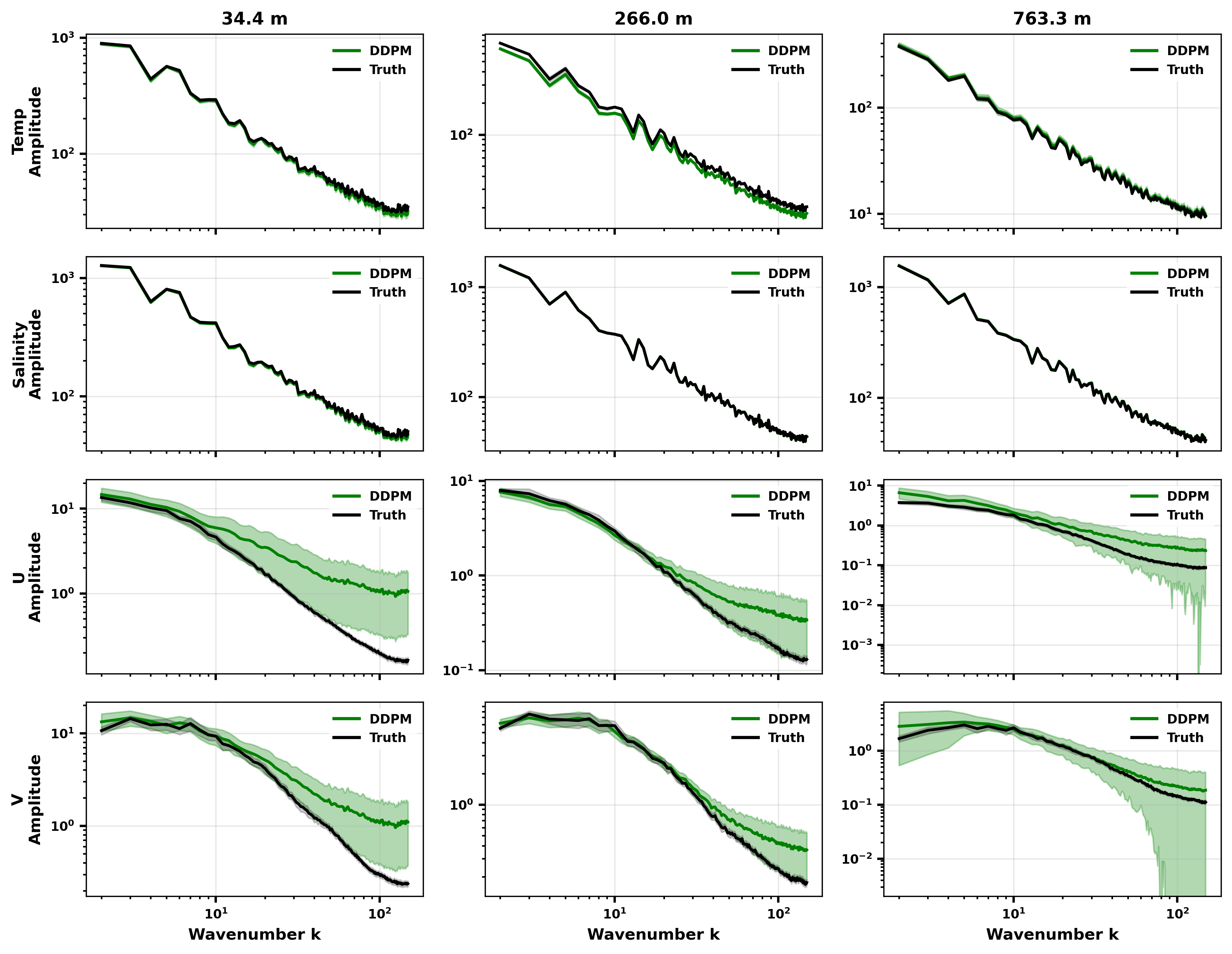
Figure 7: Spectral analysis at unseen depths exhibits consistent recovery of temperature and salinity across scales.
Computational Scaling and Practical Implications
The architectural design results in constant memory and compute scaling O(1) in the number of vertical levels, a crucial advantage for high-resolution 3D field emulation. Unlike conventional per-depth or per-field training, model size does not scale linearly with vertical discretization, enabling operational extension to very fine vertical grids or even continuous depth axes.
Additionally, the absence of an external dynamical model (e.g., numerical ocean simulation), or ensemble propagation for uncertainty quantification, significantly reduces compute requirements and enables direct, probabilistic mapping from sparse observations.
Theoretical and Practical Impact in Geoscientific AI
This approach establishes the practical feasibility of high-resolution, data-driven, and probabilistic ocean state estimation from severely under-sampled real-world satellite conditions, without reliance on dynamical constraints or idealized simulations. The unified DDPM, incorporating continuous log-depth coordinates, is a substantial methodological innovation, supporting:
- Scalable data assimilation in operational oceanography under extreme data sparsity.
- Physics-consistent uncertainty quantification for downstream tasks (e.g., heat flux diagnostics, transport prediction).
- Modular integration with neural operator-based digital twins and hybrid data-driven/data-assimilative forecast systems [chattopadhyay2024oceannet].
- Potential generalization for analogous geophysical problems (e.g., atmospheric profiling, subsurface hydrology).
Notable limitations remain: velocity field recovery, particularly for small-scale dynamics and at large depths, exhibits higher error and spectral collapse, suggesting avenues for supplementing generative inference with physics-based regularization, explicit conservation constraints, or enhanced coupling inputs.
Conclusion
The depth-aware conditional DDPM framework presented here advances the state of regional, high-resolution, probabilistic ocean reconstruction under extreme observational sparsity. Its key technical features are log-depth embedding for continuous vertical generalization, memory- and compute-efficient 3D emulation, and robust physics-consistent recovery and uncertainty. The approach enables realistic operational and research use for climate monitoring, circulation diagnostics, and next-generation digital twins, and augments the methodological toolkit for data-limited geoscientific inference.
References
(2604.02850)
[chattopadhyay2024oceannet]