- The paper proposes a rigorous statistical framework to infer Pop III star formation efficiency and typical stellar mass using the global 21-cm signal.
- It employs detailed radiative feedback and Lyα/LW coupling models along with Fisher matrix analysis to predict observable signal variations.
- The results imply that next-generation 21-cm measurements, if foreground residuals are minimized, can constrain key Pop III parameters to within 20–25%.
Inferring Population III Star Properties from the 21-cm Global Signal
Introduction
The formation and properties of Population III (Pop III) stars fundamentally shaped the early universe. Due to their high masses, strong radiative feedback, and unique nucleosynthetic signatures, Pop III stars controlled early metal enrichment, influenced early galaxy formation, and reionized the neutral intergalactic medium (IGM). However, direct constraints on their properties, including the initial mass function (IMF) and star formation efficiency (f∗), remain elusive due to their occurrence at high redshift and the limited sensitivity of present-day instrumentation. This paper presents a rigorous statistical framework to constrain Pop III star properties by leveraging the global 21-cm signal, which encapsulates the collective imprint of early star formation on the thermal and ionization evolution of the IGM (2604.02814).
Methodology: Physical and Radiative Modeling
The radiative feedback of Pop III stars is modeled through the escape fraction fesc of ionizing photons as a function of both host halo mass and stellar mass. Unlike previous work assuming constant fesc, this study adopts an empirically-calibrated relation derived from one-dimensional radiation-hydrodynamics simulations. The analysis demonstrates a strong dependence: larger Mh leads to lower fesc due to increased absorption, while larger Ms yields higher fesc by facilitating more rapid ionized bubble expansion.
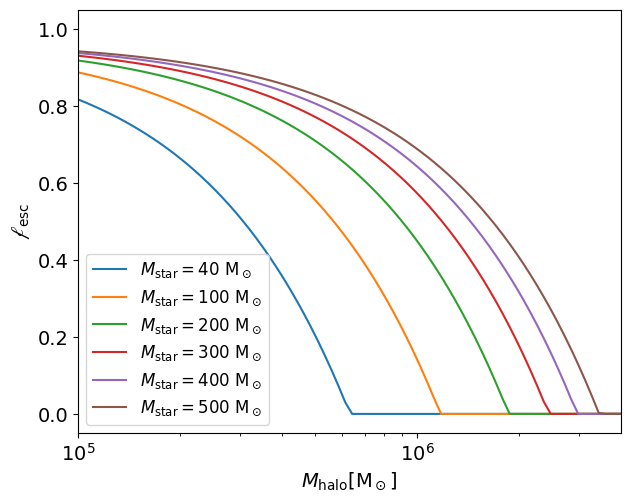
Figure 1: The escape fraction–halo mass relation exhibits a suppression at high Mh and enhancement with increasing Ms, reflecting radiative feedback effects.
To obtain the net radiative input to the IGM, the halo-mass-averaged escape fraction is computed by integrating over the Sheth-Mo-Tormen mass function. Its decline with increasing cooling threshold Mcool and decreasing redshift is shown to impact the timing and amplitude of 21-cm features.
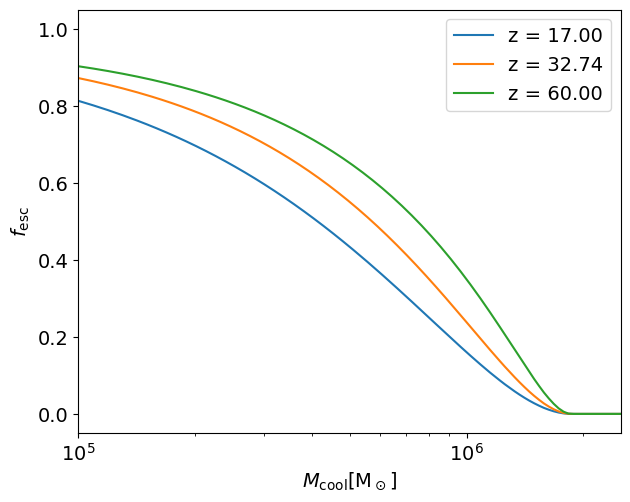
Figure 2: The halo-mass-averaged escape fraction fesc0 declines at lower redshift and higher fesc1, reflecting suppression of photoionization from low-mass halos.
Incorporation of Lyα and LW Feedback
The heating structure around individual halos is modeled, with the sub-grid method validated by RHD results regarding the warm neutral shell mass fraction. Importantly, Lyman–Werner (LW) radiative feedback is included by self-consistently evolving the background intensity and recalculating the minimum cooling halo mass fesc2 in each timestep using the framework established by Visbal et al. This approach captures the non-linear suppression—and delayed resumption—of star formation in minihalos induced by the rising LW flux.
Simulated 21-cm Signal and Parameter Dependencies
The authors simulate the global 21-cm brightness temperature as a function of redshift for a multi-dimensional parameter grid in fesc3 and fesc4. They find the depth and shape of the absorption feature are highly sensitive to these astrophysical parameters: higher fesc5 produces deeper absorption (through more vigorous early Lyα pumping and heating), while higher fesc6 leads to shallower absorption via stronger LW feedback (which suppresses star formation in low-mass halos and thus Lyα production) and enhanced ionization heating.
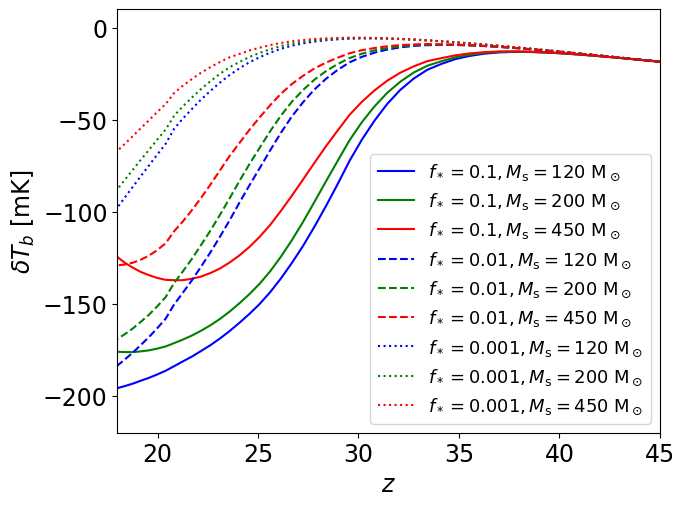
Figure 3: The global 21-cm brightness temperature as a function of redshift, with solid, dashed, and dotted lines for varying fesc7, and color encoding for fesc8; deeper absorption for higher fesc9 and shallower for higher fesc0 is evident.
The underlying star formation rate density (SFRD), which tracks the overall collapse fraction and feedback-regulated burstiness of Pop III star formation, maps onto observable features in the signal.
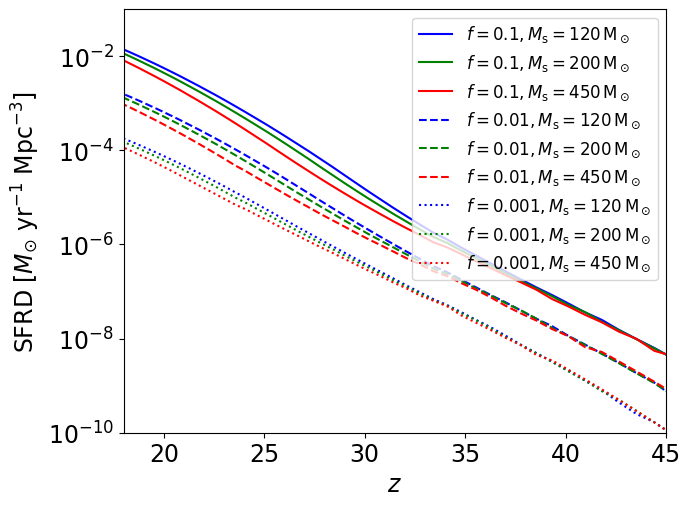
Figure 4: SFRD evolution for the same parameter grid, demonstrating suppression at high fesc1 due to feedback and amplification with high fesc2.
These trends are driven by the interactions among escape fraction, LW feedback, SFRD, and cumulative ionized fraction and heating.
Figure 5: The mass-averaged escape fraction as a function of redshift, reflecting parameter-induced variations in radiative feedback.
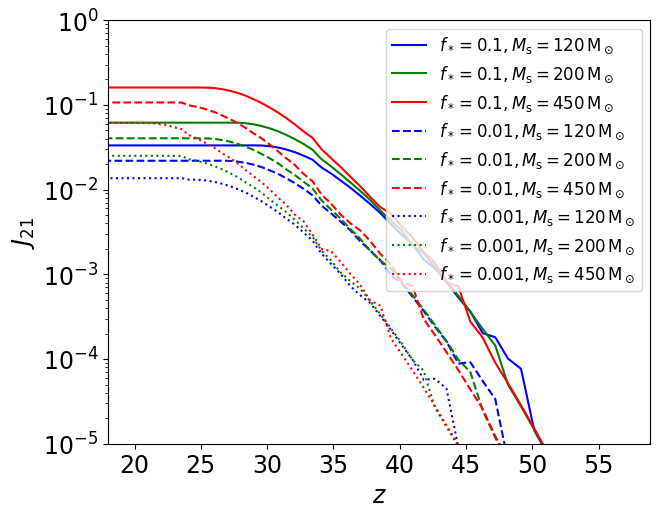
Figure 6: Computed background LW intensity, indicating increased feedback at higher fesc3.
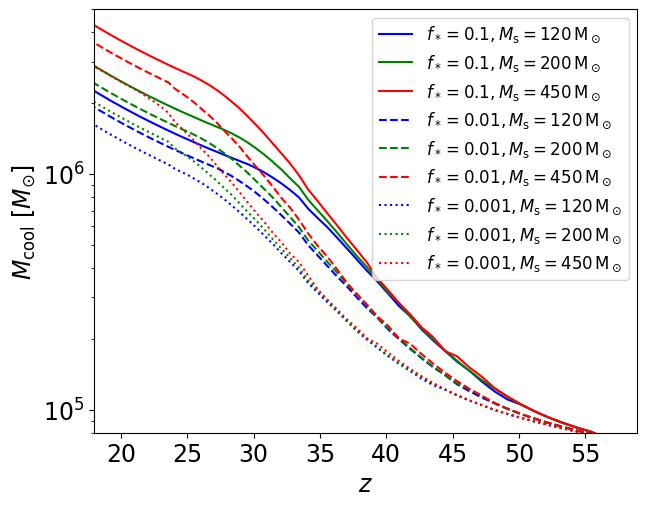
Figure 7: Evolution of the minimum halo mass for star formation, fesc4, as determined by feedback processes.
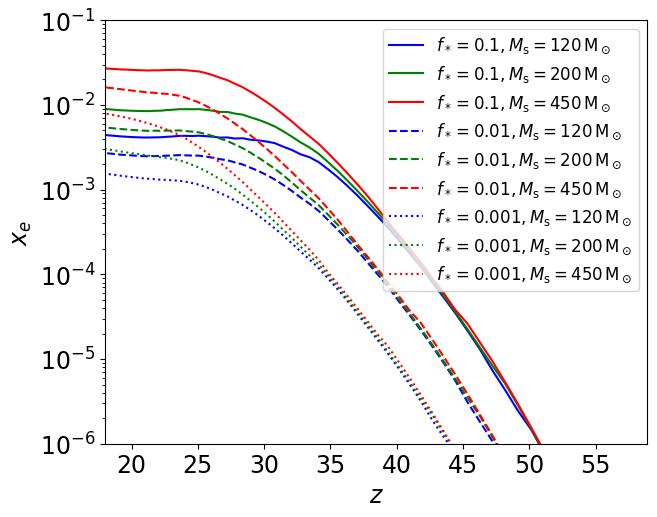
Figure 8: The ionized fraction as a function of redshift for several model choices, quantifying the progress of reionization and associated heating.
Fisher Matrix Analysis and Forecasting Constraints
To quantify the information content of the global 21-cm signal, a Fisher matrix analysis is performed. The likelihood incorporates both astrophysical dependencies in the mean signal and parameter-dependent covariance due to the scaling of thermal and systematic noise with total sky brightness. The foreground modeling uses the fesc5 template relevant for low-frequency radio observations. The signal is modeled across fesc6–30, above the expected onset of significant Pop II galaxy formation.
The derivatives of the 21-cm spectrum with respect to fesc7 and fesc8 are shown to be highly anti-correlated during absorption-dominated phases (deep trough becomes both deeper and shallower as fesc9 and Mh0, respectively, increase), but this degeneracy weakens at high Mh1 where UV/ionization heating causes the derivative sign to flip for Mh2, breaking the parameter degeneracy.
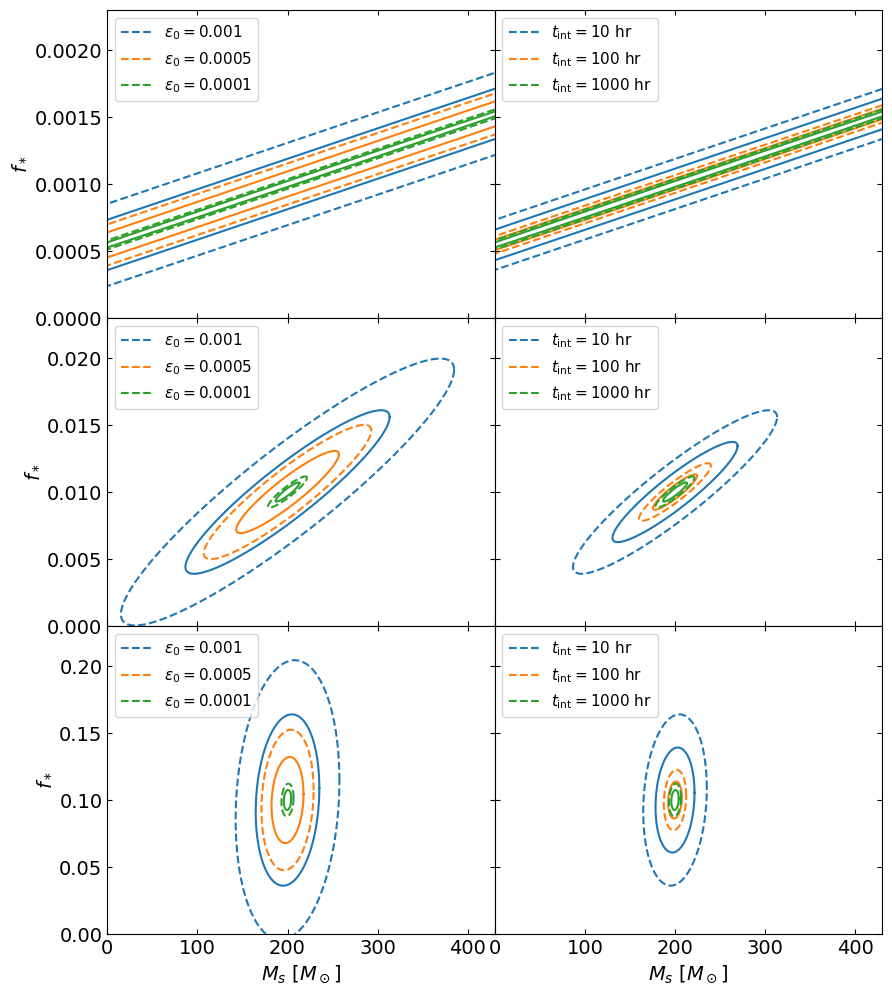
Figure 9: Forecasted joint Mh3 and Mh4 constraints for Pop III parameters in several experimental configurations; the constraints are foreground-limited as opposed to thermal-noise-limited.
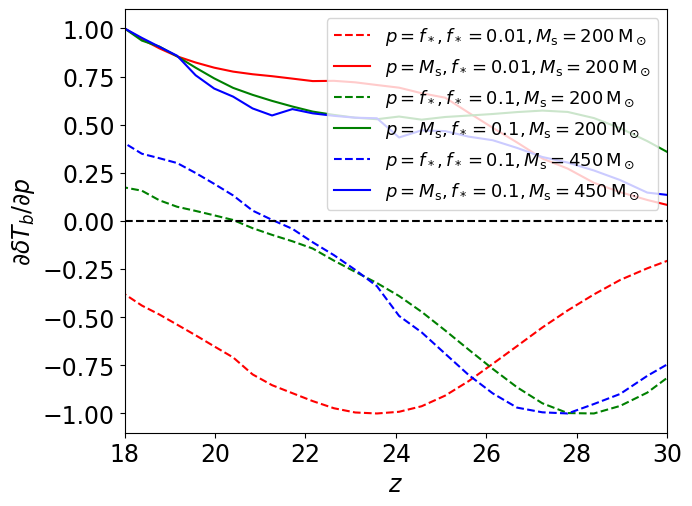
Figure 10: Normalized derivatives of the global signal with respect to Mh5 and Mh6 across redshift, showing sign change for Mh7 at high Mh8 and nearly constant sign for Mh9.
The main results include:
- For fesc0, fesc1, with fesc2 hr and residual foreground fesc3, fesc4 and fesc5 can be simultaneously constrained to fesc6 and fesc7 (fesc8).
- All near-term constraint regimes are foreground-residual-limited; modest integration times suffice once fesc9 is subdominant.
- The Ms0 degeneracy is sensitive to the location of the absorption trough, and can be efficiently broken if both pre- and post-heating epochs are probed.
Noise forecasts utilizing the REACH instrument configuration indicate that instrumental sensitivities are sufficient to achieve these statistical constraints.
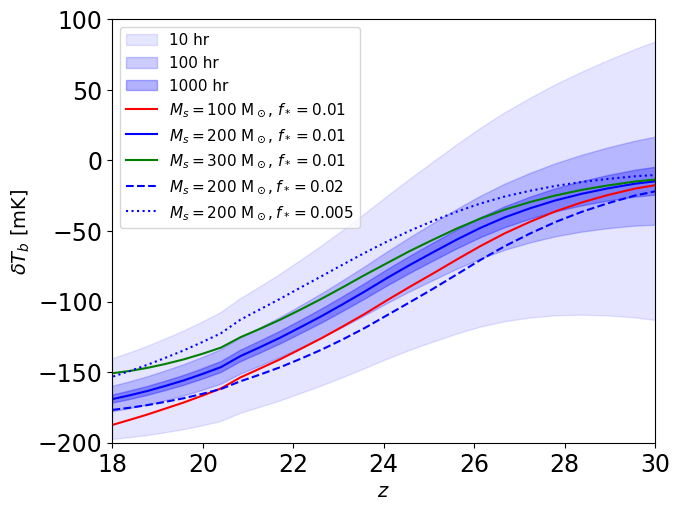
Figure 11: Estimated noise contours for the 21-cm global measurement as a function of redshift and integration time, compared against the model signal variation.
Implications, Limitations, and Prospects
This work demonstrates that the next generation of sky-averaged 21-cm observations (typified by REACH) can move Pop III astrophysics into a precision-constrained regime, provided foreground mitigation reaches levels of Ms1 of total sky signal. The methodology incorporates improvements over previous efforts by explicitly modeling the stellar mass dependence of the escape fraction and including physical heating structure, expanding on earlier studies [2022MNRAS.516..841G, 2025NatAs...9.1268G, 2018MNRAS.478.5591M].
However, the analysis imposes a single-mass Pop III IMF and assumes a spatially-homogeneous LW background. Incorporating a realistic IMF (and constraining its parameters) as well as stochastic fluctuations in the background intensity is essential for robust parameter inference. Analysis of the 21-cm power spectrum—especially with interferometric data (e.g., SKA-Low)—will provide complementary constraints by distinguishing spatial scales affected by Ms2 versus Ms3.
Practical limitations include residuals from calibration, beam chromaticity, polarization leakage, and actual transition redshift from Pop III- to Pop II-dominated star formation, which may depend non-trivially on feedback and chemical enrichment history. Comprehensive joint inference with high-redshift galaxy surveys (JWST, Roman Space Telescope) will further constrain the Pop III star formation landscape.
Conclusion
The paper establishes a general framework for quantifying the constraint power of the global 21-cm signal on fundamental Pop III star parameters. By incorporating radiative feedback, Lyα/LW dynamical coupling, and realistic noise models, it is shown that precision measurements of the 21-cm brightness temperature across Ms4 can statistically constrain both the star formation efficiency and typical stellar mass at the Ms5--Ms6 level. These results highlight that robust foreground removal, rather than thermal instrument sensitivity, is the foremost requirement for realizing the scientific potential of next-generation 21-cm cosmology experiments in the context of first star astrophysics. The extension to IMF parameter inference and high-dimensional feedback modeling remains a compelling avenue for future work.