- The paper introduces an LLM-based restriction operator that pre-fixes select binary commitment variables to reduce the MILP search space while preserving solver guarantees.
- It combines data-driven variable selection with a feasibility screening filter to ensure all network, operational, and inter-temporal constraints remain intact.
- Empirical tests show solve times reduced by up to 6.7× with less than 0.3% optimality loss, even under significant load perturbations and system variations.
Structure-Aware Commitment Reduction for Network-Constrained Unit Commitment with Solver-Preserving Guarantees
Problem Motivation and Background
The growth of grid complexity—marked by increased generator count, hybrid assets, and tightened security constraints—has inflated the computational burden of network-constrained unit commitment (UC), a core MILP in power system operation. Traditional algorithmic improvements focus on solver-side acceleration, reformulation, and decomposition, but do not fundamentally reduce the scale of binary search required by the MILP solvers. Data-driven and learning-based binary guidance methods have shown only limited reliability and robustness, particularly under distribution shift or limited historical data. Crucially, previous ML-based methods often compromise feasibility or cannot guarantee objective optimality due to inconsistent or infeasible variable predictions.
This work introduces a structure-aware commitment reduction framework that leverages the stability of UC patterns under similar operating conditions to reduce the combinatorial search dimension. Specifically, it proposes using LLMs as a selection module: not for scheduling, but for identifying a sparse subset of generator-hour binaries to pre-fix. This variable restriction is tightly coupled with a solver architecture, ensuring all operational, network, and inter-temporal constraints are preserved. The framework is agnostic to system size or historical data availability and is theoretically guaranteed to preserve feasibility and achieve solver-certified optimality within the restricted feasible space.
Methodology
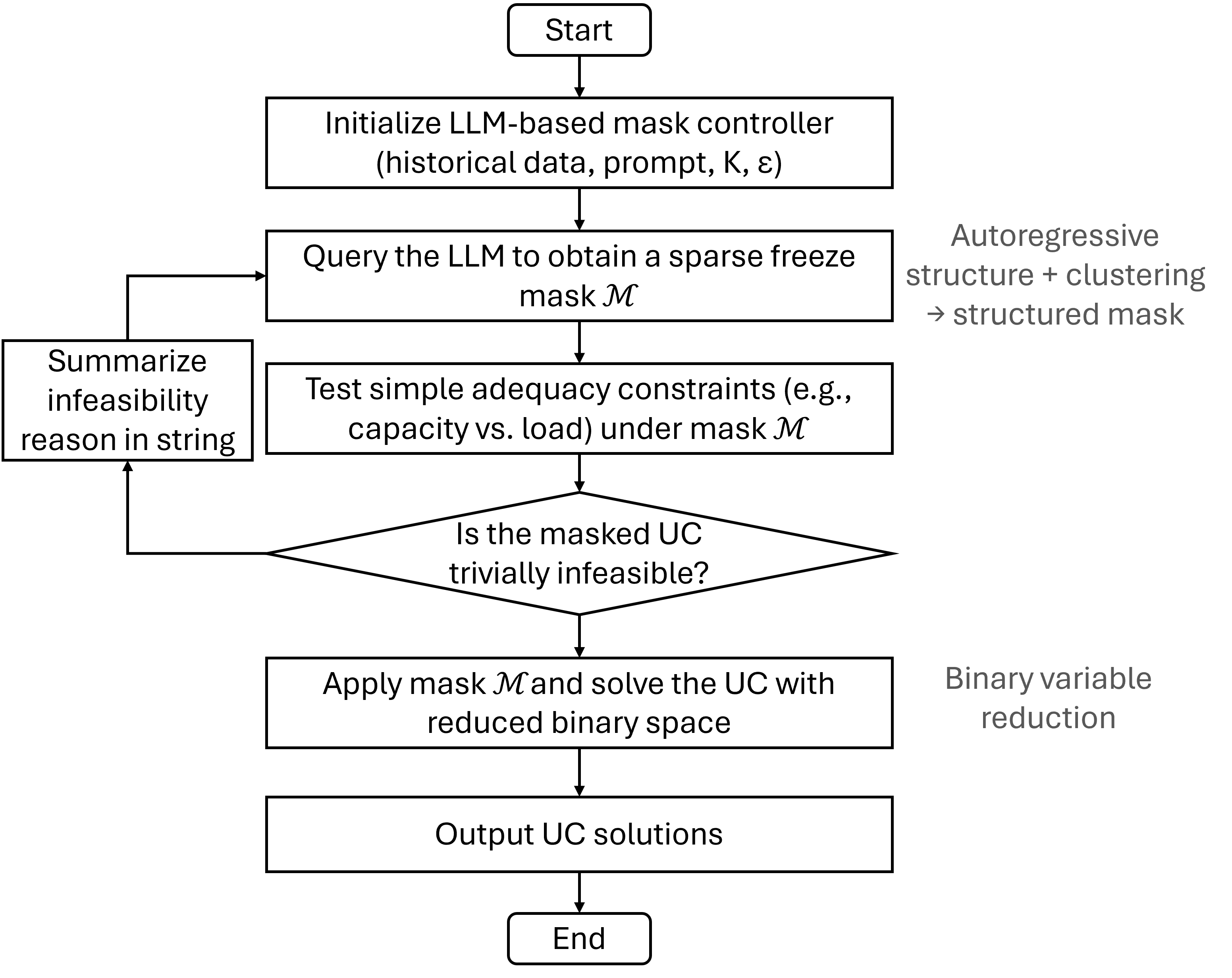
The key innovation is the introduction of an LLM-driven restriction operator that selects a structurally stable, sparse mask of binary unit-hour variables to be pre-fixed prior to MILP solution. The workflow is as follows:
Critically, this approach does not alter the underlying optimization model and does not attempt schedule prediction. Instead, it exploits structural regularity and inter-temporal coupling in practical UC instances: for example, the persistent online status of large baseload units or generator sequences determined by long minimum up/down times.
The restriction limit (number of fixable binaries per hour) is explicitly capped to maintain solution flexibility and control objective degradation. Logical inter-temporal coupling, especially due to minimum up/down and ramping, is addressed by always deferring marginal units and uncertain intervals to the MILP solver.
Theoretical Guarantees
Let X be the feasible region of the original UC MILP, and XF the reduced region after variable restriction. It is formally established that XF⊆X, so any MILP-feasible solution for the restricted problem is also feasible for the original. The MILP solver certifies optimality within XF. No operational, network, or economic constraint is relaxed, so feasibility is never compromised—a critical property in practical market and reliability applications.
The approach ensures tight control over objective suboptimality: variable restriction limits can be chosen to trade off speed and optimality. Empirical evidence demonstrates that, with moderate restriction (∼10% of binaries), solution times are reduced by orders of magnitude with less than 0.3% optimality loss.
Experimental Results
Extensive experiments are conducted on IEEE 57-bus, RTS 73-bus, IEEE 118-bus, and augmented 118-bus test cases. A variety of settings are considered, including the absence of historical data, significant load perturbations (up to 40%), and year-long sequential UC instances.
Numerical comparisons consistently demonstrate:
- Substantial reduction in branch-and-bound nodes and simplex iterations.
- Solve time reductions up to 6.7× even in challenging, large-scale, and perturbed cases.
- Objective deviations limited to 0.3% or less in most scenarios, and never exceeding 3.8% under heavy noise.
- Robust performance across demand uncertainties, generator augmentations, and long-horizon operation.
- Empirical confirmation that random commitment-fixing increases both cost and computational effort, underscoring the necessity of structure-aware selection.
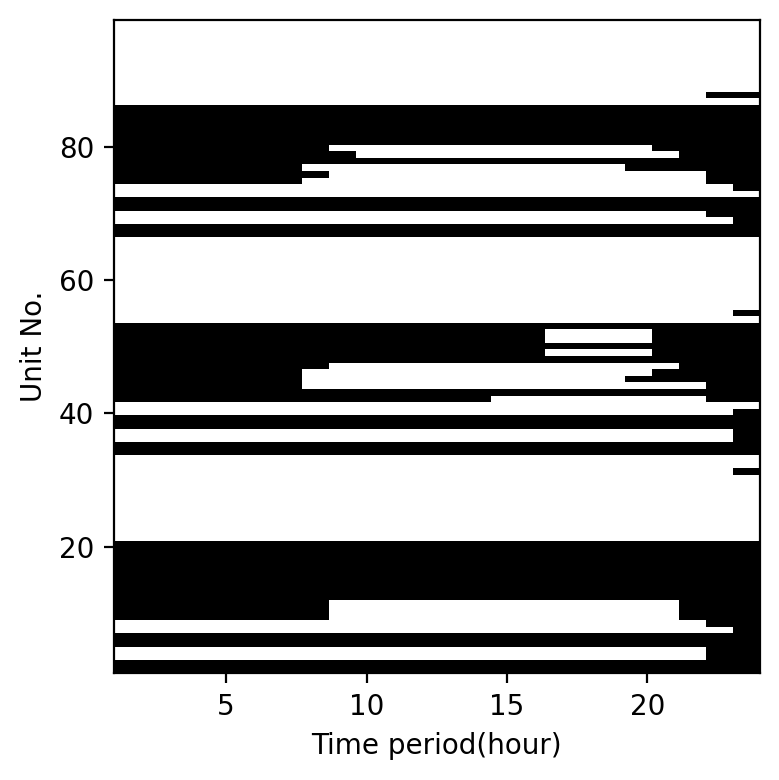
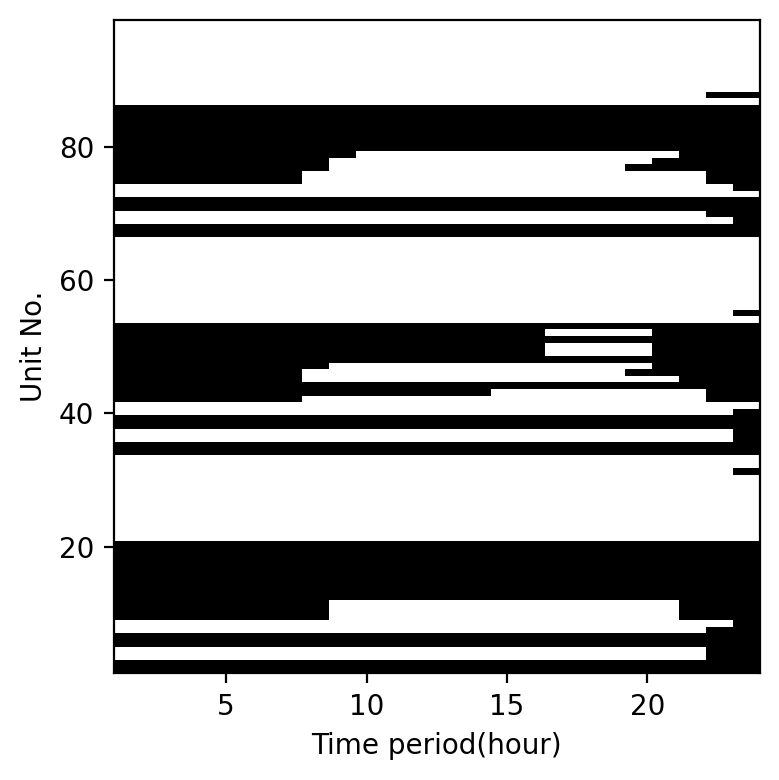
Figure 2: Comparison of 24-hour unit commitment schedules for MILP and LLM-Assisted restriction, illustrating high agreement and preservation of core commitment patterns.
A year-long simulation reveals the standard MILP solver displays dramatic day-to-day variability, often requiring 1500–2500 seconds per instance; LLM-assisted restriction consistently limits solution time to below 300 seconds on all days, increasing tractability for rolling and scenario-based scheduling.
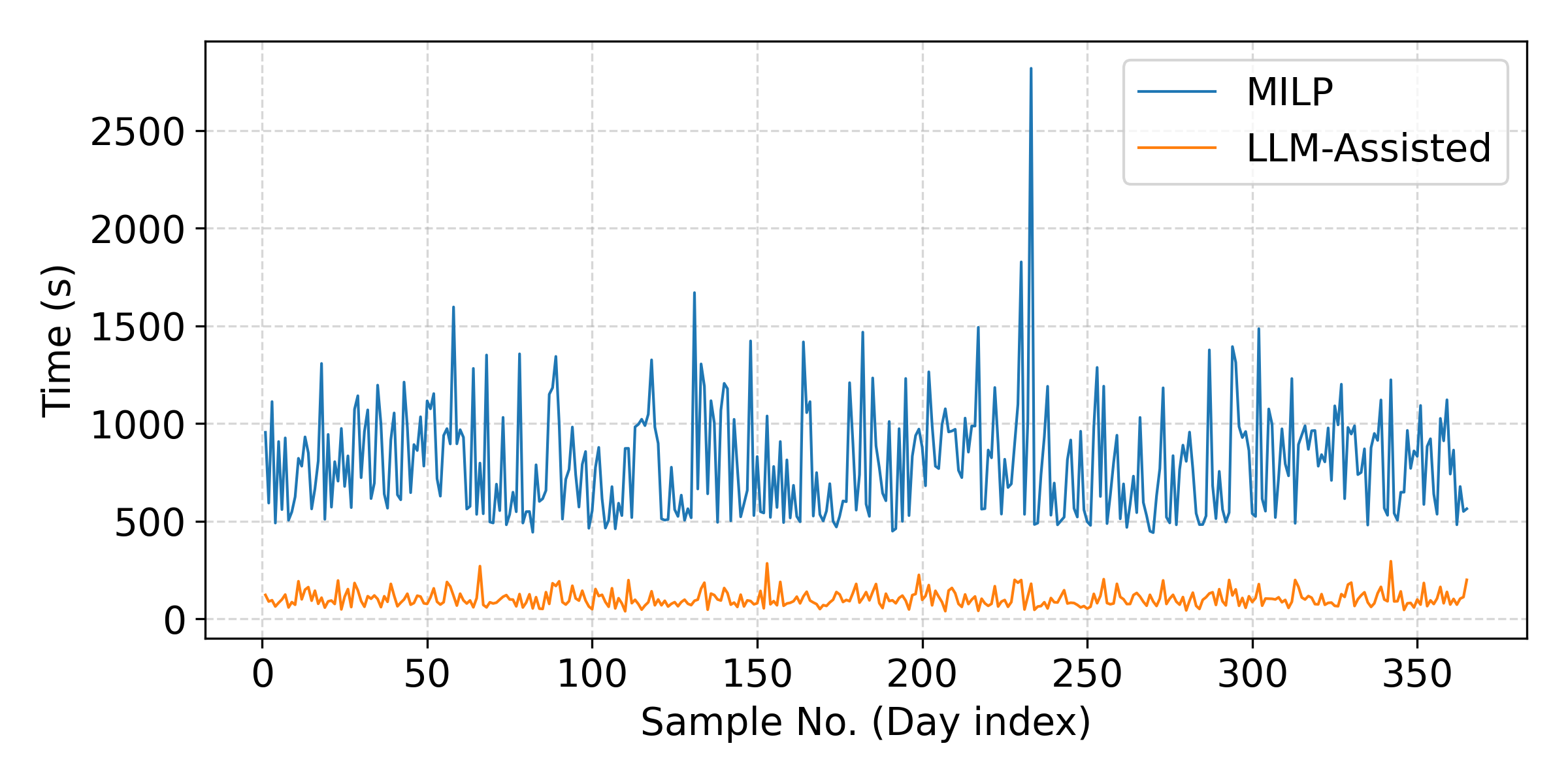
Figure 3: Solve-time comparison over 365 consecutive daily UC instances, illustrating solve time stability and dramatic reduction with the LLM-Assisted method.
Analysis and Implications
The empirical and theoretical analysis confirms the primary effect of the framework is pruning combinatorially redundant search branches—especially for the binary variables of structurally stable generators and hours. The approach aligns with observations from both practice and polyhedral studies of UC structure: in realistic regimes, much of the solution variability originates from a small number of marginal generators at critical hours, not from the core of the schedule.
Unlike prior data-driven or heuristic methods, the LLM-restricted framework is solver-compatible and constraint-preserving by design. It is robust against system changes and does not depend critically on high-quality historical data. It can be immediately adopted as a drop-in acceleration module for existing MILP-based UC solvers, with implications for market clearing, reliability assessment, and real-time operation.
The underlying abstraction—externally generated sparse variable restriction with solver-side feasibility verification—can be readily extended to other large-scale, tightly-coupled MILPs in power system optimization, such as stochastic SCUC, security-constrained UC, and rolling-horizon dispatch. Further, the modular LLM interface allows seamless integration with future multi-agent system and co-optimization workflows.
Conclusion and Future Directions
This work establishes an LLM- and structure-aware commitment reduction framework as a practically effective, theoretically justifiable acceleration strategy for network-constrained UC. By coupling a data-driven variable restriction operator with MILP solver certification, it achieves large computational gains while rigorously maintaining feasibility and providing direct control over objective gap.
The framework’s abstraction invites additional research directions:
- Extension to stochastic/robust UC and co-optimized gas-electric systems.
- Integration with advanced decomposition, parallel MIP, or metaheuristic frameworks for further scalability.
- Deployment in real-time systems and market environments where solver time predictability is mission-critical.
This solver-compatible, structure-aware restriction approach addresses core computational bottlenecks and offers a path forward for efficiently solving next-generation, large-scale, and dynamically changing unit commitment problems.
Reference: “Structure-Aware Commitment Reduction for Network-Constrained Unit Commitment with Solver-Preserving Guarantees” (2604.02788)