- The paper reveals that spin underpins degeneracy pressure, crucially shaping the neutron star equation of state and stability against gravitational collapse.
- It employs meta-modeling and Bayesian inference to connect nucleonic pairing, magnetic field influences, and superfluid dynamics with observable mass–radius relations.
- The study explores vortex dynamics and potential transitions to color-superconducting quark matter, highlighting their impact on pulsar glitches and neutron star evolution.
Spin Effects in Superfluidity, Neutron Matter, and Neutron Stars
Introduction and Motivation
The centennial review of electron spin’s conceptual basis foregrounds the essential role that spin plays in compact stellar objects, particularly neutron stars. The quantum mechanical property of spin, manifesting as degeneracy pressure through the Pauli exclusion principle, is foundational to the hydrostatic support and structure of neutron stars that would otherwise collapse gravitationally. The authors analyze the consequences of spin at all scales—from microphysical channel selection in nucleonic pairing, to the macroscopic configuration of dense matter, and to the dynamical phenomena observed in pulsar timing and neutron star glitches. Special attention is given to superfluidity and superconductivity, the influence of strong magnetic fields, and the emergence of exotic quantum phases in neutron star interiors, including the possibility of color-superconducting quark matter.
Role of Spin in the Neutron Star Equation of State
The spin–statistics connection determines the global properties of neutron stars, as the degeneracy pressure from spin-21 baryons is the principal counter to gravitational collapse. The traditional Fermi gas model illustrates the scaling behavior of pressure and energy density with occupation of spin-degenerate momentum states, although realistic modeling requires interaction corrections that substantially affect mass–radius relations and the maximum stable mass. Observational constraints from Shapiro delay, gravitational wave analysis (especially tidal deformability from GW170817 and GW190425), and X-ray pulse profile modeling by NICER converge to restrict the permissible range of nuclear equations of state: the maximum mass must exceed 2M⊙ and typical radii cluster about $12$–$13$ km.
The authors employ meta-modeling strategies, performing Taylor expansions of the energy per baryon in both density and isospin asymmetry, with coefficients tied to empirical nuclear data and subsequently refined by Bayesian inference combining laboratory, astrophysical, and gravitational-wave observations. Variation in parameters such as skewness Qsat and symmetry energy slope Lsym is shown to tune the stiffness of the EoS and, hence, the mass–radius and moment-of-inertia curves.
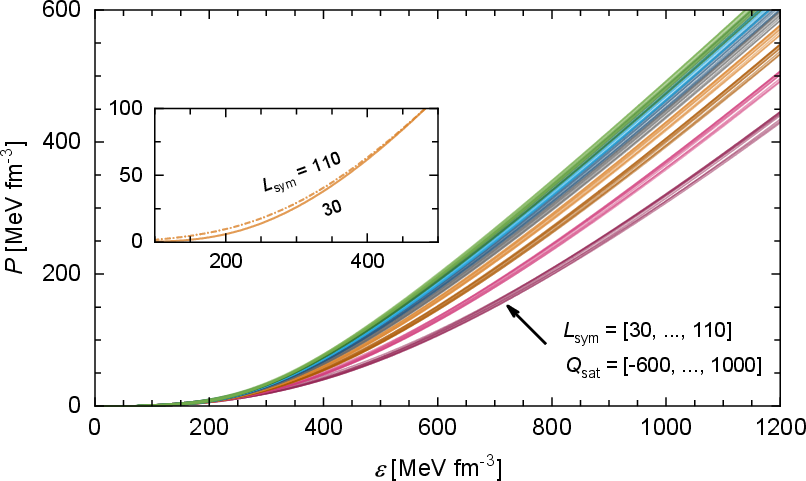
Figure 1: Variation of the equation of state as a function of Qsat and Lsym in covariant density functional theory, illustrating sensitivities of pressure and energy density to high-order parameters.
The resulting macroscopic observables are mapped to astrophysically testable relationships.
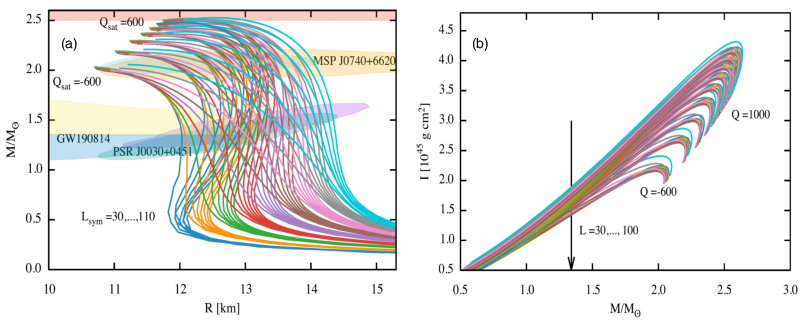
Figure 2: Mass–radius and moment-of-inertia–mass relations for nucleonic EoS under observational constraints from NICER and LIGO–Virgo.
The addition of hyperons generally softens the EoS, reducing the maximum mass—a phenomenon often termed the hyperon puzzle—necessitating the careful tuning of hyperon coupling constants within density functionals. Deconfinement transitions to quark matter, possibly through strong first-order transitions, introduce further phenomenological complexity, such as disconnected stable branches (“twin stars”).
Spin and Magnetic Field Effects
Magnetar-class fields (1014–1015 G, with theoretical upper limits near 2M⊙0 G) break spin degeneracy via both Landau quantization of charged particles and coupling to nucleon anomalous magnetic moments. The transition to the quantum regime occurs when the Landau energy spacing approaches the Fermi energy; for electrons, this is achieved at 2M⊙1 G, far below the critical field for protons. At even higher fields (2M⊙2 G), spin polarization can become substantial, and, in principle, spontaneous ferromagnetic transitions may occur at several times nuclear saturation density, although empirical confirmation is lacking and may be rendered moot by the early onset of hyperon or quark components.
Landau quantization strongly modifies thermodynamic and transport properties, shifting beta equilibrium, stiffening or softening the EoS, and influencing cooling and conduction. The internal field configuration, likely a twisted-torus comprising both poloidal and toroidal components, is expected to be stable against large-scale MHD instabilities.
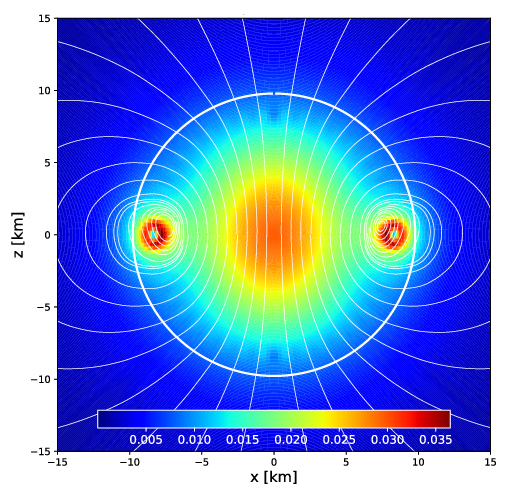
Figure 3: Twisted-torus magnetic field configuration, displaying the coexistence and spatial variation of poloidal and toroidal fields in a magnetar.
Superfluidity, Superconductivity, and Spin-Dependent Pairing
Superfluidity of neutrons and superconductivity of protons is dictated by the microphysical pairing channels, selected via spin and isospin quantum numbers. The 2M⊙3 pairing dominates for neutrons at sub-saturation densities and protons throughout most of the core, while 2M⊙4–2M⊙5 spin-triplet pairing emerges for neutrons at higher density, with quantitative predictions for the gap size heavily contingent upon three-nucleon forces and beyond-mean-field correlations.
The superconducting type is determined by the Ginzburg–Landau parameter; neutron star protons are typically type II at lower density, allowing for flux tube formation. Magnetic fields suppress pairing both via Pauli paramagnetism (in 2M⊙6-wave neutron condensates) and via orbital effects for protons.
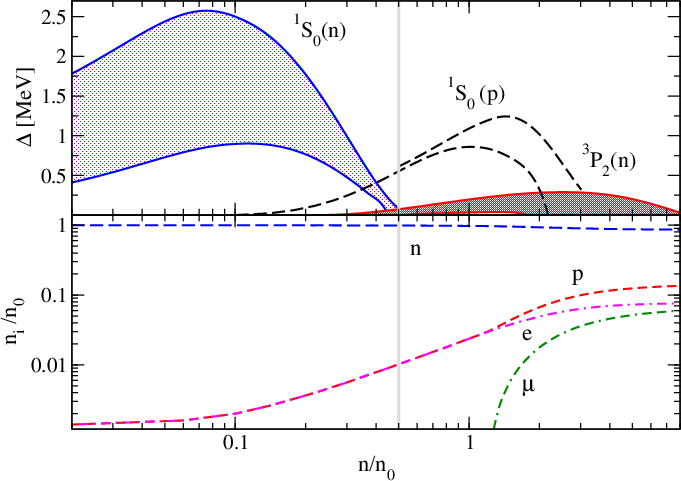
Figure 4: Density dependence of neutron and proton pairing gaps and compositional profiles within the neutron star core.
Vortex Dynamics, Mutual Friction, and Astrophysical Implications
Rotation and magnetic fields induce the formation of quantized neutron vortices and proton flux tubes, arranged in triangular lattices and subject to complex interactions that couple the various stellar components through mutual friction. The vortex lattice evolution under spin-down, pinning to crustal lattice nuclei, and possible pinning to flux tubes in the core, establishes the mechanisms underlying pulsar glitch phenomena and their varied post-glitch relaxation timescales.
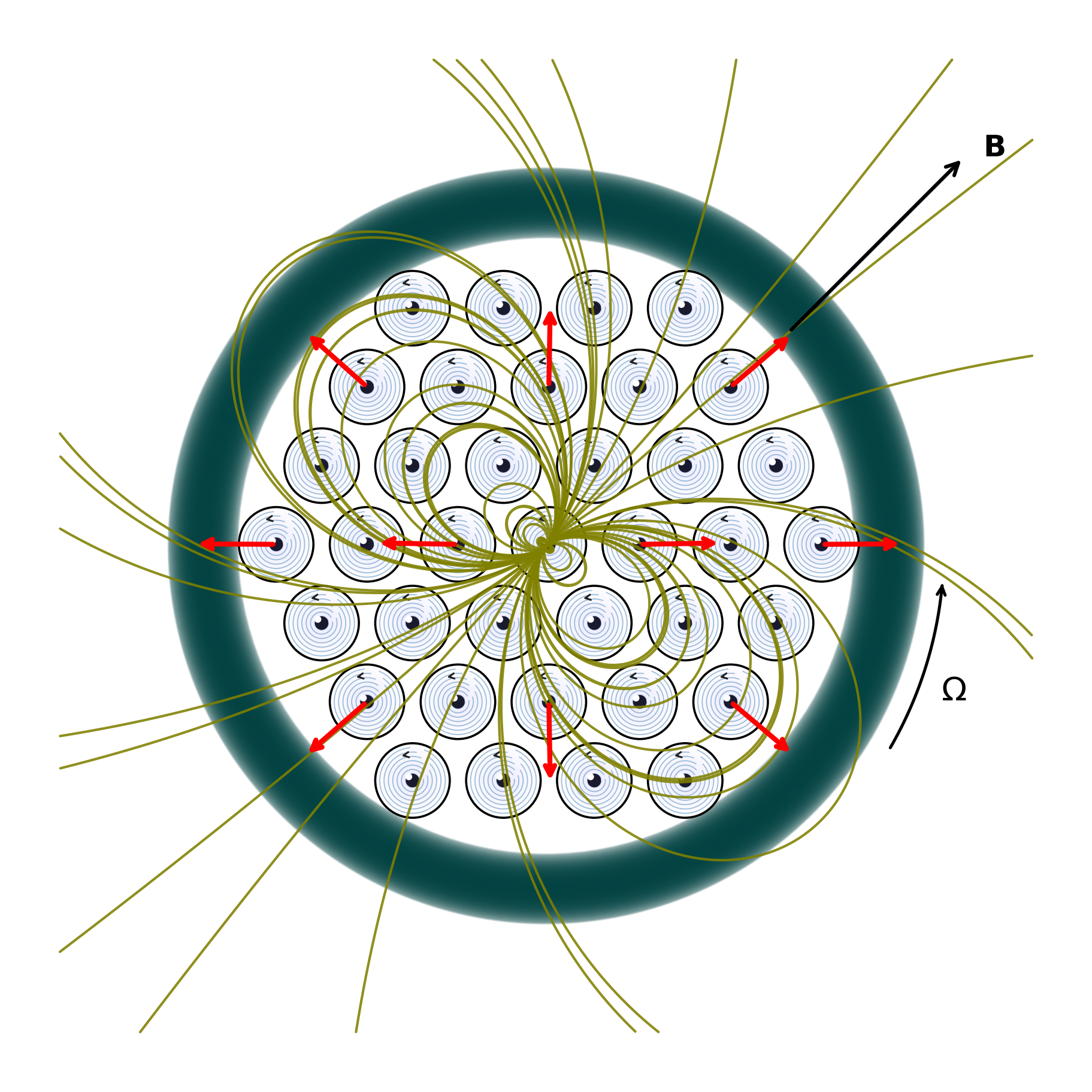
Figure 5: Cross-section of a neutron star displaying triangular lattices of neutron vortices and proton flux tubes, as well as their interplay with secular spin-down–driven outward vortex migration.
Vortex dynamics span two regimes: free sliding (linear response) and thermally activated creep in the presence of pinning; the latter underpins the leading theoretical models for glitches and post-glitch recovery, and defines the macroscopic observable timescales.
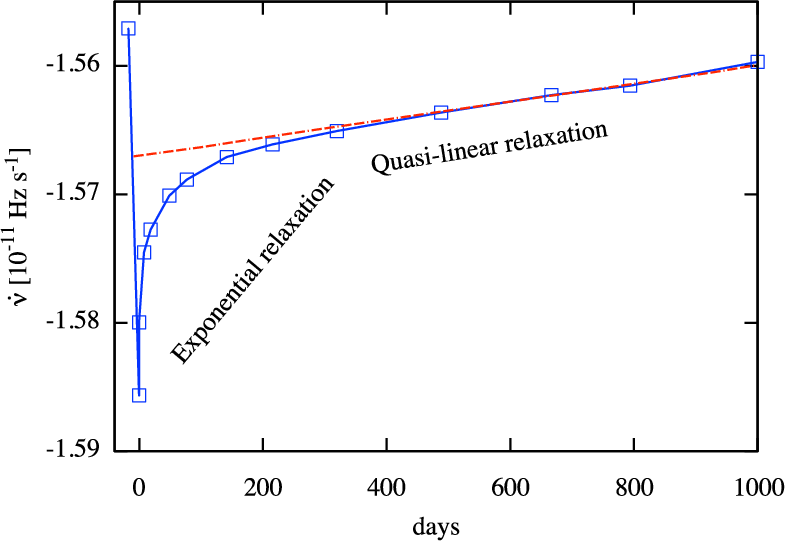
Figure 6: Post-glitch evolution in the Vela pulsar’s spin-down rate, highlighting the rapid recovery and persistent offset associated with loosely coupled superfluids.
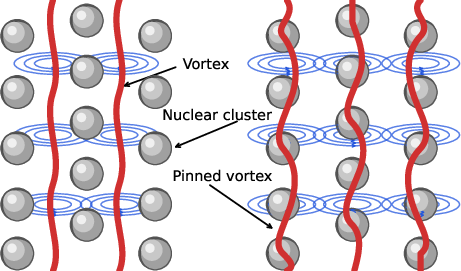
Figure 7: Schematic of free vortex motion and thermally activated creep regimes for neutron vortex lines in the stellar crust.
Superfluid hydrodynamics further predicts the existence of Tkachenko modes (oscillatory deformations of the vortex lattice) and multiple precessional modes associated with weak inter-component coupling, providing plausible explanations for long-term periodicities observed in some pulsars.
Spin, Superfluidity, and Vorticity in Quark Matter
At higher densities, deconfined quark matter is expected to pair via color-superconductivity. The primary candidates are 2SC and CFL phases, the latter supporting non-Abelian semi-superfluid vortices that conjoin superfluid and color-magnetic properties. Due to the peculiar nature of gauge symmetry breaking, magnetic response is controlled by a rotated 2M⊙7 (mixing photon and gluon), resulting in partial Meissner screening and the possibility of color-magnetic flux tubes.
Vortex continuity across hadron–quark interfaces leads to complex topological structures such as boojums, and may contribute novel mechanisms to angular momentum and magnetic flux transport in hybrid stars, with implications for both glitch physics and observable magneto-thermal evolution.
Conclusions
Spin effects pervade the structure, composition, and observable phenomena of neutron stars. Theoretical advances in EoS meta-modeling and pairing theory have yielded tight constraints on macroscopic observables by integrating terrestrial nuclear physics with multi-messenger astrophysics. Superfluid and superconducting phases underlie the physics of glitches and long-term rotational irregularities. The implications of spin also extend to exotic QCD phases in the deepest regions of massive compact stars, where color-superconducting quark matter may introduce new forms of vorticity and flux quantization.
The open problems identified include: the detailed structure of 2M⊙8 vortices, the role and dynamics of type-I versus type-II superconductivity, the magnitude and behavior of mutual friction in various pairing regimes, and the precise localization of the superfluid reservoir engaged in glitches and relaxing dynamics. Moreover, the interface and continuity between hadronic and quark phases remain subjects of active inquiry, with possible observable signatures in glitch and thermal evolution data.
Future work will be driven by improved observational sensitivity—via both gravitational-wave and electromagnetic instrumentation—and by advances in many-body theory, which together promise to clarify the microphysical underpinnings of macroscopic neutron star phenomena, and to interleave nuclear, condensed matter, and astrophysical physics in the strongly interacting, relativistic regime.