Abstract: Citizens' assemblies are a form of democratic innovation in which a randomly selected panel of constituents deliberates on questions of public interest. We study a novel goal for the selection of panel members: maximizing the entropy of the distribution over possible panels. We design algorithms that sample from maximum-entropy distributions, potentially subject to constraints on the individual selection probabilities. We investigate the properties of these algorithms theoretically, including in terms of their resistance to manipulation and transparency. We benchmark our algorithms on a large set of real assembly lotteries in terms of their intersectional diversity and the probability of satisfying unseen representation constraints, and we obtain favorable results on both measures. We deploy one of our algorithms on a website for citizens' assembly practitioners.
The paper presents maximum-entropy-based algorithms (MaxEntropy and FairMaxEntropy) that achieve fair and diverse selection in citizens' assemblies under complex quota constraints.
It introduces dynamic programming, rejection sampling, and stochastic gradient descent techniques to efficiently enforce both quota and marginal constraints.
Empirical evaluations on 86 real-world datasets demonstrate enhanced intersectionality, transparency, and resistance to manipulation compared to conventional methods.
Maximally Random Sortition: Maximum-Entropy Algorithms for Citizens’ Assemblies
Context and Motivation
The paper "Maximally Random Sortition" (2604.02712) addresses a central algorithmic and normative question in the design and implementation of citizens’ assemblies: how to select an assembly from a pool of volunteers in a manner that combines fairness, representativeness, and resistance to manipulation. Unlike idealized uniform sortition from the full population, practical selection operates from a self-selected pool and must satisfy complex quotas (e.g., gender, region, education). Existing approaches, primarily based on equalizing selection probabilities (via column generation algorithms, e.g., LexiMin and Goldilocks), have limitations regarding support size, induced correlations, and lack of canonicity in the distributions. The authors propose and implement maximum-entropy distributions that maximize randomness subject to the feasibility constraints and, if desired, prescribed selection marginals.
Algorithmic Contributions
Two main algorithmic schemes are introduced: MaxEntropy (pure maximum entropy under quotas) and FairMaxEntropy (maximum entropy under quotas and marginal constraints).
MaxEntropy exploits a pseudo-polynomial dynamic programming (DP) recursion inspired by Papadimitriou’s approach for ILPs with few constraints. The DP counts panels satisfying as many quotas as feasible, applying three critical optimizations:
Simultaneous processing of pool members with identical features to reduce DP steps.
Exploiting feature orderings (especially those with many values, e.g., geographic region) to minimize required profile space.
Aggressive DP state pruning via upper bounds computed on feature subsets.
For instances where the full set of quotas cannot be incorporated by DP, the algorithm samples feasible panels among those covered, then applies rejection sampling to satisfy the remaining constraints. Experimental results show that this approach scales to all but the most extreme assemblies. Specifically, MaxEntropy samples from 78/86 real-world datasets with up to 7 features and over 1700 candidates.
FairMaxEntropy generalizes MaxEntropy to target user-specified marginal selection probabilities (e.g., from LexiMin/Goldilocks). The maximum-entropy distribution subject to marginals is realized as an exponential family over feasible panels:
λ∗(P)∝∏i∈Pμi
where μi=exp(θi) are dual variables. The convex dual (with only as many variables as pool members) is optimized via stochastic gradient descent, using unbiased estimates of selection probabilities from sampled panels. The authors prove an O(1/T) convergence rate on target marginals. The optimization is robust, and by mixing with the uniform distribution, any boundary issues in the relative interior can be mitigated.
Empirical Insights
The empirical evaluation leverages a large dataset of 86 real sortition instances. The main findings are as follows.
Fairness and Marginals
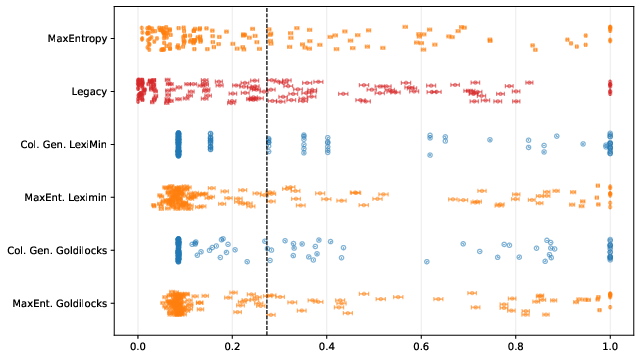
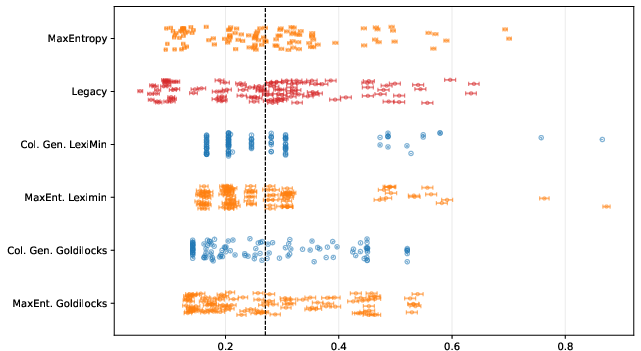
Fairness is evaluated via minimum/maximum selection probabilities, Gini coefficients, and geometric mean. MaxEntropy, while not optimizing fairness by construction, achieves intermediate fairness between LexiMin/Goldilocks and the ad hoc Legacy algorithm, with markedly fewer zero-probability assignments compared to ℓ2-based fairness or column generation.
Figure 1: Selection probabilities for a real instance (sf_c_44), illustrating that MaxEntropy avoids the extreme zero probabilities evident in Legacy and achieves intermediate equity.
FairMaxEntropy, even with a small number of gradient iterations, rapidly interpolates between pure MaxEntropy and fair column-generation marginals, effectively restoring minimum selection probabilities without collapsing panel diversity.
Diversity and Intersectional Representation
A principal critique of existing algorithms is insufficient intersectional diversity: quotas only indirectly encourage joint representativeness (e.g., ethnicity × age × geography). The analysis leverages feature-value vector count, total correlation, and normalized mutual information (NMI) to evaluate intersectionality.
MaxEntropy yields significant improvements:
Highest vector count (expected number of intersectional groups per panel).
Lowest total correlation and median NMI, i.e., less spurious dependence between features, indicating more intersectionally diverse panels.
These trends persist for FairMaxEntropy, indicating that maximizing entropy does not compromise intersectionality when targeting fair marginals.
Figures 4–8 (not shown here) visualize NMI across pairwise feature comparisons, highlighting the suppression of feature–feature correlation in entropy-maximizing approaches.
Generalization to Unprotected Features
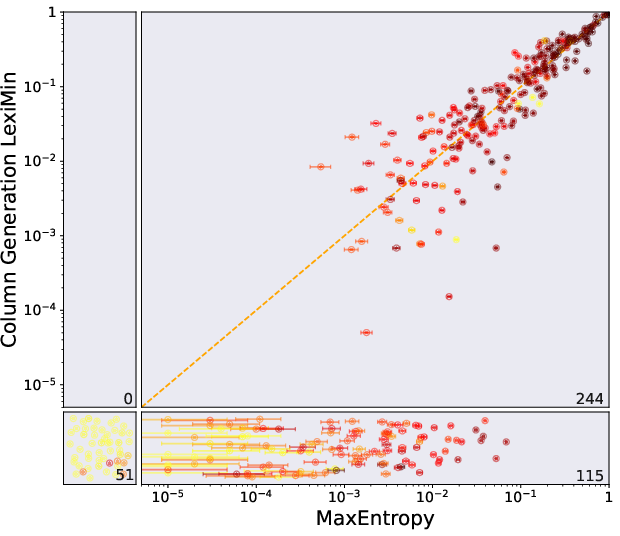
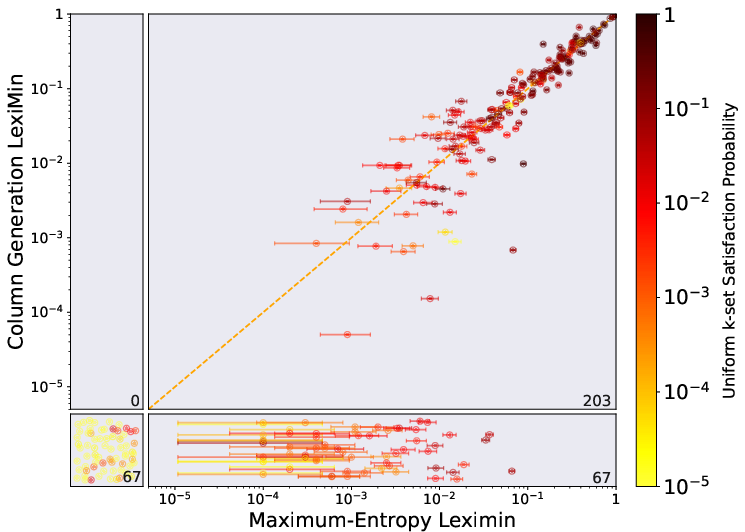
An essential property for legitimacy in sortition is the likelihood that the panel, given constraints on some features, generalizes to other (unprotected) features. The authors measure the probability a panel satisfies random quotas on a held-out feature not used in panel construction.
Figure 2: Generalization probabilities for held-out features, colored by the baseline uniform satisfaction probability. MaxEntropy and its marginals preserve support for all combinations, while column generation frequently collapses to zero.
MaxEntropy and FairMaxEntropy assign nonzero probability to all feasible joint categories, whereas column generation algorithms can assign exactly zero probability. This is a direct statistical manifestation of Jaynes’ maximum-entropy principle: among all consistent panel distributions, the uniform (maximum entropy) is least biased towards arbitrary information not encoded in the constraints.
Manipulation-Resistance and Transparency
Theoretically, MaxEntropy and FairMaxEntropy are shown to satisfy strong forms of anonymity and resistance to manipulation (internal, external, compositionally) under standard models. The entropy-maximizing solution uniquely treats equally situated candidates and ensures optimal asymptotic immunity to strategic misreporting, outperforming Nash and LexiMin variants that can admit arbitrarily manipulable solutions in large pools.
For transparency, the authors discuss how to operationalize a "transparent lottery": since explicit support of MaxEntropy is generally too large, m independent samples can be used to approximate the distribution. While the concentration of marginals converges at O(1/m), this still suffices for practical transparency in assembly settings.
Deployment, Usability, and Future Directions
The MaxEntropy algorithm has been open-sourced and is being integrated into Panelot, an assembly practitioner platform. The user interface (Figure 3) will facilitate algorithm selection, quota diagnostics, and present real-time analytics on panel composition, aiding practitioners in balancing quota satisfaction, diversity, and runtime.
Figure 3: Planned interface for Panelot, highlighting algorithm selection and dynamic diagnostics for successful and failed quota constraint satisfaction.
The practical consequences are twofold: practitioners can now explore more unbiased, representative lotteries and analyze the downstream effects of quota design; transparency for public trust is improved via operationalizable randomization and traceable lottery events.
Implications and Theoretical Significance
The approach advocated in this work solidifies maximally random (maximum-entropy) distribution as a new standard for sortition algorithms. The key implications are:
Uniqueness and Canonicality: Maximum entropy removes hidden biases present in arbitrary implementation choices among distributions with the same marginals.
Intersectionality: By eschewing support compression, MaxEntropy algorithms provide de facto intersectional representation, mitigating panel correlations.
Manipulation and Transparency: The algorithms attain manipulation-robustness and practical transparency without recourse to explicit, small-support lotteries.
Operational Feasibility: Sophisticated dynamic programming and rejection sampling scale to real-world problem instances, grounded by extensive empirical validation.
Theoretically, the duality-based construction for imposing arbitrary marginals under maximum-entropy sampling generalizes beyond citizens' assemblies to a broad class of combinatorial randomization and resource allocation problems, including apportionment, diversity-constrained selection, and stochastic representative sampling.
Conclusion
"Maximally Random Sortition" rigorously advances the theory and practice of sortition algorithms via maximum-entropy techniques. By demonstrating that maximum-entropy distributions yield desirable fairness, diversity, and manipulation-resistance properties—while being tractable for realistic assembly design—these methods now set a new reference point for algorithmic foundations in democratic innovations and social choice. Further developments could extend to online sortition, scalable transparent lotteries, and integration with participatory AI platforms.
“Emergent Mind helps me see which AI papers have caught fire online.”
Philip
Creator, AI Explained on YouTube
Sign up for free to explore the frontiers of research
Discover trending papers, chat with arXiv, and track the latest research shaping the future of science and technology.Discover trending papers, chat with arXiv, and more.