- The paper presents DocShield, a unified framework that integrates multi-modal visual-logical reasoning for robust text-centric forgery detection and explanation.
- The approach employs a six-stage Cross-Cues-aware Chain of Thought (CCT) pipeline to jointly extract, validate, and ground visual and semantic cues in document analysis.
- The model leverages a weighted multi-task reward with GRPO to achieve state-of-the-art performance and enhanced robustness on benchmarks like RealText-V1.
DocShield: Evidence-Grounded Agentic Reasoning for AI Document Safety
Motivation and Problem Definition
Recent advances in generative AI have dramatically escalated the risk and sophistication of text-centric image forgeries, which now threaten the authenticity of high-stakes documents such as receipts, legal records, and financial certificates. Existing forensic models are either narrowly focused on visual clues or treat detection, localization, and explanation as independent tasks. This compartmentalization leads to error cascades, limits holistic interpretability, and results in unreliable analysis—particularly when forgeries intentionally minimize or obfuscate low-level artifacts. There exists a critical need to establish AI document safety methodology that is robust, interpretable, and grounded in rigorous cross-modal evidence.
The DocShield Framework
DocShield proposes a unified, generative approach that formulates text-centric forgery analysis as a visual-logical co-reasoning task. Central to this framework is the Cross-Cues-aware Chain of Thought (CCT) mechanism, which mandates structured, multi-stage reasoning that cross-validates spatial visual cues against semantic logical clues. The model generates a single, machine-readable analysis report—including detection verdict, localized coordinates, and explanation—by autoregressively synthesizing multi-modal evidence.
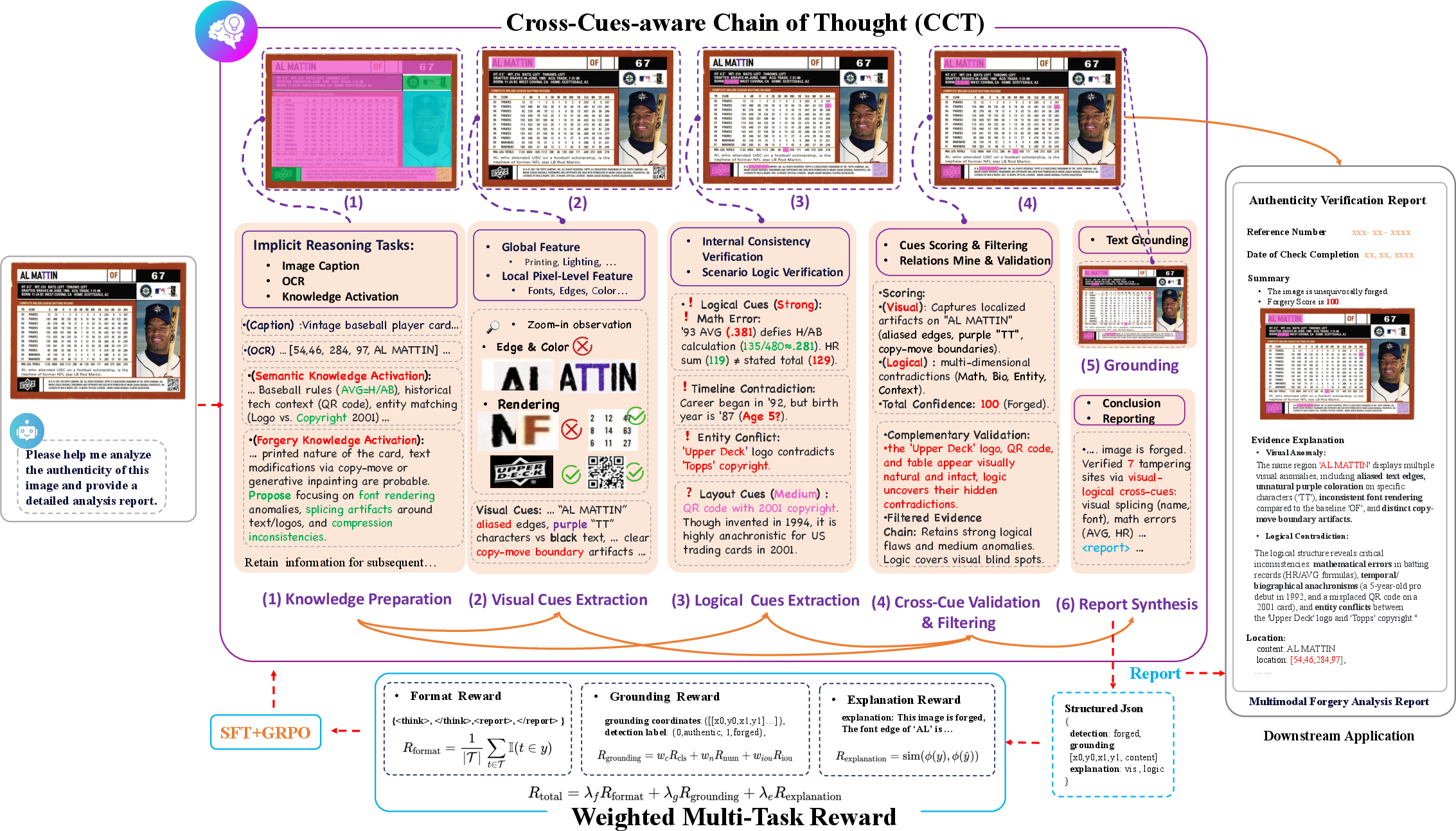
Figure 1: DocShield’s architecture performing end-to-end reasoning via the CCT pipeline, ultimately outputting a structured forensic report integrating detection, grounding, and explanation.
The CCT pipeline is designed to mitigate error propagation and hallucination, compensating for challenges such as visually imperceptible but semantically inconsistent manipulations. Six distinct stages are executed:
- Knowledge Preparation: Context creation via implicit captioning, prior retrieval, and OCR extraction.
- Visual Cues Extraction: Multiscale analysis for detecting subtle artifact patterns.
- Logical Cues Extraction: Internal consistency checks, world knowledge integration, and semantic anomaly detection.
- Cross-Cues Validation: Joint evidence synthesis, enabling logical cues to recover visual ‘blind spots’.
- Grounding: Precise mapping of reasoning findings to pixel-level tampered regions.
- Report Synthesis: Compilation of verdict, evidence, and rationale in a structured output.
Combinatorially, these components ensure that detection and localization are fully justified by a causally-connected rationale, crucial for trustworthy document forensics.
Weighted Multi-Task Reward and GRPO Alignment
To rigorously optimize this multi-faceted analysis pipeline, DocShield implements a weighted multi-task reward function—balancing format adherence, grounding precision, and explanation fidelity—and trains the model using Group Relative Policy Optimization (GRPO). Empirical results indicate that this composite, reward-optimized RL objective is essential for suppressing hallucinated rationales and maximizing both accuracy and robustness, especially under domain shifts and adversarial perturbations.
RealText-V1: A Fine-Grained Benchmark
A core contribution is RealText-V1, the first dataset to provide multilingual, pixel-level masks, and structured explanations for text-centric forgery detection, grounding, and rationale. Data curation is achieved via a PR² (Perceiver, Reasoner, Reviewer) hierarchical agent pipeline:
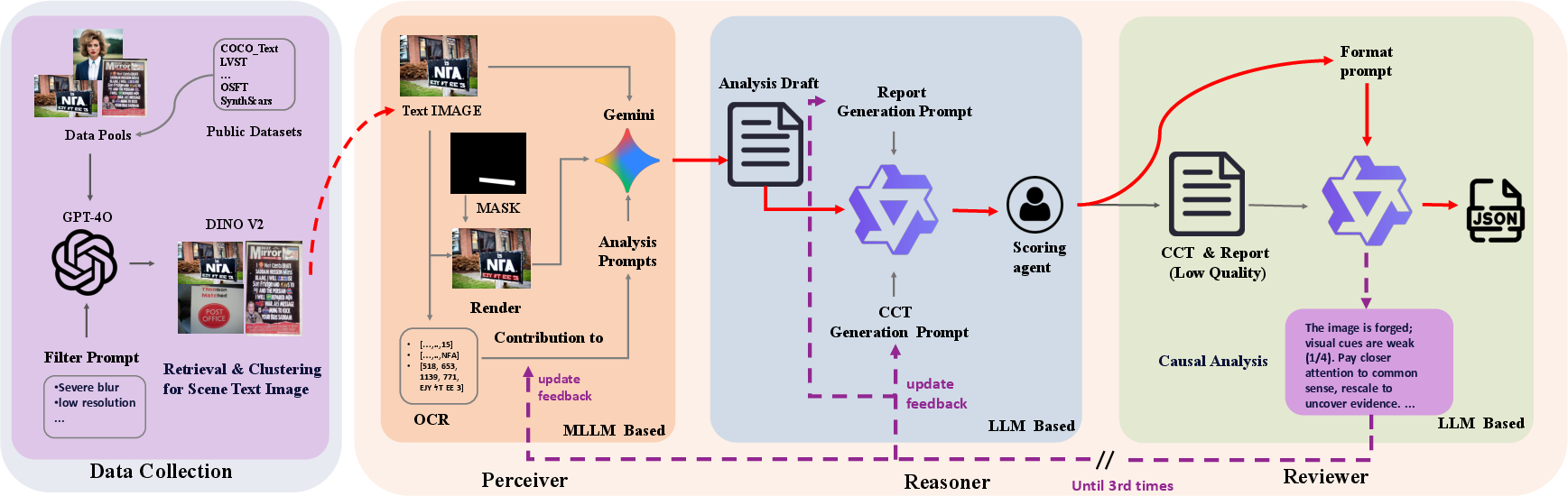
Figure 2: The PR² multi-agent pipeline generating high-fidelity structured annotations via iterative, feedback-driven assessment and refinement.
This protocol ensures annotation integrity, fine-grained evidence-alignment across tasks, and supports robust, scalable supervision for multi-modal reasoning architectures.
Empirical Evaluation and Analysis
DocShield is thoroughly benchmarked against state-of-the-art MLLM-based and traditional forensic models across RealText-V1, T-IC13, and T-SROIE datasets. The unified macro-F1 (M-F1) metric, encompassing detection, grounding, and explanation, consistently demonstrates the superiority and balance of the proposed approach.
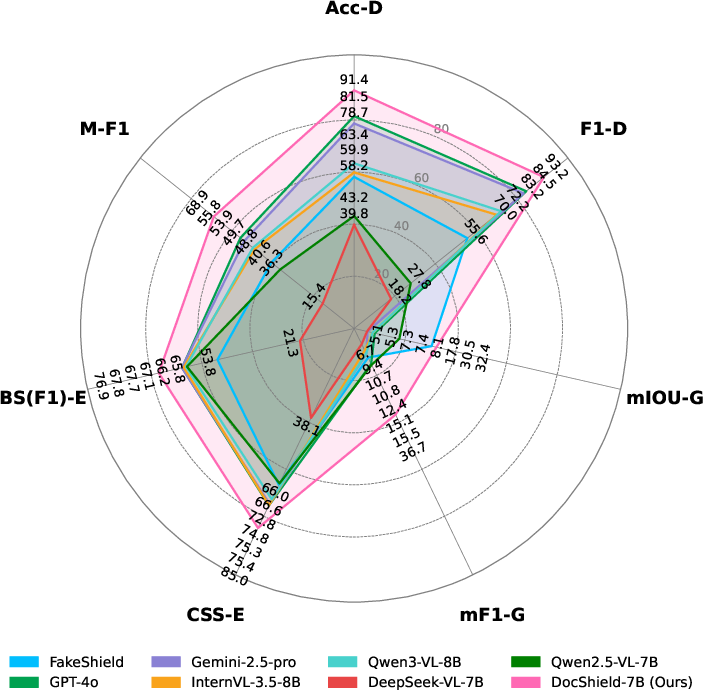
Figure 3: Aggregate performance on RealText-V1, with DocShield delivering state-of-the-art detection, grounding, and explanation (pink area), reflecting its balanced, multi-task proficiency.
Key numerical results:
- RealText-V1: M-F1 68.9% (vs. 55.8% for GPT-4o, 40.6% for FakeShield)
- T-IC13 (zero-shot): M-F1 79.8%, outperforming all baselines.
- T-SROIE (robustness): M-F1 62.5%, indicating superior resilience under dense-text and complex scenes.
Crucially, DocShield achieves this using a 7B-parameter architecture, surpassing larger proprietary MLLM systems; this suggests that architectural coherence and evidence-based reward shaping, not model scale, drive performance gains. Furthermore, robustness studies under heavy visual distortions (blur, compression, noise) show consistently smaller performance drops than competitive baselines, attributable to the co-reasoning mechanism’s compensatory logic.
Comprehensive ablations reveal that removal of the CCT pipeline or reward components each leads to marked drops in detection, grounding, and explanation F1, quantitatively underscoring their necessity. In comparative qualitative analysis, DocShield’s explanations are less prone to high-confidence hallucinations and demonstrate higher causal linkage between evidence and verdict.
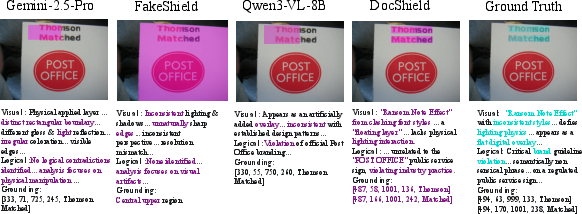
Figure 4: Qualitative artifact grounding and logical explanation comparison; DocShield accurately identifies challenging manipulations while justifying its findings.
Theoretical and Practical Implications
DocShield marks a significant advance in multi-modal, explainable document forensics by demonstrating that structured, evidence-aligned agentic reasoning is fundamentally superior to monolithic or cascaded approaches. Its formalization of reasoning as a chain of visual-logical validation closes critical vulnerabilities both in direct image artifacts and semantic manipulation. DocShield’s methodology, especially the CCT mechanism and multi-task reward-driven RL, sets a new methodological baseline for explainability, robustness, and generalization in forensic AI.
Practically, the unified forensic report output is directly compatible with regulatory compliance demands and can serve as an actionable substrate for downstream auditing, legal documentation, or feedback-driven model improvement.
Future Directions
Several open research avenues are highlighted:
- Failure Mode Mitigation: Reducing failure cases in extremely degraded images or masterfully consistent forgeries remains an open challenge, potentially requiring further advances in visual reasoning, calibration, or fact-checking modules.
- Scalability and Real-Time Trade-offs: While current inference is computationally intensive, advances in efficient vision encoders and modular CCT components could allow deployment at scale.
- Dataset Expansion: RealText-V1 offers a foundation, but further multilingual, high-density annotation will be required, especially reflecting cross-cultural and regulatory diversity.
Continued integration of agentic reasoning, reinforcement alignment, and fine-grained annotation is likely to remain a critical triad in the evolution of trustworthy AI document safety.
Conclusion
DocShield introduces an evidence-grounded, agentic reasoning paradigm for text-centric forgery analysis, combining structural innovation with rigorous reward shaping and comprehensive benchmarking. The framework’s superiority across detection, grounding, and explanation tasks—both in accuracy and robustness—positions it as a new reference point for AI-driven document safety and explainable multimodal forensics (2604.02694).

