- The paper establishes new lower bounds for the area and mean width of closed convex hypersurfaces in terms of the minimum intrinsic displacement under continuous self-maps.
- It employs a blend of convex geometry, integral geometry, and topological degree theory to derive inequalities that refine classical isoembolic results.
- The results reveal that only round spheres with the antipodal map saturate the bounds, highlighting rigidity and asymptotically decaying constants in higher dimensions.
Area and Antipodal Distance Lower Bounds for Convex Hypersurfaces
Introduction and Context
This paper rigorously investigates lower bounds on the area (i.e., the n-dimensional Hausdorff measure) of closed, convex hypersurfaces Mn⊂Rn+1, given intrinsic metric displacement under continuous self-maps. The central objective is to establish inequalities of the form
Area(M)>hnμ(α)n
where α:M→M is a continuous map and μ(α)=minx∈MdM(x,α(x)) denotes the minimum intrinsic (path) displacement of α. The formulation is inspired by, but distinct from, earlier conjectures and results about volume lower bounds in Riemannian and convex geometry—specifically, Berger’s isoembolic inequalities for spheres and related work by Croke addressing the non-extension of Berger’s bounds to higher-dimensional manifolds.
A notable consequence of the presented results is that analogues of Berger’s lower bounds—known to fail for general Riemannian n-spheres with n≥3—hold for all convex hypersurfaces across dimensions. Additional sharp lower bounds for the mean width of convex hypersurfaces are also established, with corresponding characterizations of equality cases: only round spheres equipped with the antipodal map saturate the bound.
Lower Bounds via Intrinsic and Extrinsic Displacement
A crucial technical component is the interplay between intrinsic and extrinsic metrics. For points x,y∈M, with intrinsic distance dM(x,y) and ambient Euclidean distance Mn⊂Rn+10, the paper provides a family of lower bounds depending on their ratio. Specifically, for Mn⊂Rn+11, there is a function Mn⊂Rn+12 such that
Mn⊂Rn+13
The construction relies on geometric estimates for convex sets, leveraging the structure of supporting hyperplanes and orthogonal projections. The argument is stratified based on the alignment and multiplicity of supporting hyperplanes through Mn⊂Rn+14 and Mn⊂Rn+15, and geometry of intersections with affine subspaces, yielding a detailed case analysis. The optimality gap of Mn⊂Rn+16 is discussed; the given bounds differ from corresponding cylindrical examples by at most a polynomial factor in Mn⊂Rn+17 for large Mn⊂Rn+18.
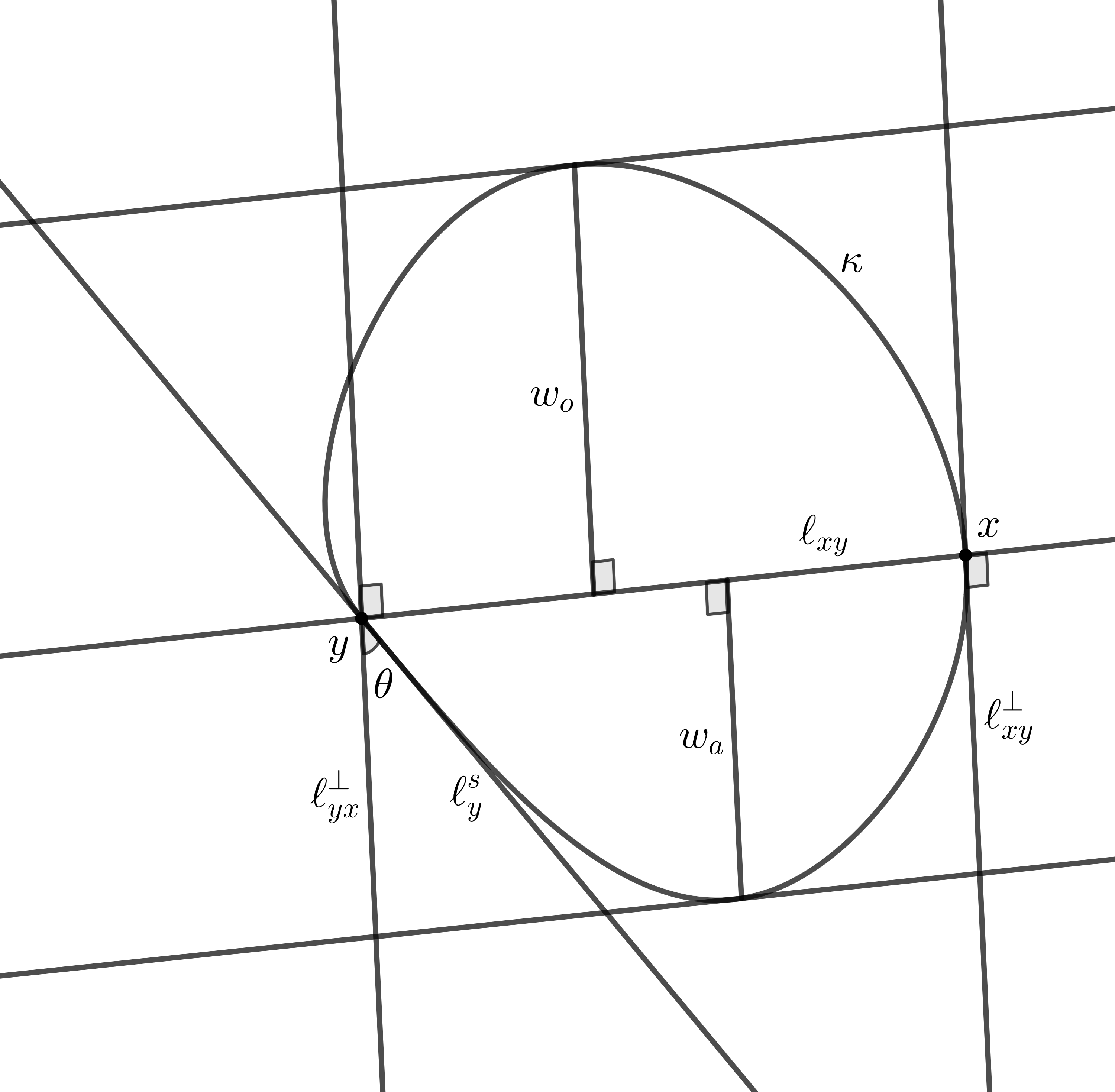
Figure 1: The configuration when the orthogonal hyperplane Mn⊂Rn+19 serves as a support at Area(M)>hnμ(α)n0, helping generate area lower bounds.
A geometric corollary is that in special situations—e.g., when Area(M)>hnμ(α)n1 realize the extrinsic diameter and have supporting (orthogonal) hyperplanes—an asymptotically sharp lower area bound is achieved.
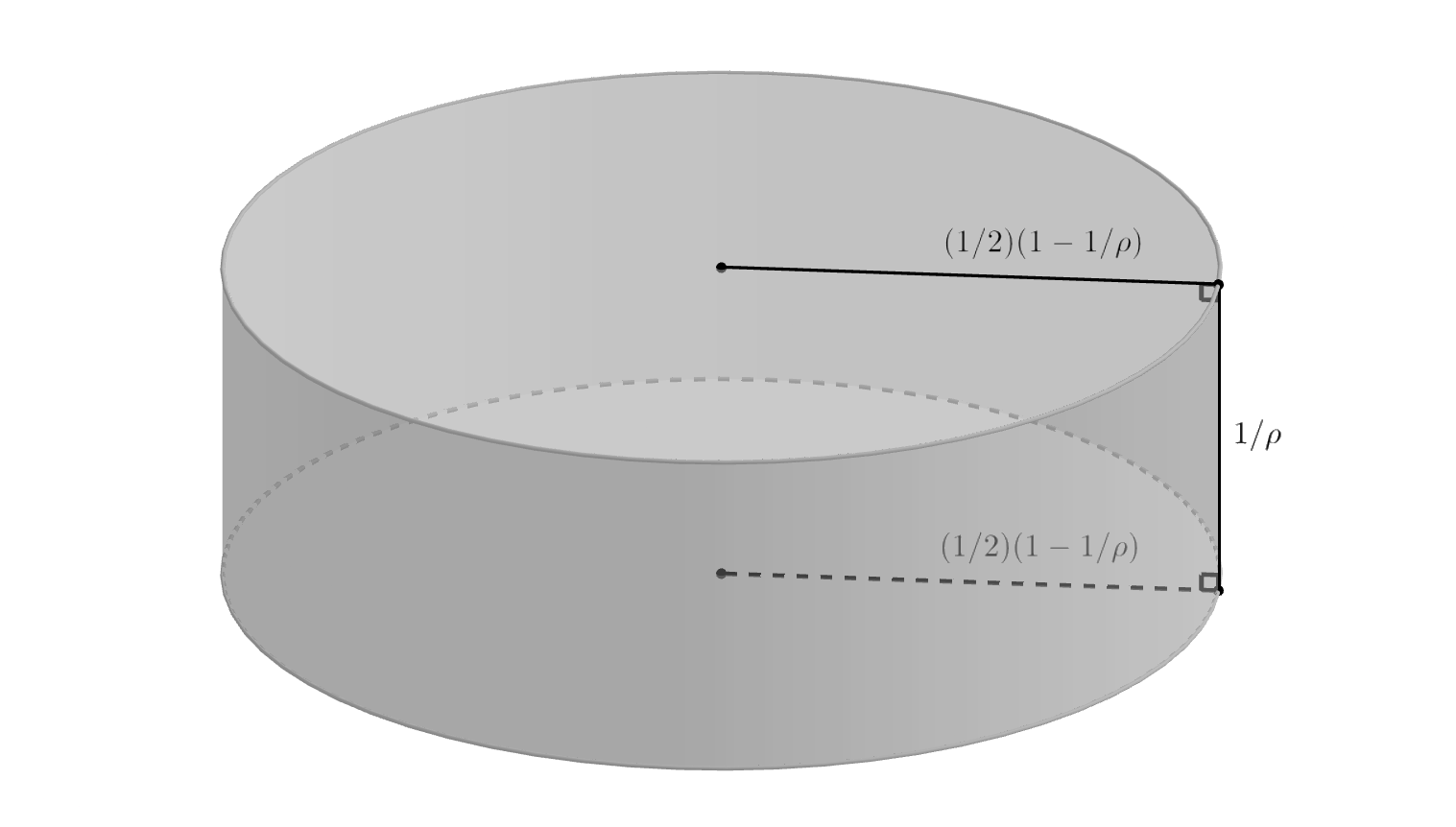
Figure 2: A right circular cylinder of given height, whose side area provides an upper comparison bound for the area of convex hypersurfaces with prescribed intrinsic-extrinsic length ratio.
Displacement Bounds for General Continuous Self-Maps and Involutions
Motivated by Berger’s and Croke’s work on the isoembolic problem for the Area(M)>hnμ(α)n2-sphere, the authors generalize to statements involving all continuous self-maps, not only fixed-point-free involutions as in the antipodal cases. The main result is that for closed, convex Area(M)>hnμ(α)n3 and any continuous Area(M)>hnμ(α)n4, there exists a dimension-dependent positive constant Area(M)>hnμ(α)n5 so that
Area(M)>hnμ(α)n6
Notably, Croke showed that the analogous inequality fails for general Riemannian spheres in Area(M)>hnμ(α)n7, but by exploiting the rigidity of convex hypersurfaces (Cauchy’s theorem, generalized by Pogorelov, Sen'kin, Borisenko, et al.), the result holds in the convex embedding case in all dimensions.
The authors further analyze and explicitly compute Area(M)>hnμ(α)n8 for small Area(M)>hnμ(α)n9 and characterize its suboptimal decay, showing that α:M→M0 decays roughly as α:M→M1. The discussion clarifies that even with stronger geometric inequalities, further improvement in α:M→M2 via their method is fundamentally limited by isoperimetric and intrinsic-extrinsic comparison obstructions.
Volume and Mean Width Bounds
A complementary set of results addresses the volume enclosed by α:M→M3 in terms of α:M→M4 and the ratio α:M→M5. When the displacement is nearly extrinsic (α:M→M6), a lower bound on α:M→M7 is proven, drawing from theorems of Pál and Firey on minimal width and convex volume.
This yields, via the isoperimetric inequality, another family of area lower bounds that are tight for “cigar"-like surfaces (thin, long regions), providing a complementary regime to the “pancake”-like bounds captured by large α:M→M8.
The paper also establishes a sharp lower bound for the mean width of α:M→M9 in terms of μ(α)=minx∈MdM(x,α(x))0, showing that
μ(α)=minx∈MdM(x,α(x))1
Equality is characterized by round spheres with the antipodal map; this is proved by exploiting integral geometry (Crofton’s formula, spherical Radon transforms), support function decompositions, and, in the smooth case, the Blaschke conjecture.
Technical Methods and Rigidity
The proofs synthesize results from convex geometry, Riemannian geometry, and measure-theoretic integral geometry:
- Rigidity: Intrinsic metric properties determine (up to congruence) the embedding of a convex hypersurface in μ(α)=minx∈MdM(x,α(x))2; isometries of the intrinsic metric extend to ambient rigid motions ([Borisenko 2025]).
- Orthogonal projections: Lower bounds for projected measure (width, area) and convex geometry inequalities (Minkowski, isoperimetric, Pál-Firey).
- Integral geometry: Crofton’s formula for lengths; mean width via spherical and Grassmannian integration.
- Topological degree theory & Borsuk-Ulam: Surjectivity of "chordal Gauss maps" for fixed-point-free maps, even for non-involutive continuous self-maps.
Asymptotics and Constants
The paper provides a detailed asymptotic analysis of the constants, using Stirling’s and Binet’s estimates for gamma functions, and Lagrange–Bürmann inversion for transcendental equations. The optimal constant for convex hypersurfaces is strictly smaller than that for the round sphere, decaying super-exponentially with dimension due to the structure of the lower bounds.
The possibility of alternative or improved constants, using Bezdek’s refinements for minimal width-volume inequalities, is discussed in depth, with explicit formulas provided for both even and odd dimensions.
Implications and Future Perspectives
The results have several important implications:
- Metric geometry of convex hypersurfaces: Establishing sharp, dimension-sensitive lower bounds for area (and mean width) under continuous maps is foundational for understanding metric invariants of convex embeddings, beyond the smooth or constant curvature setting.
- Nonnegatively curved length spaces: The authors conjecture the extension of such inequalities to more general classes, e.g., nonnegatively curved Riemannian metrics, guided by Sacksteder's and Grove-Petersen’s structural results. The connection to isoembolic inequalities, filling area conjectures, and the geometry of shortest closed geodesics is explicit.
- Integral geometric invariants: The mean width inequality, exact in the round sphere/antipodal case, enriches the landscape of sharp isoperimetric-type results in convex and Riemannian geometry.
- Complexity of optimality: The explicit technical computation of the constants and their behavior in high dimensions highlights deep obstacles in determining optimal geometric inequalities, even in the convex setting.
Conclusion
The paper resolves several longstanding questions regarding area and volume lower bounds for convex hypersurfaces in terms of intrinsic displacement, generalizing and clarifying the limits of isoembolic-type inequalities that fail in the broader Riemannian context. By combining techniques from convex geometry, integral geometry, and topological degree theory, the authors not only establish new sharp inequalities but also provide pathways for further generalization to broader classes of length spaces with curvature bounds. Future developments would focus on weakening the convexity assumption, improving constant estimates (e.g., via Bezdek’s approach or further understanding optimal domains for minimal width), and exploring relationships with geodesic and curvature invariants in nonnegatively curved spaces.