- The paper introduces DTPTrack, a drift-suppression framework that integrates a Temporal Reliability Calibrator and Temporal Guidance Synthesizer to reduce model drift.
- It employs a masking and confidence-gating mechanism combined with dynamic prior token synthesis to enhance tracker performance on benchmarks like LaSOT and TrackingNet.
- Empirical ablation studies confirm that anchoring the initial template and adaptive reliability modeling are critical for robust, efficient visual tracking across diverse architectures.
Drift-Resilient Temporal Priors for Visual Tracking: An Expert Analysis
Introduction and Motivation
Visual object tracking (VOT) requires maintaining robust, accurate target localization throughout video sequences, often under significant occlusion, motion, and appearance changes. Deep multi-frame trackers, especially those based on Vision Transformers (ViT), have improved state estimation by aggregating temporal information. However, a persistent vulnerability remains: model drift due to the naive integration of noisy or erroneous historical predictions. Failure to differentiate reliable from corrupted temporal cues frequently leads to cumulative tracking errors. The paper "Drift-Resilient Temporal Priors for Visual Tracking" (2604.02654) introduces DTPTrack, a lightweight, modular drift-suppression framework with two core mechanisms: the Temporal Reliability Calibrator (TRC) and the Temporal Guidance Synthesizer (TGS).
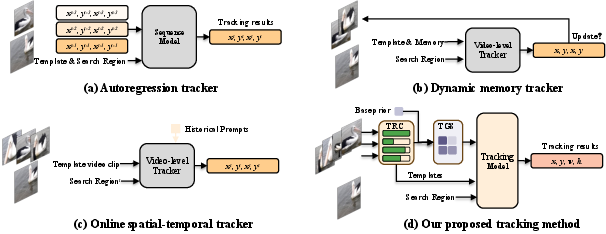
Figure 1: A taxonomy of temporal modeling strategies in visual tracking, highlighting sources of drift and the corrective architecture of DTPTrack.
Architecture: DTPTrack Module
DTPTrack is designed as a plug-and-play augmentation compatible with various tracker backbones. Its architecture comprises two stages that explicitly model temporal reliability and provide structured temporal guidance, distinct from both autoregressive and traditional online aggregation approaches.
Temporal Reliability Calibrator (TRC)
TRC computes a per-frame reliability score for each state in the temporal memory, using masked average pooling over token embeddings intersecting the target and a confidence gate MLP. Crucially, the initial template, corresponding to the ground-truth, is always assigned maximal reliability. This anchoring mechanism prevents long-term drift—a notable empirical finding is that relaxing this constraint degrades performance. The confidence-gated embeddings act as a reliability-weighted summary of the observed temporal context.
Temporal Guidance Synthesizer (TGS)
TGS projects the reliability-calibrated state summaries into a compact set of dynamic prior tokens via a modulator MLP and a set of learnable base priors. These dynamic tokens, augmented with positional and type embeddings, are prepended to the backbone’s visual input sequence, shaping the backbone’s self-attention dynamics without directly contaminating input features. In ViT-based backbones with Frame-Wise Causal Attention (FWCA), these priors, alongside the initial template, form the reference chunk underpinning the entire causal attention structure.
Experimental Results
DTPTrack is validated across diverse backbone architectures (OSTrack, ODTrack, LoRAT), consistently yielding notable gains with minimal computational overhead. Integration is non-invasive, supporting architecture-agnostic deployment. When instantiated on a strong LoRATv2 backbone, DTPTrack establishes new state-of-the-art results on major benchmarks:
- LaSOT: 77.5% Success rate (AUC)
- GOT-10k: 80.3% Average Overlap (AO)
- VastTrack: 47.2% AUC
- TrackingNet: 86.9% Success
The method also attains best-in-class performance on UAV123, OTB2015, and TNL2K under comparable compute and supervision constraints.
Efficiency and Generalization
Despite using a five-frame temporal context, the framework maintains favorable efficiency, attributed to the FWCA backbone and the minimal parameter count of DTPTrack (1-3M over baseline). Inference and parameter footprints are competitive with, or superior to, multi-frame and spatial-temporal attention models with shorter sequences. Critically, significant numerical gains are observed regardless of backbone and attention structure, confirming the generic utility of reliability-gated temporal history and prior token injection.
Analytical and Ablation Findings
A series of ablations corroborate key claims regarding the necessity and sufficiency of DTPTrack’s design:
- Anchored Confidence: Fixing the initial template reliability is vital; learned gating for this frame re-introduces drift.
- Learned Gating: Static or non-learned gating substantially impairs drift suppression, underscoring the need for context-adaptive reliability modeling.
- Prior Token Synthesis: Injecting dynamic prior tokens, rather than concatenating pooled states or employing heuristics (optical flow, momentum), yields the most robust performance, especially in settings with rapid geometric variations or distractors.
- Temporal Context: Performance monotonically improves with increased reference length, peaking at five frames in empirical studies.
Visualization results reveal that DTPTrack can systematically downweight occluded or corrupt frames and maintain prediction stability under severe distractor prevalence, outperforming both autoregressive and naive fusion schemes.
Implications and Future Directions
DTPTrack advances the robustness of transformer-based trackers in long-term, open-world scenarios by decoupling historical information integration from drift susceptibility. Its lightweight reliability gating and modular guidance paradigm suggests promising avenues for both visual and multimodal temporal sequence modeling. Key implications include:
- Architectural Compatibility: The design is adaptable to differing backbone paradigms and can be extended to video recognition, segmentation, and video-LLMs.
- Generalization: Improved generalization to unseen categories and domains due to noise-resilient temporal modeling.
- Temporal Prompting: The prior token mechanism is aligned with trends in temporal prompting, enabling future work in compositional and task-adaptive visual reasoning for tracking, video QA, and multi-agent perception.
Prospective developments may encompass learning more structured priors (e.g., via cross-modal signals), continual adaptation in online settings, and integration with memory-efficient attention algorithms for even longer temporal horizons.
Conclusion
The DTPTrack module presents a principled, performant, and broadly applicable solution to model drift in multi-frame visual tracking, confirmed by strong empirical results and meticulous ablation. Through explicit reliability gating and dynamic temporal prompting, it delivers robust, stable tracking in challenging real-world video and sets a new benchmark in the design of temporal models for vision transformers (2604.02654).