Evidence of ZZ$γ$ production and observation of $4\ellγ$ in proton-proton collisions at $\sqrt{s}$ = 13 TeV
Published 3 Apr 2026 in hep-ex | (2604.02594v1)
Abstract: Evidence of the production of two Z bosons and a photon in proton-proton collisions is reported for the first time in CMS. The analysis uses data collected by the CMS experiment between 2016 and 2018 at a center-of-mass energy of 13 TeV, corresponding to an integrated luminosity of 138 fb${-1}$. The first evidence for the process pp $\to$ ZZ$γ$ $\to$ 4$\ellγ$ ($\ell$ = e, $μ$), with an observed (expected) significance of 3.7 (3.1) standard deviations in a fiducial region defined by $p_\mathrm{T}γ$ $\gt$ 20 GeV, $\lvertηγ\rvert$ $\lt$ 2.4, $ΔR(\ell,γ)$ $\gt$ 0.5, $m_\text{Z}$ between 60 and 120 GeV, and the invariant mass of either of the two Z bosons combined with the photon ($m_{\text{Z}γ}$) larger than 100 GeV, is reported. The measured (predicted) fiducial cross section is 60${+27}_{-22}$ ab (47.56 $\pm$ 0.04 ab). Additionally, the inclusive production of pp $\to$ 4$\ellγ$ is studied by removing the $m_{\text{Z}γ}$ requirement to include final state radiation where one Z boson decays to 2$\ellγ$, yielding an observed (expected) significance of 5.0 (4.2) standard deviations and a measured (predicted) fiducial cross section of 156${+39}_{-35}$ ab (99.97 $\pm$ 0.09 ab).
The paper reports the first CMS evidence for ZZγ production with a 3.7σ significance, measuring cross sections in agreement with Standard Model predictions.
Advanced multivariate photon identification and data-driven background estimation techniques were applied to isolate the rare 4ℓγ final state.
The findings establish a benchmark for precision multiboson studies and set tighter constraints on anomalous gauge couplings at future high-luminosity LHC runs.
Evidence of ZZγ Production and Observation of 4ℓγ in Proton-Proton Collisions at 13 TeV
Introduction
The production of three electroweak (EW) bosons in a single proton-proton (pp) collision, particularly ZZγ, is a high-priority rare process in LHC physics, offering stringent tests of the Standard Model (SM) and potential sensitivity to new physics via anomalous triple and quartic gauge couplings. "Evidence of ZZγ production and observation of 4ℓγ in proton-proton collisions at s = 13 TeV" (2604.02594) presents a comprehensive measurement of the pp→ZZγ cross section and the inclusive 4ℓγ final state, using the full Run 2 dataset (138 fb−1) of the CMS detector. This work reports the first CMS evidence for 4ℓγ0 triboson production and the first observation of the 4ℓγ1 inclusive process.
Theoretical and Experimental Context
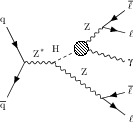
EW triboson production (4ℓγ2) is rare, with cross sections 4ℓγ3 at 4ℓγ4 TeV for channels such as 4ℓγ5. The 4ℓγ6 signature receives contributions both from genuine triboson (4ℓγ7) processes and final-state radiation (FSR) where a leptonically decaying 4ℓγ8 radiates a photon. The study leverages both the 4ℓγ9 threshold and photon properties to distinguish the triboson signal. Higher-order contributions, Higgs-mediated diagrams (e.g., pp0 associated production with pp1), and various backgrounds are incorporated at NLO QCD accuracy in the modeling.
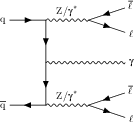
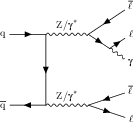
Figure 1: Representative tree-level standard model Feynman diagrams with four isolated leptons and a photon in the final state.
Kinematic selections are optimized to select two pp2 bosons decaying to pp3 or pp4, plus a high-quality, isolated photon. Advanced object selection uses multivariate photon identification, leveraging ECAL shower shapes and isolation, to enhance sensitivity to rare signatures and to robustly estimate nonprompt backgrounds.
Simulation, Event Selection, and Background Estimation
Signal samples are generated with MG5_aMC@NLO at NLO QCD+LO EW, interfaced to PYTHIA 8 for parton branching and hadronization. pp5 and pp6, along with backgrounds such as pp7, pp8, pp9, and rare ZZγ0+X, are simulated with state-of-the-art generators and PDF sets (NNPDF3.1).
Photon candidates are required to be well-separated from all signal leptons (ZZγ1), with strict identification criteria to suppress jets and electrons misidentified as photons. Nonprompt lepton and photon backgrounds are constrained using tight-to-loose fake rates in data-driven control regions, and rare irreducible backgrounds are taken from MC simulation with theory-derived uncertainties.
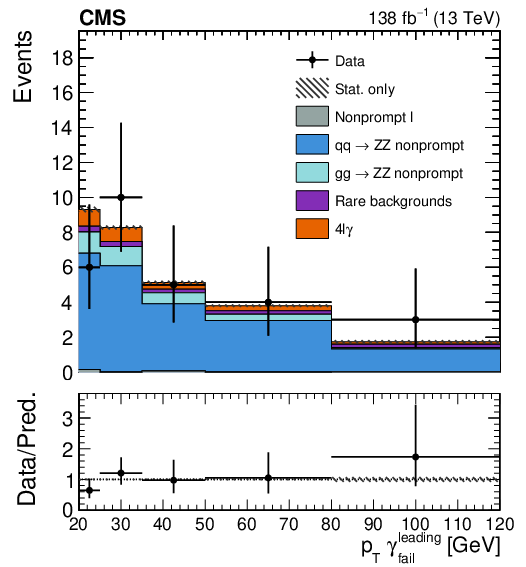
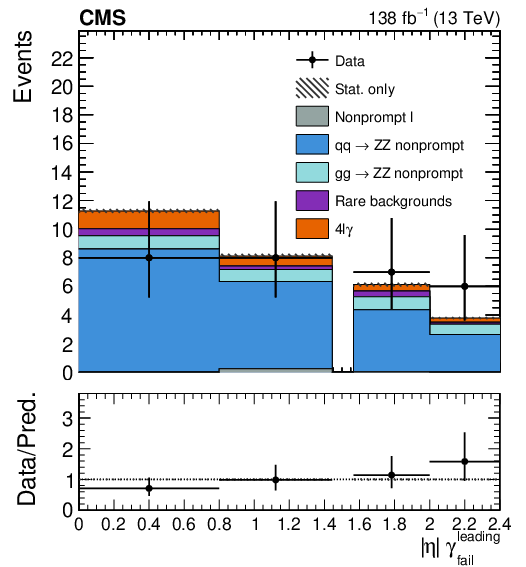
Figure 2: Distributions of transverse momentum and pseudorapidity for leading photons in the nonprompt photon application region, showing agreement between data and simulation.
Experimental uncertainties from luminosity, lepton/photon efficiency scale factors, energy scales, and pileup, as well as theoretical modeling uncertainties (PDF, scales), are incorporated as nuisance parameters in a maximum likelihood fit.
Statistical Analysis and Results
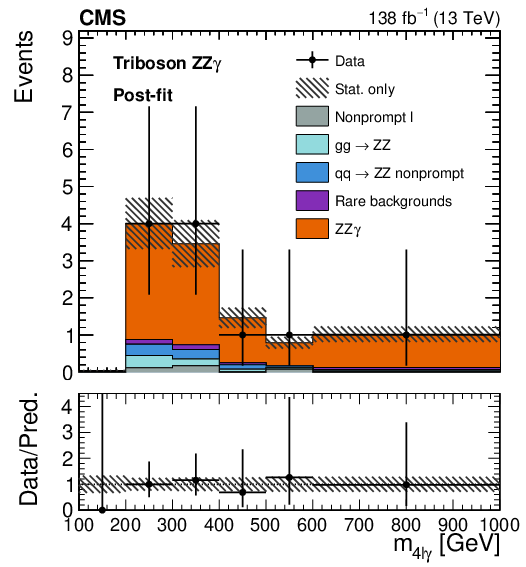
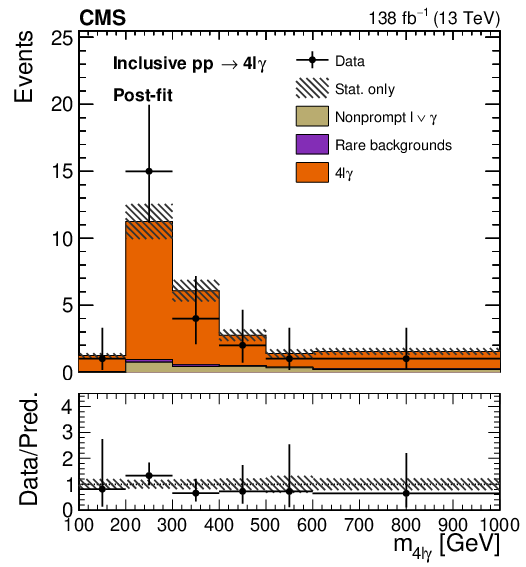
The fiducial cross sections are measured using a template fit to the five-body invariant mass (ZZγ2) in both the triboson-enhanced ("ZZγ3") and inclusive ("ZZγ4") regions. The ZZγ5 region is defined by ZZγ6 GeV, ZZγ7, ZZγ8 GeV (for both ZZγ9 candidates), and γ0 GeV. The inclusive region omits the γ1 cut to allow FSR events.
The observed fiducial cross sections are:
γ2: γ3 ab (SM pred.: γ4 ab)
Inclusive γ5: γ6 ab (SM pred.: γ7 ab)
Observed significances:
γ8 region: γ9 (expected: 4ℓγ0)
Inclusive 4ℓγ1 region: 4ℓγ2 (expected: 4ℓγ3)
Figure 3: Post-fit distributions of 4ℓγ4 in both the triboson and inclusive regions, illustrating consistency between data and predictions.
Statistical uncertainties dominate both results. Systematic uncertainties are subdominant, with leading contributions from electron efficiency (triboson) and nonprompt photon background shape/modeling (inclusive). The measurement places the 4ℓγ5 cross section at the attobarn level, among the smallest ever measured at the LHC.
Discussion and Implications
This analysis yields several technically significant results:
First evidence for 4ℓγ6 production in CMS, reaching 4ℓγ7 significance, with a measured cross section in agreement with the SM.
Observation of inclusive 4ℓγ8 production at 4ℓγ9, again with cross section compatible with theoretical predictions.
The inclusive cross section is systematically higher than the SM predictions, but the difference does not constitute a significant deviation given the uncertainties.
The analysis achieves strong control of backgrounds (nonprompt photon misidentification, rare s0, s1) and employs advanced photon ID and data-driven background estimation, demonstrating the maturity of rare SM process measurements at LHC Run 2 luminosity.
These measurements directly probe the SM's non-Abelian gauge structure, especially trilinear/quartic bosonic vertices, and are sensitive (within statistical precision) to potential new physics in effective field theory (EFT) scenarios with anomalous s2 or s3 couplings. No evidence for anomalous production is observed, tightening bounds on relevant Wilson coefficients.
Practically, the techniques and background modeling validate strategies for even rarer process searches at the HL-LHC. The precision control of nonprompt photon and lepton backgrounds and rigorous object selection are extensible to other multiboson or Higgs-linked final states.
Outlook and Future Directions
With Run 3 and the advent of the HL-LHC—with integrated luminosity exceeding 3 abs4—significant advances are expected in multiboson measurement precision and sensitivity to small deviations from the SM. Differential cross section measurements, polarization studies, and EFT parameter fits in s5 and related channels will be enabled by larger datasets. Improvements in detector performance (timing, granularity) and further development of multivariate discriminants for object identification will reduce systematics, enabling sub-attobarn sensitivity and increased reach for subtle new physics signatures.
Conclusion
The reported measurement marks the first CMS evidence of s6 and the first observation of the inclusive s7 final state. Both measured cross sections are statistically compatible with SM expectations within uncertainties. This result consolidates multiboson triboson production as an experimentally accessible sector at current LHC luminosities and provides a benchmark for future precision and new physics searches in the multiboson sector (2604.02594).