- The paper introduces DR-DAQP, which combines Douglas-Rachford splitting with active-set acceleration to achieve finite-time convergence for affine variational inequalities.
- The methodology exploits warm-starting and Newton corrections to reduce solve times by up to two orders of magnitude compared to traditional solvers.
- Empirical evaluations on game-theoretic MPC and autonomous driving demonstrate DR-DAQP's efficiency and robustness in real-time, safety-critical scenarios.
Hybrid Operator Splitting and Active-Set Solution for Affine Variational Inequalities: An Expert Perspective on DR-DAQP
Problem Context and Motivation
Affine Variational Inequalities (AVIs) generalize convex optimization and linear complementarity problems, forming the foundation of Nash equilibrium formulations in noncooperative control and game-theoretic model predictive control (GT-MPC). Such problems frequently arise in multi-agent autonomous systems, e.g., autonomous vehicles and robotic swarms, with quadratic cost and linear constraints. Solving the AVI at high sampling rates is computationally crucial for real-time closed-loop control.
Traditional AVI solvers fall into three main categories:
- Pivot-based methods: Algorithms like PATH generalize simplex but exhibit scalability concerns for large-scale AVIs due to combinatorial complexity.
- Operator-splitting methods: Iterative approaches (e.g., Douglas-Rachford splitting) that provide asymptotic convergence but often require many iterations for tight tolerances, impacting real-time feasibility.
- Explicit parametric approaches: Piecewise-affine solution maps viable only for modest-sized AVIs due to exponential partition growth.
DR-DAQP responds to the scarcity of reliable, high-speed AVI solvers by hybridizing operator splitting with active-set methodology.
Algorithmic Architecture and Methodological Innovations
Douglas-Rachford Splitting Foundation
DR-DAQP leverages the Douglas-Rachford (DR) operator splitting for AVIs, decomposing the affine mapping into symmetric and skew-symmetric components. Each DR iteration solves a fixed-structure QP subproblem, facilitating pre-factorization and efficient repeated solves.
Active-Set Identification and Newton-Type Acceleration
DR-DAQP augments DR splitting with active-set detection:
- At each QP solve, the active constraints are monitored. Upon stabilization of the active set, a Newton correction via the KKT system for the AVI is attempted.
- If the candidate solution from the KKT system is both primal and dual feasible, the solver halts with the exact solution.
- Otherwise, a merit function based on the natural residual is employed, accepting Newton steps only if they strictly reduce residual norm.
The dual active-set QP solver DAQP is exploited for efficient warm-starting—reusing matrix factorizations and previous active sets, leading to substantial computational savings.
Finite Termination Guarantees
Theoretical analysis establishes that DR-DAQP achieves global convergence due to its DR foundation, and finite termination with the exact AVI solution under standard regularity assumptions (LICQ, strict complementarity). Pure operator splitting approaches lack this finite-time guarantee.
Numerical Evaluation and Empirical Results
Extensive benchmarking on randomly generated AVIs demonstrates that DAQP, when warm-started, outperforms both cold-started variants and the Clarabel QP solver by up to two orders of magnitude, validating the importance of exploiting fixed QP problem structure and active-set continuity across DR iterations.
(Figure 1)
Figure 1: Solve time comparison using DAQP (warm and cold) versus Clarabel as the DR subproblem solver, illustrating superior efficiency with warm-starting.
Comparison to State-of-the-Art Solvers
DR-DAQP outperformed PATH by one to two orders of magnitude in median and worst-case solve times, particularly on AVIs with asymmetric H matrices. Moreover, QP-lifted AVI reformulations, despite standard QP solver compatibility, suffered from problem dimension blowup and poor conditioning.
(Figure 2)
Figure 2: DR-DAQP shows consistently lower solve times across AVI sizes compared to PATH and QP-lifted formulations.
Convergence Properties
DR-DAQP achieves finite residual convergence due to the Newton acceleration steps, contrasted against the asymptotic convergence of DR splitting and projected gradient methods. Even absent Newton steps, active-set warm-starting accelerates convergence.
(Figure 3)
Figure 3: Residual norm decay per iteration, highlighting DR-DAQP's finite termination and improved rate with Newton steps.
Application to Game-Theoretic MPC
On game-theoretic MPC benchmarks, DR-DAQP delivered solve times several orders of magnitude faster than NashOpt (MIP-based), supporting large horizons and real-time feasibility, while maintaining solution accuracy despite active constraints.
(Figure 4)
Figure 4: Solve time per MPC step for DR-DAQP versus NashOpt, revealing DR-DAQP's scalability across constraint horizons.
Autonomous Driving Scenario
DR-DAQP was deployed in a receding-horizon GT-MPC controller for a vehicle overtaking maneuver, with nonlinear dynamics approximated via sequential affineization. AVI solves requiring only 2.1×10⁻⁴ s enabled control rates in the kHz range. The active-set and DR hybridization ensured both solution quality and computational speed, crucial for safety-critical constraints in autonomous driving.
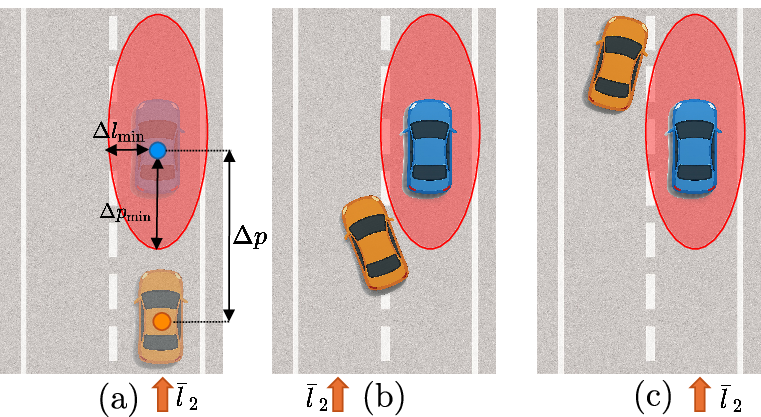
Figure 5: Simulated overtake maneuver where DR-DAQP handles active safety distance constraints in real-time.
Theoretical and Practical Implications
Theoretical Impact: DR-DAQP bridges the conceptual gap between asymptotic operator splitting methods and exact active-set solutions for AVIs. Under strong monotonicity and constraint regularity, it ensures both global convergence and finite-time delivery of the exact solution—an uncommon guarantee in the broader VI landscape.
Practical Impact: High-performance C-based implementation, along with direct Julia, MATLAB, and Python interfaces, positions DR-DAQP as an enabling technology for real-time multi-agent systems, game-theoretic controllers, and large-scale optimization under coupled objectives and constraints.
Bold Claims:
- DR-DAQP achieves up to two orders of magnitude speedup versus PATH on random AVIs.
- Finite-time termination with the exact AVI solution is established under standard regularity conditions.
- On GT-MPC benchmarks, DR-DAQP consistently outperforms mixed-integer NashOpt by several orders of magnitude.
Speculation on Future Developments
DR-DAQP's hybridization strategy could extend to broader classes of VIs, including nonlinear and non-polyhedral constraint sets, by tailoring active-set identification and leveraging adaptive DR parameterization. Real-time deployment in larger-scale, distributed multi-agent systems presents an exciting frontier, potentially integrating online structure exploitation and further warm-starting strategies. Deeper exploration of parallelized and hardware-accelerated versions (e.g., FPGA or GPU coupling) could push the computational envelope for real-time control.
Conclusion
DR-DAQP provides a robust, efficient method for solving strongly monotone AVIs, fusing Douglas-Rachford splitting with active-set acceleration to deliver exact solutions in finite time. Its performance advantages are substantiated theoretically and empirically, notably on real-time game-theoretic control and autonomous driving tasks. Extension to broader VI families and deeper integration into real-time control architectures represent promising directions for future research.

