- The paper establishes holographic banners as a novel framework for mapping boundary sources to semiclassical quantum states in eternal AdS black holes.
- It derives analytical expressions in BTZ and higher-dimensional settings, detailing the relation between boundary inputs and interior wavepacket evolution.
- The study uncovers chaotic wavepacket spreading near singularities, quantifying mixing timescales that bridge classical and quantum regimes.
Holographic Banners: Boundary-to-Interior Maps in Eternal AdS Black Holes
Summary and Motivation
The paper "Holographic Banners" (2604.02514) develops a novel framework for describing quantum states in both the exterior and interior of eternal AdS black holes via objects termed "holographic banners." The holographic banner is defined as the on-shell bulk action as a function of boundary field data on four components: left/right AdS boundaries and future/past interior slices, S[ϕ(0)L,ϕ(0)R,ϕ(0)F,ϕ(0)P]. This construction provides a Hamilton-Jacobi description for the bulk that places the cosmological future and past interiors on equal footing with the boundary sources, enabling a unified treatment of classical and quantum evolution in black hole spacetimes, particularly in settings with dynamical spacetime and chaotic near-singularity dynamics.
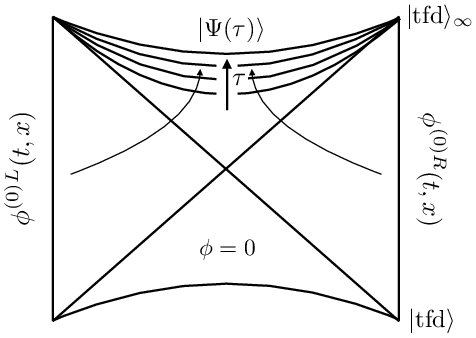
Figure 1: A holographic banner, representing the mapping between boundary couplings and semiclassical quantum state evolution in the black hole interior.
Holographic Banner Construction
The banner formalism extends prior Hamilton-Jacobi and Wheeler-DeWitt approaches, encoding quantum bulk evolution from a past slice ("white hole" region) to a future interior slice, subject to arbitrary time- and space-dependent boundary sources. The banner can be regarded as a preparation of bulk wavefunctions, via functional integration against distributions over the past or future interior field values. Notably, the banner obeys the Hamilton-Jacobi equation with respect to all four arguments independently, reflecting the relational nature of the emergent interior time τ distinct from boundary time t.
The explicit calculation for a massive scalar in planar AdS black hole backgrounds yields:
- The map between boundary sources and semiclassical interior quantum states, expressed via boundary and interior Green's functions.
- Gaussian wavepacket states on the interior slices, with semiclassical phases determined by the classical bulk action.
The technical core computes this mapping in closed form for a scalar in BTZ backgrounds and higher dimensions, including all relevant matching conditions across horizons and boundary/singularity cutoffs.
Near-Singularity Dynamics and BKL Mixing
When gravitational backreaction is included, the bulk interior dynamics near the singularity are dominated by the BKL scenario, leading to spatially decoupled, chaotic billiard dynamics for the local metric degrees of freedom. The holographic banner, in principle, provides a map from boundary data to local semiclassical quantum cosmological states that evolve under hyperbolic Maass Hamiltonians. The ergodic property of this dynamics guarantees exponential spreading of trajectories, with a "mixing time" τmix=log(k0/Δk) at which a semiclassical wavepacket becomes uniform across the domain. This mixing is highly sensitive to the quantum variance in the past state or to classical ensembles of boundary sources.
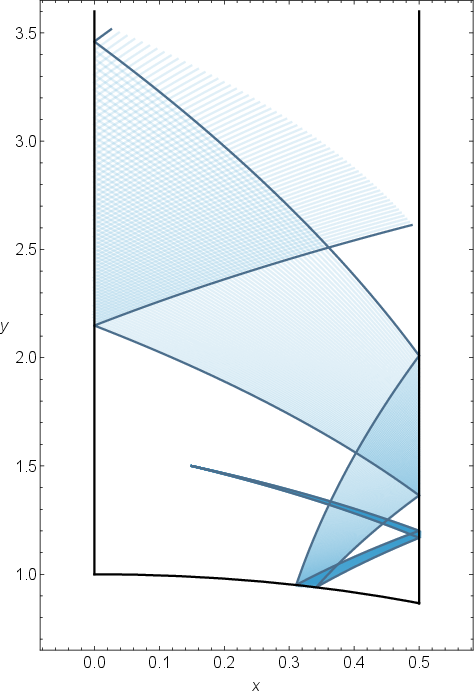
Figure 2: The universe near a BKL singularity, where local dynamics at each spatial point are reduced to chaotic billiard motion resulting in wavepacket spreading and mixing.
Explicit Results and Technical Details
For the case of the BTZ black hole (d=1), analytic expressions are presented:
- The semiclassical interior fields are linear functions of boundary sources, with precise dependence governed by hypergeometric solutions to the wave equation.
- Wavepacket spreading near the singularity exhibits faster-than-free-particle growth, attributed to nontrivial susceptibility (van Vleck terms) relating past and future slices.
- The leading behavior near singularity generalizes to higher dimensions; mass terms become subleading, reducing dynamics to free particle evolution in τ.
For BKL scenarios (e.g., pure gravity in four bulk dimensions):
- The interior semiclassical state at each spatial point x is a quantum hyperbolic billiard wavepacket, with transverse variance growing exponentially in τ.
- The critical mixing time, after which quantum ergodicity dominates and memory of boundary/initial data is lost, is derived, and comparisons to the collapse timescale at the Planck scale are analyzed.
The paper emphasizes that quantum mixing in the interior may be inaccessible in conventional semiclassical states (such as thermofield double) due to rapid volume collapse, but classical ensembles or states with enhanced variance may achieve a quantum-smeared interior before reaching the Planck regime.
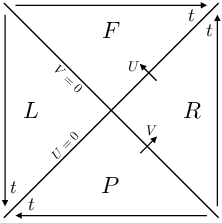
Figure 3: Four regions in AdS black hole spacetime, each with distinct z,t coordinates. Matching of field modes across the horizons and boundaries forms the technical basis of the holographic banner construction.
Implications, Extensions, and Future Directions
The banner framework provides a powerful tool for boundary-to-interior mapping in AdS/CFT, bridging classical Hamilton-Jacobi, Wheeler-DeWitt, and path integral approaches. Its formulation clarifies the relationship between exterior field theory data and relational quantum cosmological states, including chaotic mixing and ergodic properties at singularities.
Potential extensions include:
- Fully quantum banners, defined via four-sided path integrals encompassing metric and stringy degrees of freedom, generalizing the semiclassical limit.
- Applications to de Sitter spacetime, with banners connecting static patch sources and Hartle-Hawking states.
- Exploration of relational observables in the boundary theory, possibly through matrix degrees of freedom or SU(N) gauge symmetries.
- Links to arithmetic chaos, random matrix theory, and number-theoretic structures (e.g., primon gas partition functions), offering insights into interior dualities and dS/CFT correspondences.
The banner formalism potentially offers new probes of bulk quantum gravity, interior ergodic mixing, and may inform future approaches to the resolution of singularities and the emergence of time in holographic dualities.
Conclusion
The paper systematically establishes holographic banners as central objects in the study of eternal AdS black holes, unifying boundary and interior quantum data via the on-shell action and Hamilton-Jacobi theory. It provides explicit mappings in both fixed and dynamical backgrounds, quantifies wavepacket spreading and mixing timescales, and identifies routes to classical and quantum universality in black hole interiors. The theoretical implications are substantial, suggesting new avenues in quantum cosmology, boundary observables, and the mathematical structure underlying gravitational chaos.

